Table of contents

Surrogacy is YMYL content with an unusual problem: the pages that decide the sale - state law, eligibility, itemised cost - are the ones most likely to be unindexed, unrendered or marked up incorrectly. Here is the 2026 technical data, and the fix order that pays.
Key Takeaways
- Only 51.3% of origins pass all three Core Web Vitals on mobile; 67.8% on desktop.
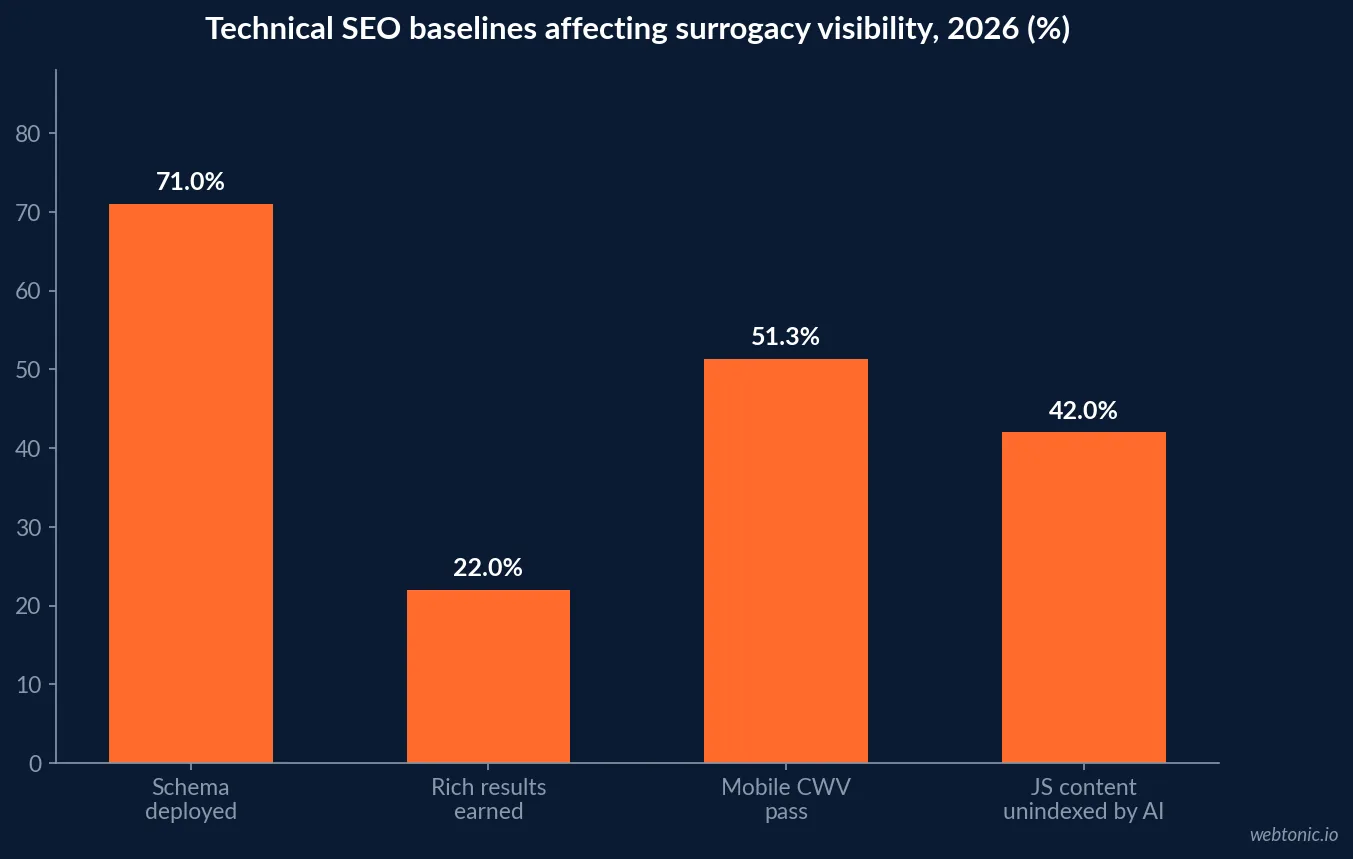
- About 71% of sites deploy schema, but only around 22% earn rich results.
- Roughly 42% of JavaScript content is never indexed by AI systems.
- In one study of 16 million pages, 61.94% were never indexed at all.
- Bounce probability rises by roughly 90% at a 5-second load.
- Surrogacy decisions take 3 to 12 months for intended parents and 2 to 6 months for surrogates.
- The full commitment runs 18 to 24 months, so evergreen technical work compounds.
- A US journey costs $140,000 to $180,000; $200,000-plus in California.
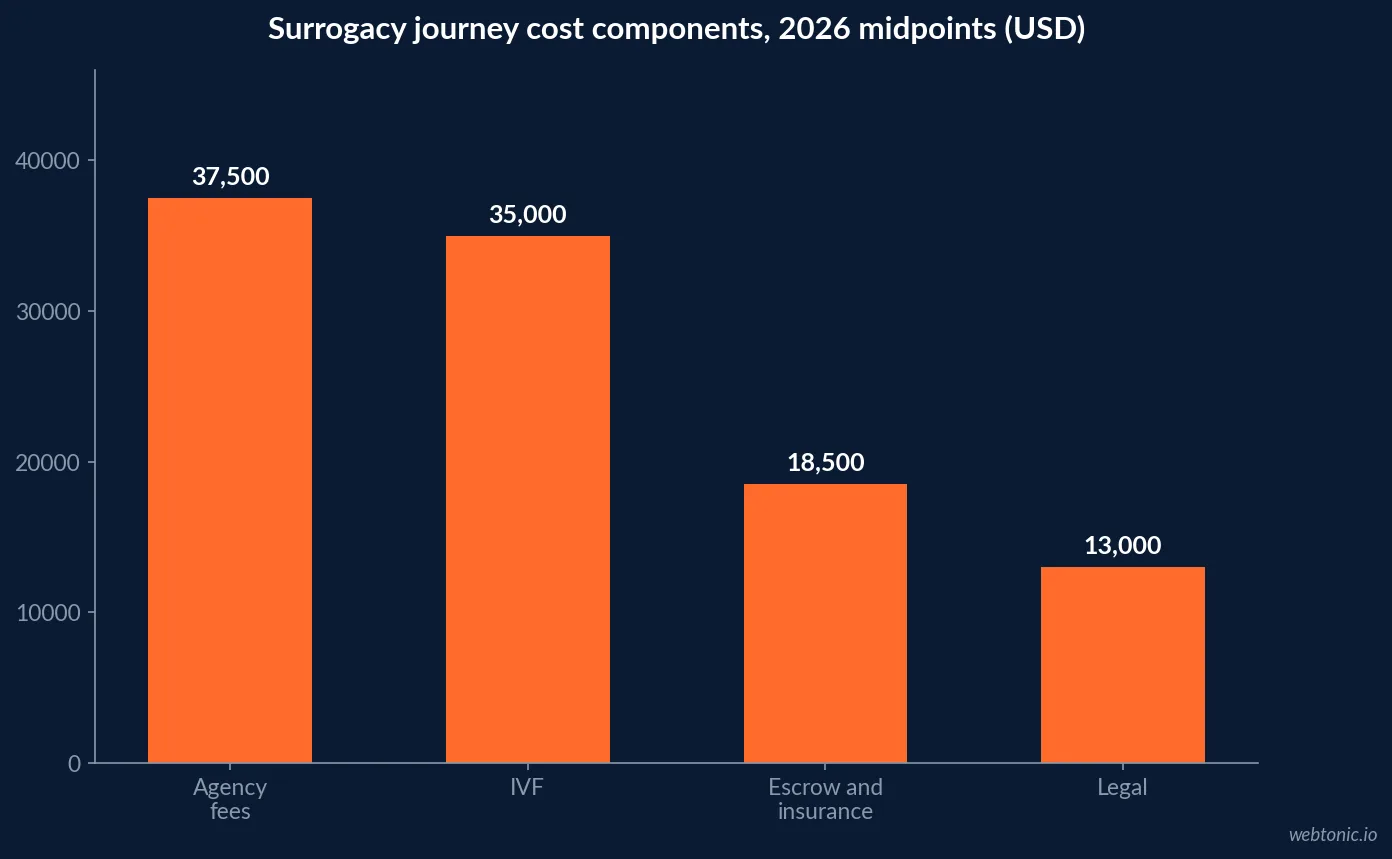
- Agency fees run $25,000 to $50,000; IVF $20,000 to $50,000; legal $8,000 to $18,000.
- Escrow and insurance add $12,000 to $25,000 per journey.
- Compensated surrogacy is legally protected in about 13 states plus DC.
- Gestational arrangements exceed 95% of US surrogacy.
- More than 210,000 IVF cycles were performed in 2025.
- The market reached $28.91 billion in 2026 at a 22.19% CAGR to 2031.
- North America holds 45% of the global market.
- Fertility paid search costs $9.84 per click with a $112 CPA - organic is the cheaper long game.
- Fertility landing pages convert at about 6.2%, so technical friction is expensive.
- 35.6% of US fertility practices rate below 4.0 stars; the weighted average is 4.20.
- 60% of reproductive endocrinology patients arrive by physician referral - branded search must be flawless.
- Around 89% of patients check reviews first and 51% read six or more.
- 80% to 90% of healthcare appointments are booked by phone, so mobile page speed drives calls.
The 2026 technical baseline
Start with the honest industry-wide numbers, because they set what "good" costs. State of Core Web Vitals data puts only 51.3% of origins passing all three metrics on mobile against 67.8% on desktop, and 2026 technical SEO research reports 71% schema deployment with only 22% rich-result eligibility.
| Benchmark | 2026 figure | Surrogacy relevance | Priority |
|---|---|---|---|
| Origins passing all 3 CWV (mobile) | 51.3% | Mobile carries most first research sessions | High |
| Origins passing all 3 CWV (desktop) | 67.8% | Desktop dominates late comparison | Medium |
| Sites deploying schema | About 71% | Presence is not eligibility | High |
| Sites earning rich results | About 22% | Validation is the missing step | High |
| JavaScript content unindexed by AI systems | About 42% | Answer engines mediate early research | Critical |
| Pages never indexed (16M-page study) | 61.94% | State and eligibility pages disappear | Critical |
| Bounce lift at a 5-second load | About 90% | Cost pages are the slowest and most valuable | High |
Indexation is the first-order problem, not speed. Crawl analysis from the 2026 crawl waste report shows templated, near-duplicate pages absorbing crawl budget that thin-content sites cannot spare - the exact failure mode of a fifty-state page set on a business that can legally serve about thirteen.
Which surrogacy pages must be crawlable and static
Rank the templates by decision value, then guarantee those are server-rendered and indexable before touching anything else.
| Page type | Decision value | Common technical failure | Required state |
|---|---|---|---|
| Itemised journey cost | Highest for intended parents | Interactive calculator, no static text | Server-rendered figures in HTML |
| State legality explainer | Highest for both audiences | Tab or accordion loaded on click | Static content, one URL per state with real substance |
| Surrogate eligibility criteria | Highest for supply | Behind an application gate | Public, indexable, plain list |
| Compensation breakdown | High for supply | Image of a table | Real HTML table with text |
| Process and timeline | High for both | Animated stepper without text fallback | Text-first |
| FAQ hub | High | Schema absent or invalid | FAQPage markup, validated |
| Journey stories | Medium | Client-side pagination | Crawlable pagination |
The cost page deserves special attention. Journey pricing decomposes into agency fees of $25,000 to $50,000, IVF at $20,000 to $50,000, legal at $8,000 to $18,000 and escrow plus insurance at $12,000 to $25,000 against a $140,000 to $180,000 total, per 2026 surrogacy statistics. Those numbers are the long-tail traffic. If they live inside a JavaScript calculator, they are invisible.
Rendering: the AI visibility problem
Answer engines are now the first read for many prospective parents, and they are far less tolerant of client-side rendering than Google is. Research on AI crawler behaviour finds most do not execute JavaScript, leaving roughly 42% of JS-delivered content outside the index they build answers from.
| Rendering pattern | Google outcome | AI crawler outcome | Recommendation |
|---|---|---|---|
| Server-side rendered HTML | Fully indexed | Fully readable | Default for every key page |
| Static site generation | Fully indexed | Fully readable | Ideal for state and cost pages |
| Client-side rendering | Usually indexed, delayed | Frequently missed | Avoid on decision pages |
| Content behind click interaction | Often missed | Almost always missed | Render in initial HTML |
| Infinite scroll listings | Partial | Poor | Add paginated crawlable URLs |
| Gated PDFs of cost data | Not indexed | Not indexed | Publish as HTML as well |
The conversion cost of getting this wrong is measurable: fertility landing pages convert at about 6.2% and fertility paid clicks cost $9.84 with a $112 CPA, per fertility clinic benchmarks, so every organic session recovered is a paid session saved. The page-level side of that work is in our surrogacy landing page statistics.
Schema that actually earns something
With 71% deployment and 22% rich-result eligibility, the industry has a validation problem rather than an adoption problem.
| Schema type | Where to use it | Common mistake |
|---|---|---|
| Organization | Site-wide, with sameAs profiles | Missing sameAs and logo references |
| FAQPage | Eligibility and cost FAQs | Marking up questions not visible on the page |
| Article | Editorial and statistics content | No named author or credentials |
| BreadcrumbList | All nested pages | Breadcrumb trail that does not match navigation |
| Service | Programme and journey pages | Describing outcomes rather than the service |
| MedicalWebPage | Clinically substantive explainers | Applied to marketing pages |
| Person | Team and consultant bios | No jobTitle or professional profile link |
Adoption research from a 5,000-site schema audit found presence without validity to be the dominant pattern. In a YMYL category, invalid markup is worse than none: it signals carelessness on exactly the pages where credibility is being assessed.
Crawl budget and the state-page trap
Surrogacy sites tend to generate location pages because competitors do. Most of them should not exist.
| Pattern | Verdict | Reason |
|---|---|---|
| One page per legally protected state with statutory detail | Build | Genuinely distinct substance |
| Pages for states that prohibit compensated surrogacy | Build carefully | Explain the law and the alternative, do not solicit |
| City pages templated from state text | Do not build | Classic crawl waste with no unique value |
| Duplicate cost pages per audience | Consolidate | Splits authority on the top query |
| Tag and archive pages | Noindex | Consumes crawl for no ranking |
| Filtered search parameters | Canonicalise | Infinite URL space |
| Old campaign landing pages | Redirect | Thin pages drag site quality signals |
Aggregate audit data from 2026 technical SEO issue research shows duplicate and near-duplicate templates among the most common findings, and with 61.94% of pages in one large study never indexed, pruning is usually faster than publishing.
Speed work that pays on a phone
Mobile matters disproportionately here because 80% to 90% of healthcare appointments are booked by phone, and the call usually starts on the phone that loaded the page.
| Fix | Typical impact | Effort |
|---|---|---|
| Compress and lazy-load journey imagery | Largest single LCP gain | Low |
| Serve WebP or AVIF with correct dimensions | Removes layout shift | Low |
| Defer third-party chat and tracking | Frees the main thread | Low |
| Self-host fonts with font-display swap | Faster first text paint | Low |
| Preload the hero image only | Improves LCP without regressions | Medium |
| Remove unused CSS from the page builder | Reduces render blocking | Medium |
| Static-generate state and cost pages | Fixes indexation and speed together | High |
Core Web Vitals research from 2026 CWV analysis puts the practical bar within reach of most agency sites, and passing all three on mobile still places a site in a minority.
A 90-day technical sequence
Ordered by decision value, not by audit-tool severity score.
| Phase | Work | Success test |
|---|---|---|
| Days 1-15 | Indexation audit of cost, eligibility and state pages | Every priority URL indexed |
| Days 16-30 | Move decision content into server-rendered HTML | Content visible with JavaScript disabled |
| Days 31-45 | Schema deployment and validation | Rich-result eligibility confirmed per type |
| Days 46-60 | Prune templated location and archive pages | Crawl requests concentrated on priority URLs |
| Days 61-75 | Mobile Core Web Vitals remediation | All three metrics passing on mobile |
| Days 76-90 | Internal linking from editorial to decision pages | Every priority page 2 clicks from home |
Against a market of $28.91 billion in 2026 growing at 22.19% with North America at 45%, and 60% of reproductive endocrinology patients arriving by physician referral - which makes branded search integrity non-negotiable - ninety days of technical work is the highest-leverage spend available. Our data intelligence team runs this sequence, and the demand it unlocks is quantified in our surrogacy marketing dashboard statistics and our surrogacy social media marketing statistics.
Frequently Asked Questions
What technical SEO issues hurt surrogacy sites most?
Three, in order. First, indexation: a large share of pages on modern site builds are never indexed at all, so state-law and eligibility pages that should earn long-tail traffic simply do not exist to search engines. Second, rendering: roughly 42% of JavaScript-delivered content is never indexed by AI systems, which matters because answer engines now mediate early research. Third, structured data: about 71% of sites deploy schema but only around 22% earn rich results, so most markup is present and useless.
Do Core Web Vitals matter for a surrogacy agency?
They matter as a conversion and crawl-efficiency lever more than as a ranking lever. Only 51.3% of origins pass all three Core Web Vitals on mobile against 67.8% on desktop, so passing is a genuine differentiator, and bounce probability rises steeply past a few seconds of load. For a decision worth $140,000 to $180,000 spread over 3 to 12 months of research, a slow cost page is not a ranking problem, it is a trust problem.
Should surrogacy state-law pages be separate URLs?
Yes, when each one carries genuinely different substance. Compensated gestational surrogacy is legally protected in only about 13 states plus DC, so a real state page has distinct statutory detail, parentage process and timeline. What fails is templated state pages differing by a place name - that is the crawl waste pattern that consumes budget without earning rankings, and it dilutes the pages that do deserve to rank.
What schema should a surrogacy site use?
Organization with sameAs profiles, FAQPage on eligibility and cost questions, Article with a named author and credentials for editorial content, BreadcrumbList for navigation, and Service or MedicalWebPage where the content genuinely describes a clinical process. Given only about 22% of schema deployments earn rich results, validate every type against live testing rather than assuming presence equals eligibility, and never mark up success rates you cannot cite.
How does technical SEO affect AI visibility for surrogacy?
Directly. If content is rendered client-side, gated, or buried behind interaction, answer engines often never see it - about 42% of JavaScript content goes unindexed by AI systems - and the surrogacy summaries prospective parents read get built from forums and competitors instead. Server-rendered, plainly structured pages with citable figures are the cheapest AI-visibility work available, and they help human readers at the same time.
Sources
State of Core Web Vitals 2026
SearchLab - Technical SEO Statistics 2026
Just Analytics - Core Web Vitals Statistics 2026
Seomator - Crawl Waste Report 2026
Crawlix - 2026 Technical SEO Issues Aggregate
Digital Applied - Schema Markup Adoption Audit
Hybrid Ranking - AI Crawlers and JavaScript
ACRC Global - Surrogacy Statistics 2026
Benchmarketing - Fertility Clinic Benchmarks
Inside Reproductive Health - Fertility Center Google Ratings
Tandem - Fertility and IVF Marketing