Table of contents
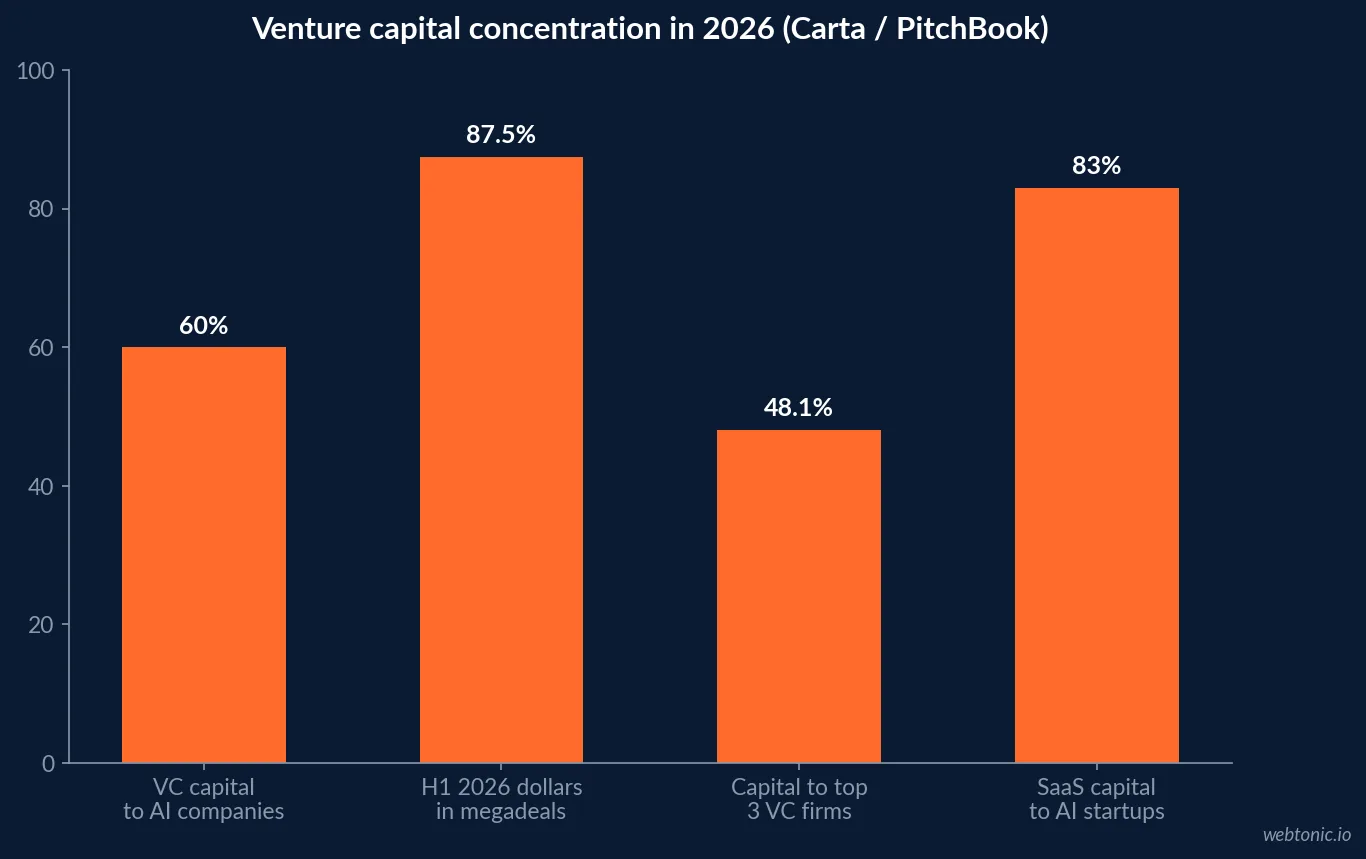
More than 60% of all 2026 venture capital went to AI companies, and megadeals of USD 100 million or more absorbed 87.5% of the money deployed in the first half of the year. Before a founder sets a growth budget for the rest of 2026, the honest starting point is how concentrated the capital, the marketing spend benchmarks and even the founder's own salary have become by stage and by category.
Key Takeaways
- Over 60% of Q1 2026 venture capital went to AI companies.
- Foundational model startups alone took 14.2% of total capital.
- Megadeals of USD 100M+ captured 87.5% of H1 2026 venture dollars.
- Three venture firms took 48.1% of all capital raised in H1 2026.
- First-time fund formation is on pace for its lowest year since 2016.
- The down-round rate fell to 11.4% in Q1 2026.
- Series B valuations rose 17.2% year over year.
- Series C valuations rose 12.5% year over year.
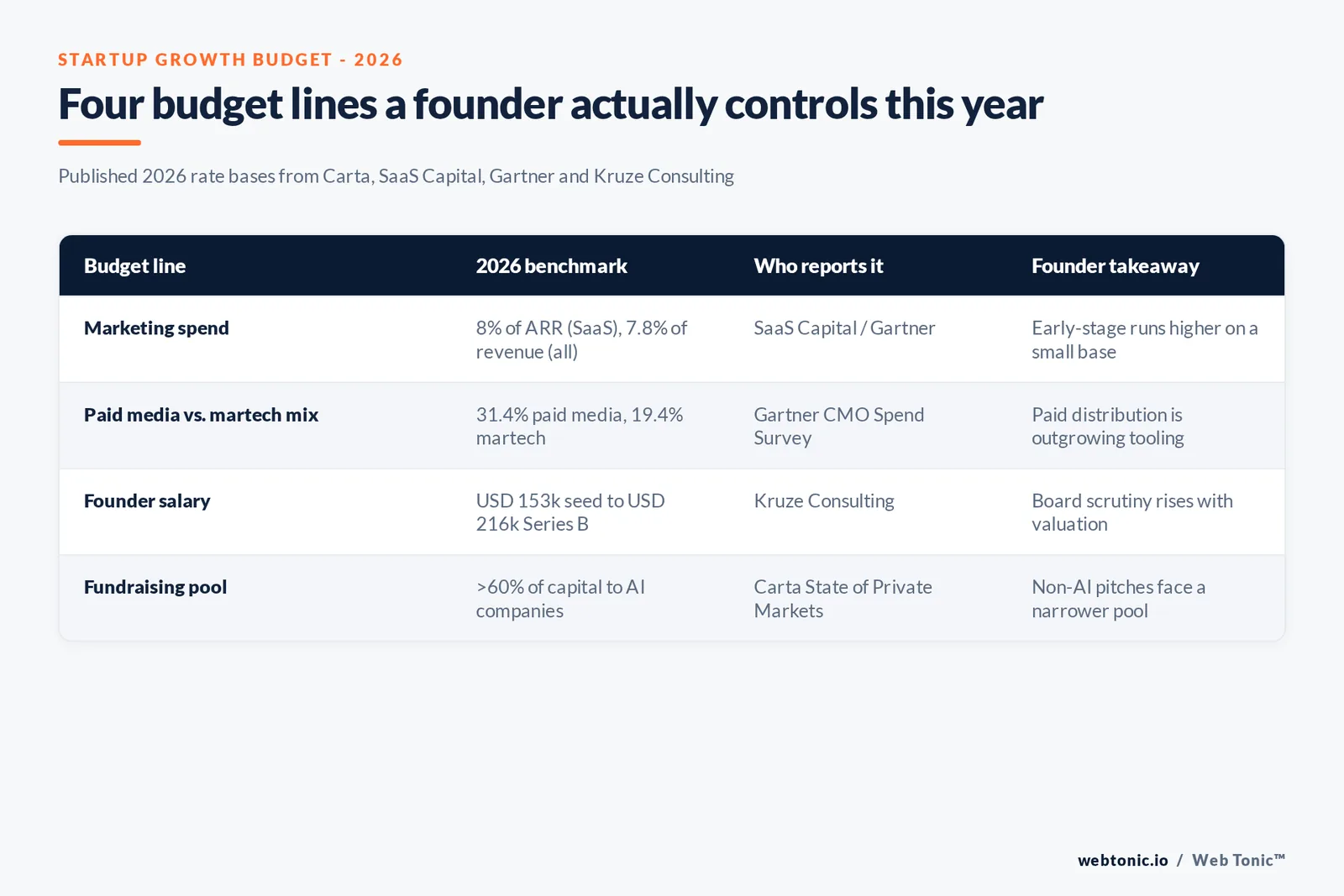
- Median B2B SaaS marketing spend is 8% of ARR.
- Cross-industry marketing budgets average 7.8% of revenue.
- Fully AI-optimized marketing orgs spend 11% of revenue.
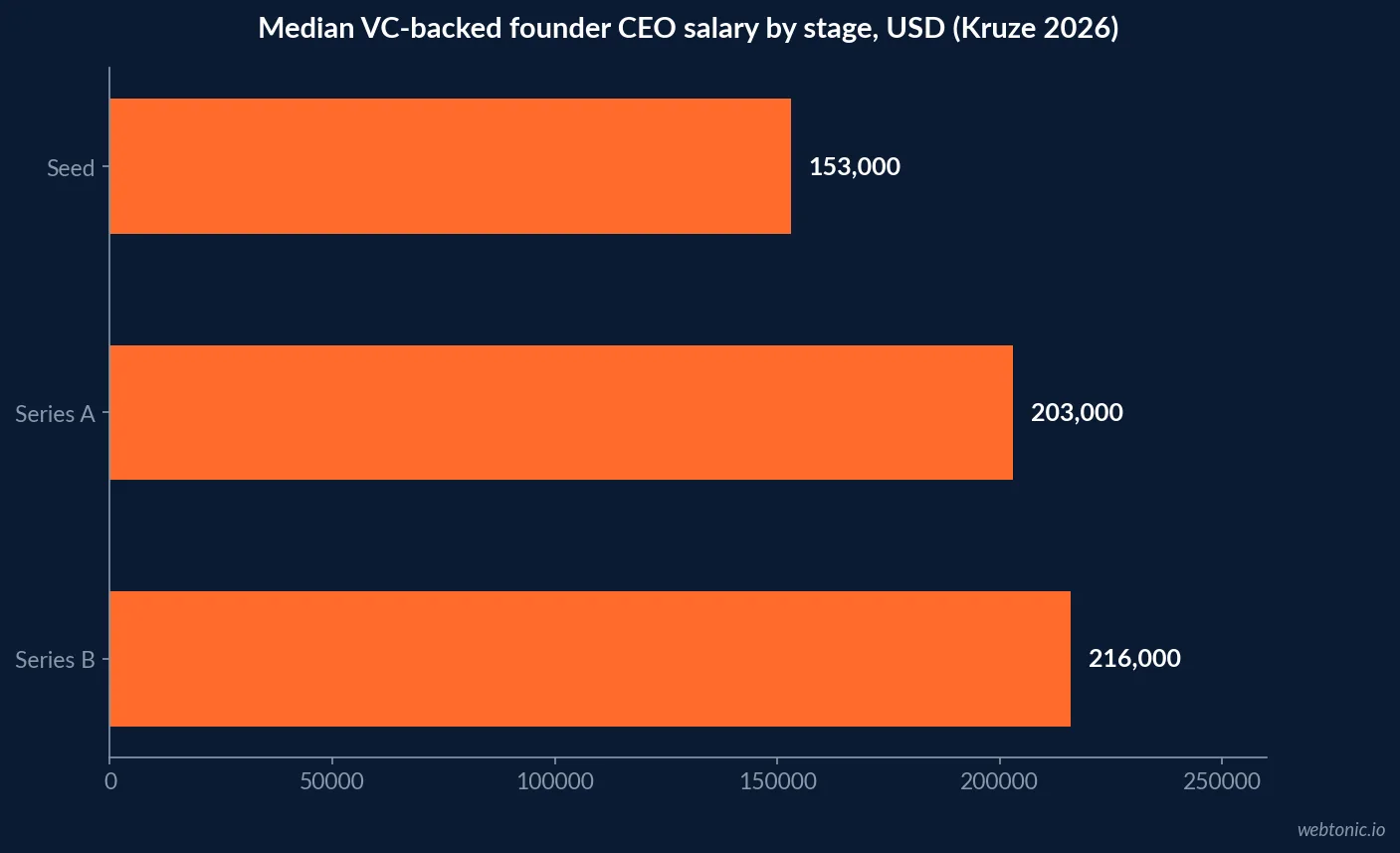
- Median seed-stage CEO salary is USD 153,000.
- Median Series A CEO salary is USD 203,000.
- Median Series B CEO salary is USD 216,000.
- August 2026 business applications fell 7.8% month over month.
- Projected business formations fell 4.6% in the same month.
- Startup firms average just 4 employees at birth.
- Silicon Valley's ecosystem value now exceeds USD 3 trillion.
Where the capital is actually going in 2026
Carta's State of Private Markets for Q1 2026 recorded USD 30.4 billion raised by companies on its platform, with more than 60% of that capital going to AI companies - the highest share Carta has recorded to date. Foundational model companies alone took 14.2% of total capital, and in SaaS specifically 83% of capital went to AI-labeled startups. An AI foundational model startup at Series A can carry a median valuation near USD 300 million against roughly USD 55 million for a non-AI startup at the same stage - two different funding realities inside one round label.
| Q1 2026 funding metric (Carta) | Figure | Founder implication |
|---|---|---|
| Share of VC capital going to AI | >60% | Non-AI pitches compete for a shrinking pool |
| Foundational model share of capital | 14.2% | A narrow slice absorbs outsized dollars |
| Down-round rate | 11.4% | Lowest since 2019-2020, terms have improved |
| Series B valuation growth, YoY | +17.2% | Later-stage non-AI names are also re-rating |
| Series C valuation growth, YoY | +12.5% | Growth-stage capital is following B rounds up |
Deal concentration at the very top of the market
The Q2 2026 PitchBook-NVCA Venture Monitor reports that megadeals of USD 100 million or more captured 87.5% of the USD 412.7 billion deployed across the first half of 2026, that AI accounted for 86% of all venture dollars, and that three firms - Andreessen Horowitz, Thrive Capital and Founders Fund - took 48.1% of all capital raised. First-time fund formation is on pace for its lowest year since 2016. Records are being set at the top of the market while the rest of it visibly contracts underneath. The report also tracks a widening gap between private and public market valuations and a divergence in fundraising between established managers and emerging ones - both symptoms of the same concentration a founder feels first-hand as a slower, more selective process the further a company sits from an AI label.
For a founder outside that concentration, the practical read is to budget for a longer, more competitive fundraising process even in a year the aggregate headlines call record-breaking.
| Startup ecosystem metric (Startup Genome GSER 2026) | Figure |
|---|---|
| Global Ecosystem Value growth, GSER 2025 to 2026 | +~40% |
| Prior year's Ecosystem Value contraction | -31% |
| Silicon Valley Ecosystem Value | >USD 3 trillion |
| North America Ecosystem Value growth since GSER 2025 | +51% |
| Global Ecosystem Value growth, same period | +33% |
Pricing the marketing line of a growth budget
SaaS Capital's 2026 survey of more than 1,000 private B2B SaaS companies found a median marketing spend of 8% of ARR, unchanged from the prior year. Its size-banded data for a USD 3-5 million ARR company also shows 12% on selling costs, 24% on R&D and 15% on general and administrative expense, useful context for weighing a marketing ask against the rest of the budget. Gartner's 2026 CMO Spend Survey, covering 401 marketing leaders, found overall budgets averaging 7.8% of revenue, rising to 8.9% among "AI strategist" organizations and 11% among the top 9% with fully optimized AI marketing capability.
| ARR-band spending (SaaS Capital 2026, $3-5M ARR company) | Median % of ARR |
|---|---|
| Marketing | 8% |
| Selling costs | 12% |
| Customer support/success | 10% |
| Research and development | 24% |
| General and administrative | 15% |
What a founder can actually budget to pay themselves
Kruze Consulting's 2026 data on VC-backed founders puts median CEO salary at USD 153,000 at seed (range USD 130,000-170,000), rising to USD 203,000 at Series A (range USD 180,000-230,000) and USD 216,000 at Series B (range USD 200,000-260,000). Boards are watching burn multiples more closely than during the 2021 fundraising peak, so founders raising below their stage's median valuation should budget conservatively inside that range rather than at the top of it.
| Stage | Median CEO salary (Kruze 2026) | Typical range |
|---|---|---|
| Seed | USD 153,000 | USD 130,000-170,000 |
| Series A | USD 203,000 | USD 180,000-230,000 |
| Series B | USD 216,000 | USD 200,000-260,000 |
Is now actually a good time to form a new company?
The US Census Bureau's Business Formation Statistics for August 2026 reported 531,728 seasonally adjusted business applications, down 7.8% from July, and projected business formations of 28,501 within four quarters, down 4.6% month over month. That single-month softening sits inside a longer pattern the Bureau of Labor Statistics has documented for years: startup firms average only about 4 employees at birth yet consistently generate an outsized share of net new job growth once they scale, which is the argument for treating a soft formation month as noise rather than a signal to delay. In the last full year the Bureau broke out in that series, more than 420,000 startup firms were responsible for almost 1.7 million job gains, even though older firms - those in business 10 years or more - still accounted for most of total employment. Startups do the disproportionate hiring; incumbents hold the base.
Our own data and analytics work treats a monthly Census dip the same way: as one data point inside a multi-year trend, not a reason to rewrite a growth budget. A quick benchmark call is usually enough to see whether a specific founder's plan sits inside or outside these 2026 ranges.
Martech versus paid media: where the marketing dollar actually goes
Beyond the headline percent-of-revenue figure, Gartner's 2026 CMO Spend Survey shows the mix inside that budget shifting hard toward paid media: the share of marketing expense going to paid media rose from 25.1% in 2021 to a five-year high of 31.4% in 2026, with 53% of CMOs planning to invest even more. Over the same period, the share going to martech fell from 26.6% to a five-year low of 19.4%, even though 62% of the 401 CMOs surveyed planned to invest more in martech specifically. A founder copying an enterprise CMO's allocation should expect the same tension: more of the marketing dollar is chasing paid distribution, not new tooling, regardless of stated intent. Our own growth marketing practice sizes an early-stage budget against this split before recommending a martech purchase.
| Marketing budget mix, 2021 vs 2026 (Gartner) | 2021 | 2026 |
|---|---|---|
| Share of expense on paid media | 25.1% | 31.4% |
| Share of budget on martech | 26.6% | 19.4% |
The early-stage surge investors are already pricing in
PitchBook's midyear 2026 update to its US venture capital outlook finds the early-stage surge it had anticipated "arrived ahead of schedule," driven by AI compressing the cost of building a company and megafunds deepening their participation at seed and Series A. That timing shift matters for a founder's own fundraising calendar: a round that historically took most of a quarter to close can now move faster when it fits the pattern investors are already funding, and slower when it does not.
Frequently Asked Questions
How much of 2026 venture funding is actually reachable outside AI?
Less than half. Carta's Q1 2026 data, drawn from companies on its cap table platform, found more than 60% of all venture capital invested went to AI companies, with foundational model companies alone taking 14.2% of total capital. PitchBook-NVCA's Q2 2026 Venture Monitor adds that megadeals of USD 100 million or more captured 87.5% of the USD 412.7 billion deployed in H1 2026, and three firms took 48.1% of all capital raised. A non-AI founder should budget assuming a narrower, more competitive investor pool than the aggregate growth numbers suggest.
How much should a startup budget for marketing as a percent of revenue?
SaaS Capital's 2026 survey of over 1,000 private B2B SaaS companies found a median marketing spend of 8% of annual recurring revenue, unchanged from the prior year. Gartner's 2026 CMO Spend Survey, across 401 marketing leaders company-wide, found overall marketing budgets averaging 7.8% of revenue, though companies with fully optimized AI marketing operations averaged 11%. Early-stage startups with little or no revenue will run well above either median in percentage terms simply because the denominator is still small.
What should a founder budget to pay themselves?
Kruze Consulting's 2026 data on VC-backed founders puts median CEO salary at USD 153,000 at seed (range USD 130,000-170,000), USD 203,000 at Series A (range USD 180,000-230,000), and USD 216,000 at Series B (range USD 200,000-260,000). Founders raising at or above the median for their stage can generally afford the midpoint of that range without drawing board scrutiny on burn discipline.
Is startup formation actually growing or shrinking right now?
It softened most recently. The US Census Bureau's Business Formation Statistics for August 2026 reported business applications of 531,728, seasonally adjusted, down 7.8% from July, and projected business formations of 28,501 within four quarters, down 4.6% month over month. That is a single month's dip inside a longer expansion; the Bureau of Labor Statistics has previously found startup firms consistently drive most net new job growth even in slower formation years.
Where is startup valuation actually rising this year?
Not evenly. Carta's Q1 2026 data shows Series B and Series C primary pre-money valuations up 17.2% and 12.5% respectively year over year, while early-stage primary valuations softened in the same quarter. An AI foundational model startup at Series A can carry a median valuation near USD 300 million against roughly USD 55 million for a comparable non-AI startup, so the same funding stage now spans two very different budgeting realities depending on category.
Sources
Carta - State of Private Markets, Q1 2026
PitchBook-NVCA - Q2 2026 Venture Monitor
Startup Genome - GSER 2026
SaaS Capital - 2026 Spending Benchmarks
Gartner 2026 CMO Spend Survey, via Chief Marketer
Kruze Consulting - Startup CEO Salaries 2026
US Census Bureau - Business Formation Statistics
US Bureau of Labor Statistics - Business Employment Dynamics