



Table of contents
Key Takeaways
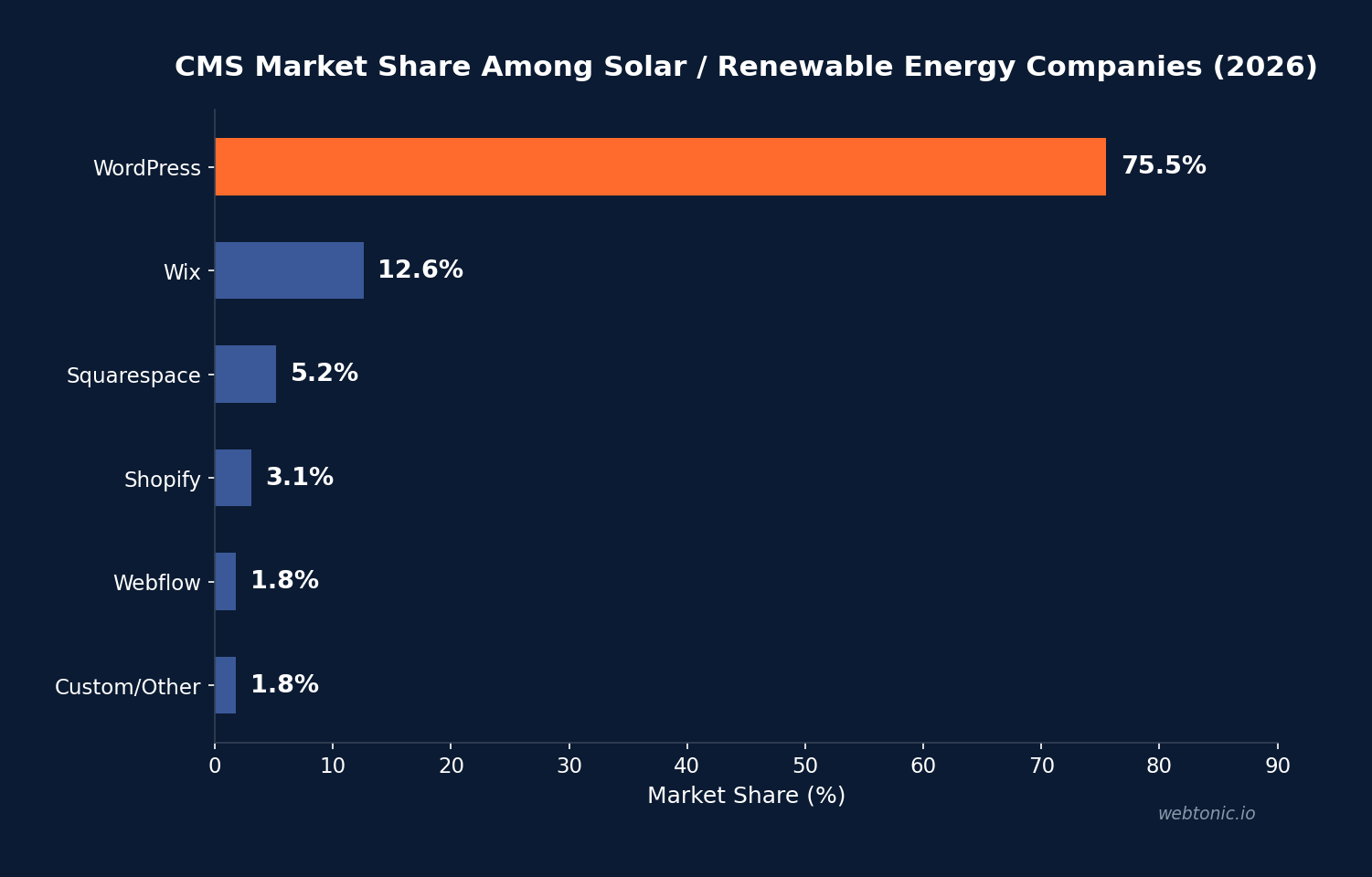
- WordPress powers 75.5% of solar and renewable energy company websites in the UK market, far ahead of Wix (12.6%) and Squarespace (5.2%) (Firmbase).
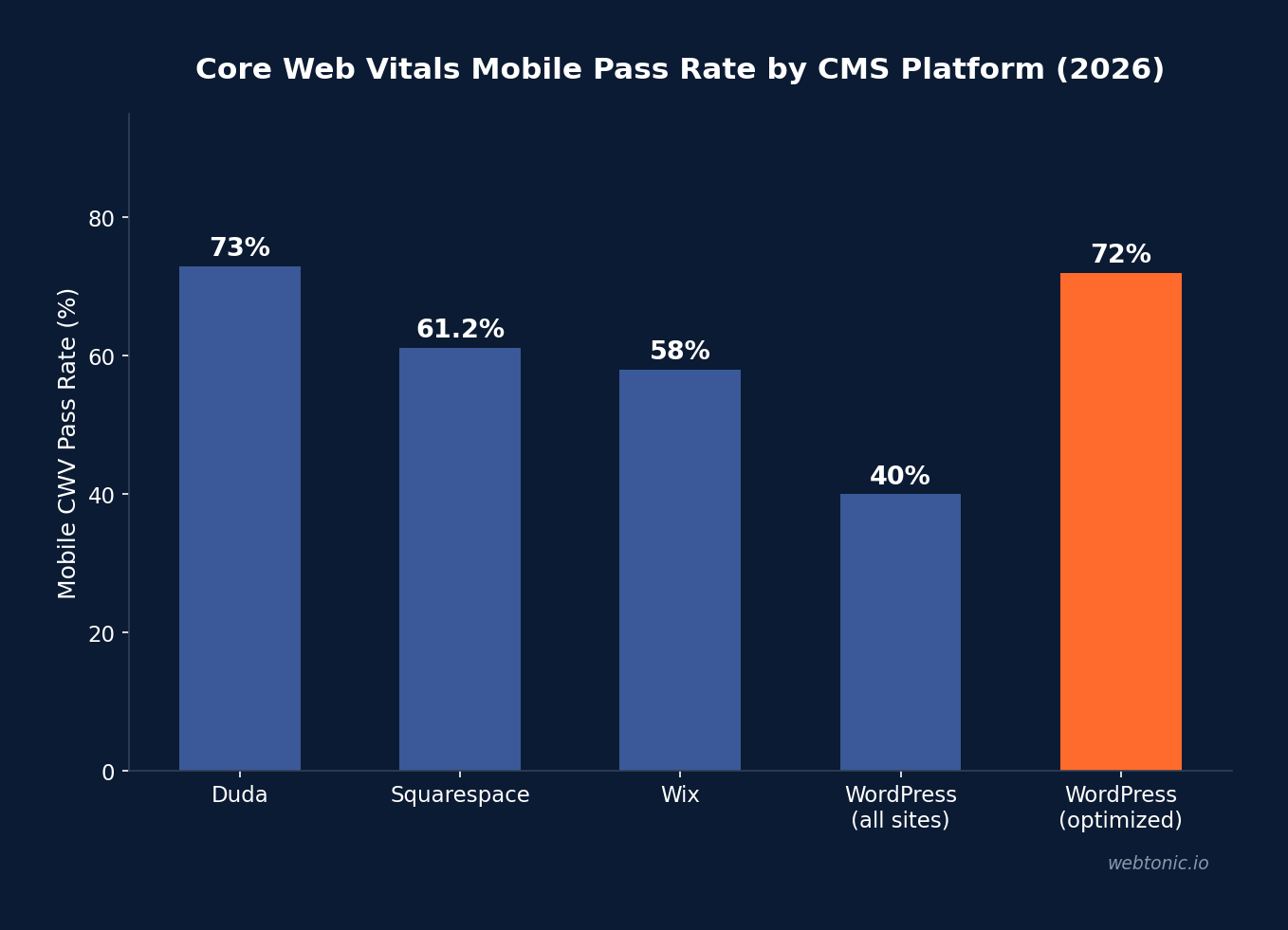
- Only 40% of WordPress sites pass Google's "good" LCP threshold on mobile, compared to 73% for Duda and 61.2% for Squarespace (Studio Slate).
- 85% of solar landing pages fail Core Web Vitals benchmarks, with an average mobile LCP of 10.2 seconds — 4× the 2.5-second standard (Pipeline ON).
- Websites loading under 2 seconds convert 15% more solar quote requests than slower competitors (WiFi Talents).
- 52.8% of WordPress sites run at least one plugin with a known CVE at scan time, and 91% of all WordPress vulnerabilities originate in plugins (GuardingWP).
- A growth-oriented solar WordPress site costs $15,000–$40,000 to build, while a starter site runs $5,000–$12,000 (Qrolic).
- WordPress holds 41.2% of all websites globally (59.1% of CMS-powered sites), though its share has declined from a 2023 peak of ~43% (W3Techs).
Solar WordPress Benchmarks at a Glance
| Metric | Value | Source |
|---|---|---|
| WordPress CMS share (solar/PV) | 75.5% | Firmbase 2026 |
| Global WordPress CMS share | 59.1% of CMS / 41.2% all sites | W3Techs Jul 2026 |
| Mobile LCP pass rate (WordPress) | 40% | Studio Slate |
| Avg solar mobile LCP | 10.2 seconds | Pipeline ON |
| Sites with unpatched plugin CVE | 52.8% | GuardingWP |
| Plugin-origin vulnerabilities | 91% | Patchstack 2026 |
| Starter site build cost | $5,000–$12,000 | Qrolic |
| Growth site build cost | $15,000–$40,000 | Qrolic |
| Website CVR (solar quotes) | 3%–8% | Nfinity IT |
| Sub-2s load speed CVR lift | +15% | WiFi Talents |
WordPress Dominates CMS Adoption in the Solar Industry
WordPress has cemented itself as the default content management system for solar and renewable energy companies. According to Firmbase's 2026 technology analysis, 75.5% of UK PV installation companies with a detectable CMS run WordPress — a ratio that mirrors the broader clean energy sector. Wix trails at 12.6%, Squarespace at 5.2%, and Shopify at 3.1%.
Globally, W3Techs reports WordPress powers 41.2% of all websites (59.1% of CMS-powered sites) as of July 2026. However, its share has been trending downward — from a peak of roughly 43% in 2023 to 41.2% in mid-2026, as platforms like Shopify (now 7.2% CMS share) and Wix continue to gain ground.
For solar companies, WordPress's popularity stems from its flexibility: solar calculator plugins, quote-request form builders, and deep SEO customizability make it a natural fit for lead-generation-focused installer websites. The most popular WordPress plugins among renewable energy firms include Site Kit (35.4%), Max Mega Menu (13.7%), and Jetpack (11.1%).
Page Speed and Core Web Vitals: WordPress's Biggest Solar Weakness
Speed is where WordPress solar sites consistently underperform. Pipeline ON's 2026 audit of 114 solar landing pages found that 85% fail Google's "good" Core Web Vitals threshold, with an average mobile Largest Contentful Paint (LCP) of 10.2 seconds — four times the 2.5-second benchmark.
Across all CMS platforms, Studio Slate's analysis shows only 40% of WordPress sites achieve "good" LCP on mobile, up from 28% in 2023 but still trailing Duda (73%), Squarespace (61.2%), and Wix (58%). The culprits are predictable: uncompressed hero images, render-blocking plugins, and unoptimized third-party scripts.
Websites that load in under 2 seconds have a 15% higher conversion rate for solar quote requests (WiFi Talents). For context, Nfinity IT Media reports that the typical solar website conversion rate is 3%–8% — meaning speed optimization alone can move the needle by roughly half a percentage point on a baseline 4% rate.
Optimized WordPress setups, however, can compete. Industry data shows that well-optimized WordPress sites reach a 72% mobile CWV pass rate, on par with Duda and outperforming Squarespace. The performance gap between an optimized and a default WordPress install is enormous — roughly 32 percentage points in pass rate.
Security Landscape for Solar WordPress Sites
Solar companies face elevated security risks on WordPress. GuardingWP's 2026 security report found that 52.8% of live WordPress sites run at least one plugin with a known CVE — not a hypothetical risk, but a documented vulnerability with a published patch sitting unpatched on the live site.
Patchstack's 2026 State of WordPress Security whitepaper breaks down the threat landscape: 91% of all reported WordPress vulnerabilities originate in plugins, 9% in themes, and only 6 vulnerabilities were found in WordPress core itself (all low-priority).
The most severe recent vulnerability — the wp2shell pre-auth RCE chain (CVE-2026-63030 + CVE-2026-60137) — exploits WordPress core's REST API batch route confusion combined with a WP_Query SQL injection. Tenable's analysis confirms the full RCE chain works on WordPress 6.9.x and 7.0.x. For solar companies processing customer financial data and utility information, keeping WordPress core and plugins patched is not optional — it's business-critical.
What a Solar WordPress Website Costs in 2026
| Website Tier | Cost Range | Typical Features |
|---|---|---|
| Starter | $5,000–$12,000 | 5–7 pages, basic contact form, mobile responsive, template theme |
| Growth | $15,000–$40,000 | Solar calculator, multi-step quote form, blog, CRM integration, speed optimization |
| Enterprise | $40,000–$100,000+ | Custom configurator, dealer/installer portal, headless CMS, API integrations, multilingual |
| Monthly maintenance | $200–$2,000/mo | Updates, security monitoring, backup, hosting, CDN, uptime checks |
Qrolic's 2026 pricing analysis shows a clear value tier structure. The most common investment for a conversion-optimized solar WordPress site sits in the $15,000–$40,000 growth tier, which includes the solar-specific features (savings calculators, multi-step qualification forms) that drive lead quality.
By comparison, a template-based starter site can launch for $5,000–$12,000, but typically lacks the performance optimization and conversion architecture that separate high-performing solar sites from the rest. With growth marketing, even a mid-range site can outperform a high-budget site that neglects speed and UX fundamentals.
Ongoing maintenance costs add $200–$2,000 per month for hosting, security monitoring, plugin updates, and CDN management. Solar companies that skip maintenance frequently face compounding technical debt — outdated plugins introduce both security vulnerabilities and performance degradation, creating a downward spiral that eventually requires a costly site rebuild rather than incremental fixes.
WordPress vs. Alternative Platforms for Solar Companies
| Factor | WordPress | Wix | Squarespace | Webflow |
|---|---|---|---|---|
| Market share (solar/PV) | 75.5% | 12.6% | 5.2% | 1.8% |
| Mobile CWV pass rate | 40% (default) / 72% (optimized) | 58% | 61.2% | 68% |
| SEO flexibility | Full control (plugins) | Improved, limited | Moderate | Excellent |
| Solar calculator plugins | Multiple available | Limited | None native | Custom build |
| Security responsibility | Owner-managed | Platform-managed | Platform-managed | Platform-managed |
| Build cost (growth tier) | $15K–$40K | $5K–$15K | $5K–$12K | $10K–$35K |
WordPress offers the deepest customization and plugin ecosystem for solar-specific features, but it comes with speed and security trade-offs that require active management. For teams without dedicated DevOps, managed WordPress hosting or a move to a platform like Webflow can close the performance gap. Understanding your options is key to maximizing ROI across all digital channels.
Best Practices for Solar WordPress Performance
- Implement server-side caching + CDN — reduces LCP by 40–60% on average. Consider managed WordPress hosts (WP Engine, Cloudways) that bundle this by default.
- Audit and remove unused plugins quarterly — with 91% of vulnerabilities in plugins, each unused plugin is an attack surface with no benefit.
- Compress hero images to WebP, cap at 200KB — solar sites are notorious for 2MB+ hero images of rooftop panels that tank mobile load times.
- Use a lightweight theme with <100ms TBT — avoid multipurpose themes with 30+ built-in modules. GeneratePress, Astra, or Kadence load in a fraction of the time.
- Enable auto-updates for security patches — the wp2shell RCE chain (CVE-2026-63030/60137) affected sites that delayed core updates by even two weeks.
- Add a solar savings calculator above the fold — calculator pages convert 2–3× higher than static service pages because they deliver immediate personalized value.
- Test mobile experience monthly — 70%+ of solar website traffic comes from mobile devices, yet most optimization efforts focus on desktop.
Conversion Performance: How WordPress Solar Sites Compare
The typical solar website converts at 3%–8% for quote requests (Nfinity IT Media), with the variation largely explained by speed and UX quality rather than CMS choice. Enervio's analysis breaks it down further: overall solar lead conversion rates run 10–20% (inquiry to appointment), with referral leads above 25% and cold social leads below 5%.
A Solar Weekly study of UK installer sites found that the fastest, content-rich solar sites — often statically generated — consistently outperform typical WordPress builds. The key factors: sub-2.5s LCP, prominent phone numbers, and multi-step qualification forms that filter low-intent traffic before it reaches the sales team.
With Meta Ads and Google Ads driving a growing share of solar leads, landing page speed becomes directly tied to ad ROAS — slow pages waste ad spend at scale.
WordPress Ecosystem Statistics Relevant to Solar (2026)
| Statistic | Value | Context |
|---|---|---|
| Global WordPress market share | 41.2% of all websites | Down from ~43% peak in 2023 |
| CMS-only market share | 59.1% | Still dominant but declining monthly |
| Shopify growth trajectory | 7.2% → growing | Gaining ~0.3%/month in CMS share |
| Plugin vulnerabilities (2025) | 91% of total | Theme vulns = 9%, core = 6 total |
| Sites with unpatched CVE | 52.8% | Patch published, not applied |
| Mobile CWV pass (WordPress avg) | 40% | Global avg is 63.4% |
| Mobile CWV pass (optimized WP) | 72% | With caching, CDN, optimized theme |
| Popular WP plugin (renewable) | Site Kit — 35.4% | Analytics integration dominates |
Related reading
- Inside Solar Energy Landing Pages & CRO: Key Statistics & Insights for 2026
- Solar Energy Shopify & Ecommerce Statistics: Online Sales Data (2026)
- Solar Webflow Statistics: Platform, Speed & Conversion (2026)
- Custom Web Development services at Web Tonic
FAQ
Is WordPress still the best CMS for solar companies in 2026?
WordPress remains the dominant choice with 75.5% market share among solar firms, thanks to its plugin ecosystem (solar calculators, quote forms, SEO tools) and content flexibility. However, solar companies that can't invest in ongoing speed optimization and security patching may find platforms like Webflow or managed website builders more cost-effective for their total cost of ownership.
Why do solar WordPress sites load so slowly on mobile?
The primary culprits are uncompressed hero images, render-blocking plugins, and heavy multipurpose themes. Solar sites often use large photography of installations and panels without proper compression. With an average mobile LCP of 10.2 seconds across the solar industry, most sites are 4× slower than Google's benchmark — costing them both rankings and conversions.
How much should a solar company budget for a WordPress website?
A starter WordPress site costs $5,000–$12,000, while a conversion-optimized growth site runs $15,000–$40,000. Factor in $200–$2,000/month for ongoing maintenance, security monitoring, and hosting. The growth tier typically pays for itself faster because it includes solar-specific conversion features like savings calculators and multi-step quote forms.
How can I improve my solar WordPress site's Core Web Vitals?
Focus on three high-impact actions: switch to a lightweight theme (GeneratePress, Astra, Kadence), implement server-side caching with a CDN, and compress all images to WebP under 200KB. These three changes alone can improve your mobile CWV pass rate from the WordPress average of 40% to the optimized tier of 72%. Removing unused plugins further reduces both load time and security risk.
What security risks should solar companies worry about on WordPress?
The biggest risk is unpatched plugin vulnerabilities — 52.8% of live WordPress sites have at least one. The recent wp2shell pre-auth RCE chain (CVE-2026-63030/60137) demonstrated that core vulnerabilities can also be severe. Solar companies handling customer financial data, utility bills, and personal information should enable auto-updates, run a Web Application Firewall, and audit plugins quarterly.
Sources
Firmbase — CMS Used by UK PV Installation Companies
W3Techs — WordPress Usage Statistics, July 2026
Studio Slate — WordPress Performance in 2026
Pipeline ON — Solar Landing Page Speed Audit
GuardingWP — State of WordPress Security 2026
Patchstack — State of WordPress Security Whitepaper 2026
Qrolic — Solar Company Website Cost 2026
WiFi Talents — Marketing in the Solar Industry Statistics
Nfinity IT Media — Solar SEO ROI Calculator Benchmarks
Tenable — wp2shell RCE FAQ


