



Table of contents
Key Takeaways
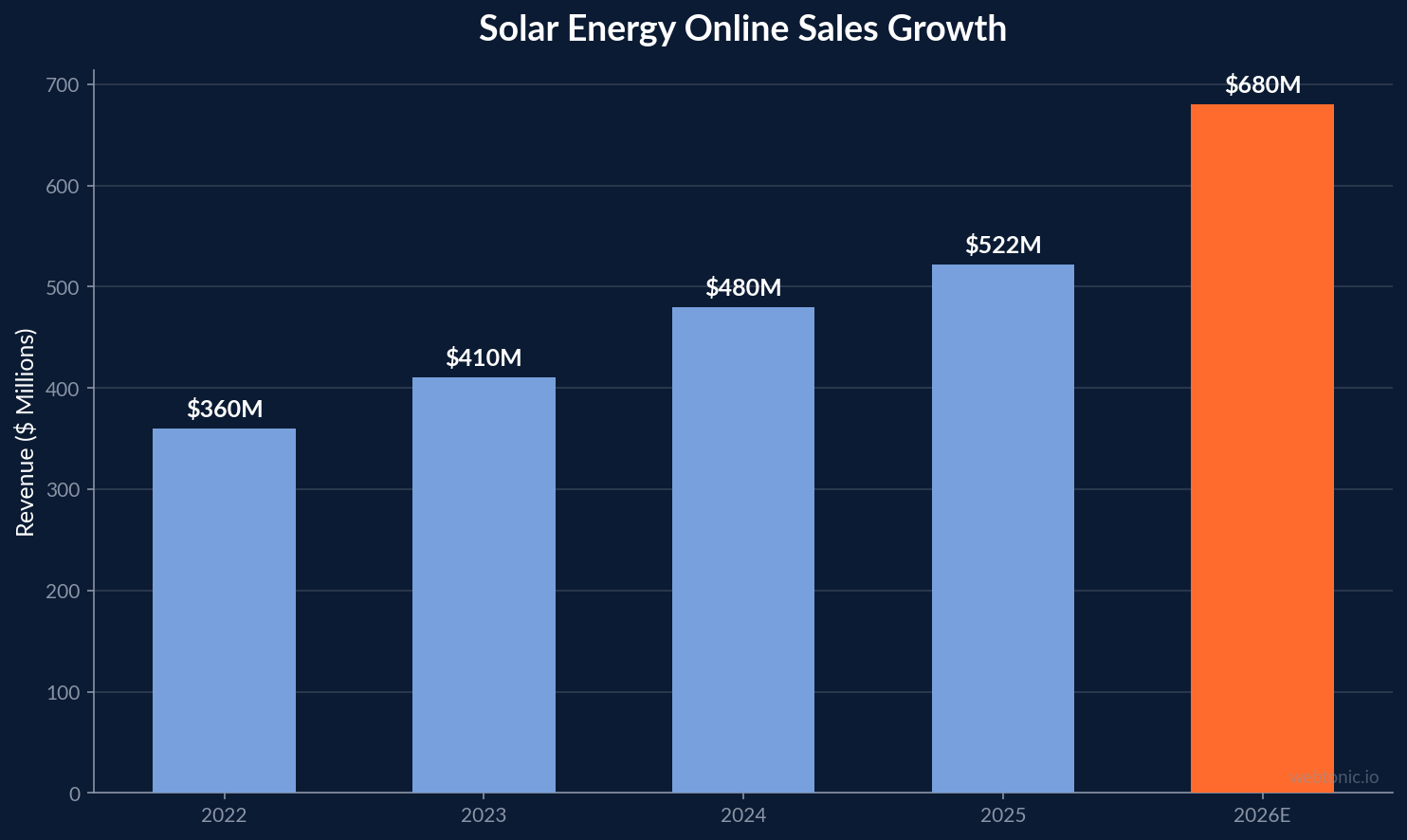
- Solar energy online sales reached $522 million in 2025, with 20–50% growth forecast for 2026 (Grips Intelligence).
- Solar ecommerce conversion rates average 1.0–1.5%, with an average order value (AOV) of $600–$700 (Grips Intelligence).
- 37+ active Shopify stores operate in the renewable energy niche, generating an average of 122,586 monthly visits per store (Brandsearch).
- Shopify's total GMV reached $378.4 billion in 2025, with the platform holding 14%+ of US ecommerce market share (Axis Intelligence).
- The global solar power equipment market is forecast to reach $410.44 billion by 2035, growing at a 9.70% CAGR (MarkWide Research).
- Direct-to-consumer (DTC) solar sales are expanding rapidly in Europe, with companies like Solago pioneering ecommerce-first models since 2022 (SalesTechStar).
Solar Ecommerce Benchmarks at a Glance
| Metric | Value | Source |
|---|---|---|
| Total online solar sales (2025) | $522 million | Grips Intelligence |
| Revenue growth forecast (2025→2026) | 20–50% | Grips Intelligence |
| Avg. ecommerce conversion rate | 1.0–1.5% | Grips Intelligence |
| Average order value (AOV) | $600–$700 | Grips Intelligence |
| Active Shopify renewable energy stores | 37+ | Brandsearch |
| Avg. monthly visits per store | 122,586 | Brandsearch |
| Shopify total GMV (2025) | $378.4 billion | Axis Intelligence |
| Solar equipment market forecast (2035) | $410.44 billion | MarkWide Research |
Solar Ecommerce Market Size and Growth
The solar energy ecommerce market is entering a period of accelerated growth. Aggregate online solar sales across tracked retailers reached $522 million in 2025, with revenue expected to grow by 20–50% in 2026. This growth is driven by expanding consumer comfort with high-ticket online purchases and the proliferation of digital-first sales channels.
The broader solar power equipment market provides context for this growth. Global solar equipment sales are forecast to reach $410.44 billion by 2035, progressing at a 9.70% CAGR. Within this, online channels—including ecommerce platforms and direct-to-consumer sales—represent a rapidly growing share of total distribution, with major distributors like Sonepar and Rexel expanding their digital product portfolios.
Monthly solar ecommerce revenue follows seasonal patterns. Across tracked retailers, indexed revenue declined by 16% from January to June 2026, reflecting the typical spring slowdown before summer installation season drives renewed purchasing activity.
Shopify Platform Performance for Solar Retailers
Shopify has become a significant platform for solar energy retailers. 37+ active Shopify stores currently operate in the renewable and alternative energy niche, collectively generating 4.5 million monthly visits with an average of 122,586 visits per store. The average renewable energy Shopify store lists approximately 93 products.
At the platform level, Shopify generated $11.56 billion in revenue and $378.4 billion in GMV in 2025—its first full year above $300 billion in merchant sales. In Q1 2026 alone, merchants cleared $100.7 billion in GMV (up 35% year over year). The platform now powers businesses in 175+ countries and holds more than 14% of the US ecommerce market by GMV.
For solar-specific Shopify stores, the data shows that leading brands achieve significant scale. Rich Solar generates approximately 46,000 monthly visits and an estimated $215,000 in monthly revenue. Renogy's Canadian store reaches 102,000 monthly visits with CA$386,000+ in revenue. These figures demonstrate that solar ecommerce on Shopify can support substantial businesses.
Leading Solar Shopify Stores by Traffic
| Store | Monthly Visits | Est. Revenue | Product Count |
|---|---|---|---|
| Renogy (CA) | 102K | CA$386K+ | 200+ |
| Rich Solar | 46K | $215K | 80+ |
| RPS Solar Pumps | 29K | $69K | 50+ |
| Niche average | 122.6K | Varies | 93 |
Solar Ecommerce Conversion Rates and AOV
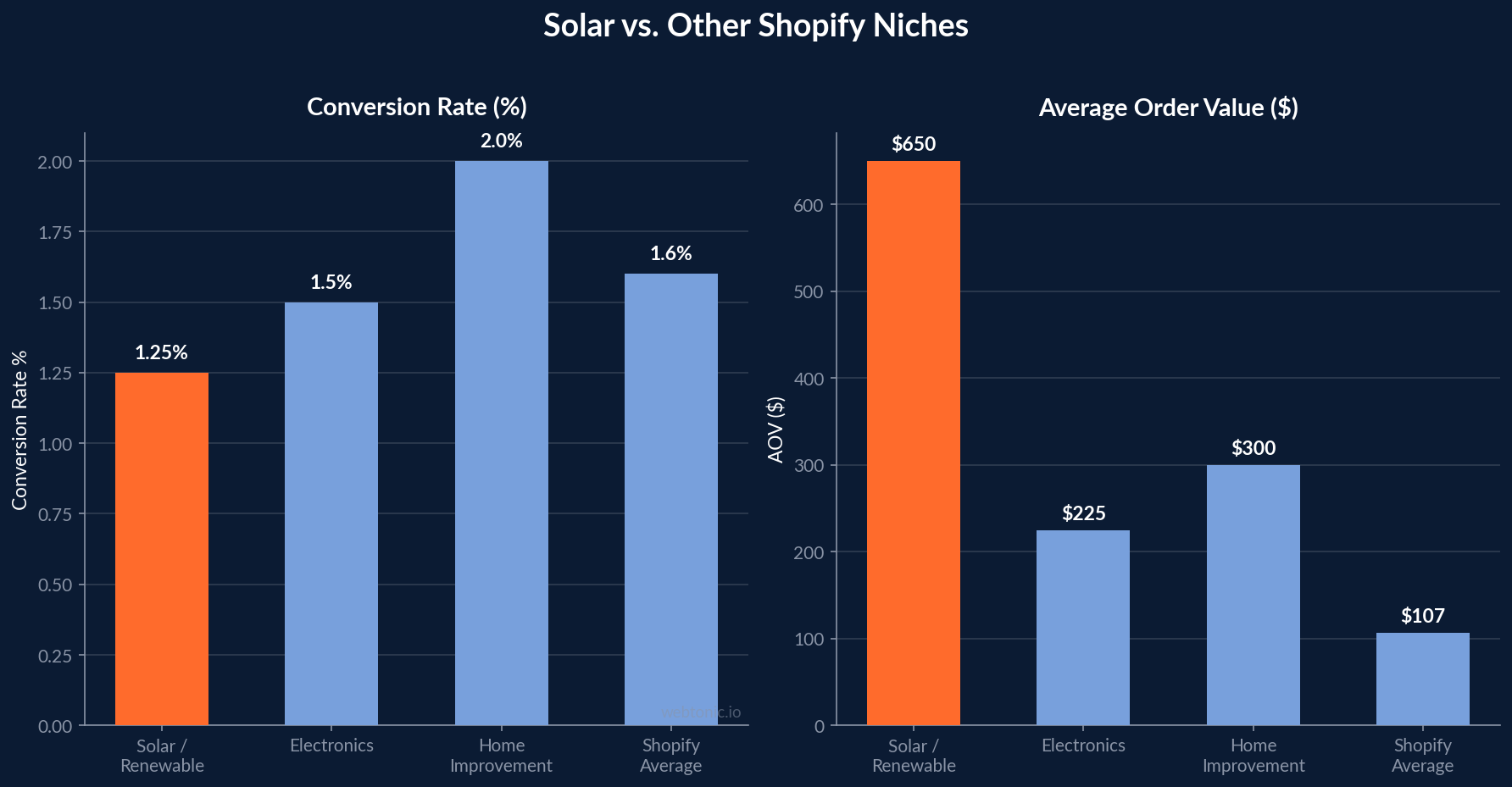
Solar ecommerce conversion rates average 1.0–1.5% across tracked retailers. This is lower than the overall Shopify average of 1.4–1.8% but consistent with high-ticket electronics categories where longer consideration cycles are the norm. The average order value of $600–$700 for solar products reflects the premium nature of panels, inverters, batteries, and system components.
Conversion optimization for solar ecommerce differs from typical retail. Customers researching solar purchases spend significantly longer in the consideration phase—often weeks to months—comparing specifications, calculating ROI, and evaluating installation compatibility. This makes strategic remarketing and educational content critical conversion drivers.
Shopify B2B performance adds another dimension. Shopify's B2B GMV reached $9.4 billion in 2025 (+140% year over year), with an average B2B AOV of $1,840. For solar distributors selling to installers and contractors, the B2B ecommerce channel represents a growing revenue stream with higher order values than consumer sales.
SEO and Traffic Acquisition for Solar Ecommerce
Traffic acquisition for solar ecommerce stores relies heavily on organic search. Organic search accounts for 45% of all high-quality solar leads for residential installers, making SEO the most cost-effective channel for driving ecommerce traffic. The most successful solar Shopify stores invest in long-tail keyword targeting around specific product categories, system sizing queries, and comparison searches.
80% of solar companies now use content marketing to educate prospects on net metering, energy savings, and equipment specifications. Stores that publish educational blog content alongside their product catalogs see 30–50% of leads coming from organic content, with typical content marketing programs generating 150–220 leads per month after 12 months of sustained publishing.
Paid acquisition through Google Shopping campaigns and Meta product ads complements organic traffic. Solar Shopify stores running Google Shopping campaigns face CPCs of $2–$8 for product-specific terms, significantly lower than the $10–$25+ CPCs for installation-focused keywords. This makes ecommerce-focused PPC a more capital-efficient entry point for solar companies building their digital presence.
Direct-to-Consumer Solar Ecommerce Trends
The direct-to-consumer (DTC) model is reshaping solar equipment distribution. Companies like Solago have pioneered selling solar components directly to end customers via ecommerce since 2022, expanding into the Netherlands and Belgium with a model that was previously rare in the market. This shift reflects broader consumer expectations for transparent pricing and self-service purchasing.
Industry data reveals a permanent structural realignment in how consumers procure off-grid and renewable energy hardware. Procurement behaviors are shifting away from conventional brick-and-mortar retail networks toward digital-first channels, driven by:
- Price transparency — online comparison shopping allows consumers to evaluate multiple brands and configurations without sales pressure
- Product education — detailed product specifications, installation guides, and customer reviews reduce the knowledge barrier
- Logistics improvements — enhanced shipping capabilities now support delivery of heavy solar panels and battery systems directly to residential addresses
- Sustainability alignment — Shopify's renewable energy commitment covers 100% of operations, resonating with environmentally conscious solar buyers
Solar Energy vs. Other Shopify Niches: Ecommerce Comparison
| Metric | Solar / Renewable | Electronics (General) | Home Improvement | Shopify Average |
|---|---|---|---|---|
| Conversion rate | 1.0–1.5% | 1.2–1.8% | 1.5–2.5% | 1.4–1.8% |
| AOV | $600–$700 | $150–$300 | $200–$400 | $85–$130 |
| Avg. monthly visits (top stores) | 46K–122K | 80K–500K | 50K–200K | Varies |
| B2B AOV (Shopify B2B) | $1,840+ | $500–$1,200 | $800–$1,500 | $1,840 |
| Product consideration cycle | Weeks–months | Days–weeks | Days–weeks | Hours–days |
| Seasonal revenue variation | ±16% (Jan–Jun) | ±10–15% | ±20–30% | ±15–20% |
Ecommerce Technology Stack for Solar Retailers
Solar ecommerce demands a technology stack that supports high-ticket purchases with long consideration cycles. The most successful solar Shopify stores share several technical characteristics that drive higher conversion rates and customer lifetime value.
Product configurators and compatibility checkers are critical differentiators. Solar buyers need to verify that panels, inverters, batteries, and mounting hardware work together before committing to a $600–$5,000+ order. Stores that implement interactive system builders see measurably higher time-on-site and add-to-cart rates than those relying on static product listings.
Content-rich product pages outperform stripped-down listings in the solar vertical. Top-performing stores include technical specification tables, installation guides, warranty documentation, and video demonstrations on every product page. This depth addresses the educational needs of solar buyers who often spend weeks comparing options before purchasing.
Payment and financing options also matter disproportionately for solar ecommerce. With average order values of $600–$700 (and system packages reaching $3,000–$10,000+), stores offering installment payments through Shopify's Shop Pay Installments or third-party financing apps capture sales that would otherwise stall at checkout. The Shopify B2B channel supports custom pricing, net payment terms, and volume discounts that are essential for selling to contractors and installers.
Global Solar Ecommerce Market Context
The growth of solar ecommerce operates within a rapidly expanding global solar market. Online solar equipment purchasing is growing fastest in Europe, where DTC solar retailers are disrupting traditional installer-led distribution. In North America and Asia-Pacific, which together account for 60–65% of global solar equipment demand, ecommerce channels are gaining share as both consumer and B2B buyers move to digital procurement.
Utility-scale and commercial buyers are also shifting purchasing behavior. Utility-scale buyers are consolidating procurement digitally across the United States, India, and China. Feed-in tariff revisions in Germany and Japan are creating new demand patterns that favor agile ecommerce sellers who can respond quickly to policy-driven price shifts.
For Shopify-based solar retailers, this global context matters because the platform's international infrastructure—supporting 175+ countries with multi-currency checkout—positions it as the natural platform for solar companies expanding beyond their home markets. The combination of global reach and specialized B2B features makes Shopify increasingly the default ecommerce platform for solar equipment sellers scaling internationally.
Shipping and Logistics Challenges in Solar Ecommerce
Solar products present unique shipping challenges that directly impact ecommerce profitability and customer satisfaction. Solar panels are heavy, oversized, and fragile—a standard 400W residential panel weighs 45–50 pounds and measures approximately 69" × 41". Shipping a single panel typically costs $50–$150 domestically, and damage rates during transit remain a significant concern for retailers.
Leading solar ecommerce businesses have addressed these logistics challenges through several approaches:
- Regional warehouse networks — distributing inventory across multiple fulfillment centers reduces shipping distances and costs for heavy solar equipment
- Freight shipping integration — Shopify's freight shipping apps handle the LTL (less-than-truckload) shipping required for panel pallets and battery systems
- Free shipping thresholds — stores that offer free shipping on orders above $1,000–$2,000 see higher AOV as buyers consolidate purchases to qualify
- Damage protection programs — offering optional shipping insurance and hassle-free replacement policies builds purchase confidence for high-value orders
Despite these challenges, the shift to online solar sales continues accelerating. Logistics innovation—particularly the expansion of solar-specialized fulfillment networks—is removing one of the last major barriers to full ecommerce adoption in the solar industry.
Ecommerce Best Practices for Solar Retailers
- Invest in detailed product education — solar buyers need technical specifications, compatibility guides, and ROI calculators. Stores with comprehensive product pages see higher conversion rates and lower return rates.
- Optimize for mobile — with 84% of solar prospects researching online and a growing share using mobile devices, responsive design and fast load times are non-negotiable for paid traffic conversion.
- Implement B2B pricing tiers — Shopify's B2B capabilities support tiered pricing for installers and contractors, capturing the high-AOV ($1,840+) wholesale segment.
- Use solar savings calculators as lead magnets — interactive tools that estimate energy savings and payback periods convert browsers into buyers by quantifying the purchase value.
- Leverage seasonal inventory planning — with revenue swings of ±16% between seasons, align inventory and advertising budgets with installation season peaks (typically late spring through fall).
- Highlight sustainability credentials — Shopify's carbon-neutral shipping and 100% renewable energy operations align with the values of solar energy buyers and can be featured prominently in checkout flows.
Related reading
- Solar Energy WordPress Statistics
- Inside Solar Energy Landing Pages & CRO: Key Statistics & Insights for 2026
- Solar Webflow Statistics: Platform, Speed & Conversion (2026)
- Custom Web Development services at Web Tonic
FAQ
How big is the solar ecommerce market?
Solar energy online sales reached $522 million in 2025 across tracked retailers, with 20–50% growth forecast for 2026. The broader solar power equipment market is projected to reach $410.44 billion by 2035.
What is the average conversion rate for solar Shopify stores?
Solar ecommerce conversion rates average 1.0–1.5%, which is slightly below the overall Shopify average of 1.4–1.8%. The lower rate reflects longer consideration cycles typical of high-ticket purchases with an average order value of $600–$700.
How many solar companies sell on Shopify?
37+ active Shopify stores currently operate in the renewable and alternative energy niche, collectively generating 4.5 million monthly visits. Leading stores like Renogy and Rich Solar demonstrate that solar ecommerce can support substantial revenue on the Shopify platform.
Is direct-to-consumer solar ecommerce growing?
Yes. DTC solar sales are expanding rapidly, with companies like Solago pioneering ecommerce-first models in Europe since 2022. Industry data confirms a permanent structural shift away from traditional retail toward digital channels for solar equipment procurement.
What Shopify features work best for solar retailers?
Solar retailers benefit most from Shopify's B2B pricing tiers (B2B AOV reaches $1,840), carbon-neutral shipping options, and comprehensive product page customization for technical specifications. The platform's 14%+ US ecommerce market share also provides built-in consumer trust.
Sources
Grips Intelligence — Solar Energy Online Industry Intelligence
Axis Intelligence — Shopify Statistics 2026
Brandsearch — Renewable & Alternative Energy Shopify Stores
MarkWide Research — Solar Power Equipment Sales Market
SalesTechStar — Direct-to-Consumer Sales of Solar Components
Dataintelo — Photovoltaic Power Equipment Market
Ecommerce Fastlane — Renewable Energy Products Market


