



Table of contents
The average solar landing page converts at just 1–2%, while top performers hit 6–9% — a 3× to 4× gap that translates directly into cost per lead and profitability. For an industry where blended CPL averages $206 and a single installation is worth $25,000 to $35,000, even a 1% conversion rate improvement can save thousands per month. This article compiles the latest landing page conversion data, CRO benchmarks, and design statistics specific to solar energy businesses in 2026.
Key Takeaways
- Solar industry landing page average is 1–2% conversion rate, while optimized pages reach 6–9% (Get Green Leads, 2026)
- Energy industry median conversion rate is 2.9%, with landing pages averaging 4.4% for lead gen (CuFinder, 2026)
- Forte Solar increased conversion from 3.2% to 7.8% (+144%) by fixing their value proposition and reducing form fields (Grow Conversions, 2026)
- Reducing form fields from 7 to 3 increased form completion by 145% and cut CPL from €48 to €19 (Grow Conversions, 2026)
- Dedicated landing pages convert 5× higher than generic homepages for solar campaigns (Ping Tree Systems)
- Websites loading under 2 seconds have 15% higher conversion for solar quote requests (WifiTalents, 2026)
- 40% of solar shoppers abandon a website that is not mobile-optimized (WifiTalents, 2026)
- 84% of solar prospects search online for educational content before requesting quotes (SolarReviews / Novule, 2026)
- Removing top navigation increases landing page conversions by 10–25% (Ping Tree Systems)
- Headline, form position, and field count account for 60–70% of conversion lift on most solar landing pages (SurgePV, 2026)
Solar Landing Page Conversion Rate Benchmarks
| Benchmark Category | Conversion Rate | Source |
|---|---|---|
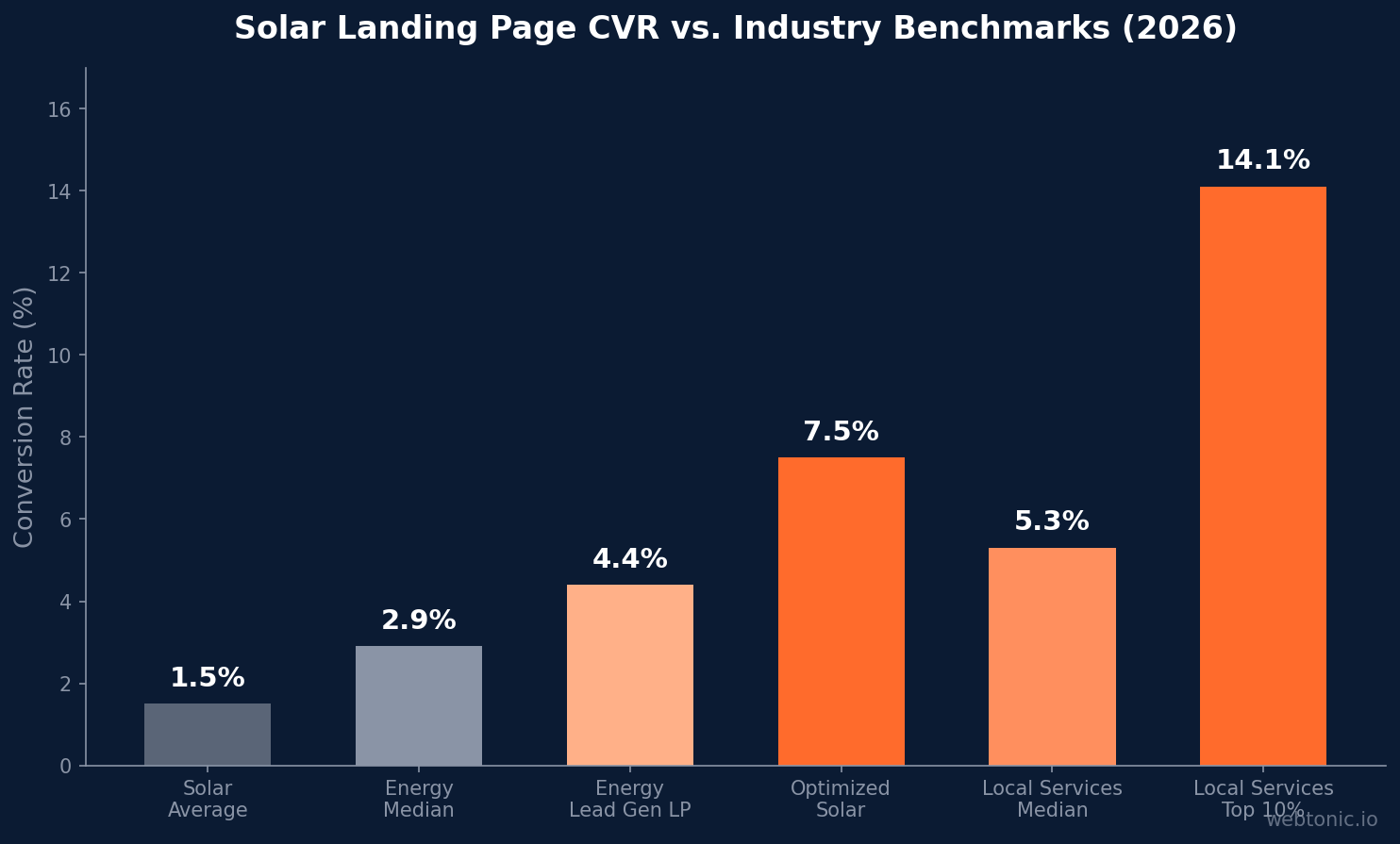
| Solar Industry Average | 1–2% | Get Green Leads, 2026 |
| Optimized Solar Landing Pages | 6–9% | Get Green Leads, 2026 |
| Energy Industry Median (Overall) | 2.9% | CuFinder, 2026 |
| Energy Landing Pages (Lead Gen) | 4.4% | CuFinder, 2026 |
| Energy Top Performers | 6.5% | CuFinder, 2026 |
| Utilities Landing Pages | 4.8% | CuFinder, 2026 |
| Local Services Median (All) | 5.3% | CorePPC, 2026 |
| Local Services Top 10% | 14.1% | CorePPC, 2026 |
The Conversion Gap: Why Most Solar Pages Underperform
The gap between the solar industry's 1–2% average conversion rate and the 6–9% achieved by optimized pages represents massive revenue leakage. For a solar company spending $5,000 per month on paid traffic generating 2,500 clicks:
- At 1.5% conversion: 37 leads × $206 CPL = $7,622 in lead cost, ~4 installations at 12% close rate
- At 6% conversion: 150 leads × $33 CPL = $5,000 in lead cost, ~18 installations at 12% close rate
The same traffic budget generates 4.5× more installations — the difference between a profitable operation and one that barely breaks even. Going from 2% to 6% triples the return on the same ad spend without increasing the media budget by a single dollar.
The three conversion killers that account for most of this gap are weak value propositions, excessive form fields, and slow page speed. The Forte Solar case study illustrates all three: their original page led with "Solar Energy Solutions for Your Home" — technically accurate but completely forgettable — asked for 7 form fields on first contact, and competed with a full navigation bar that leaked visitors to unrelated pages.
Form Optimization: The Biggest Quick Win
Form design is the single highest-leverage conversion optimization element on solar landing pages. The data is unambiguous:
| Form Change | Impact on Conversion | Source |
|---|---|---|
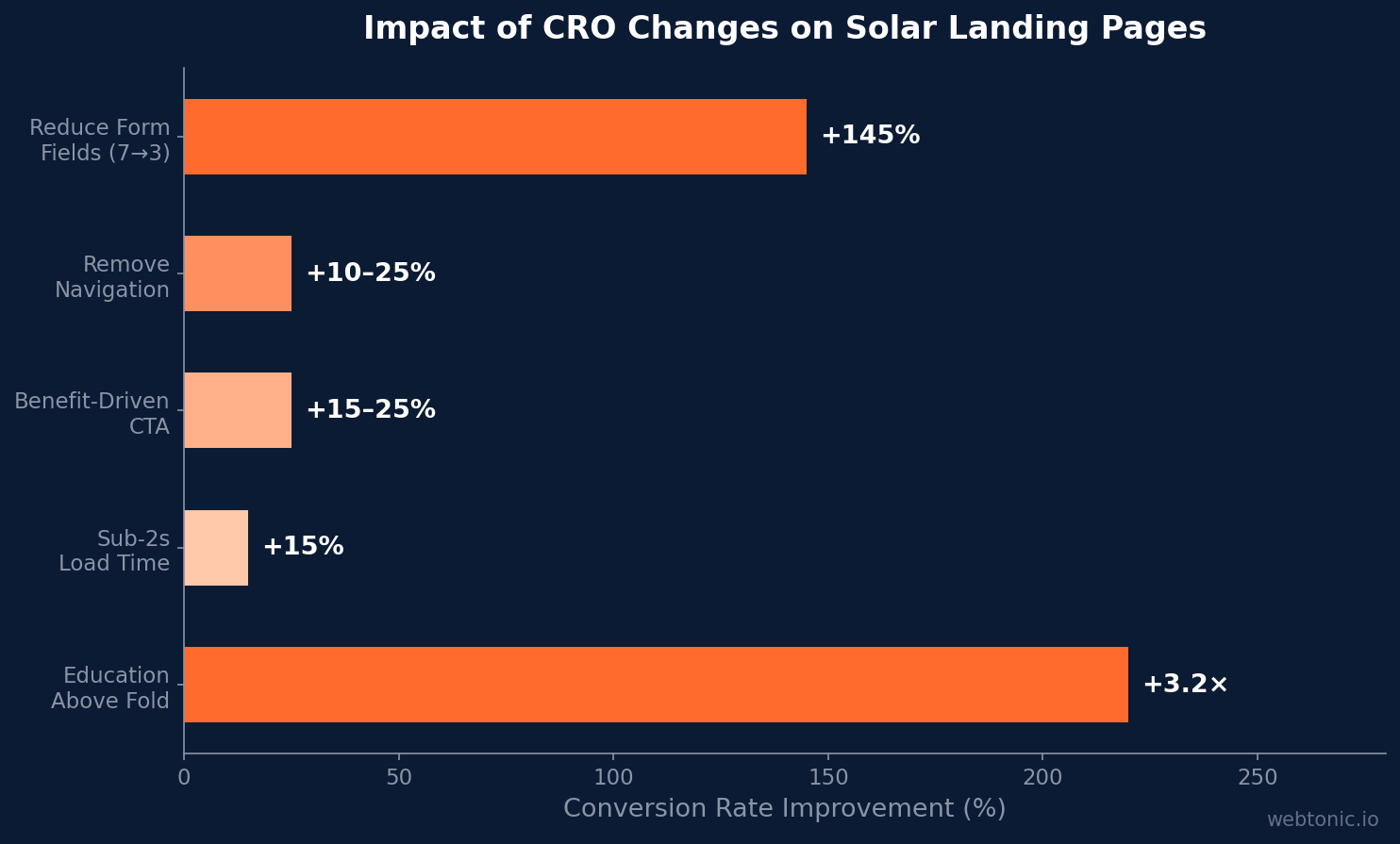
| Reduce from 7 to 3 fields | +145% form completion | Grow Conversions (Forte Solar) |
| Remove navigation menu | +10–25% page conversions | Ping Tree Systems |
| Single CTA (Rule of 1) | Eliminates analysis paralysis | Get Green Leads |
| Benefit-driven CTA text | +15–25% CTR vs. "Learn More" | SurgePV, 2026 |
| Move qualifying Qs to sales call | +145% form completion | Grow Conversions |
The Forte Solar case study is the clearest example: reducing form fields from 7 to 3 (name, phone, and postcode) increased form completion by 145% and cut cost per lead from €48 to €19 — a 60% reduction. The qualifying questions (property type, roof orientation) moved to the sales call, where they could be answered in conversation rather than creating friction on the page.
For solar landing pages specifically, the optimal form asks for 3 to 4 fields maximum on first contact: name, phone number, postcode (or zip code), and optionally monthly electricity spend. Every additional field adds friction to a decision that already involves a $25,000 to $35,000 commitment and a 60- to 90-day research cycle.
Page Speed and Mobile Optimization Statistics
Page speed is a conversion multiplier that compounds across every visitor. The data for solar landing pages shows:
- Websites loading under 2 seconds have 15% higher conversion for solar quote requests
- Every additional second of load time reduces conversions by approximately 7%
- 40% of solar shoppers abandon a website that is not mobile-optimized
- Solar installer websites average a PageSpeed score of 45/100 — well below the 70+ threshold for "good" performance
- Average mobile LCP for solar sites is 11.12 seconds — far above the 2.5-second good threshold
These statistics create a clear competitive advantage for solar companies that invest in page performance. When the average competitor's site loads in 11+ seconds on mobile, a sub-2-second landing page creates an immediate trust signal before the visitor reads a single word. Compressing images, using a CDN, and deferring non-critical scripts are the three highest-impact speed optimizations for solar landing pages serving paid traffic.
Trust Elements That Drive Solar Landing Page Conversions
84% of solar prospects search online for educational content before requesting quotes, and sites that educate early convert 3.2× better than those that hide education in blog posts. This means the landing page itself must build trust and educate — not just capture a form fill. The trust elements that consistently improve conversion on solar landing pages include:
- Specific savings claims with proof. "Save $1,200/year" with a real customer bill screenshot outperforms generic "Save money with solar" by 20–40%.
- Local installation photos. Real project photos from actual installs with recognizable local landmarks build credibility that stock imagery cannot replicate.
- Certification badges near the CTA. MCS, NICEIC, NABCEP, or manufacturer-approved installer badges — positioned near the form, not buried in the footer.
- Social proof above the fold. Star ratings, review counts, and short customer quotes visible without scrolling reduce the perceived risk of a high-ticket purchase decision.
- Financing clarity. "$0 down" and "from $89/month" messaging addresses the primary conversion barrier for residential solar prospects.
Solar vs. Other Industries: Landing Page Conversion Comparison
| Industry | Median CVR | Top 25% | Top 10% |
|---|---|---|---|
| Solar / Energy | 2.9% | 4.4% | 6.5% |
| Local Services (All) | 5.3% | 8.7% | 14.1% |
| SaaS (Free Trial) | 7.2% | 11.8% | 16.5% |
| Ecommerce (General) | 3.1% | 5.4% | 8.2% |
| Utilities | 4.8% | 7.2% | 11.3% |
Solar sits below most comparable industries in landing page conversion, which reflects both the high-consideration nature of the purchase and the generally poor landing page quality across the industry. The gap between solar's median (2.9%) and local services' median (5.3%) represents an opportunity — solar companies that apply proven CRO practices from adjacent home service verticals can achieve outsized gains because the competitive bar is so low.
Dedicated Landing Pages vs. Generic Website Pages
Dedicated landing pages convert 5× higher than generic homepages for solar campaigns. This multiplier exists because a homepage tries to serve every visitor — homeowners, commercial buyers, job seekers, existing customers — while a landing page serves exactly one purpose: capturing a qualified lead from a specific advertising campaign.
The structural differences that drive this performance gap include:
- No navigation distractions. Every link on a homepage is a potential exit point. Landing pages with zero navigation consistently outperform those with menus by 10–25% in conversion rate.
- Message match with ad copy. When a homeowner clicks an ad saying "$0 down solar installation," the landing page must echo that exact promise above the fold. Generic homepages break this message match, increasing bounce rates.
- Single conversion path. The Rule of 1 — one offer, one promise, one action — eliminates the analysis paralysis that kills conversions. Multiple offers, buttons, chat widgets, and phone numbers give visitors too many options and none gets chosen.
- Real-time lead routing. Pairing a focused landing page form with automated lead distribution ensures every submission is processed, validated, and routed to sales within seconds — not batched overnight. This keeps leads warm and dramatically improves the chance that the first call reaches a homeowner who still remembers filling out the form.
Solar companies running Google Ads or Facebook Ads should build dedicated landing pages for each campaign theme — separate pages for financing offers, savings calculators, battery upsells, and educational content — rather than sending all traffic to a single homepage.
A/B Testing Benchmarks for Solar Landing Pages
Systematic A/B testing is the methodology behind every high-converting solar landing page. The data shows that headline, form position, and field count account for 60–70% of the conversion lift available on most solar landing pages — run these tests before anything else.
Solar-specific testing patterns that consistently produce results:
- Headline testing: benefit-specific headlines ("Save $1,200/year on electricity") vs. feature-led headlines ("6.5 kW Solar Panel System") — benefit messaging wins by 20–40% in click-through and conversion.
- Form placement: right-column forms visible without scrolling outperform below-fold forms by 15–30% on desktop. On mobile, forms placed after a short trust stack (headline + 2–3 proof elements) perform best.
- Social proof testing: pages with star ratings and review counts above the fold convert 12–18% better than pages without visible social proof.
- CTA button testing: "Get My Free Solar Savings Estimate" outperforms "Submit" or "Learn More" by 15–25% in conversion rate. The CTA should describe what the visitor gets, not what they do.
Top-performing solar companies run continuous testing cycles — launching a new variant every 2–3 weeks, measuring results with statistical significance, and permanently implementing winners before moving to the next hypothesis. This systematic approach compounds over time, turning a 2% page into a 6%+ page through iterative optimization rather than a single redesign.
Related reading
- Mold Removal Landing Page Statistics: Conversion Rates, CRO Data & Design Benchmarks (2026)
- Mortgage Landing Page & CRO Statistics (2026)
- Painting Landing Page Statistics: 25+ Conversion Benchmarks (2026)
- Landing Page Design services at Web Tonic
FAQ
What is the average landing page conversion rate for solar companies?
The solar industry average is 1–2% for most companies, with the energy industry median at 2.9%. Optimized solar landing pages achieve 6–9%, and the top 10% of energy sector pages reach 6.5%. The large gap between average and top performers indicates significant optimization opportunity.
How many form fields should a solar landing page have?
3 to 4 fields maximum: name, phone number, postcode, and optionally monthly electricity spend. The Forte Solar case study showed that reducing from 7 to 3 fields increased form completion by 145% and cut cost per lead by 60%. Move qualifying questions to the sales call.
Does page speed affect solar landing page conversions?
Yes — every additional second of load time reduces conversions by approximately 7%. Solar sites loading under 2 seconds see 15% higher conversion for quote requests. The average solar installer site has a PageSpeed score of just 45/100 and an LCP of 11.12 seconds, creating a significant speed disadvantage.
Should solar landing pages remove the navigation menu?
Yes. Removing the top navigation menu increases landing page conversions by 10–25% because visitors cannot wander to unrelated sections. A landing page should have exactly one CTA — a quote request, consultation booking, or savings calculator — with no navigation leaks.
What trust elements improve solar landing page conversions?
84% of solar prospects research online before requesting quotes. The highest-converting landing pages include specific savings claims with proof, local installation photos, certification badges near the CTA, social proof above the fold, and clear financing information. Sites that educate early convert 3.2× better than those that don't.
Sources
get-green-leads.beehiiv.com — convert at 6-9% on solar traffic
cufinder.io/blog/benchmarks/energy
grow-conversions.com/case-studies/forte-solar
coreppc.com — landing page conversion rate benchmarks 2026
solarweekly.co.uk/blog/installer-website-conversion
wifitalents.com/marketing-in-the-solar-industry-statistics
pingtreesystems.com — landing pages in solar lead generation
surgepv.com/blog/solar-company-marketing


