Table of contents
Two 2026 market forecasters disagree by roughly 26x on how big the social CRM software category even is. That disagreement is the honest starting point for this page - the market isn't standardized enough to size cleanly, but the underlying agent and customer data on what unifying social with CRM actually delivers is consistent, and that's the real basis for a buying decision.
Key Takeaways
- Market size estimates for social CRM diverge by roughly 26x between two named 2026 reports.
- One forecast puts social CRM at USD 354.2 billion in 2026, growing 53.6% a year.
- Another puts it at USD 13.44 billion in 2025, growing 17.58% a year through 2034.
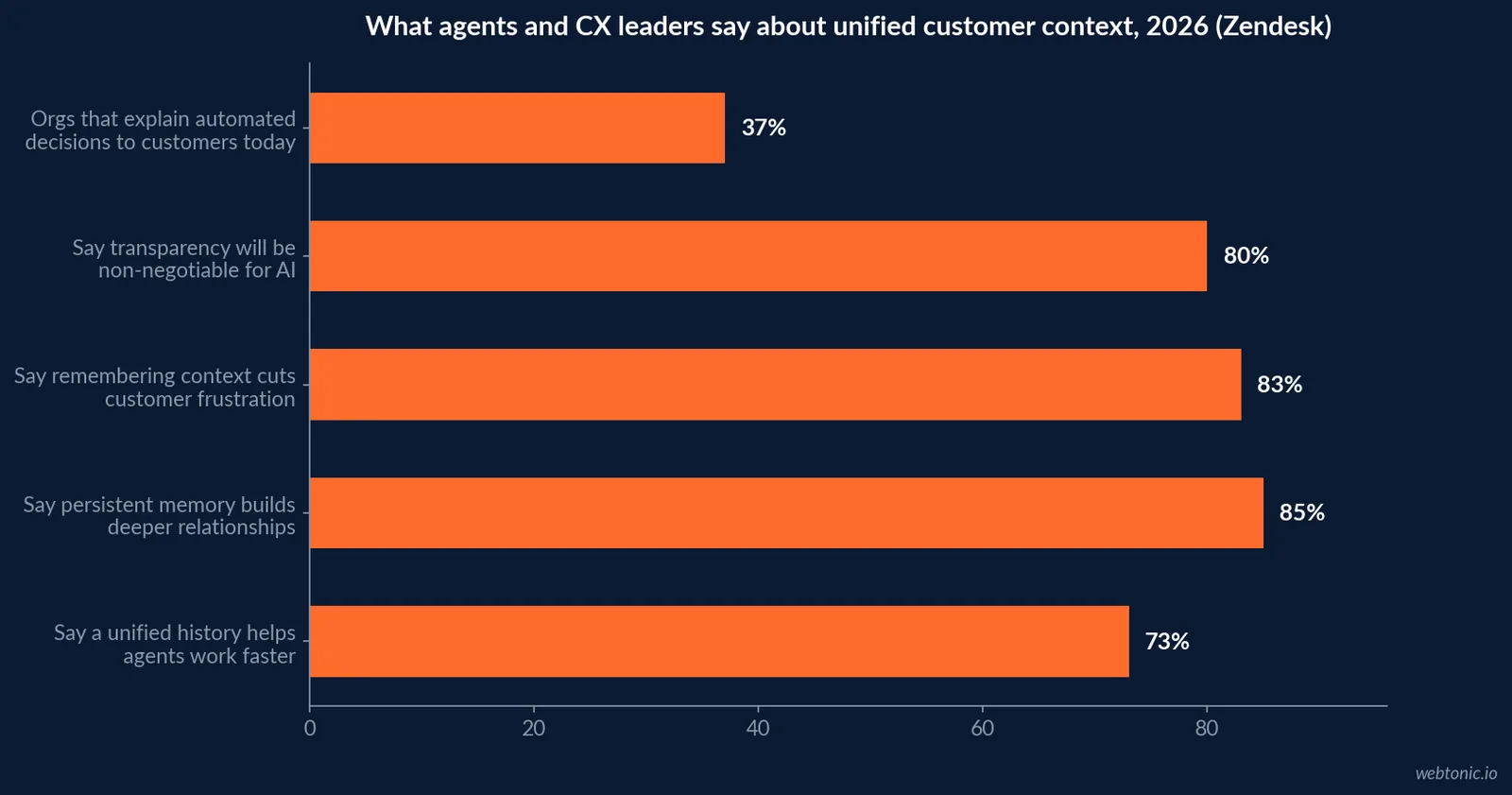
- 73% of support agents say a unified customer history helps them work faster.
- 83% say remembering context across channels cuts customer frustration.
- 85% say persistent memory builds deeper customer relationships.
- 76% of customers expect a social reply within 24 hours.
- 27% of consumers plan to use social media more for customer service this holiday season.
- Over 90% of Gen Z consumers will use social care the same or more than last year.
- TikTok is now the top channel consumers use to reach a brand for support, at 50%.
- Facebook (46%) and Instagram (44%) follow as support contact channels.
- 63% of social marketers say executives now rate social more important than in 2025.
- 27% of marketers cite attributing social activity to revenue as a top challenge.
- 94% of social media marketers already use AI in their workflow.
- 73% of consumers report having their personal information protected as a rising concern.
- Only 37% of CX organisations explain the reasoning behind an automated decision to customers.
The market can't agree on how big this even is
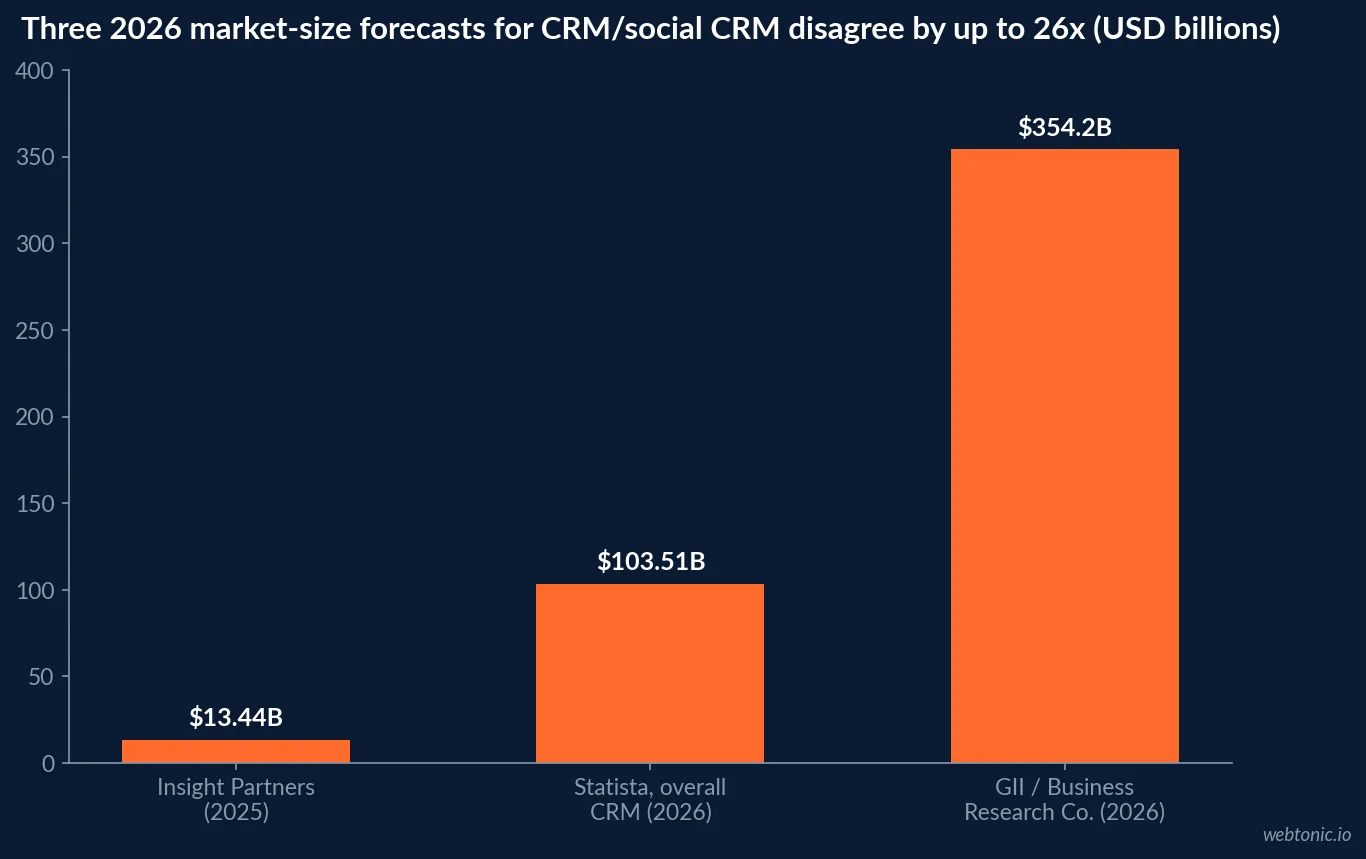
Before asking whether social CRM is "worth it," it's worth noticing that the category doesn't have a settled size. The Business Research Company, via GII Research, values social CRM at USD 354.2 billion in 2026, up from USD 230.61 billion in 2025, growing at a 53.6% compound rate, reaching USD 1,539.22 billion by 2030. The Insight Partners values the same category at just USD 13.44 billion in 2025, growing 17.58% a year to USD 49.09 billion by 2034, with a projected addressable market of USD 296.22 billion across 2026-2034.
Both are named research firms citing named methodologies, and both are pricing "social CRM." The gap comes from what each counts inside the category - social monitoring software alone versus the whole customer-engagement stack it touches. Buyers should read any single social CRM market-size headline as a definition choice, not a fact.
Social CRM market sizing at a glance
| Forecaster | 2025/2026 size | Growth rate | 2030/2034 projection |
|---|---|---|---|
| The Business Research Company (GII) | USD 354.2B (2026) | 53.6% CAGR | USD 1,539.22B by 2030 |
| The Insight Partners | USD 13.44B (2025) | 17.58% CAGR (2026-34) | USD 49.09B by 2034 |
| Insight Partners addressable market | n/a | n/a | USD 296.22B (2026-2034 TAM) |
What actually holds up: the agent-side evidence
Set the market-size noise aside and look at what Zendesk's 2026 CX Trends report measured directly from support agents and CX leaders, not vendors. 73% of agents say seeing a customer's full interaction history in one place helps them do their job better - fewer repetitive questions, faster resolution, no piecing together fragments across separate tools. 83% say remembering context across channels sharply reduces customer effort and frustration, and 85% say persistent memory lets brands build deeper, longer-lasting relationships. That's the actual case for social CRM: not the market-size number, but what happens when a rep stops switching tabs.
| Agent/CX-leader claim (Zendesk, 2026) | Share agreeing | What it means operationally |
|---|---|---|
| Unified interaction history helps agents work faster | 73% | Less time piecing together context |
| Remembering context across channels cuts frustration | 83% | Fewer repeated questions from customers |
| Persistent memory builds deeper relationships | 85% | Case for retention, not just efficiency |
| Transparency will be non-negotiable for customer AI | 80% | Sets the bar higher than most tools meet |
| Orgs currently explain automated decisions to customers | 37% | Most tools fall short of that bar today |
Where customers actually show up asking for help
Sprout Social's Q3 2026 Pulse Survey found consumers most likely to reach a brand for support via TikTok (50%), followed by Facebook (46%), Instagram (44%), X (28%) and WhatsApp (17%). Compared to the 2025 holiday season, 27% of consumers plan to use social media more for customer service questions and 59% plan to use it about the same amount - a combined 86% holding or increasing reliance on social support.
Generational appetite skews young: 44% of Gen Z plan to use social care more this year (versus 2025), against just 18% of Gen X and 12% of Boomers. Every generation surveyed leans toward "more or the same," which is the pattern that makes a unified social-to-CRM record worth the integration cost as volume grows.
| Channel consumers use to reach a brand for support (2026) | Share |
|---|---|
| TikTok | 50% |
| 46% | |
| 44% | |
| X (Twitter) | 28% |
| 17% |
| Generation | Plan to use social care more (vs. 2025) | Plan to use about the same |
|---|---|---|
| Gen Z | 44% | 49% |
| Millennial | 31% | 59% |
| Gen X | 18% | 65% |
| Baby Boomer | 12% | 63% |
Response-time expectations are the pressure that makes this urgent
Sprout Social's own published index puts the baseline customer expectation at 76% wanting a reply within 24 hours across social platforms. A team routing social messages into a separate tab from the CRM record is racing that clock with less context per reply, not more - the opposite of what a growing support queue needs. HubSpot's 2026 Social Trends survey of over 1,000 social marketing decision-makers backs up the pressure from the marketing side: 63% say executives now rate social more important than in 2025, but 27% still cite attributing social activity to revenue or leads as a top challenge - a measurement gap that a proper CRM connection is built to close.
| HubSpot 2026 Social Trends signal | Figure |
|---|---|
| Social marketing decision-makers surveyed | 1,000+ |
| Execs who rate social more important than in 2025 | 63% |
| Marketers who already use AI in their social workflow | 94% |
| Cite producing high-quality content as top challenge | 45% |
| Cite attributing social activity to revenue as a challenge | 27% |
| Believe social is more important than performance marketing for brand-building | 85% |
The trust layer a CRM integration has to clear
Salesforce's State of the Connected Customer research, surveying 15,015 consumers and 1,570 business buyers worldwide, found 71% of customers feel increasingly protective of their personal information, and only 42% trust businesses to use AI ethically with that data - down from 58% in 2023. At the same time, 73% of customers say companies now treat them like an individual rather than a number, up from 39% in 2023, which is precisely the personalization a unified social-CRM record is supposed to deliver. Any social CRM rollout inherits that trust deficit the moment it starts pulling social data into a customer profile, and has to be transparent about it or the personalization gain gets discounted by the privacy concern.
| Salesforce Connected Customer signal (2026) | Figure | 2023 comparison |
|---|---|---|
| Consumers + business buyers surveyed | 15,015 + 1,570 | Worldwide |
| Feel treated as an individual, not a number | 73% | Up from 39% |
| Feel increasingly protective of personal data | 71% | n/a |
| Trust businesses to use AI ethically | 42% | Down from 58% |
| Say it's important to know if they're talking to an AI agent | 72% | n/a |
A third market number, and why "social suites" is the term vendors actually use
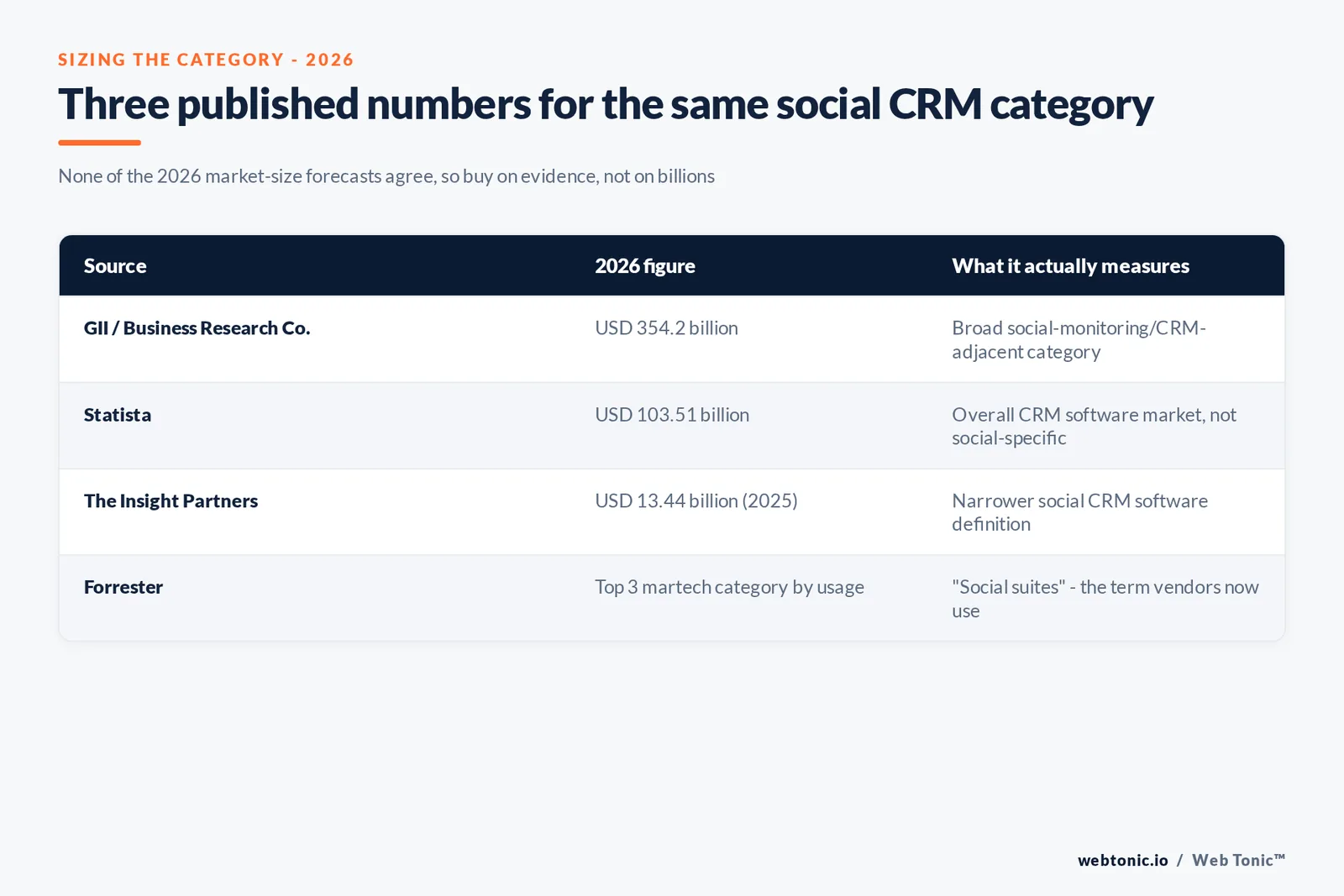
Add a third figure to the two that already disagree by 26x: Statista forecasts the broader CRM software market - the category social CRM sits inside, not a standalone slice - at USD 103.51 billion in 2026, growing at 6.16% a year to USD 139.56 billion by 2031. None of the three published numbers on this page agree with each other, which is a sign the vendors themselves don't sell "social CRM" as a labeled category anymore.
Forrester's January 2026 analysis confirms that shift in language: analysts now call the category "social suites," ranking it as one of the top three marketing technologies organizations use, and defining it as platforms that combine content publishing, consumer intelligence, creator marketing and customer response - CRM sync being one feature inside a bigger platform, not the product itself. Two of the top challenges Forrester's report flags for buyers: too many metrics to track, and inconsistent data quality across systems - the exact problem a real CRM connection is supposed to solve.
| Market-size figure (2026) | What it actually measures | Source |
|---|---|---|
| USD 354.2 billion | Broad social-monitoring/CRM-adjacent category | GII / Business Research Co. |
| USD 13.44 billion | Narrower social CRM software definition | The Insight Partners |
| USD 103.51 billion | Overall CRM software market (not social-specific) | Statista |
| Top 3 martech category by usage | "Social suites" - the term vendors now use | Forrester |
What good looks like before you buy
Given the label confusion, the buying decision should be anchored to the agent-side evidence, not a market-size claim from any single vendor. If a platform can show a rep the customer's social history alongside CRM records in one screen, cut repeat questions, and hold up against the transparency bar Zendesk's own leaders set for themselves (80% say it will be non-negotiable, 37% currently meet it), it's doing the job regardless of what market-research firm sized the category. Our growth marketing team treats that agent-side test as the real due diligence step before recommending any tool.
So is it worth it?
The honest answer scales with volume and channel mix, not with either market-size headline. Once a team is fielding meaningful support or sales volume across TikTok, Facebook, Instagram and X at once, the 73% agent-productivity and 83% frustration-reduction figures from Zendesk's research are the real return on the integration - not the disputed billions in the market reports. Below that volume, a shared social inbox without full CRM sync is the cheaper, adequate answer.
If you're weighing that build against buying it in, our data and analytics practice can model the actual support and revenue-attribution volume before you commit to a tool, and we're happy to walk through it.
Frequently Asked Questions
What exactly is a social CRM tool?
It's software that routes social media mentions, comments and direct messages into the same record a CRM keeps for email, phone and purchase history, so a support or sales rep sees one customer timeline instead of five disconnected inboxes. Sprout Social, HubSpot and Zendesk all sell a version of this, typically through a Salesforce, HubSpot or Zendesk integration rather than a standalone product.
Is the social CRM market actually growing that fast?
Two 2026 market reports disagree sharply on size, which is itself informative. GII Research/The Business Research Company puts the social CRM market at USD 354.2 billion in 2026 growing 53.6% a year, while The Insight Partners puts total social CRM at USD 13.44 billion in 2025 growing 17.58% a year through 2034. A 26x gap between two named forecasters on the same category means the market isn't standardized enough to buy on the growth number alone.
What's the actual evidence that unifying social with CRM helps?
Zendesk's 2026 CX Trends report, surveying agents and CX leaders, found 73% of agents say seeing a customer's full interaction history in one place helps them do their job better, and 83% say remembering context across channels sharply reduces customer effort and frustration. That's an agent productivity claim, not a vendor marketing claim, which is why it's the strongest evidence in this space.
How fast do customers expect a reply on social channels?
Sprout Social's own index found 76% of customers expect a reply within 24 hours across social platforms, and Sprout's Q3 2026 pulse survey found consumers reaching out primarily via TikTok (50%), Facebook (46%) and Instagram (44%). Gen Z is the most social-first generation for support: over 90% say they'll use social media the same amount or more for customer service this holiday season versus last year.
Is a social CRM integration worth it for a small or mid-size brand?
It's worth it once social volume is high enough that reps are already losing time piecing together context across separate tools - the same 73% productivity claim from Zendesk's agent survey applies regardless of company size. Below that volume threshold, a shared inbox tool without full CRM sync is usually the cheaper, adequate answer; the integration earns its cost when the customer record, not just the inbox, needs to be unified.
Sources
GII Research / The Business Research Company - Social CRM Global Market Report 2026
The Insight Partners - Social CRM Market Trends, Size & Growth by 2034
Zendesk - CX Trends 2026 Report
Sprout Social - Q3 2026 Pulse Survey Analysis
HubSpot - 2026 Social Trends Report
Salesforce - State of the AI Connected Customer
Statista - Customer Relationship Management Software Market Outlook
Forrester - Four Takeaways On The State Of Social Suites