



Table of contents
Single Keyword Ad Groups (SKAGs) are a Google Ads account structure where each ad group contains exactly one keyword, allowing you to write hyper-relevant ad copy that matches the search term precisely. SKAGs were the gold standard for granular campaign control, and while Google's push toward automation has changed the conversation, the underlying principles still deliver measurable results for the right accounts.
Key Takeaways
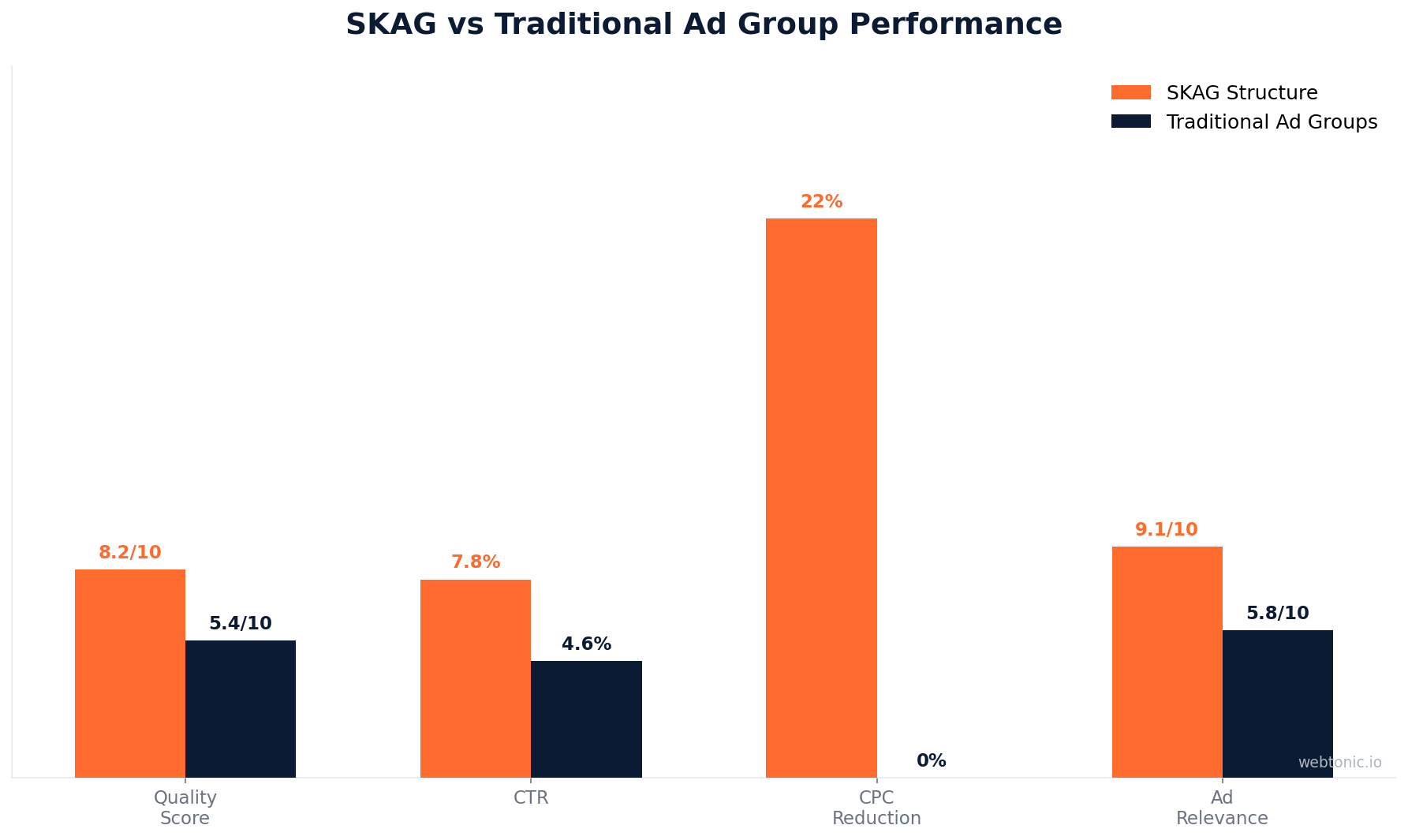
- SKAGs can improve click-through rates by 20–30 % and reduce cost per click by 15–25 % compared to traditional multi-keyword ad groups.
- Google now recommends consolidated account structures with broad match and Smart Bidding, claiming advertisers see 25 % more conversions at similar cost when pairing broad match with Target CPA.
- The hybrid approach — SKAGs for top 10–20 revenue-driving keywords and Single Theme Ad Groups (STAGs) for everything else — lets advertisers keep granular control where it matters most without drowning in management overhead.
- Quality Score still drives 50 % of your ad rank calculation, and SKAGs remain the most direct way to maximize the ad relevance and expected CTR components.
- L'Oréal reported a 2× higher conversion rate at 31 % lower cost per conversion after switching to AI Max for Search, illustrating how automation-first structures can outperform manual granularity at scale.
What Are Single Keyword Ad Groups?
A Single Keyword Ad Group is exactly what it sounds like — an ad group containing one keyword (historically in multiple match types: exact, phrase, and broad match modifier before its 2021 deprecation). Instead of grouping 10 or 20 related keywords into one ad group with generic ads, you create a dedicated ad group for each keyword with ad copy written specifically for that search term.
The core logic is simple: tighter keyword-to-ad alignment produces higher Quality Scores. When your ad headline mirrors exactly what the user searched, they are more likely to click. Higher CTR improves Quality Score, which lowers CPC and improves ad position — creating a compounding cycle of better performance at lower cost.
How SKAGs Improve Quality Score
Quality Score is the metric that determines both your cost per click and your ad position. It has three components, and SKAGs directly improve two of them:
| Quality Score Component | Weight | How SKAGs Help |
|---|---|---|
| Expected CTR | ~39 % | Ad copy that mirrors the exact search term gets more clicks. SKAGs let you write headlines using the keyword verbatim. |
| Ad Relevance | ~22 % | With one keyword per ad group, every ad is perfectly relevant to the triggering query — no mismatches between generic ads and specific searches. |
| Landing Page Experience | ~39 % | SKAGs make it easy to pair each keyword with a dedicated landing page, improving message match between ad and page content. |
The result is a virtuous cycle: better ad copy leads to more clicks, which improves Quality Score, which lowers CPC, which means you get more clicks for the same budget. Practitioners widely report that most SKAG keywords reach Quality Scores of 7–9+ within 2–4 weeks, compared to 4–6 in loosely themed ad groups.
How to Set Up SKAGs (Step by Step)
- Identify your highest-value keywords. Pull your search term report and sort by conversions or conversion value. Your top 10–20 keywords that drive the most revenue are SKAG candidates.
- Create one ad group per keyword. Name the ad group after the keyword for easy management (e.g., ad group "running shoes" contains only the keyword [running shoes]).
- Choose your match types. In 2025, use exact match as your primary match type for SKAGs. Phrase match can be added for discovery, but monitor the search term report closely for irrelevant matches.
- Write keyword-specific ad copy. Include the exact keyword in at least one headline. Write 3 responsive search ad headlines that incorporate the keyword and its close variants, plus 2–4 descriptions that speak to the searcher's intent.
- Set up dedicated landing pages. Each SKAG should point to a landing page that matches the keyword's intent. A searcher for "men's running shoes" should land on a men's running shoes page, not a generic footwear category.
- Add negative keywords. Cross-negative between SKAG ad groups to prevent keyword cannibalization. If you have ad groups for both "running shoes" and "best running shoes," add "best" as a negative in the "running shoes" ad group.
- Monitor and optimize. Track Quality Score, CTR, CPC, and conversion rate by ad group weekly for the first month. Expect improvements to materialize within 2–4 weeks as Google collects enough data.
SKAGs vs. STAGs vs. Broad Match: Which Structure Wins?
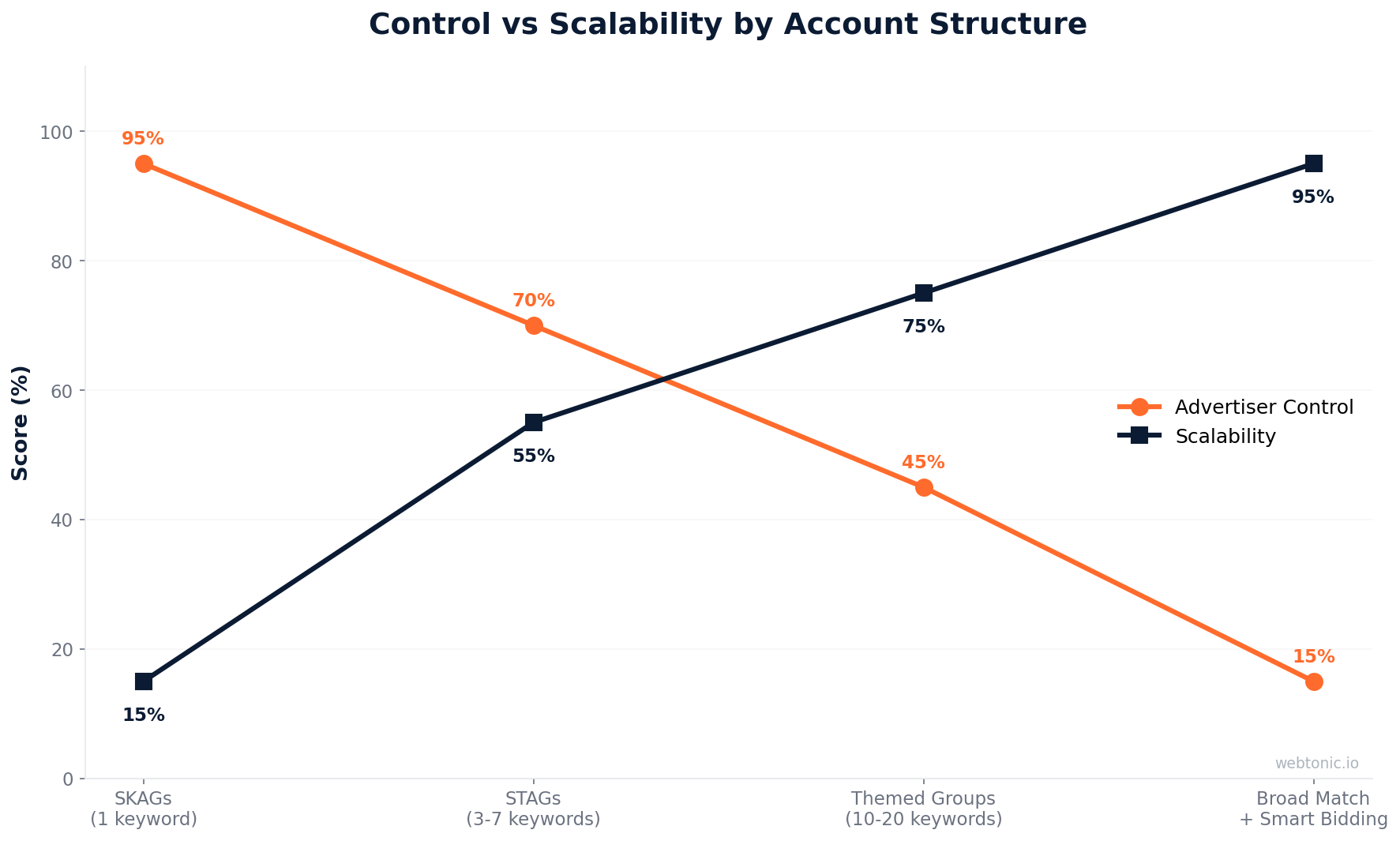
The debate over account structure in Google Ads has shifted dramatically since Google began pushing for consolidated campaigns with broad match and Smart Bidding. Here is how the three main approaches compare:
| Factor | SKAGs | STAGs | Broad Match + Smart Bidding |
|---|---|---|---|
| Keywords per Ad Group | 1 keyword | 3–7 themed keywords | 10–20+ keywords, broad match |
| Ad Relevance | Maximum — ads match keyword exactly | High — ads match keyword theme | Variable — relies on RSA permutations |
| Quality Score | Typically 7–9+ | Typically 6–8 | Typically 5–7 |
| Management Effort | Very high — every keyword needs unique ads | Moderate — grouped by intent/theme | Low — Google AI handles matching |
| Data Clarity | Perfect — 1:1 keyword-to-conversion data | Good — data clarity per theme | Low — conversions attributed to broad queries |
| Scalability | Poor above 50 keywords | Good for most account sizes | Excellent — works at any scale |
| Best For | High-value keywords, limited budgets | Most advertisers (balanced approach) | Large accounts with strong conversion data |
When SKAGs Still Make Sense in 2025
Despite Google's consolidation push, SKAGs remain the right choice in specific scenarios:
- Limited budgets. When you are spending under $5,000/month, you cannot afford to let Google's AI learn on your dime. SKAGs ensure every dollar goes to proven, high-intent keywords with ads written specifically for them.
- High-value keywords. If a single keyword drives $50,000+ in monthly revenue, it deserves its own ad group with custom copy, a dedicated landing page, and granular bid control.
- Low conversion volume. Smart Bidding requires 30–50 conversions per campaign per month to optimize effectively. Accounts below this threshold often see worse performance with automated bidding — SKAGs with manual CPC or Target CPA give you more control.
- Regulated industries. Healthcare, finance, and legal advertisers often need precise control over which ad copy appears for specific search terms. SKAGs prevent generic ads from triggering on sensitive queries.
- New accounts. Accounts without historical conversion data starve Smart Bidding of the signal it needs. SKAGs build a clean conversion baseline that you can later use to transition to automation.
The Case Against SKAGs
Honesty matters: SKAGs have real downsides that have become more significant as Google's AI capabilities have improved.
- Management overhead. An account with 200 keywords means 200 ad groups, each needing unique ad copy, negative keywords, and bid management. At scale, this is unsustainable without automation tools.
- Match type evolution. Google deprecated broad match modifier in 2021 and has expanded exact match to include close variants. The control SKAGs were designed to provide has been partially eroded by Google's match type changes.
- Smart Bidding performance. Google's machine learning genuinely outperforms manual bidding for accounts with sufficient conversion data. Consolidated structures give Smart Bidding more data per campaign, enabling better optimization.
- AI Max for Search. Google's newest automation layer combines broad match, creative optimization, and AI-powered targeting into a single solution. Early adopters report significant performance gains — but it requires surrendering the granular control SKAGs provide.
- Diminishing returns on ad relevance. Responsive Search Ads (RSAs) generate thousands of headline-description combinations automatically. Google's AI selects the most relevant combination for each query, partially replicating the ad relevance benefit SKAGs provide.
The Hybrid Approach: Best of Both Worlds
The smartest advertisers in 2025 are not choosing between SKAGs and automation — they are using both strategically:
- SKAG your top 10–20 revenue keywords. These are the keywords that drive the majority of your paid media revenue. They deserve custom ad copy, dedicated landing pages, and granular bid control.
- STAG everything else. Group remaining keywords by intent or theme into ad groups of 3–7 keywords. This keeps ads relevant without exploding your management workload.
- Run a broad match + Smart Bidding campaign for discovery. Use a separate campaign with broad match keywords and Target CPA to find new converting queries. Mine the search term report weekly and promote winners into your SKAG or STAG structure.
- Set clear budgets for each tier. Allocate the largest share to your proven SKAG keywords, then distribute remaining budget across STAGs and the discovery campaign.
SKAG Performance Metrics to Track
Once your SKAGs are running, monitor these metrics weekly to verify the structure is delivering value:
- Quality Score distribution — Most SKAG keywords should reach 7+ within 2–4 weeks. If they do not, review ad copy relevance and landing page alignment.
- CTR by ad group — Compare against industry benchmarks. SKAGs should consistently outperform your account average by 20–30 %.
- CPC trend — Should decrease over time as Quality Scores improve. If CPC is flat or rising, the ad relevance benefit is not materializing.
- Impression share — Higher Quality Scores earn more impressions for the same bid. Track lost impression share (rank) to identify opportunities.
- Conversion rate by keyword — The cleanest data benefit of SKAGs. You know exactly which keywords convert and at what cost, enabling precise ROAS optimization.


Related reading
- The AdWords Keyword Tool: How to Use Google Keyword Planner for Free
- Keyword Match Types in Google Ads: How Broad, Phrase and Exact Really Behave
- Dynamic Keyword Insertion: Setup, Best Practices & When to Use DKI
- Paid Search services at Web Tonic
FAQ
Are SKAGs still effective in 2025?
Yes, but selectively. SKAGs remain effective for high-value keywords, limited budgets, and accounts without enough conversion data for Smart Bidding. For large accounts with strong conversion history, consolidated structures with broad match and automated bidding often outperform SKAGs because Google's AI has sufficient data to optimize effectively.
How many keywords should a SKAG ad group contain?
By definition, a SKAG contains exactly one keyword. In 2025, that keyword should primarily be in exact match. You may add phrase match as a secondary match type for incremental discovery, but monitor the search term report closely and add negative keywords to maintain control.
What is the difference between SKAGs and STAGs?
SKAGs (Single Keyword Ad Groups) contain one keyword per ad group for maximum control. STAGs (Single Theme Ad Groups) contain 3–7 closely related keywords that share the same intent and can be served by the same ad copy. STAGs reduce management overhead while maintaining reasonable ad relevance — they are the most common middle ground in 2025.
Do SKAGs work with Smart Bidding?
They can, but the pairing is not ideal. Smart Bidding performs best with consolidated campaign structures that provide large data pools. Spreading conversions across hundreds of single-keyword ad groups fragments the signal Smart Bidding needs. If you use SKAGs with Smart Bidding, group them into a single campaign and use portfolio bid strategies to aggregate conversion data.
How do I transition from SKAGs to a consolidated structure?
Transition gradually. Start by consolidating your lowest-performing SKAGs into theme-based ad groups. Keep your top revenue-driving SKAGs intact. Switch the consolidated ad groups to broad match with Target CPA bidding and let them run for 4–6 weeks before evaluating. Only consolidate your top SKAGs once the automated structure proves it can match or exceed their performance.
Sources
Google — Account Structures for Search Growth with AI
Google Ads Help — Reaching the Right Customers on Search
WonderAds — Single Keyword Ad Groups: How to Maximize Performance
Benly.ai — SKAGs vs STAGs: Which Account Structure Wins?
DigitalChew — Are SKAGs Still Worth It in 2025?
CXL — Single Keyword Ad Groups Guide


