Table of contents
Someone in Atlanta decides they want tacos tonight. They don't call a friend, they open Google, type "best tacos near me," and pick from whichever three restaurants show up first. If yours isn't one of them, that hungry person, and the table they would have filled, goes to a competitor instead.
SEO for restaurants is the work of making sure your restaurant is one of those three names: a Google Business Profile that answers every question before the phone even rings, a menu that's actually online, and reviews that build trust before the first bite. This guide walks through exactly how to build that presence.
Key Takeaways
- 64 percent of diners check Google before deciding where to eat, and 88 percent of local searches lead to a visit within 24 hours, making search visibility one of the highest-leverage investments a restaurant can make.
- A fully optimized Google Business Profile generates an average of 1,260 monthly views for restaurants in mid-size markets, and far more in dense metro areas. (source added: Searchlab's 2026 Google Business Profile Statistics)
- Google Business Profile actions, calls, direction requests, and website visits, grew 41 percent year over year, meaning the payoff for a complete profile is bigger than it was even last year.
- 45 percent of consumers now use AI assistants to discover restaurants, and AI-generated answers now appear on more than 60 percent of "best [cuisine] in [city]" queries.
- Local pack rankings depend on the same signals across platforms: consistent name, address, and phone number (NAP), complete profiles, and active review management.
- Reviews influence rankings by volume as much as rating. One industry analysis found a restaurant with 400 reviews at 4.6 stars will often outrank one with 80 reviews at 4.9 stars.
What Is SEO for Restaurants?
SEO for restaurants is the practice of optimizing a restaurant's online presence so it appears in local search results and the map pack when people search for a place to eat nearby. It follows the same core principles as any local SEO effort, or search engine optimization more broadly: a complete Google Business Profile, consistent listings, and active reviews, but weighted heavily toward local and cuisine-specific searches, since almost nobody searches for a restaurant outside their own neighborhood when they're deciding where to eat tonight.
That local weighting matters because of how fast restaurant decisions actually happen. 64 percent of diners check Google before deciding where to eat, and 88 percent of local searches lead to a visit within 24 hours. A restaurant website or profile that's incomplete, outdated, or missing entirely from search engines loses that decision before the food even gets a chance to speak for itself. Google Ads can fill gaps immediately around a launch or slow season, but the value of a well-optimized profile keeps compounding for free long after any ad budget runs out.
How Diners Decide Where to Eat
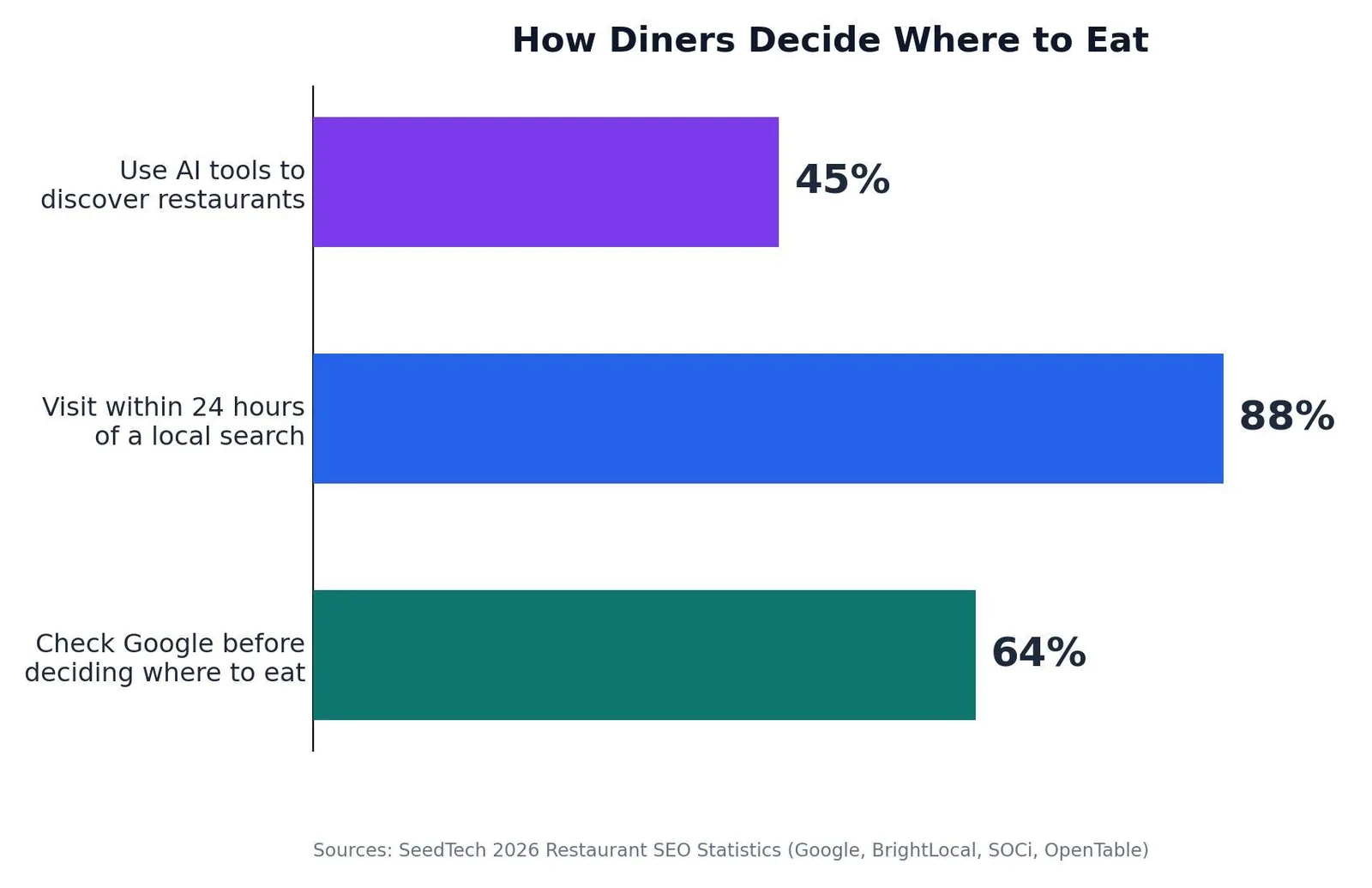
The numbers make the priority clear. According to SeedTech's 2026 Restaurant SEO Statistics, drawing on data from Google, BrightLocal, SOCi, and OpenTable, 64 percent of diners check Google search results or Google Maps before deciding where to eat, and 88 percent of consumers who do a local search on their phone visit or call a business within 24 hours. The same research found that 45 percent of consumers now use AI assistants at least occasionally to discover restaurants, and AI-generated answers appear on more than 60 percent of "best [cuisine] in [city]" queries, often above the traditional map pack.
That AI shift doesn't replace the fundamentals. It adds to them. AI tools like ChatGPT, Perplexity, and Gemini pull their restaurant recommendations from the same signals this guide already covers: Google Business Profile accuracy, structured schema markup, and review content.
Google Business Profile Actions Are Surging
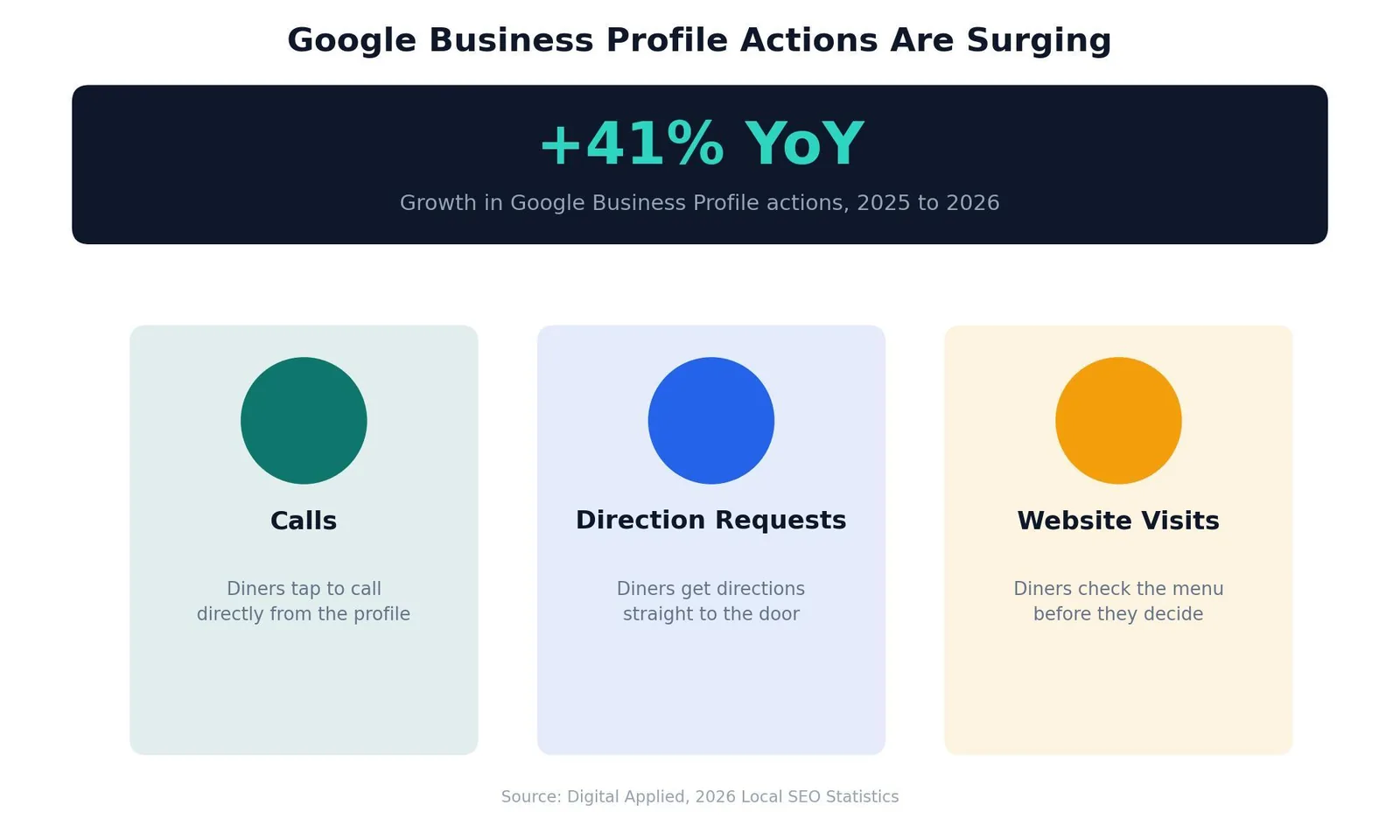
A complete profile matters more this year than last. According to Digital Applied's 2026 Local SEO Statistics, Google Business Profile actions, calls, direction requests, and website visits, increased 41 percent year over year. Google continues expanding Google Business Profile features, effectively turning it into a free storefront, and restaurants that keep their profile complete and current capture a disproportionate share of that growing action volume.
Optimized vs. Unoptimized: What Actually Changes
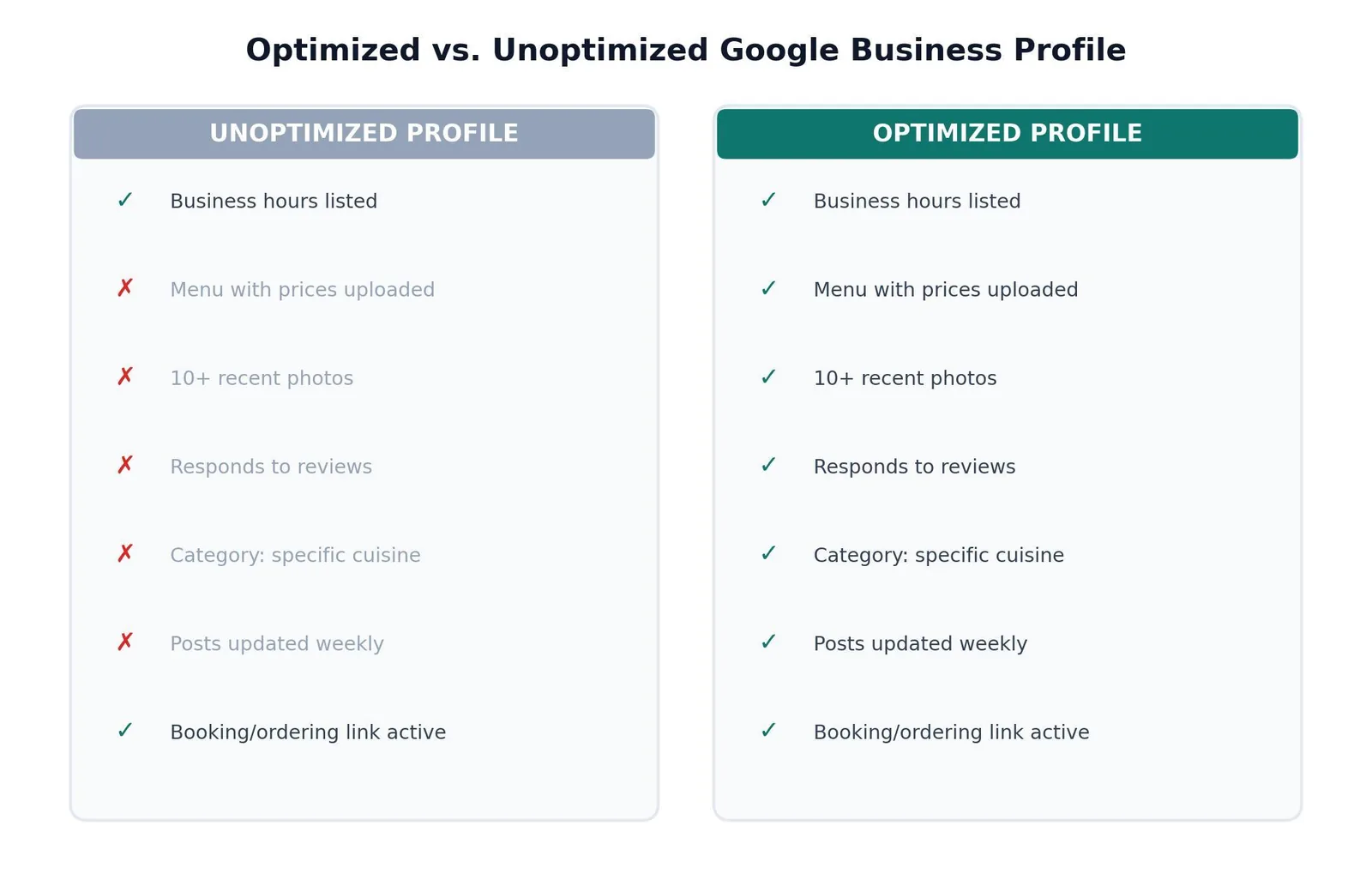
The gap between a profile that converts and one that doesn't usually comes down to a short list of details: accurate hours, an uploaded menu with prices, ten or more recent photos, active review responses, the correct cuisine category, weekly posts, and a working booking or ordering link. None of these individually take more than a few minutes. Left unchecked, they stack up into the difference between a profile that fills tables and one that quietly loses business to a better-maintained competitor down the street.
Restaurant Listing Platforms Compared
| Platform | Best For | Cost | Key Feature |
|---|---|---|---|
| Google Business Profile | Local map pack visibility, "near me" searches | Free | Direct integration with Google Search and Maps |
| Yelp | Review-driven discovery, casual dining | Free (paid ad options) | Large existing review base and user trust |
| TripAdvisor | Tourist and traveler discovery | Free (paid placement options) | Strong influence with out-of-town diners |
| OpenTable | Reservation management and discovery | Percentage per seated diner or subscription | Direct table booking integrated with discovery |
Most restaurants only need to actively manage two or three of these, prioritized by where their specific customer base actually searches. A destination restaurant leaning on tourism benefits more from TripAdvisor; a neighborhood spot depends more on Google Business Profile and Yelp.
The Diner Discovery Journey
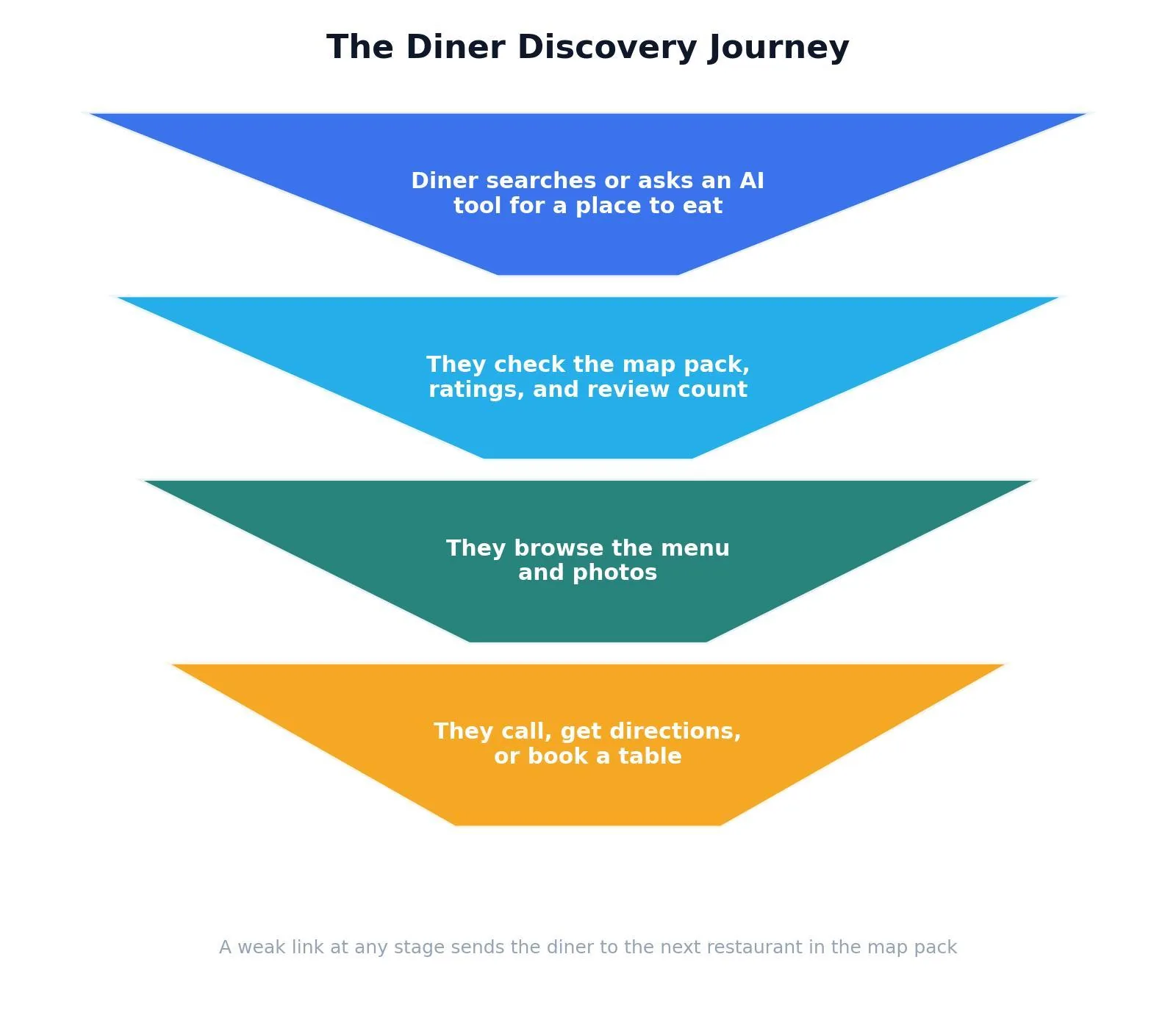
Most dining decisions follow the same sequence. A diner searches Google or asks an AI tool for a place to eat, checks the map pack along with ratings and review counts, browses the menu and photos, then calls, gets directions, or books a table. A weak link at any stage, missing hours, no photos, thin reviews, sends that diner to the next name in the map pack instead.
Restaurant SEO tool
Is your Google Business Profile ready?
Check off what's already true for your restaurant. Your score updates as you go.
0 of 5
Check off items above to see how ready your profile really is.
The Restaurant SEO Roadmap
Step 1: Claim and fully optimize your Google Business Profile
Verify the profile, correct the cuisine category, add accurate hours, and keep photos current. This single step helps search engines understand exactly what your restaurant offers and where.
Step 2: Add your menu with structured data
Upload a current menu with prices directly to your profile and website, and mark it up with structured data (schema) so search engines understand restaurant offerings well enough to surface rich results like dish photos and pricing directly in search. Google's own structured data documentation confirms this is exactly what Restaurant markup is designed to enable, feeding both the knowledge panel and the business carousels that appear for searches like "best NYC restaurants."
Step 3: Target local and cuisine-specific keywords
Broad terms like "restaurant" are unwinnable against directories and chains. Terms combining cuisine and location, like "best ramen downtown Chicago," reach diners and customers with local search intent and far less competition.
Step 4: Generate and respond to reviews consistently
Review volume matters as much as rating. A simple system, asking happy customers before they leave, responding to every review, positive or negative, compounds into stronger local pack rankings over time.
Step 5: Fix technical SEO and mobile friendliness
A restaurant website that's slow or hard to use on a phone loses diners before they see the menu. Since most local searches happen on mobile, a fast, mobile friendly site with clean photo alt text directly affects whether a visit turns into a call or a booking.
Step 6: Connect third-party delivery and reservation apps
Keep listings on third party delivery apps, OpenTable, and Google's own ordering links accurate and synced with your website. Inconsistent hours or menu items across platforms erode the trust signals that both diners and search engines rely on.
Step 7: Track performance in Search Console and social channels
Google Search Console shows which searches actually bring diners to the site. Pairing that with active social media posting on platforms like Facebook and Instagram, especially photo-heavy content, reinforces the same visual trust signals that convert a search into a reservation.
Common Restaurant SEO Mistakes to Avoid
The most common one is letting the Google Business Profile go stale. Diners can tell within seconds whether a profile is actively managed, and an outdated one costs bookings that a fresh one would have won for free.
A close second is skipping menu uploads or leaving prices off the profile, which pushes curious diners toward a competitor whose menu is one tap away instead of a phone call.
Inconsistent hours, addresses, or phone numbers across Google, Yelp, and delivery apps confuse both diners and the algorithms trying to validate the listing, and that inconsistency shows up as a trust penalty in rankings.
Ignoring reviews rounds out the list, whether that means never asking for them or responding to none of them. Either way, it hands control of the restaurant's reputation to whoever posts next, without any counterbalance from the business itself.
Frequently Asked Questions
How is SEO for restaurants different from general local SEO?
The mechanics overlap heavily with any local SEO restaurants effort needs: Google Business Profile, consistent listings, and reviews. What's different is the weight of visual and menu content, and the review-volume dynamic. One local SEO guide for restaurants notes that a restaurant with 400 reviews at 4.6 stars will often outrank one with only 80 reviews at 4.9 stars, meaning volume can matter as much as rating.
Do online ordering and delivery apps help or hurt restaurant SEO?
Both, depending on execution. Online ordering and third party delivery apps extend reach, but inconsistent menu items, prices, or hours between the app and the restaurant's own profile create the same trust problems as inconsistent NAP data anywhere else.
How much should a restaurant budget for local SEO?
It depends on market competition and whether the work is handled in-house or outsourced, so there's no single number to quote here. Get a quote specific to your restaurant and city before committing budget, and treat any figure in USD as a starting point for negotiation.
Does social media affect restaurant SEO rankings?
Not directly as a ranking factor, but it functions as a major discovery channel that feeds the same trust signals search engines reward. Photo-heavy platforms in particular help diners evaluate a restaurant before they ever reach the Google Business Profile.
The Bottom Line on SEO for Restaurants
Diners decide where to eat faster than almost any other purchase, which means a restaurant's search presence has to be ready the moment someone gets hungry. A complete Google Business Profile, an accurate menu, active reviews, and consistent listings across platforms turn that moment into a booked table instead of a missed opportunity.
Start with your Google Business Profile this week. It's free, it takes under an hour to bring current, and it's the single highest-leverage item on this entire list.
Ready to Fill More Tables and Book More Catering?
Web Tonic already runs a dedicated SEO and ads program for restaurants and caterers, built specifically around local keyword targeting for both dine-in customers and catering clients, menu-focused content, and Google Maps optimization across Google, Facebook, and Instagram. This is the kind of work that pays off best with a dedicated team behind it, which is exactly what this program provides.
More from Web Tonic: growth marketing services, data & analytics.
Sources: searchlab.nl · digitallytop.com · seedtechllc.com · digitalapplied.com · developers.google.com