Table of contents

No study publishes an organic-specific cost per lead or click-through rate for dermatology or plastic surgery. What exists instead is a position-based organic CTR curve that applies to any specialty, a 2026 paid-search benchmark that prices exactly what SEO has to displace, and consumer research on why reviews and search visibility matter more in this category than in most others. Put together honestly, they show what "ranking" is actually worth here.
Key Takeaways
- Organic position 1 captures roughly 39.8% average click-through rate on Google US results; position 2 falls to 18.7%; position 3 to 10.2%.
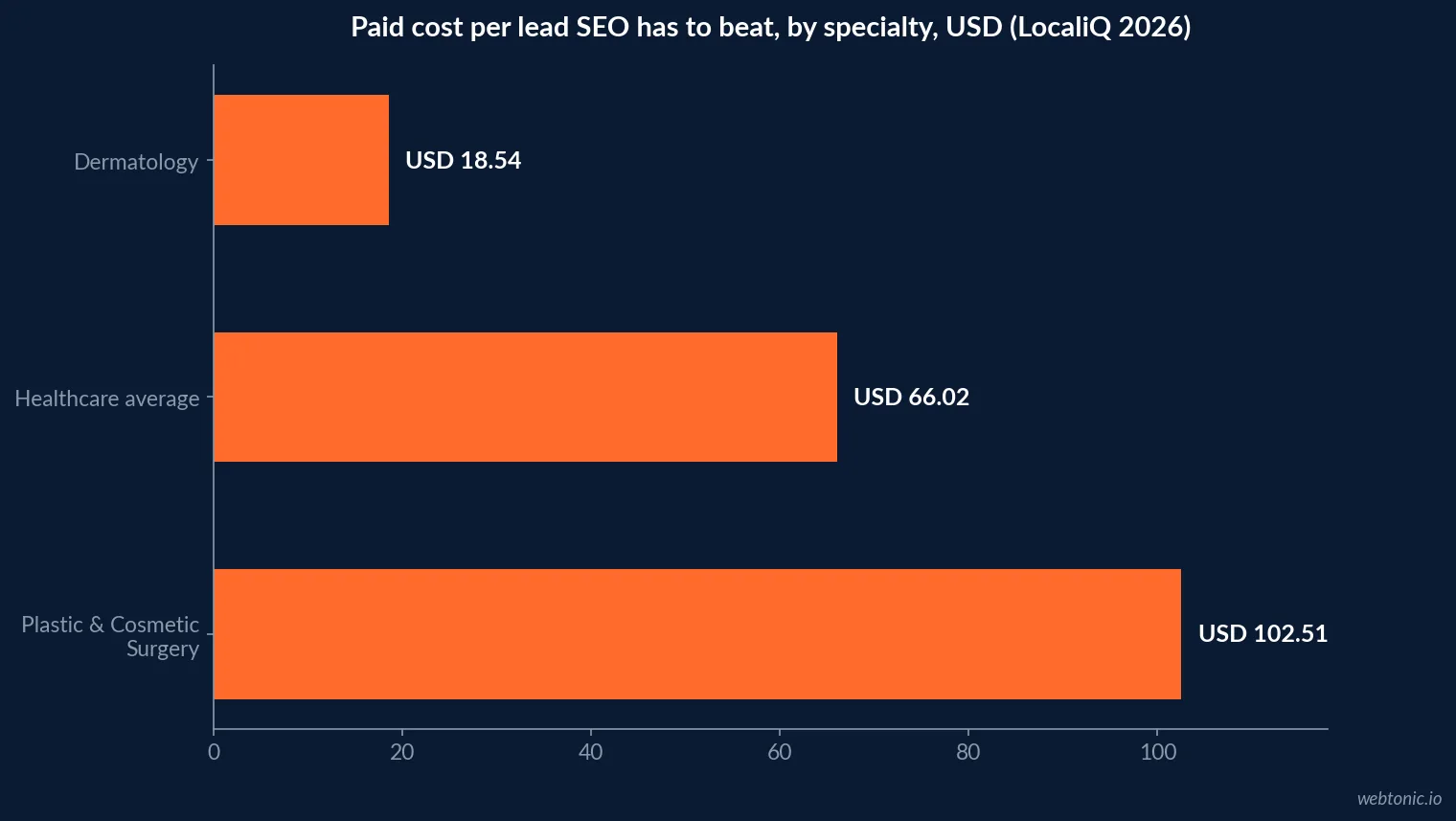
- Dermatology's average paid cost per lead is USD 18.54, the lowest of 16 healthcare subcategories LocaliQ tracks.
- Plastic & Cosmetic Surgery's average paid cost per lead is USD 102.51, the third-highest of those 16 subcategories.
- Dermatology converts paid clicks at 25.33%, the highest conversion rate of any healthcare subcategory tracked.
- Plastic & Cosmetic Surgery converts paid clicks at 8.52%, close to the healthcare average of 8.09%.
- 94% of consumers use rating and review sites to choose a cosmetic provider, per the ASDS's 2025 Consumer Survey.
- Nearly half of consumers say a provider's social media presence affects whether they book, per the same survey.
- Consumer trust in reviews "as much as a personal recommendation" fell to 42% in 2025, down from 79% in 2020, per BrightLocal.
- Cosmetic surgical procedure volume rose 7% year over year in 2025, per the ASPS Procedural Statistics Report.
- Neuromodulators and hyaluronic fillers made up 80% of all minimally invasive plastic surgery procedures in 2025.
- 70% of consumers say they are considering a cosmetic procedure, per the ASDS's 2025 survey.
- Dermatology's paid CTR fell 28% year over year, the steepest decline of the 16 healthcare subcategories LocaliQ tracks.
- Dermatology's paid CVR rose 54% year over year, the largest CVR gain of those subcategories.
What organic CTR looks like once you leave the ad block
Nobody publishes dermatology- or plastic-surgery-specific organic click-through data, so the honest starting point is the general position curve. Advanced Web Ranking's Q4 2025 CTR study, tracking millions of Google US SERPs monthly since 2015, reports organic position 1 at roughly 39.8% average CTR, position 2 at 18.7% and position 3 at 10.2%, with a steep drop after the top three and further compression where an AI Overview displaces organic results. That curve is specialty-agnostic, but it sets the ceiling: a dermatology or med-spa page that ranks 4th to 6th is competing for a small remainder of clicks regardless of how well the content converts once clicked.
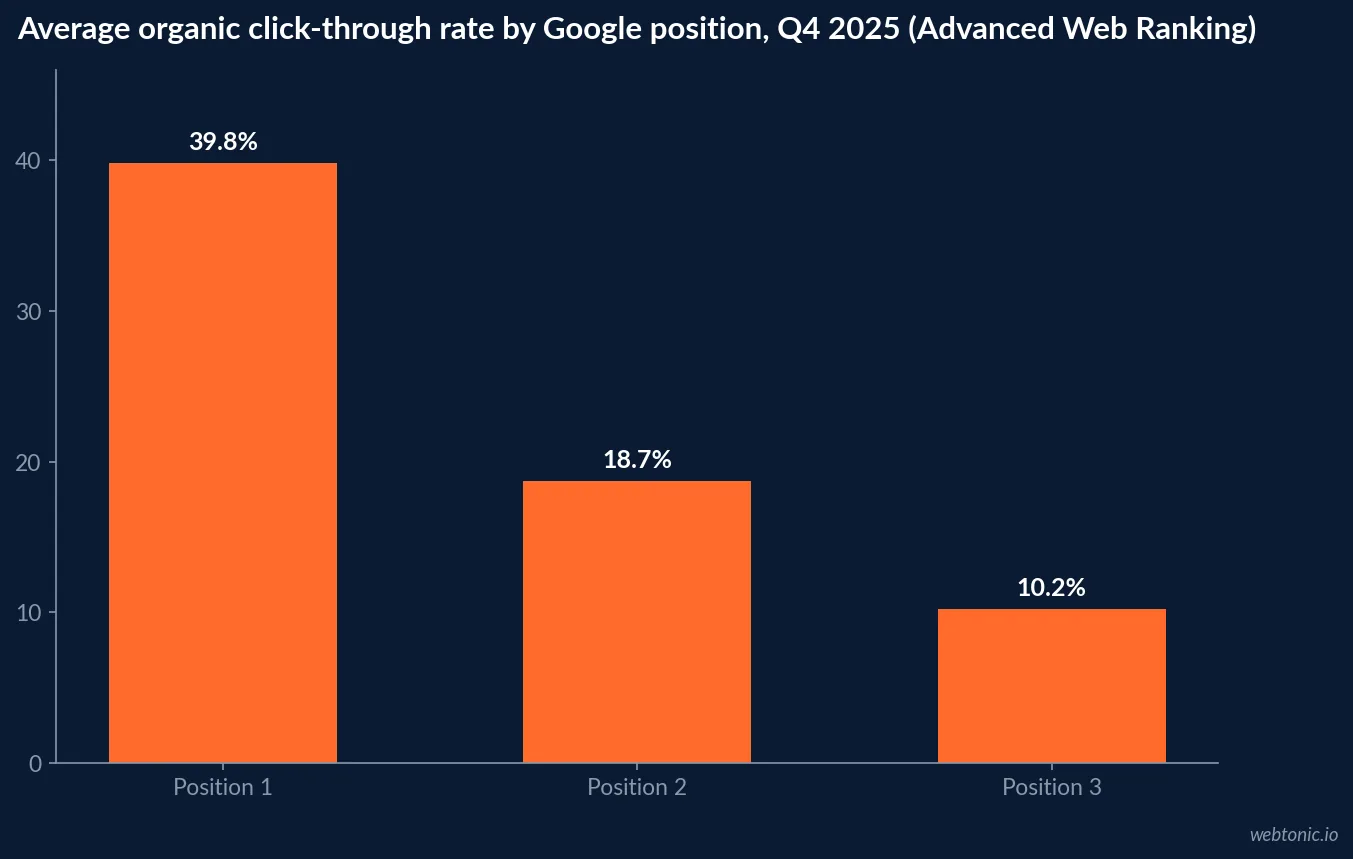
| Google organic position | Average CTR (Q4 2025) | Source |
|---|---|---|
| Position 1 | ~39.8% | Advanced Web Ranking |
| Position 2 | ~18.7% | Advanced Web Ranking |
| Position 3 | ~10.2% | Advanced Web Ranking |
| Positions 4-10 | Sharp additional drop-off | Advanced Web Ranking |
What SEO is actually displacing: the 2026 paid CPL baseline
There is no organic-specific CPL for either specialty, so the closest honest comparison is what paid search currently charges for the same intent. LocaliQ's 2026 healthcare search benchmarks, built from 3,542 US campaigns running October 2024 through September 2025, put dermatology at the lowest cost per lead of the 16 healthcare subcategories tracked - USD 18.54 - against plastic & cosmetic surgery at USD 102.51, the third-highest. Dermatology also posts the highest conversion rate in the set, 25.33%, while plastic and cosmetic surgery converts at 8.52%, near the healthcare-wide average of 8.09%. Every organic ranking earned instead of bought skips that per-click cost entirely - a bigger practical win for a category paying USD 102.51 a lead than one already paying USD 18.54.
| Metric (paid search, 2025-26) | Dermatology | Plastic & Cosmetic Surgery | Healthcare average |
|---|---|---|---|
| Click-through rate | 5.91% | 5.81% | 6.07% |
| Cost per click | USD 4.90 | USD 5.75 | USD 5.64 |
| Conversion rate | 25.33% | 8.52% | 8.09% |
| Cost per lead | USD 18.54 | USD 102.51 | USD 66.02 |
| CTR, year over year | -28% | n/a published | n/a published |
The trust signals that decide who gets the click
Rankings alone do not convert; the review layer sitting underneath a listing does a lot of the work. The American Society for Dermatologic Surgery's 2025 Consumer Survey on Cosmetic Dermatologic Procedures, drawing over 3,500 US consumer responses, found that 94% use rating and review websites to choose a provider and that dermatologists have ranked as the top influencer on cosmetic-procedure and skincare decisions every year since 2018. Nearly half of respondents said a provider's social media presence affects whether they book an appointment. But that reliance on reviews now comes with real skepticism: BrightLocal's 2025 Local Consumer Review Survey found that consumer trust in online reviews "as much as a personal recommendation" has fallen to 42%, down from 79% in 2020 - a signal that thin or generic reviews carry less weight in a ranking or booking decision than they did five years ago, even as review sites remain the default research tool.
A smaller peer-reviewed study adds a caution worth carrying into any local SEO plan: a cross-sectional survey of 365 dermatology-clinic patients published on PubMed Central found that a friend's or family member's recommendation still outranked social media as the top way patients chose a dermatologist, even though Instagram followers specifically skewed toward cosmetic-purpose visits. It is a single-clinic, non-US sample, so treat it as a caution against over-indexing on follower counts, not a benchmark to hit.
| Consumer-trust signal | 2025 figure | Prior comparison | Source |
|---|---|---|---|
| Use rating/review sites to choose a cosmetic provider | 94% | n/a published | ASDS 2025 Consumer Survey |
| Social media presence affects booking decision | ~50% | n/a published | ASDS 2025 Consumer Survey |
| Considering a cosmetic procedure | 70% | n/a published | ASDS 2025 Consumer Survey |
| Trust reviews as much as a personal recommendation | 42% | 79% in 2020 | BrightLocal 2025 Survey |
Why the demand curve behind these rankings keeps rising
Rising procedure volume is the leading indicator behind rising search demand, even without a keyword-level study to draw a direct line. The American Society of Plastic Surgeons' 2025 Procedural Statistics Report recorded 7% year-over-year growth in cosmetic surgical procedure volume, with lift and volume-restoration procedures posting the largest single-category gains - facial fat grafting up 39%, forehead/brow lifts up 29% - and neuromodulators and hyaluronic fillers accounting for 80% of all minimally invasive procedures. Patients aged 66 and older recorded the largest single-group increase in procedure volume, up 24%. A page-one ranking for a lift or filler procedure in 2026 is competing for a genuinely larger and still-growing search pool than it was two years ago, which is itself an argument for treating content freshness on those pages as a ranking input, not a formality.
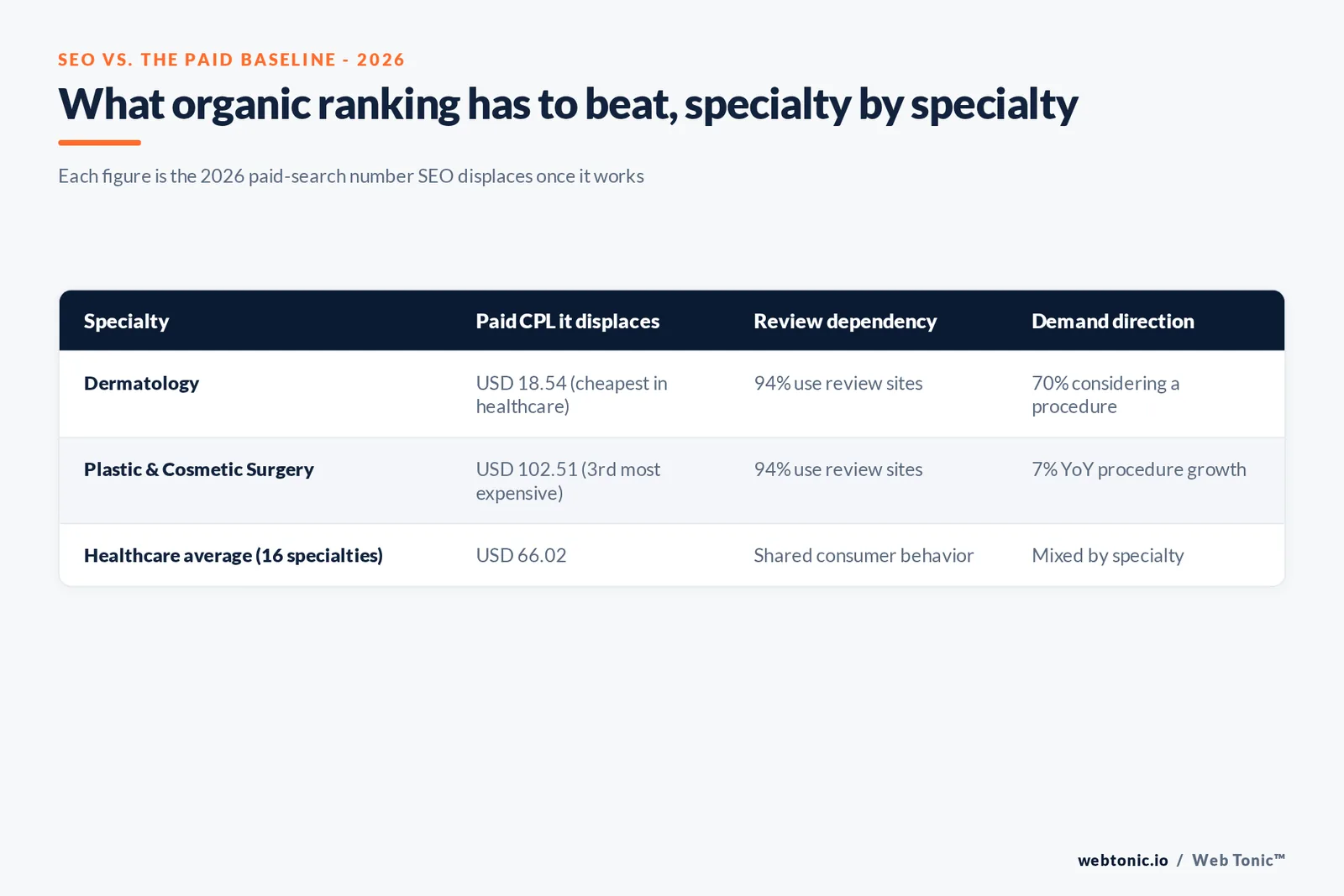
| What SEO has to prove per specialty | Dermatology | Plastic & Cosmetic Surgery |
|---|---|---|
| Paid CPL it is competing against | USD 18.54 (cheapest in healthcare) | USD 102.51 (3rd most expensive) |
| Review dependency for the booking decision | 94% use review sites | 94% use review sites (shared survey) |
| Category demand direction | 70% considering a procedure | 7% YoY procedure volume growth |
| Where content should concentrate | High-volume, lower-cost procedures (fillers, acne) | High-consideration surgical procedures (lifts, augmentation) |
Why these pages get a stricter grade than most
Dermatology and plastic surgery content does not get evaluated by the same standard as a general blog post. Google's own Search Quality Rater Guidelines state that for informational pages and pages on Your-Money-or-Your-Life (YMYL) topics - a category that explicitly includes health - "accuracy and consistency with well established expert consensus is important," and that raters weigh the effort, expertise and originality behind the Main Content more heavily than they would elsewhere. Practically, that means a dermatology page citing the ASPS or ASDS figures above by name, with a reviewing clinician credited, is doing exactly what the guidelines describe - and a thin, uncredited "top 10 fillers" page is the kind of content those guidelines are built to catch. The FTC's Health Products Compliance Guidance sets a parallel bar for any outcome or efficacy claim a ranking page makes, independent of how Google scores it - a page can satisfy E-E-A-T and still carry a claim the FTC would consider unsubstantiated, so content review needs both checks, not one.
| YMYL content signal | What the guidelines say | Applies to |
|---|---|---|
| Accuracy vs. expert consensus | Weighed more heavily than on non-YMYL pages | Any page describing a procedure, risk or result |
| Effort and originality of Main Content | Directly assessed by human raters | Blog and service pages alike |
| Named source citation (e.g. ASPS, ASDS) | Supports the expertise/trust component of E-E-A-T | Statistic and benchmark claims |
What this means for an SEO roadmap
The organic opportunity is not identical across the two specialties. Dermatology SEO is displacing an already-cheap paid channel, so the win is largely about volume and reducing dependence on a paid budget; plastic surgery SEO is displacing a genuinely expensive channel, so a handful of page-one rankings on the highest-intent procedure terms can carry outsized ROI. Both roadmaps depend on the same review-trust foundation the ASDS and BrightLocal data describe. Our growth marketing team builds that kind of specialty-specific roadmap; see our related data on cost per lead by industry and conversion rate benchmarks, or talk to us about where your own rankings sit against this curve.
Frequently Asked Questions
What counts as a good organic CTR for a dermatology or plastic surgery page?
No study measures organic CTR for these two specialties by name, so the honest benchmark is the general position-based curve. Advanced Web Ranking's Q4 2025 study of Google US results puts average organic CTR at roughly 39.8% for position 1, 18.7% for position 2 and 10.2% for position 3, falling sharply after that. A dermatology or aesthetics page ranking on page two of Google is, by that curve, capturing a small fraction of the click volume a page-one, top-three ranking would.
How does SEO's real cost per lead compare to paid search for these specialties?
There is no published organic-specific CPL for dermatology or plastic surgery, so the honest comparison is against what paid search is currently paying to buy the same intent. LocaliQ's 2026 healthcare benchmarks put dermatology's average paid cost per lead at USD 18.54 - the lowest of 16 healthcare subcategories - and plastic and cosmetic surgery at USD 102.51, the third-highest. A ranking earned through content and links has no per-click cost, which is exactly why that spread matters: dermatology SEO displaces a cheap paid channel, plastic surgery SEO displaces an expensive one.
Do online reviews actually affect rankings and clicks for these practices?
The consumer-trust data says reviews still drive the decision, even as blind trust in them has fallen. The ASDS's 2025 Consumer Survey on Cosmetic Dermatologic Procedures found 94% of respondents use rating and review websites to choose a provider, and nearly half said a provider's social media presence affects whether they book. BrightLocal's 2025 Local Consumer Review Survey found consumer trust in reviews as much as a personal recommendation has fallen to 42%, down from 79% in 2020 - people are still reading reviews closely, just more skeptically, which raises the bar for review substance over review volume.
Is search demand for dermatology and plastic surgery procedures actually growing?
Yes, on the clearest available measure. The American Society of Plastic Surgeons' 2025 Procedural Statistics Report recorded 7% year-over-year growth in cosmetic surgical procedure volume, with neuromodulators and hyaluronic fillers accounting for 80% of all minimally invasive procedures. The ASDS's 2025 consumer survey found 70% of respondents were considering a cosmetic procedure. Rising procedure volume is a leading indicator of rising search volume, even without a keyword-level study to confirm the exact correlation.
Which specialty converts better once someone lands on the site, dermatology or plastic surgery?
On the only figure available - LocaliQ's paid-search conversion data, not an organic-specific number - dermatology converts at 25.33%, the highest of 16 healthcare subcategories, against 8.52% for plastic and cosmetic surgery. That gap likely reflects dermatology's mix of lower-commitment, often insurance-adjacent visits against plastic surgery's higher-consideration surgical consultations, but no published study isolates the reason - treat the comparison as directional, not causal.
Sources
Advanced Web Ranking - Google CTR Study, Q4 2025
LocaliQ - Healthcare Search Ads Benchmarks
American Society for Dermatologic Surgery - 2025 Consumer Survey on Cosmetic Dermatologic Procedures
BrightLocal - Local Consumer Review Survey 2025
American Society of Plastic Surgeons - 2025 Procedural Statistics Report
Google - Search Quality Rater Guidelines
PubMed Central - The Influence of Modern Social Media on Dermatologist Selection by Patients
Federal Trade Commission - Health Products Compliance Guidance