Table of contents

Dermatology and plastic surgery run on two different local-trust economies. Dermatology is a recurring, near-home visit; American Society of Plastic Surgeons 2025 data shows plastic surgery volume concentrated in a handful of regions, which means patients already travel further for it. Review trust has fallen industry-wide, yet 94% of cosmetic-procedure researchers still use rating sites - the two facts sit next to each other without contradicting.
Key Takeaways
- 42% of consumers trust reviews as much as a personal recommendation in 2025, per BrightLocal.
- That figure was 79% in 2020 and peaked at 84% in 2016-2017.
- 94% of cosmetic-procedure consumers use rating and review sites before booking, per ASDS.
- South Atlantic and Western regions logged 1,093,973 cosmetic surgical procedures in 2025.
- That is 69% of the 1,585,878 total procedures ASPS counted nationally.
- The Northeast region logged just 84,124 procedures, down 1% year over year.
- The Midwest grew 8% to 113,843 procedures.
- Online search (38%) already outpaced provider referrals (30.6%) in Doctor.com's survey.
- Referral dependence fell 44% from the two years prior in that same report.
- Dermatologists are the named top influencer in 12 of 15 ASDS-tracked categories.
- Texas requires documented patient consent before any advertising use of a photo.
- California requires comparable lighting and a disclosure on before-and-after images.
- Facial plastic surgery volume is projected up 19% for 2025, per AAFPRS.
- Breast augmentation rose 18% in the Midwest region alone in 2025 versus 2024.
- South Atlantic breast augmentation volume rose 16% year over year.
Two specialties, two different local footprints
A dermatology practice mostly serves the people who can drive to it - skin checks, acne management and maintenance visits are recurring and local by nature. Plastic surgery behaves differently. The American Society of Plastic Surgeons' 2025 Plastic Surgery Statistics Report breaks procedure counts into five multi-state regions, and the concentration is stark: the South Atlantic region (DC, DE, FL, GA, MD, NC, SC, VA, WV) alone logged 548,025 procedures and the Western region (the Mountain and Pacific states) logged 545,948 - together 69% of the national 1,585,878 total. The Northeast, by contrast, logged just 84,124, down 1% year over year.
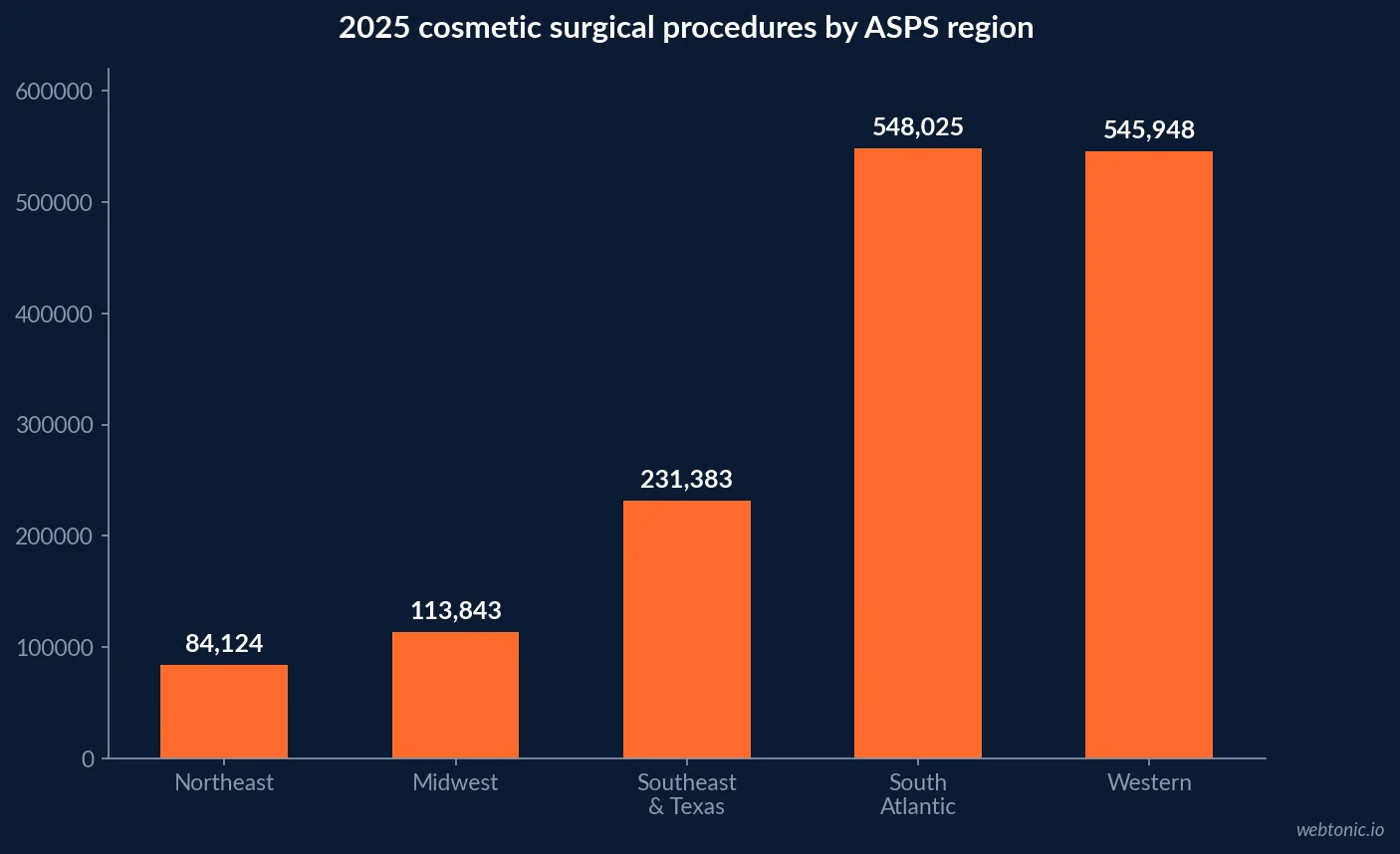
| Region (ASPS 2025) | States covered | 2025 procedures | Change vs 2024 |
|---|---|---|---|
| South Atlantic | DC, DE, FL, GA, MD, NC, SC, VA, WV | 548,025 | +8% |
| Western | AZ, CO, ID, MT, NM, NV, UT, WY, AK, CA, HI, OR, WA | 545,948 | +7% |
| Southeast and Texas | AL, KY, MS, TN, AR, LA, OK, TX | 231,383 | +7% |
| Midwest | IL, IN, MI, OH, WI, IA, KS, MN, MO, ND, NE, SD | 113,843 | +8% |
| Northeast | CT, ME, MA, NH, RI, VT, NJ, NY, PA | 84,124 | -1% |
A dermatology location page written for a single ZIP code radius is the right shape for the specialty. A plastic surgery location page written the same way is undersized for a market where more than two-thirds of national demand sits in two of five regions, meaning patients in high-volume regions are plausibly already comparing providers across a wider radius than one neighborhood.
Review trust has fallen - but not for this category
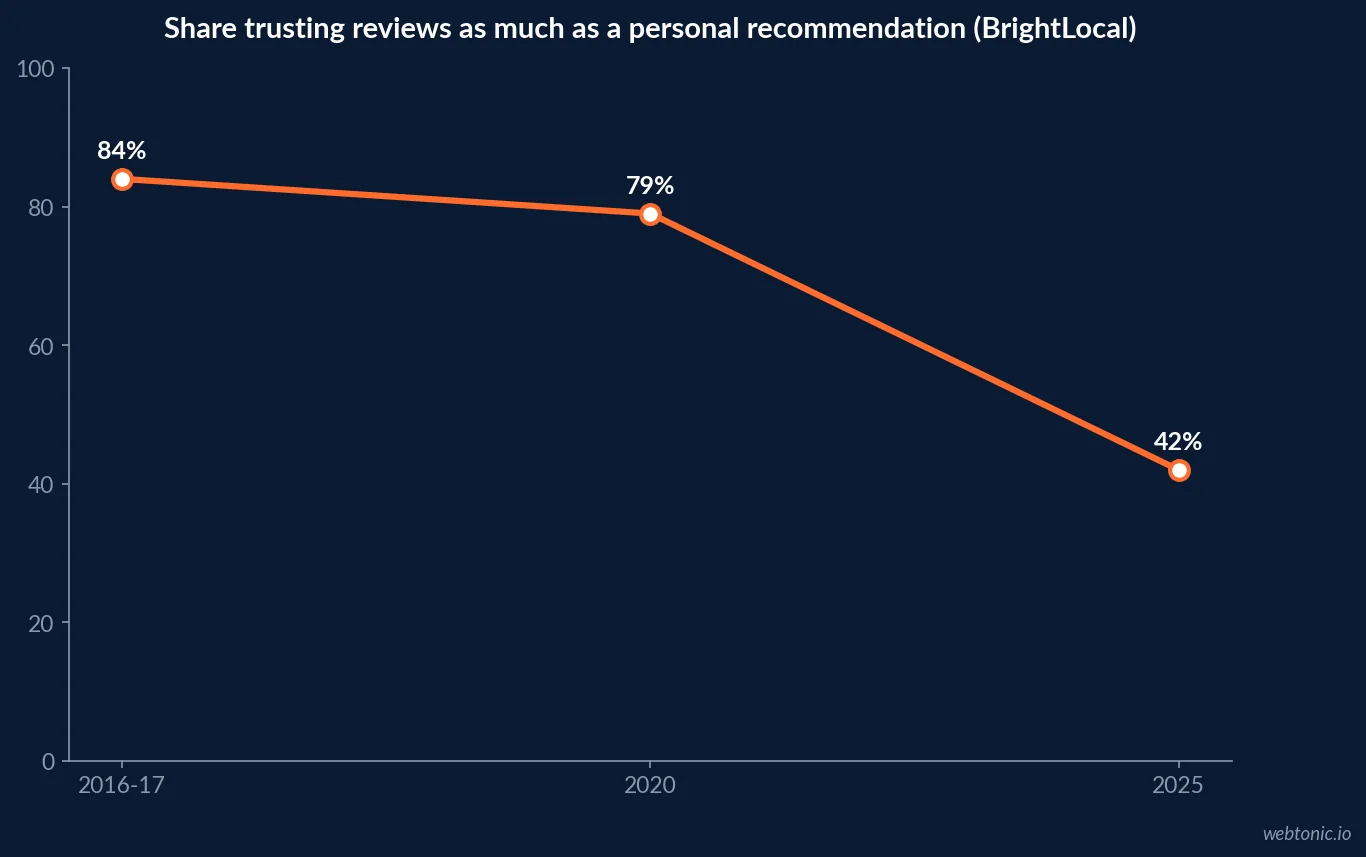
BrightLocal's Local Consumer Review Survey found that 42% of consumers trusted online reviews as much as a personal recommendation in 2025, continuing a slide from 79% in 2020 and an 84% peak in 2016-2017, per BrightLocal's own historical trends research. Read alone, that looks like reviews matter less than they used to for local SEO generally.
It doesn't hold for cosmetic procedures specifically. The 2025 ASDS Consumer Survey on Cosmetic Dermatologic Procedures found 94% of consumers use rating and review sites before a cosmetic procedure decision - a category-specific figure well above the general trust erosion BrightLocal is tracking. The honest read: general review skepticism is up, but for an elective medical decision with real physical risk, checking reviews remains close to universal.
| Trust signal | Figure | Year | Source |
|---|---|---|---|
| Trust reviews as much as personal recommendation (all categories) | 42% | 2025 | BrightLocal |
| Same figure, five years earlier | 79% | 2020 | BrightLocal |
| Same figure at its historical peak | 84% | 2016-2017 | BrightLocal |
| Use rating/review sites before a cosmetic procedure | 94% | 2025 | ASDS |
| Name dermatologists as top influencer for the decision | 12 of 15 categories | 2025 | ASDS |
Search overtook the referral, and the data is older than it should be
The most detailed comparison of search versus word-of-mouth for choosing a provider is Doctor.com's Customer Experience Trends in Healthcare report, based on a survey of more than 1,600 U.S. adults: patients relied on online search (38%) more than provider referrals (30.6%), with dependence on referrals down 44% from two years earlier. That report is dated 2020 - there is no fresher primary study with the same specificity - so treat the exact numbers as a historical snapshot of a trend, not a current benchmark. What is unlikely to have reversed is the direction: search has kept gaining on referral in every adjacent dataset since, including the ASDS and BrightLocal figures above.
| Discovery channel (Doctor.com, 2020) | Share | Change vs 2 years prior | What it means for local SEO |
|---|---|---|---|
| Online search | 38% | Gaining share | Local pack and GBP presence carry more weight than a referral network |
| Provider referral | 30.6% | Down 44% | A practice cannot rely on referral volume alone anymore |
| Word of mouth (general) | 36.4% | Not directly comparable across waves | Still relevant but overlaps with review reading |
What a Google Business Profile carries that a review score doesn't
Because 94% of this audience checks reviews and review trust overall has eroded, the review content - not just the star average - is doing more work than it used to. A profile with recent, specific reviews naming the provider and the procedure gives a skeptical researcher something to verify beyond a number. That matters more for plastic surgery, where a higher-value, one-time decision justifies more research time, than for a recurring dermatology visit booked on convenience.
The compliance layer specific to local content
Local pages and Google Business Profiles routinely carry patient photos, which puts them under the same state-level advertising rules that apply to any other channel. Texas medical board rules require documented patient consent before a photo or representation of an actual patient runs in advertising - a category that includes a GBP photo post or a website gallery, not only a paid ad. California's Business and Professions Code Section 651 requires before-and-after images to use comparable lighting and pose and to disclose that results vary. A local SEO plan that leans on before-and-after galleries for engagement needs this built in from the first upload, not retrofitted after a complaint.
| Compliance item | Source | Where it applies locally |
|---|---|---|
| Documented patient photo consent | 22 Tex. Admin. Code SS 164.2 | GBP photo posts, website galleries |
| Comparable lighting/pose + results-vary disclosure | Cal. BPC SS 651 | Before-and-after content on location pages |
What a citation and NAP audit should prioritize by specialty
Name, address and phone consistency matters for both specialties, but the audit priority differs. A dermatology practice with several locations needs every location listed separately with its own reviews and hours, since patients are choosing the nearest one. A plastic surgery practice pulling from a wider radius per the ASPS regional data above needs consistent citations across a metro area's directories and insurance/aggregator sites, since a wider-radius researcher is more likely to encounter the practice through a comparison site than a "near me" search.
| Citation priority | Dermatology (recurring, local) | Plastic surgery (elective, wider radius) |
|---|---|---|
| Multi-location NAP consistency | Critical - patients pick the nearest | Moderate - fewer, larger locations |
| Aggregator/comparison site presence | Moderate | High - researchers compare across a radius |
| Insurance-network directory listings | High - insurance-adjacent visits | Lower - often self-pay/elective |
| Review volume per location | Steady volume expected | Fewer but higher-stakes reviews expected |
How review response strategy should differ
Because the ASDS data shows dermatologists personally driving decisions in 12 of 15 categories, a review response signed by the actual provider - not a generic practice account - carries more weight for a plastic surgery decision than for a routine dermatology visit. A templated response is a bigger liability for a one-time, high-consideration purchase than for a repeat visit a patient has already decided to make regardless of how the last review was answered.
International context: the category is growing everywhere
The regional concentration above is a US pattern, but the underlying demand growth isn't a US-only story. The International Society of Aesthetic Plastic Surgery's 2024 Global Survey counted close to 38 million surgical and non-surgical aesthetic procedures worldwide, up 40% from 2020 and 42.5% over four years. A local SEO program built for a market with 42.5% four-year growth needs to expand its keyword and location footprint ahead of demand, not catch up to it after competitors already rank.
| Global aesthetic procedure data (ISAPS 2024) | Figure | Relevance to local planning |
|---|---|---|
| Total surgical + non-surgical procedures, 2024 | ~38 million | Category-wide demand signal |
| Growth since 2020 | +40% | Local content built years ago is likely undersized now |
| Growth over the last 4 years | +42.5% | Argues for expanding service-area pages ahead of demand |
| Most common surgical procedure, 2024 | Eyelid surgery (surpassed liposuction) | Keyword priorities shift as procedure mix shifts |
What the Google Business Profile has to prove, category by category
A dermatology GBP is competing on convenience and recency: is this the closest, is it accepting new patients, are the reviews recent. A plastic surgery GBP is competing on credibility for a rarer, higher cost decision: does the surgeon show board certification, does the review volume and detail support a one-time high-stakes choice, and does the profile answer questions a wider-radius researcher would ask before ever calling. The FTC's Health Products Compliance Guidance applies to GBP Q&A answers and review responses the same way it applies to a paid ad - an answer implying a guaranteed result needs the same substantiation a testimonial would.
| GBP element | Dermatology priority | Plastic surgery priority |
|---|---|---|
| Review recency | High - recurring visit category | Moderate - fewer but higher-detail reviews expected |
| Review depth/detail | Moderate | High - one-time decision needs more proof per review |
| Service-area radius setting | Narrow, hyperlocal | Wide, metro or multi-city |
| Q&A and review-response language | Convenience and availability focused | Credential and outcome-substantiation focused |
How to size the service area correctly
Use the ASPS regional data as a directional check, not a literal map: a dermatology location page in a lower-growth region like the Northeast (-1% in 2025) should still be built hyperlocal, since the specialty's own visit pattern is local regardless of regional procedure trends. A plastic surgery location page in a high-concentration region - South Atlantic or Western - has more room to target a metro-wide or multi-city radius, matching a market where patients already travel further for the procedure than for a dermatology visit. Facial plastic surgery volume specifically is projected up 19% for 2025 per AAFPRS's 2026 annual survey, which argues for building that wider radius now rather than after the growth shows up in a competitor's rankings.
If you want the citation and review-content build done against your own regional numbers, our growth marketing team can map a location strategy that matches how far your specific patients actually travel, see how paid and local complement each other in our breakdown of cost per lead by industry, or talk to us about auditing your current GBP and location-page setup.
Frequently Asked Questions
Do dermatology and plastic surgery patients search locally the same way?
No, and the difference is structural, not just behavioral. Dermatology is largely a recurring, insurance-adjacent local visit - patients search near home and return for acne, skin checks or maintenance injectables. Plastic surgery is a rarer, higher-value elective decision, and American Society of Plastic Surgeons 2025 data shows procedure volume concentrated in a handful of regions - the South Atlantic and Western regions alone accounted for over 1.09 million of the roughly 1.58 million cosmetic surgical procedures in the 2025 report - which argues for a wider service-area radius and more destination-style local content than a single-neighborhood dermatology practice needs.
How much do people still trust online reviews for choosing a provider?
Less than they did, but still a majority behavior for this category specifically. BrightLocal's Local Consumer Review Survey found that 42% of consumers trusted reviews as much as a personal recommendation in 2025, down from 79% in 2020 and from an 84% peak in 2016-2017. That said, ASDS's 2025 Consumer Survey on Cosmetic Dermatologic Procedures found 94% of consumers use rating and review websites before a cosmetic procedure decision specifically - general review skepticism has grown, but this category still treats reviews as close to mandatory research.
Has online search replaced word-of-mouth referrals for finding a doctor?
Directionally yes, though the most detailed data on this is now dated. Doctor.com's Customer Experience Trends in Healthcare report - based on a survey of more than 1,600 U.S. adults - found patients relying on online search (38%) more than provider referrals (30.6%), with dependence on referrals down 44% from two years earlier. Treat the exact percentages as a historical snapshot rather than a current figure, but the direction - search overtaking referral - has not reversed in any dataset since.
Should a dermatology practice and a plastic surgery practice use the same local SEO strategy?
No. A single-location dermatology practice competes on hyperlocal signals: Google Business Profile completeness, review volume and recency, and content built around walk-in and insurance-adjacent search terms. A plastic surgery practice pulling patients across a wider service area, per ASPS's own regional concentration data, needs location pages and citations built around a metro or multi-city radius, plus content that answers a one-time researcher rather than a repeat patient.
What compliance rule affects local content specifically?
Photo consent. A Google Business Profile or location page frequently carries patient photos, and several states regulate that directly - Texas requires documented consent before a patient photo or representation appears in advertising, which legally includes a GBP post or website gallery, not just a paid ad.
Sources
American Society of Plastic Surgeons - 2025 Plastic Surgery Statistics Report
BrightLocal - Local Consumer Review Survey 2025
BrightLocal - Historical Trends in Consumer Review Behavior
ASDS - Consumer Survey on Cosmetic Dermatologic Procedures (2025)
Doctor.com - Customer Experience Trends in Healthcare (2020)
Cornell LII - 22 Texas Administrative Code SS 164.2
California Legislative Information - Business and Professions Code Section 651
AAFPRS - 2026 Annual Survey, Trends Defining Facial Plastic Surgery
ISAPS - 2024 Global Survey on Aesthetic/Cosmetic Procedures
FTC - Health Products Compliance Guidance