



Table of contents
SEO strategists at personal injury firms should track office-level search data against Google's own limits, such as the 50K-row daily Search Console API cap, and measure AI Overview exposure query by query, because no public study publishes a personal injury organic click-through rate. The figures below are the ones with a named issuer behind them.
Key Takeaways
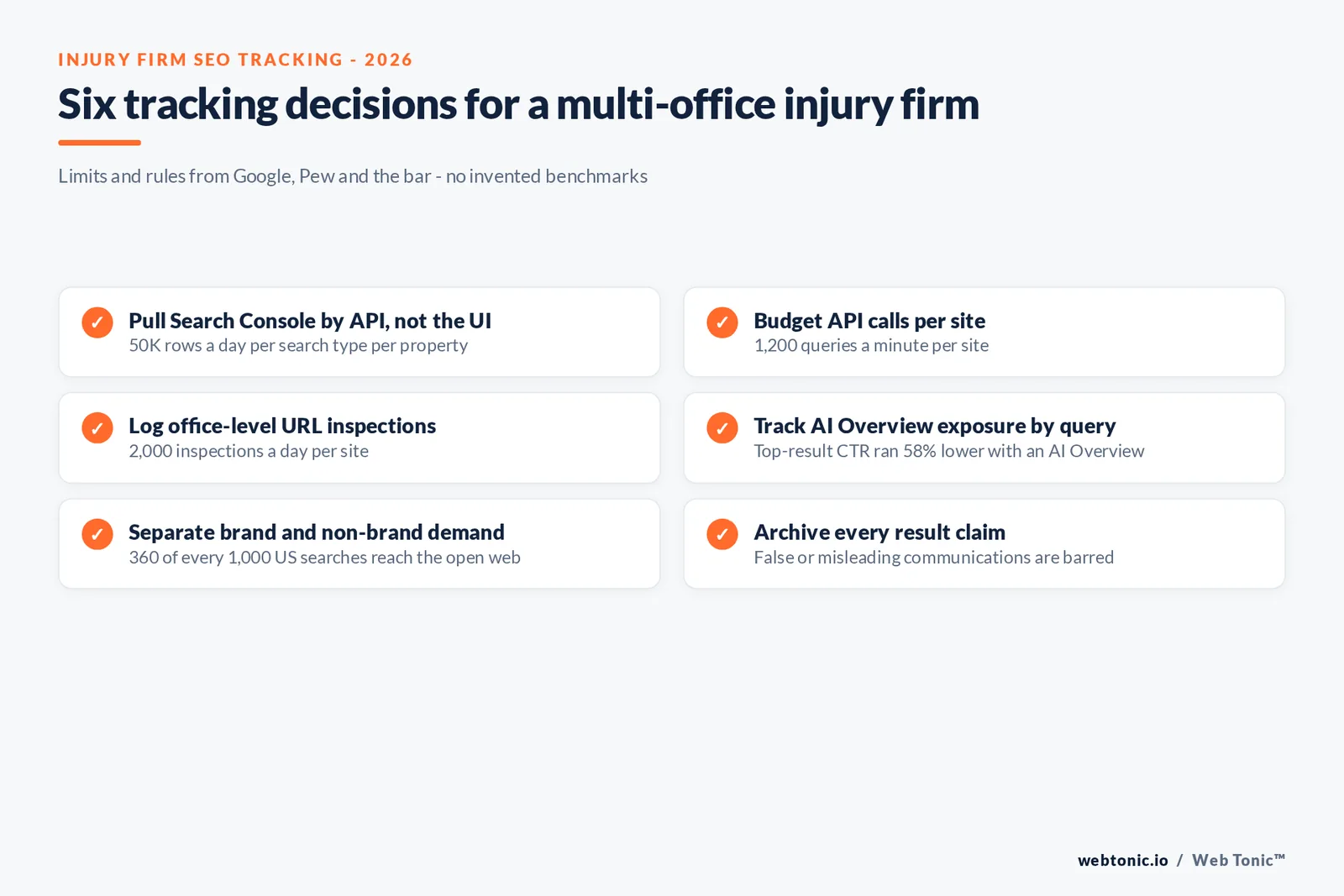
- Search Console API data is capped at 50K rows per day per search type per property.
- Search Analytics allows 1,200 queries per minute per site.
- URL inspection is capped at 2,000 queries a day per site.
- Top-result CTR was 58% lower on keywords with AI Overviews (Ahrefs, Dec 2025 data).
- The April 2025 version of that study found 34.5% lower.
- 360 of every 1,000 US Google searches sent a click to the open web in 2024.
- Personal injury lawyers averaged USD 335 an hour (Clio 2025).
- 156,583 US law firms operated in 2022; 95.3% had under 20 employees.
- Morgan & Morgan lists 140 offices and 1,100 attorneys.
- Google held 86.1% of US search share in August 2026.
Why Tracking Comes Before Benchmarks
Injury law is one of the most competitive local search categories, yet there is no published, method-backed benchmark for its organic click-through rate, ranking share or cost per signed case. What a strategist can measure precisely is the firm's own funnel. The table sets out the tracking layers and the limit that governs each one.
| Tracking layer | Metric | Governing limit | Source |
|---|---|---|---|
| Search performance | Impressions, clicks, position per office URL | 50K rows / day / type | Search Console Help |
| API throughput | Automated daily pulls | 1,200 QPM per site | Search Console API limits |
| Indexing | Status of each office page | 2,000 inspections / day / site | Search Console API limits |
| Maps presence | Calls, directions per profile | One profile per staffed office | Business Profile guidelines |
| AI exposure | Share of target queries with AI Overviews | No official report | Firm sampling |
| Outcomes | Signed cases by landing page | Intake system data | Firm CRM |
Who Needs Enterprise-Level Tracking
The Census Bureau's 2022 Statistics of U.S. Businesses count 156,583 offices-of-lawyers firms across all practice areas. 74.5% had fewer than five employees and 95.3% fewer than 20. At the top, 203 firms with 500 or more employees operated 2,528 establishments. The data does not split out injury law, so treat it as the shape of the legal market, not a count of injury firms.
| Law firm size | Firms | Establishments | Share of firms |
|---|---|---|---|
| Under 5 employees | 116,668 | 116,745 | 74.5% |
| 5-9 employees | 22,518 | 22,687 | 14.4% |
| 10-19 employees | 10,001 | 10,700 | 6.4% |
| 20-99 employees | 6,245 | 9,540 | 4.0% |
| 100-499 employees | 948 | 4,772 | 0.6% |
| 500+ employees | 203 | 2,528 | 0.1% |
The enterprise injury tier is concrete, though. Morgan & Morgan's own site lists 140 offices nationwide and 1,100 attorneys. A firm of that shape has hundreds of office, attorney and practice-area URLs, which is exactly where the Search Console row cap starts to bite.
Tracking Case Value Against Search Effort
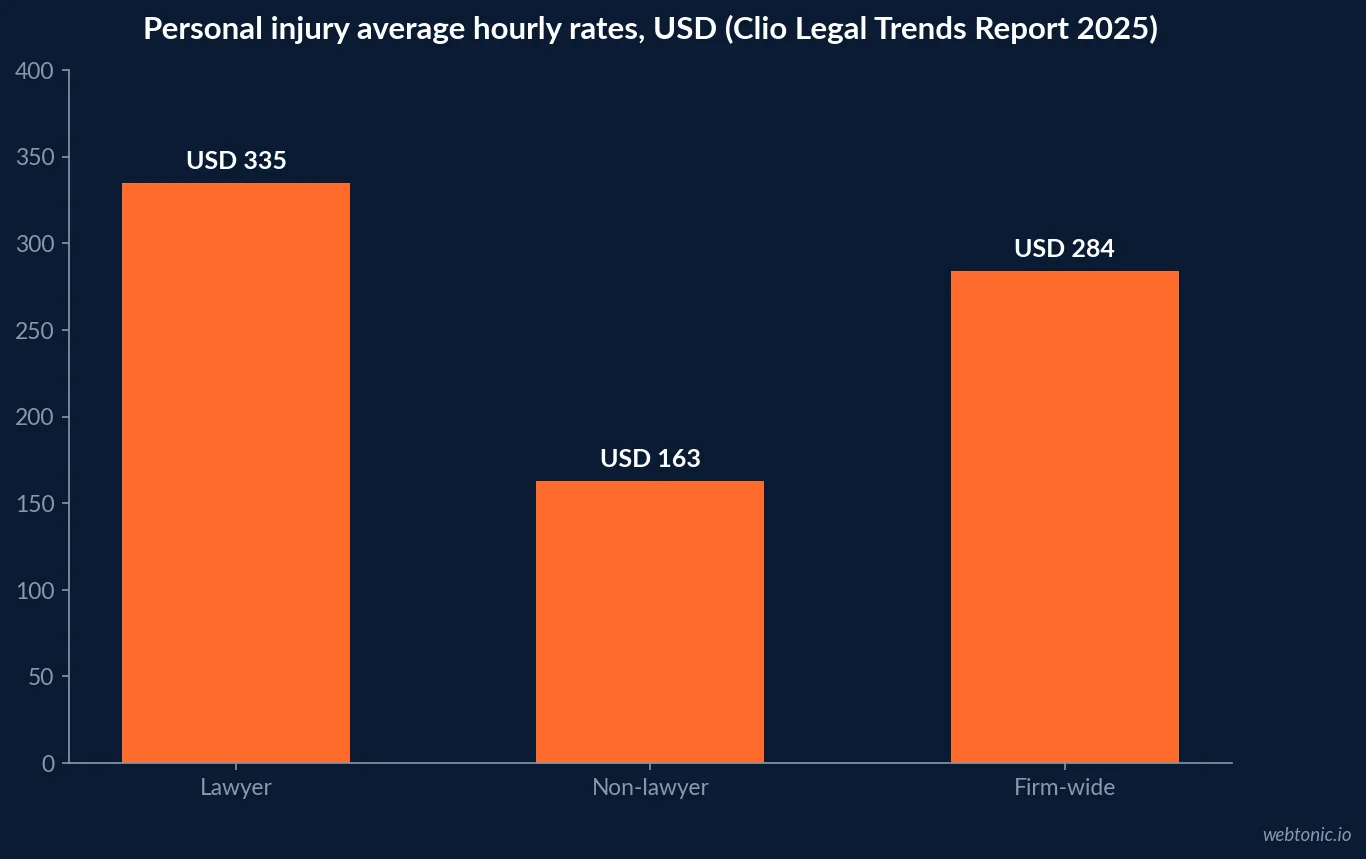
Organic cost per case is not published, but the economics a tracking plan should connect to are. Clio's 2025 Legal Trends Report lists personal injury average hourly rates of USD 335 for lawyers, USD 163 for non-lawyers and USD 284 firm-wide. Injury work is mostly contingency-based, so these rates describe the value of time rather than what clients pay; they are useful for costing the in-house hours that SEO reporting consumes.
Measuring AI Overview Exposure
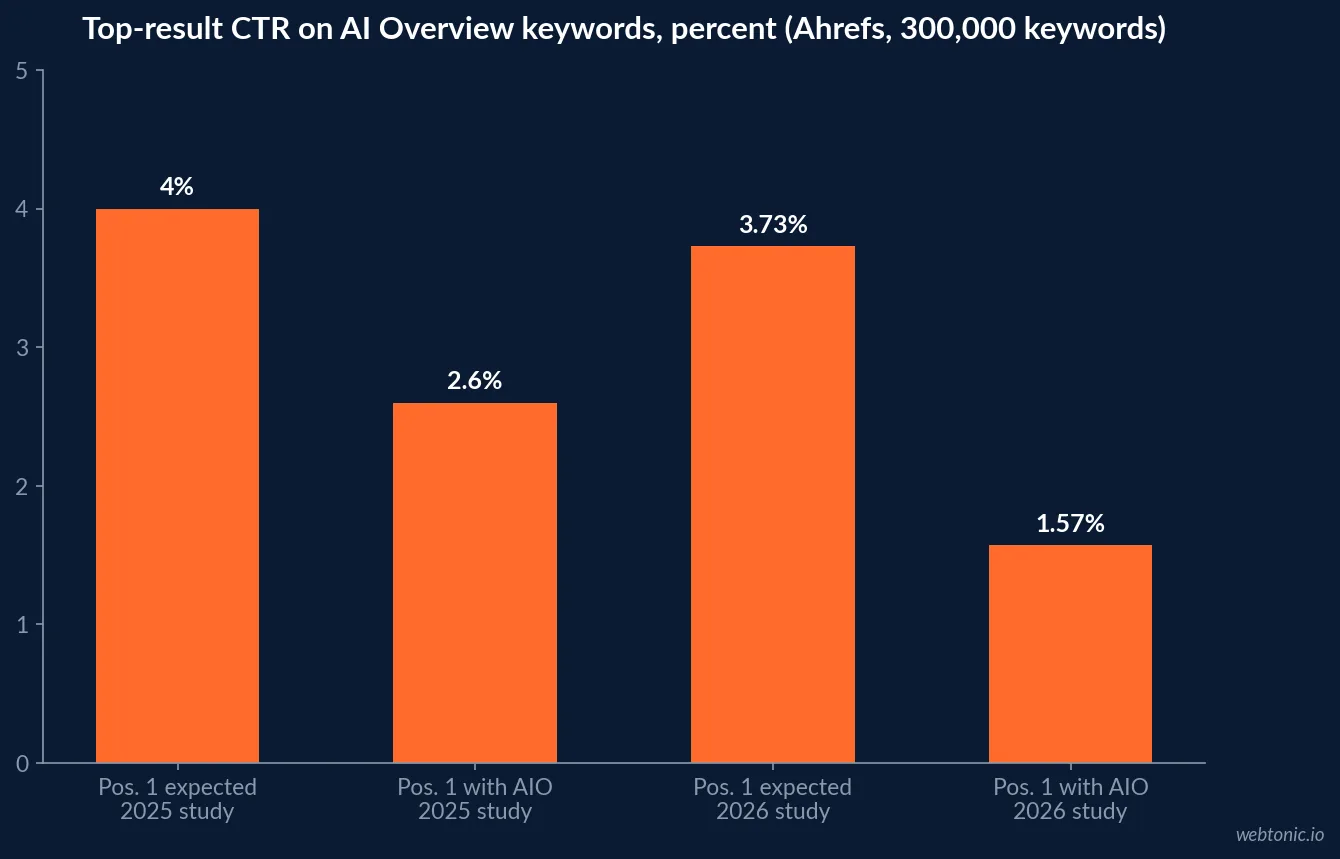
Ahrefs' April 2025 study of 300,000 keywords found the presence of an AI Overview correlated with a 34.5% lower average click-through rate for the top-ranking page. Its February 2026 update, using December 2025 data and the same method, found 58% lower: a forecast top-result CTR of about 3.73% against an actual 1.57%. Both studies use informational keywords, and many injury queries are commercial, so a strategist should tag which of the firm's own target queries trigger an AI Overview and report them separately.
| Click study | Sample | Finding | Use in tracking |
|---|---|---|---|
| Ahrefs 2025 | 300,000 keywords | 34.5% lower top-result CTR with AI Overviews | Baseline for AIO-tagged queries |
| Ahrefs 2026 | 300,000 keywords, Dec 2025 | 58% lower top-result CTR | Trend comparison |
| Pew Research 2025 | 900 US adults, March 2025 | 8% vs 15% result clicks | Explaining flat clicks |
| SparkToro 2024 | Datos US panel | 360 open-web clicks per 1,000 searches | Ceiling on organic reach |
Reading Zero-Click Data Correctly
SparkToro's 2024 study found that 58.5% of US Google searches ended without a click and only 360 of every 1,000 went to the open web. Pew Research's 2025 analysis found users who saw an AI summary clicked a traditional result in 8% of visits versus 15% without, and ended their session on 26% of summary pages. For an injury firm, the takeaway for tracking is that impressions and Business Profile calls can hold steady while site clicks fall - report all three together.
Office Pages, Profiles and the Doorway Policy
Multi-office firms often publish one page per city. Google's spam policies count "multiple domain names or pages targeted at specific regions or cities that funnel users to one page" as doorway abuse. A tracking plan should include a page-quality check: does each office page name the attorneys who work there, its address and hours? Google's Business Profile guidelines also refuse virtual offices, and co-working offices are listable only with signage, staffing and customers received during business hours. Firms with 10 or more offices can use bulk verification.
Crawl and Index Tracking for Large Firm Sites
Big injury firms publish office, attorney, practice-area, verdict and blog URLs, and many of them never earn a visit. Ahrefs' 2023 study of about 14 billion pages found 96.55% of pages got zero traffic from Google and 1.94% got one to ten visits a month. That is a web-wide sample rather than a legal one, but it is a reason to track, per template, how many URLs earn impressions at all.
Crawl budget is a narrower concern than it is often made out to be. Google's crawl budget guide is aimed at sites with 1 million+ unique pages changing weekly or 10,000+ unique pages changing daily. A firm with a few thousand URLs is far below both, so pages that are "discovered but not indexed" there are more likely a quality or duplication signal than a crawl-capacity limit.
| URL template | What to track | Why |
|---|---|---|
| Office pages | Impressions, calls, index status | Tie organic demand to each office |
| Attorney bios | Branded impressions | Name searches often precede a call |
| Practice-area pages | Non-brand clicks, AIO exposure | Where AI Overviews most often appear |
| Verdict and results pages | Dated archive, claim review | Bar misleading-communication rules |
| Blog and guides | Share of URLs with any impressions | 96.55% of pages web-wide get no Google traffic |
A practical rule for the reporting cadence: pull weekly by template, review monthly by office, and re-inspect only the URLs that changed, so the 2,000-a-day inspection quota goes to the pages that matter.
Bar Rules That Shape What You Track
Lawyer advertising rules apply to organic pages as much as to ads. North Carolina's version of the model rule, on Cornell's Legal Information Institute, states that "a lawyer shall not make a false or misleading communication" and names statements "likely to create an unjustified expectation about results" as one example. Its Rule 7.2 commentary lets lawyers pay for advertising, including online directory listings. Rules vary by state, so the tracking stack should keep a dated archive of every results page, verdict claim and testimonial.
| Compliance item to track | Why | Source |
|---|---|---|
| Dated archive of office and results pages | Misleading-communication rules | NC Rule 7.1 via LII |
| Paid directory and listing spend | Rule 7.2 allows paying for advertising | NC Rule 7.2 via LII |
| Office eligibility for profiles | No virtual offices | Business Profile guidelines |
| City-page uniqueness | Doorway abuse policy | Google spam policies |
Search Engine Mix and Structured Data
Statcounter put Google at 86.1% of US search engine share in August 2026 and Bing at 8.92%, so rank tracking for injury terms should be weighted to Google. On-page, Google's LocalBusiness structured data guide supports describing each office's hours and departments; a strategist can track markup validity per office URL alongside rankings. Our data intelligence team builds that kind of office-level reporting.
A Tracking Checklist for Injury Firms
- Pull Search Console by API per office folder so no office drops out of the 50K-row daily cap.
- Stay under 1,200 queries per minute per site when automating pulls.
- Inspect priority URLs within 2,000 a day: office, attorney and top practice pages first.
- Tag AI Overview queries and compare them with the 58% lower CTR Ahrefs measured.
- Report calls, impressions and clicks together given 58.5% zero-click searches.
- Archive every claim with a date for bar compliance.
Personal Injury Versus All Industries
Injury firms face the same Google limits and click studies as every other enterprise; what differs is the bar-rule layer and the size of the top tier. For the single-office view, see our personal injury law SEO statistics and personal injury local SEO statistics, and the cross-industry enterprise SEO statistics hub.
Frequently Asked Questions
What should an SEO strategist track for a personal injury firm?
Track office-level impressions, clicks and index status from Search Console, calls and direction requests per Business Profile, the share of target queries showing AI Overviews, and signed cases by source from the firm's own intake system. No public study publishes a personal injury organic click-through rate or cost per case, so the firm's own data is the benchmark.
What are the Search Console limits for a large law firm site?
Google says Search Console API performance data is limited to 50K rows per day per search type per property. The Search Analytics API allows 1,200 queries per minute per site and per user, and URL inspection is capped at 2,000 queries a day and 600 a minute per site.
How large are the biggest personal injury firms?
Morgan & Morgan, which calls itself America's largest injury law firm, lists 140 offices and 1,100 attorneys on its own site. Across all law offices, Census Bureau 2022 data counts 156,583 firms, of which 203 had 500 or more employees and ran 2,528 establishments. The Census figures cover all practice areas, not only injury law.
Do AI Overviews reduce clicks for law firm pages?
The published studies are cross-industry. Ahrefs measured a 58% lower top-result click-through rate on keywords with an AI Overview in December 2025 data, and Pew Research found users clicked a result in 8% of visits with an AI summary versus 15% without. No study isolates personal injury queries, so track your own affected queries.
Do bar advertising rules affect SEO tracking?
Yes. State versions of the ABA model rules, such as North Carolina Rule 7.1 on Cornell's Legal Information Institute, bar false or misleading communications, including statements likely to create unjustified expectations about results. Tracking should therefore include an archive of every page and result claim that ran, with dates.
Need an office-level SEO dashboard for your firm? Talk to Web Tonic.
Sources
Google - Export Search Console data via the API
Google - Search Console API usage limits
U.S. Census Bureau - 2022 SUSB annual tables (NAICS 541110)
Morgan & Morgan - Who we are
Clio - 2025 Legal Trends Report
Ahrefs - AI Overviews reduce clicks by 34.5% (2025)
Ahrefs - Search traffic study, 2023
Google - Crawl budget management
Ahrefs - AI Overviews reduce clicks (2026 update)
Pew Research Center - AI summaries and clicks, 2025
SparkToro - 2024 Zero-Click Search Study
Google Search Central - Spam policies
Google - Business Profile guidelines
Cornell LII - N.C. Rule 7.1
Cornell LII - N.C. Rule 7.2
Statcounter - US search engine market share


