Table of contents

Ask any gym owner where their last ten members came from, and "I saw them on Google" comes up more than any referral or flyer ever will. Long before someone walks through your door, they've already typed something like "gym near me" or "best gym in [city]" into a search bar. Whichever three results Google decides to show first get the overwhelming majority of the clicks, calls, and walk-ins.
SEO for gyms is the practice of making sure your business is one of those three. A fully optimized Google Business Profile matters. So does a gym website with a genuinely good user experience, a steady flow of reviews, and content that answers what your potential members are actually searching for online. Paid ads stop the moment the budget runs out; a strong local SEO foundation keeps generating organic traffic and sign-ups for years. This playbook walks through exactly how to build that foundation in 2026.
Key Takeaways
- Gyms in Google's Local 3-Pack get dramatically more traffic and more calls, clicks, and direction requests than gyms ranked positions 4 through 10. The exact figure is widely cited (over 100%), though the industry sources behind it attribute it differently — treat it as directionally strong rather than a precise number.
- A complete, actively managed Google Business Profile is the single highest-leverage move in local SEO for gyms, often outranking competitors with better websites and more backlinks.
- 76% of people who run a local search visit a business within 24 hours, and roughly 60% of gym searches happen on mobile with local intent, so mobile speed and map visibility matter as much as the website itself.
- Name, address, and phone number (NAP) consistency across your site, your Google Business Profile, and directories like Bing Places and Apple Maps is foundational; mismatches quietly suppress rankings.
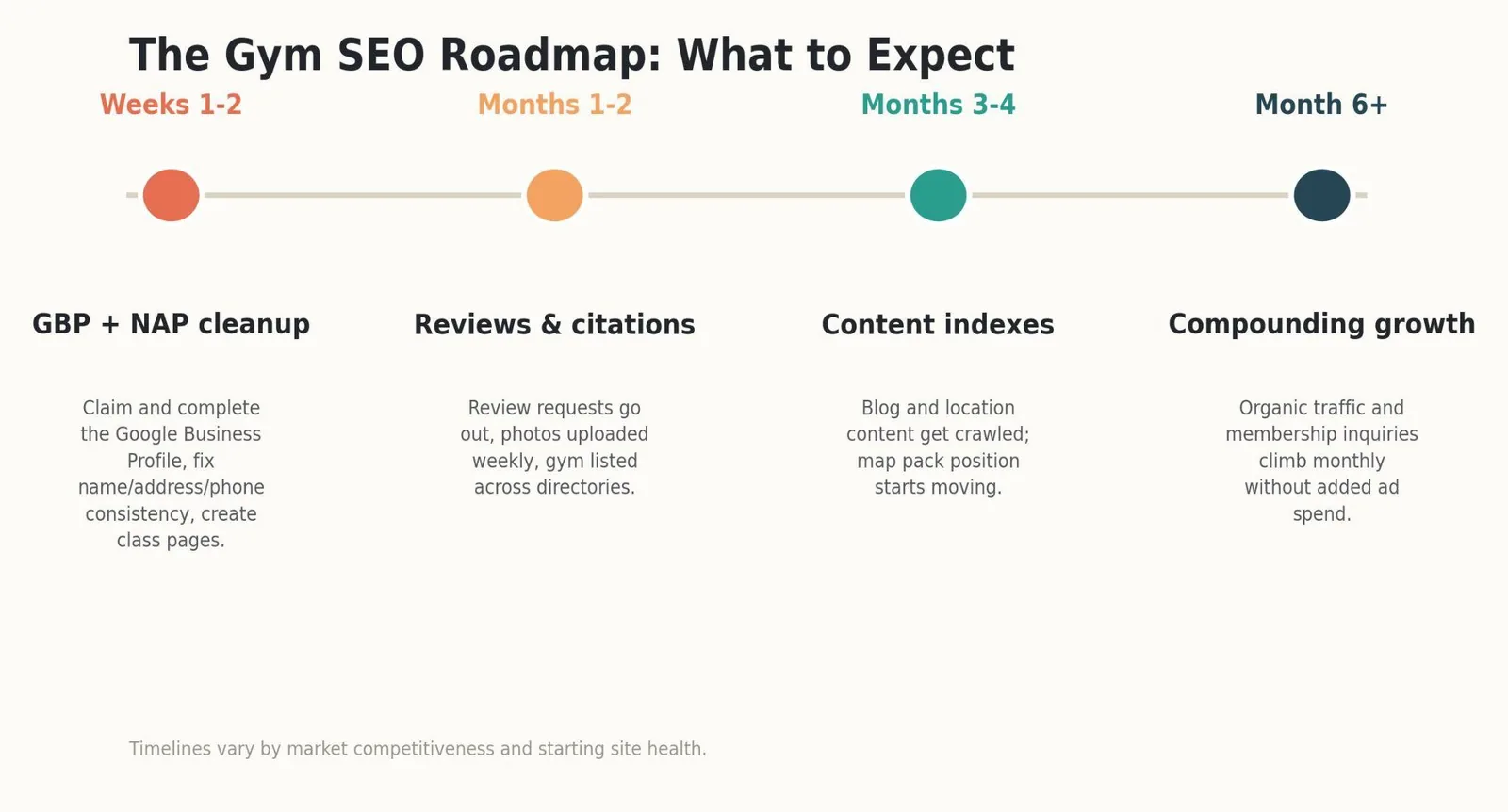
- Most gyms see meaningful ranking movement within 3 to 6 months, with compounding gains, more organic traffic, more inquiries, less reliance on paid ads, continuing well past month six.
- A dedicated SEO agency retainer for a gym typically runs $500 to $2,500 USD per month, while a full-service agency can run $2,500 to $5,000+ USD per month, with paid tools like Ahrefs or BrightLocal adding roughly $100 to $200 USD per month.
What is SEO for gyms?
SEO for gyms is the process of optimizing a fitness business's online presence, its Google Business Profile, website, and content, so it ranks higher when nearby people search for gyms, classes, or personal trainers. It combines map pack visibility, on-page optimization, technical site health, and off-page signals like reviews and citations.
What makes gym SEO distinct from general search engine optimization is how locally driven the intent is. Almost nobody searches "gym" expecting a national result. They search "CrossFit near me" or "personal training in Denver," and Google responds with the Google Maps Local Pack before it even shows traditional blue links. That means your Google Business Profile often matters more than your homepage, and the same signals increasingly carry weight across other search engines and AI search tools too, since most of them pull from the same underlying business data.
Why local search dominates gym discovery
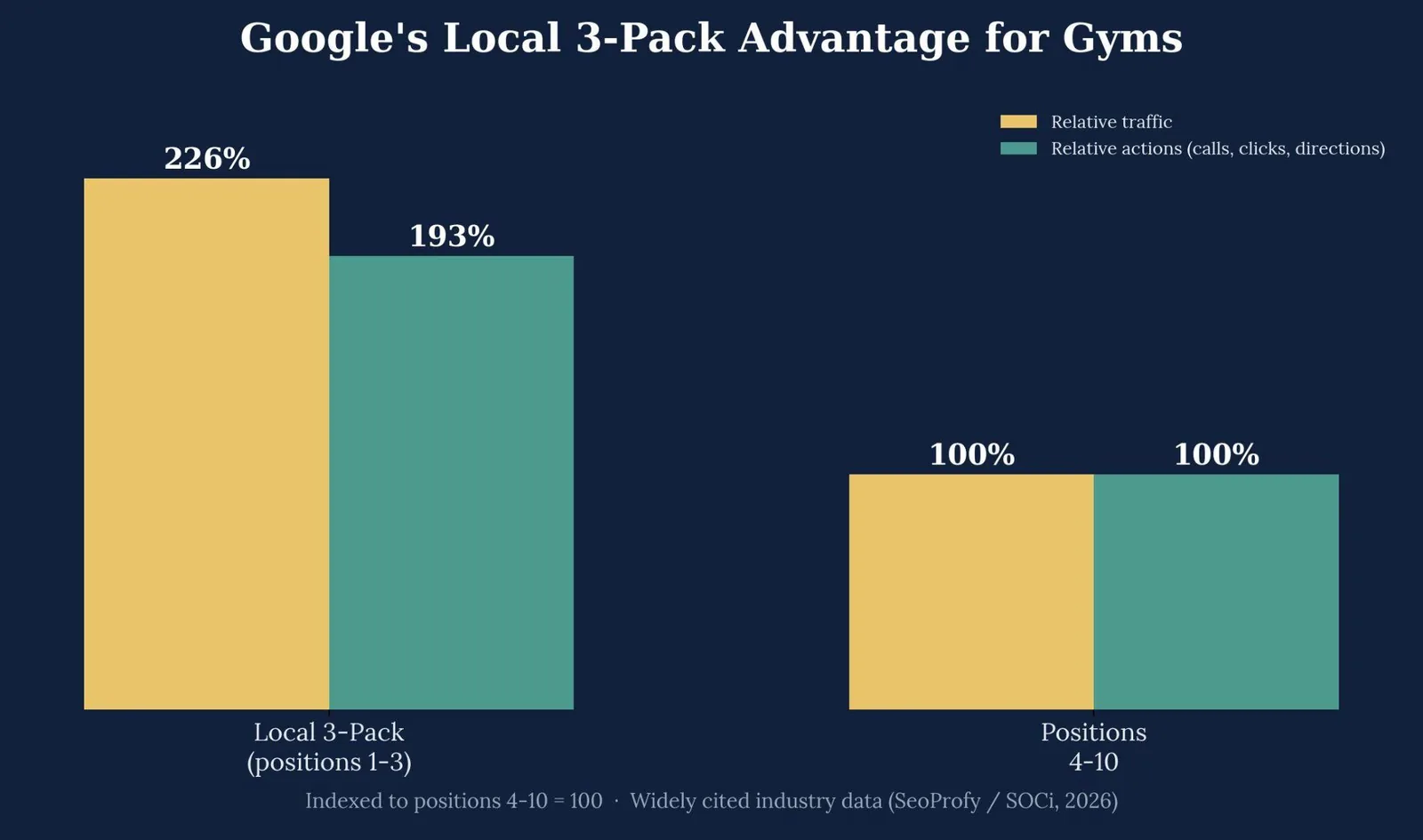
The gap between ranking in the top three and everywhere else is enormous. According to FitBudd's 2026 gym SEO guide, gyms that appear in Google's Local 3-Pack see substantially more traffic and actions — calls, clicks, and direction requests — than those ranked positions 4 through 10. If your gym isn't in the top three for "gym near me" in your neighborhood, you're effectively invisible to most of the people searching.
That gap exists because of how people behave once they search. According to Shopify's 2026 local SEO statistics roundup, 76% of people who perform a local search visit a business within 24 hours, and a large share convert to a membership inquiry or trial booking almost immediately. Gym searches tend to be higher-intent than typical browsing behavior: someone typing "gym near me" at 7 PM has usually already decided to work out somewhere. The only question is where.
SEO vs. paid ads for gyms
| Factor | SEO (organic) | Paid ads (PPC) |
|---|---|---|
| Cost model | Time invested in GBP, content, and reviews | Ongoing cost per click |
| Time to results | Typically 3-6 months | Immediate |
| Long-term value | Compounds, keeps ranking after the work is done | Stops the moment spend stops |
| Best gym stage | Any gym willing to commit 3-6 months upfront | New locations needing immediate visibility |
| Primary channel | Google Business Profile, website, reviews | Google Ads, Meta Ads |
| Typical monthly cost | $0 (DIY) to $2,500+ USD (agency retainer) | Scales directly with ad spend |
Most gyms end up running both. PPC fills the gap while local SEO compounds in the background, and once the organic side is established, many gyms scale back paid spend since the map pack and organic listings are doing the heavy lifting for free. Some bundle SEO services into a broader marketing retainer alongside social media management rather than buying it standalone.
The gym SEO roadmap
Step 1: Claim and optimize your Google Business Profile
Start by claiming the listing and choosing the correct primary category, "Fitness Center," "Gym," or "CrossFit Gym," depending on your business. Then fill in hours, photos, services, and a keyword-rich description in the first 250 characters. This single step is often the fastest lever a gym has for visibility in the map pack.
Step 2: Fix NAP consistency across the web
Your gym's name, address, and phone number need to match exactly across your website, GMB listing, and directories including Bing Places, Apple Maps, Yelp, and fitness-specific listings. Inconsistent NAP data is one of the quietest rankings killers in local SEO, and it's rarely obvious without an audit.
Step 3: Build dedicated pages for classes and services
A single homepage can't rank for fifteen different services across five neighborhoods. Dedicated pages for each class, program, or personal training offering give your gym website more distinct opportunities to rank instead of forcing everything to compete for the same handful of keywords, a gap that shows up across fitness centers of every size.
Step 4: Fix technical foundations and mobile speed
Roughly 60% of gym searches happen on mobile with local intent, according to PushPress's 2026 gym SEO guide, so a site that loads in more than three seconds loses visitors before they read a word. A slow, clunky user experience costs you conversions even if the SEO work gets people to the page. Compress images, cut unnecessary scripts, and test regularly with Google's PageSpeed Insights to keep load times competitive.
Step 5: Build a steady review and reputation engine
Reviews are one of the strongest local search ranking factors for gyms, and they directly influence whether a potential member picks your gym over the one next door. A simple system works well here: ask happy members for a review right after a great class or a milestone, and it compounds fast. Pairing that with active social media posts, member wins, new classes, community events, reinforces the same trust signals Google is already picking up on.
Step 6: Publish content that matches what members actually search
Blog posts, class guides, and neighborhood-specific pages targeting real search queries ("best HIIT gym in Phoenix," "how much does a gym membership cost in Chicago") build topical authority over time. They also give your content more chances to appear in search results and AI-generated answers alike. Google Keyword Planner helps confirm which of these searches actually have volume in your market before you commit to writing about them.
Step 7: Track everything in Search Console and Analytics
Google Search Console and Google Analytics show which queries already bring traffic, which pages convert, and where technical issues are blocking crawlers. Without them, there's no reliable way to know whether the work in steps 1 through 6 is actually paying off.
Try it yourself: the interactive checklist below scores your gym's SEO foundation across the six highest-impact items covered in this roadmap.
Gym SEO tool
Is your gym's local SEO ready to compete?
Check off what's already true for your gym. Your score updates as you go.
0 of 6
Check off items above to see how your gym's local SEO foundation stacks up.
What members search for: local search behavior
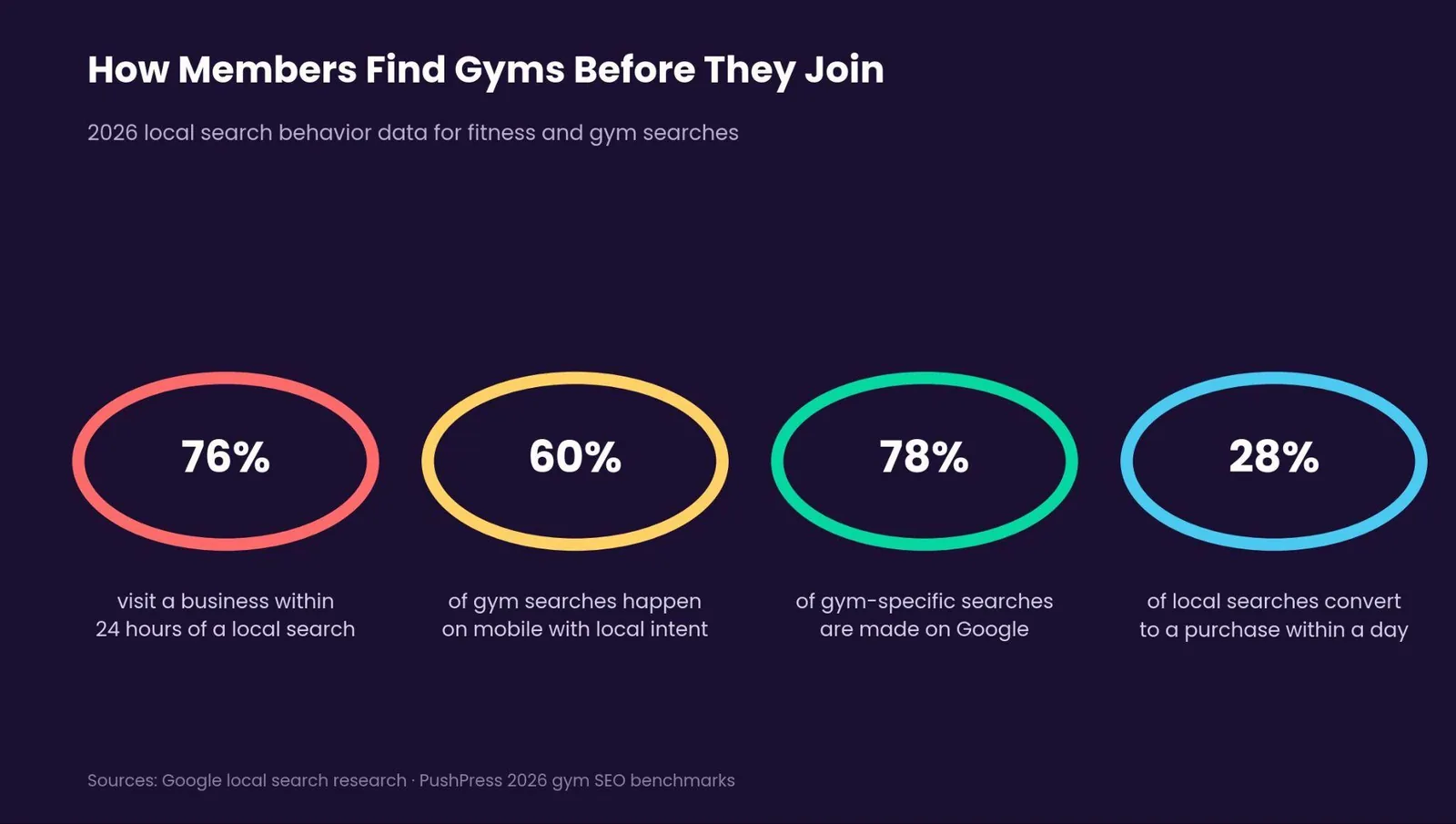
Understanding how people actually search changes what you prioritize. According to Cometrank's 2026 gym SEO guide, 78% of gym-specific searches happen on Google, ahead of any other search engine, and 60% of those searches happen on mobile with clear local intent: "near me," a neighborhood name, or a specific class type. 28% of local searches convert to a purchase within a day, which is exactly why slow rankings movement in month one isn't a sign of failure. The system compounds gradually rather than producing an overnight spike.
This is also why keyword research for gyms should lean heavily local. Broad terms like "fitness" are dominated by national brands and directories. Specifically, local keywords like "spin classes in [city]" or "personal trainer near [neighborhood]" give a gym's site an actual chance to rank while still building toward broader terms over time.
Common gym SEO mistakes
The most common mistake is treating the Google Business Profile as a one-time setup instead of an ongoing channel. Profiles that go months without a new photo, post, or review response lose visibility to competitors who stay active.
Inconsistent NAP data across directories is a close second. A gym might have three slightly different phone numbers floating around Bing Places, Yelp, and its own site, which quietly confuses Google's confidence in which listing is authoritative.
Building one homepage to cover every class and service is another frequent gap. Each additional dedicated page is another chance to rank for a specific, high-intent search.
And many gym owners give up on SEO strategies around month two or three, right before the compounding effect would have started showing in Google Search Console.
Frequently asked questions
How much does gym SEO cost?
It depends on whether the work is done in-house or outsourced. According to PushPress's 2026 guide, a specialized SEO agency retainer for a gym typically runs $500 to $2,500 USD per month, while a full-service agency runs $2,500 to $5,000+ USD per month. Paid tools like Ahrefs or BrightLocal add roughly $100 to $200 USD per month on top. Get a quote specific to your market before committing a budget.
How long does it take to rank a gym on Google?
Most gyms see initial ranking movement within 3 to 6 months, with the biggest compounding gains arriving after month six as reviews, content, and citations build on each other.
Is a Google Business Profile really that important for gyms?
Yes. It's frequently the single highest-leverage item in local SEO for gyms, since Google Business Profile signals heavily influence Local Pack placement, sometimes outranking gyms with stronger websites and more backlinks.
Do gym owners need to hire an agency, or can this be done in-house?
Either works. A gym owner or manager can run the core steps, Google Business Profile upkeep, review requests, basic content, within a few hours a week. Many gym owners bring in outside help once they want faster movement or lack the time for consistent execution.
Does gym SEO work for multi-location gyms and franchises?
Yes, and it requires more structure. Each location needs its own Google Business Profile and dedicated location page, since a single national page can't rank for "gym near me" searches in every city at once.
The bottom line on SEO for gyms
SEO for gyms rewards consistency more than any single tactic. Claim and actively manage the Google Business Profile. Keep NAP data clean across every directory. Build dedicated pages for what you actually offer, and keep the review requests flowing every week. None of it produces overnight results, but gyms that stay with it for 6 to 12 months typically build a local search presence that keeps bringing in members long after any single ad campaign would have stopped.
Start this week with one action: claim or fully complete your Google Business Profile, add your real hours, your current photos, and a description that mentions your city and your primary services by name. It's the fastest lever available, and it costs nothing but time.
Need a hand executing this?
Running all seven steps in-house takes real time, time most gym owners are already spending on classes, member questions, and the dozen other things a gym needs day to day. Web Tonic's SEO, GEO, and LLM visibility team handles the Google Business Profile management, technical SEO, and local content this playbook lays out, so the compounding work keeps happening even when your week gets full. Some gyms use it to get the foundation built faster; others bring it in once they've hit the limits of what they can maintain themselves.
More from Web Tonic: growth marketing services, data & analytics.
Sources: fitbudd.com · shopify.com · pushpress.com · cometrank.ai