



Table of contents
Key Takeaways
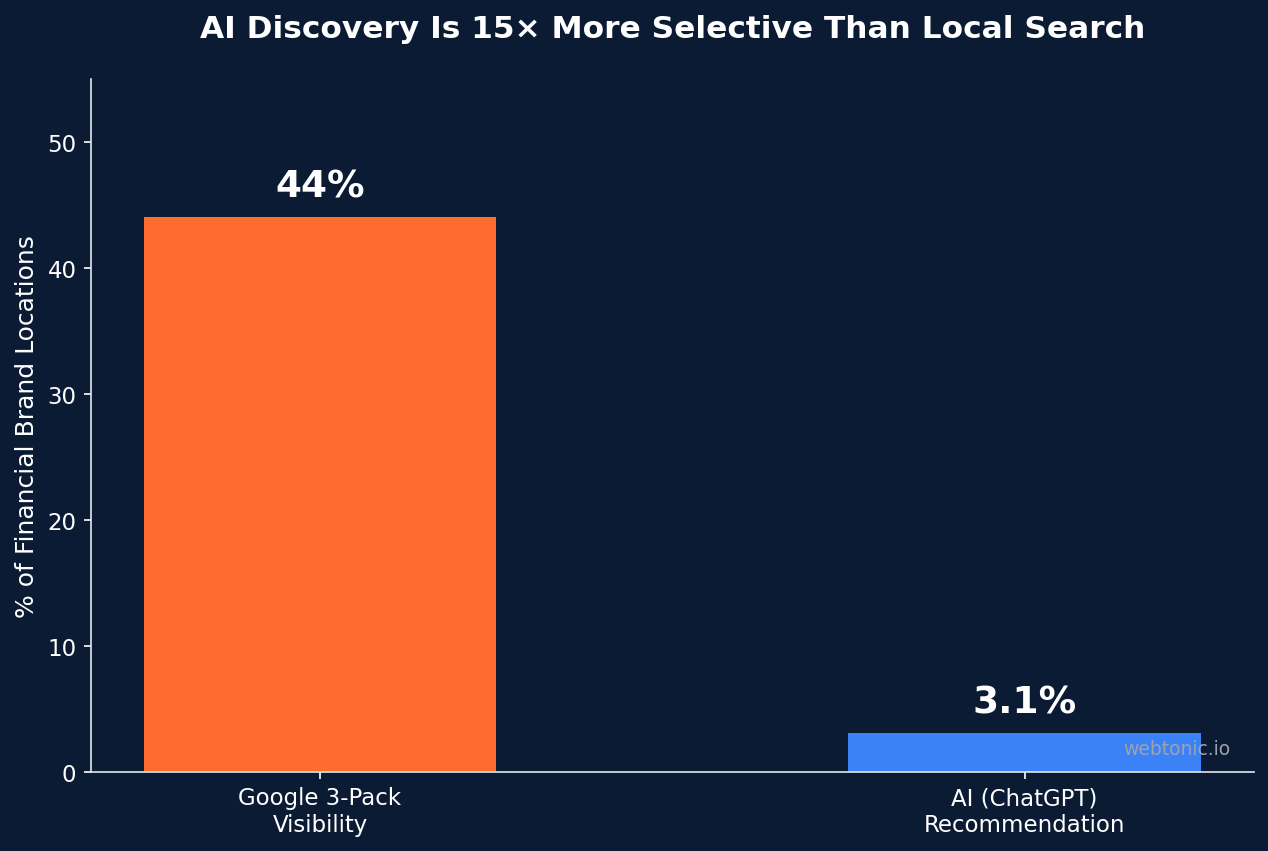
Only 3.1% of financial brand locations are recommended by ChatGPT, compared to 44% that rank in the Google 3-pack — making AI-driven discovery 15× more selective than traditional local search. Organic search drives 38–54% of non-branded website sessions for banks with mature SEO programs, versus just 12–22% for institutions with minimal optimization. "Near me" searches exceeded 200 million monthly queries globally in early 2026, with mobile and voice accounting for 78% of those searches. Financial advisors ranked in the top 3 local positions average 45.6 Google reviews, more than double the 18.67 average for positions four and five. The local pack generates a 17.6% click-through rate in position one for financial services, with roughly 5% of Google Business Profile views converting to a direct action.
Fintech Local SEO at a Glance — 2026 Benchmarks
| Metric | Financial Services | All-Industry Average |
|---|---|---|
| Google 3-pack visibility | 44% of brand locations | 35–40% |
| AI recommendation rate | 3.1% of locations | 5–8% |
| Organic share (mature SEO) | 38–54% of sessions | 40–50% |
| Local pack CTR (pos. 1) | 17.6% | 15–20% |
| GBP view-to-action rate | ~5% | 3–6% |
| Top-3 avg. Google reviews | 45.6 | 30–50 |
Sources: SOCi, Authority Specialist, Midstream Marketing, Advisor Rankings
AI Discovery vs. Traditional Local Search in Financial Services
The gap between traditional local search visibility and AI-powered recommendations is stark in financial services. SOCi's 2026 Local Visibility Index found that AI-driven discovery is 15× more selective than the Google 3-pack — while 44% of financial brand locations appear in traditional local search results, only 3.1% are recommended by ChatGPT and similar AI assistants.
This selectivity means fintech companies and financial institutions that invest exclusively in traditional local search optimization may find themselves invisible in the growing AI discovery channel. The recommendations AI systems make are disproportionately influenced by structured data quality, review sentiment, and authoritative web presence — factors that go beyond basic Google Business Profile optimization. For fintech brands with physical or hybrid-physical presence, building for both channels simultaneously has become a baseline requirement rather than an optional optimization.
"Near Me" Search Trends and Mobile Behavior
Local intent searches continue to grow across financial services categories. According to Affinco's 2026 local SEO data, early 2026 recorded more than 200 million monthly "near me" searches globally, with "near me" keyword variations alone holding a monthly search volume of 7.1 million in Semrush's 2026 data. Neil Patel's analysis shows that "near me" searches grew 220% between 2016 and 2019, plateaued during 2020–2022, and surged again in 2023–2024 to all-time highs.
Mobile and voice search account for 78% of "near me" queries, which has significant implications for fintech companies offering branch-based services or in-person consultations. Users searching for "bank near me," "financial advisor near me," or "money transfer near me" are expressing immediate, high-conversion intent. The data suggests that optimizing for mobile-first local experiences is no longer optional for any financial services company with a physical footprint.
| Near Me Search Metric | 2026 Data | Source |
|---|---|---|
| Monthly "near me" searches (global) | 200M+ | Affinco |
| "Near me" keyword volume | 7.1M (Semrush) | Affinco |
| Growth 2016–2019 | +220% | Neil Patel |
| Mobile + voice share | 78% | Neil Patel |
| Post-plateau surge | 2023–2024 all-time highs | Neil Patel |
Google Business Profile Performance for Financial Brands
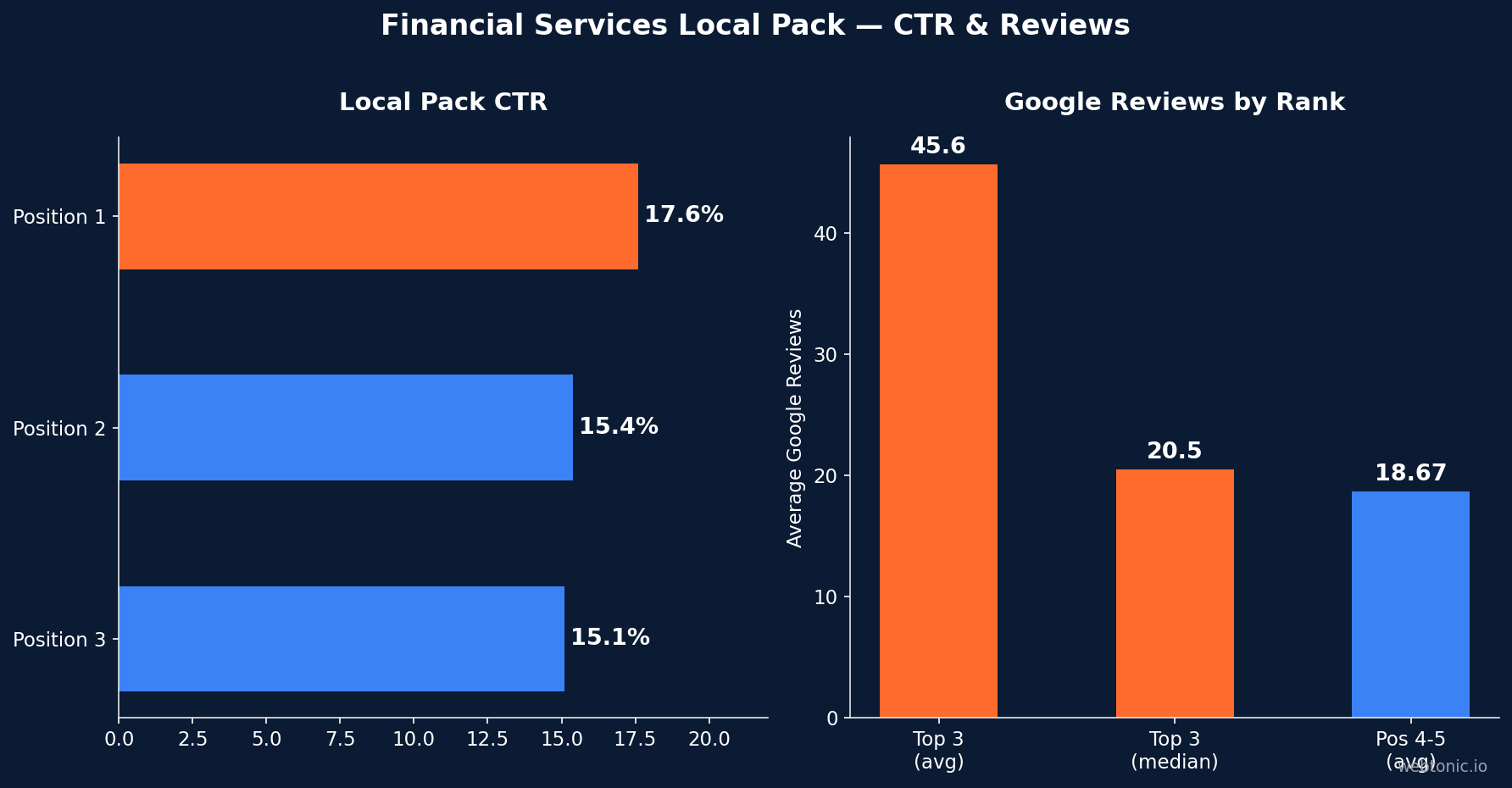
Google Business Profile remains the anchor of local visibility for financial services companies. Midstream Marketing's data shows that the local pack generates a 17.6% click-through rate in position one for financial services, dropping to 15.4% in position two and 15.1% in position three. While these click-through rates are competitive with paid advertising, the conversion funnel from click to client requires a fully optimized profile.
Approximately 5% of Google Business Profile views lead to a direct action — a phone call, website click, or direction request — according to Search Engine Journal data cited in the Midstream analysis. For a financial advisor whose profile receives 5,000 views per month, that translates to roughly 250 potential client actions without any ad spend. Scaling that across a multi-location fintech brand or banking network, the aggregate value of local search visibility compounds rapidly.
Advisor Rankings' review study quantified the review threshold needed for local pack dominance: financial advisors ranked in the top 3 positions averaged 45.6 Google reviews, with a median of 20.5. Advisors ranked fourth and fifth averaged just 18.67 reviews — less than half the average of the top 3. Only four top-3-ranked advisors in their dataset had zero reviews, confirming that review volume and recency are critical ranking signals in the financial services local pack.
Organic Search Share for Financial Institutions
Authority Specialist's 2026 bank SEO benchmarks reveal a dramatic gap in organic search performance based on SEO maturity. Banks with mature SEO programs draw 38–54% of their non-branded website sessions from organic search, while banks with minimal optimization capture only 12–22%. This 3× differential represents thousands of additional monthly visits from users actively searching for financial products and services.
For fintech companies competing against established banks, this data underscores the opportunity. Many traditional institutions still underinvest in local SEO, leaving openings for neobanks, digital lenders, and payment platforms to capture local search traffic in markets where incumbents have neglected their digital presence. The institutions ranking in the top 3 positions for branch-level local queries capture a disproportionate share of new account inquiries, particularly in markets with medium-to-high population density.
For companies planning their growth marketing strategy, combining local SEO with paid acquisition creates a reinforcing loop — paid campaigns drive brand awareness that increases branded and "near me" search volumes, while strong local SEO captures that incremental demand at zero marginal cost.
Fintech Local SEO vs. Industry Baselines
| Metric | FinTech / Banking | Healthcare | Legal |
|---|---|---|---|
| Organic session share (mature) | 38–54% | 35–50% | 40–60% |
| AI recommendation rate | 3.1% | 4.2% | 5.8% |
| Google 3-pack visibility | 44% | 38% | 42% |
| Mobile search dominance | 72% | 68% | 65% |
| Review threshold (top 3) | 45.6 avg | 52 avg | 38 avg |
Sources: SOCi, Authority Specialist, Advisor Rankings
Mobile Search and Conversion Patterns in Fintech
Mobile devices dominate local search behavior across financial services, and the conversion dynamics differ meaningfully from desktop patterns. Approximately 72% of local financial services searches occur on mobile devices according to Authority Specialist's bank SEO sample, with the share climbing even higher for neobank and digital payment searches where the user base skews younger and more mobile-native.
The implications are significant for fintech companies building local landing pages. Mobile users conducting "near me" financial searches demonstrate substantially higher purchase intent than desktop searchers — they are often looking for an immediate transaction, consultation, or branch visit. Page load speed, click-to-call placement, and frictionless contact forms become primary conversion factors rather than secondary design considerations. Companies investing in coordinated organic and paid search strategies should ensure that both channels direct mobile users to locally optimized landing experiences.
Voice search adds another dimension. With 78% of "near me" queries originating from mobile or voice interfaces, fintech brands need to structure their content and schema markup to answer the conversational queries that voice assistants process. This means using FAQ schema, direct-answer formatting in GBP descriptions, and natural-language content structures that align with how users speak rather than type.
Best Practices for Fintech Local SEO
Local SEO for financial technology companies requires balancing digital-first brand positioning with physical-world discoverability. These best practices reflect the patterns most consistently associated with strong local search performance across the data we reviewed.
- Prioritize review volume and recency — The top-3 threshold of 45.6 average reviews is a minimum target. Implement systematic review request workflows after every customer interaction to build velocity consistently.
- Optimize for AI discovery alongside traditional search — With AI recommendation rates at just 3.1%, focus on structured data, authoritative citations, and sentiment signals that AI systems weigh heavily.
- Build location-specific landing pages — Each service area or branch should have a dedicated page with localized content, schema markup, and NAP consistency to support both organic and local pack rankings.
- Ensure mobile-first experiences — With 78% of near-me searches coming from mobile and voice, page speed, click-to-call functionality, and mobile-responsive GBP content are essential conversion drivers.
- Monitor the organic session gap — The 38–54% organic share benchmark for mature programs is an achievable target. Track this metric monthly and invest in closing the gap if sitting in the 12–22% range.
- Leverage data intelligence — Use local search data to inform branch-level marketing decisions, identify underperforming markets, and allocate budgets to locations with the highest organic growth potential.
- Maintain NAP consistency — Name, address, and phone number consistency across all directories, citations, and platforms remains a foundational ranking signal that many fintechs overlook when scaling rapidly across new markets.
- Track competitor local pack positions — Monitor which competitors hold the 3-pack spots in each target market and analyze their review velocity, citation profiles, and content strategies to identify actionable gaps.
Related reading
- Maps vs Organic: Trucking and Logistics Local SEO Metrics
- Google vs Yelp: Garage Door Local SEO Stats
- Dental Local SEO Statistics & Data 2026
- Local SEO Services services at Web Tonic
Frequently Asked Questions
How important is local SEO for fintech companies?
Local SEO is critical for any fintech company with a physical presence, branch network, or service area focus. Organic search drives 38–54% of non-branded sessions for financially mature institutions, and the local pack generates a 17.6% CTR in position one — competitive with paid advertising channels. Even digital-first fintechs benefit from local signals when targeting users searching for "near me" financial services, and the growing role of AI discovery makes local optimization increasingly valuable.
How many Google reviews does a financial services business need to rank in the local pack?
Financial advisors ranked in the top 3 local positions average 45.6 Google reviews with a median of 20.5. Positions four and five average just 18.67 reviews. Building a consistent review generation process is one of the most impactful local SEO investments, as only four top-3 advisors in the studied dataset had zero reviews.
What is the CTR for the local pack in financial services?
The local pack generates a 17.6% click-through rate in position one, 15.4% in position two, and 15.1% in position three for financial services. Approximately 5% of Google Business Profile views convert to a direct action such as a phone call, website visit, or direction request.
How does AI discovery differ from traditional local search for financial brands?
AI-driven discovery is 15× more selective than the Google 3-pack. While 44% of financial brand locations rank in traditional local search, only 3.1% are recommended by AI assistants like ChatGPT. AI systems weigh structured data quality, review sentiment analysis, and authoritative web citations more heavily than traditional local ranking factors.
What percentage of financial website traffic comes from organic search?
Banks and financial institutions with mature SEO programs draw 38–54% of their non-branded website sessions from organic search. Those with minimal optimization capture only 12–22%, representing a 3× performance gap that translates to thousands of missed monthly visits from users actively seeking financial products and services. Industry-focused agencies can help bridge this gap through targeted local and technical SEO programs.
How do fintech companies optimize for voice search in local results?
With 78% of "near me" queries coming from mobile or voice interfaces, fintech companies should implement FAQ schema, use natural-language content structures in GBP descriptions, and ensure their local pages answer conversational queries directly. Voice search optimization overlaps significantly with AI discovery optimization, making it a dual-value investment for companies building long-term local visibility. Pairing this with paid social and search campaigns creates a comprehensive local acquisition strategy.
Sources
soci.ai
authorityspecialist.com
affinco.com
neilpatel.com
midstreammarketing.com
advisorrankings.io
urbangekodesign.com


