Table of contents

Meta Title
SEO for Fintech: Complete Playbook for 2026
Meta Description
High-stakes finance demands precision. Master SEO for fintech with our 2026 playbook to capture high-intent traffic and drive measurable ROI for your firm.
URL
/blog/seo-for-fintech
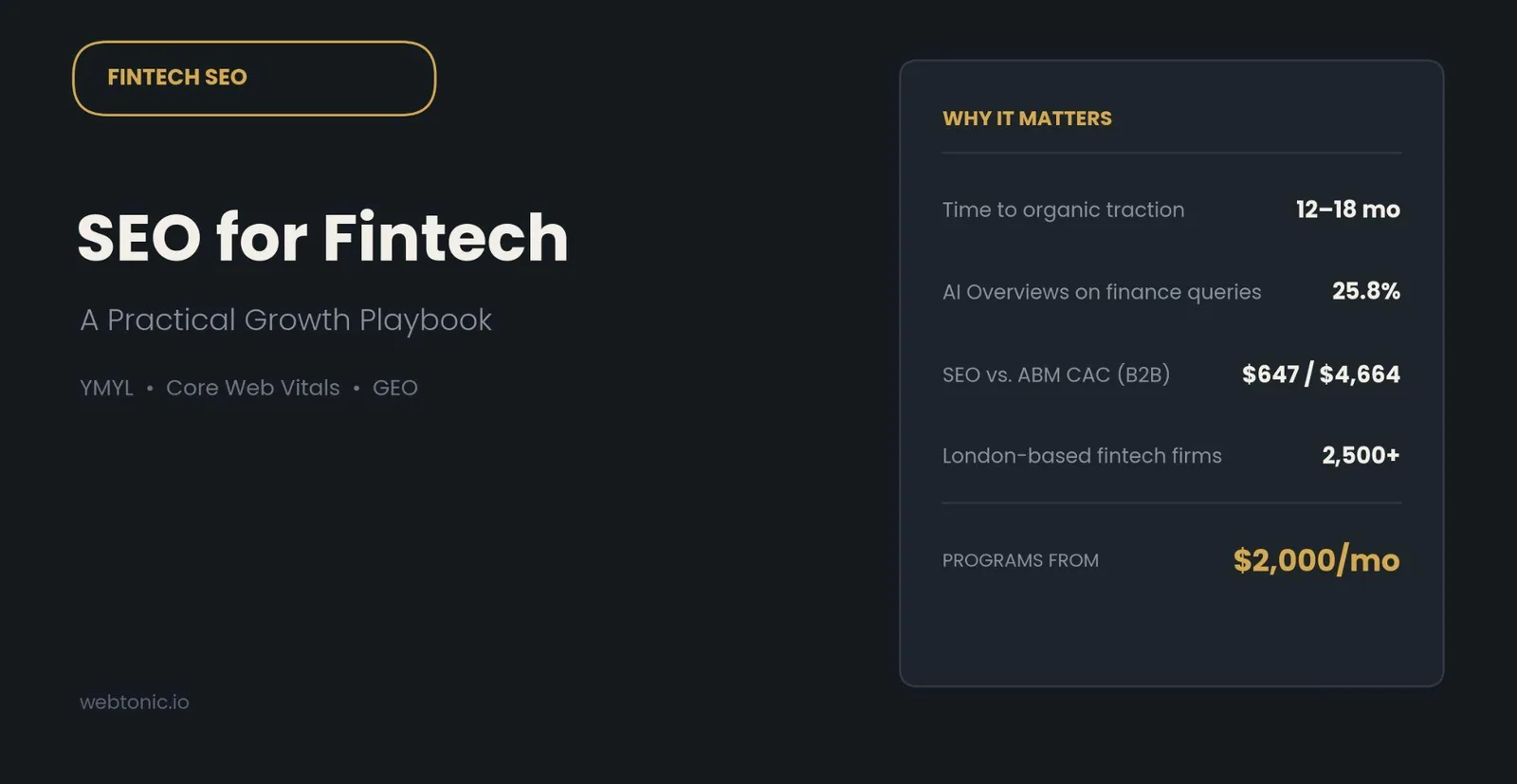
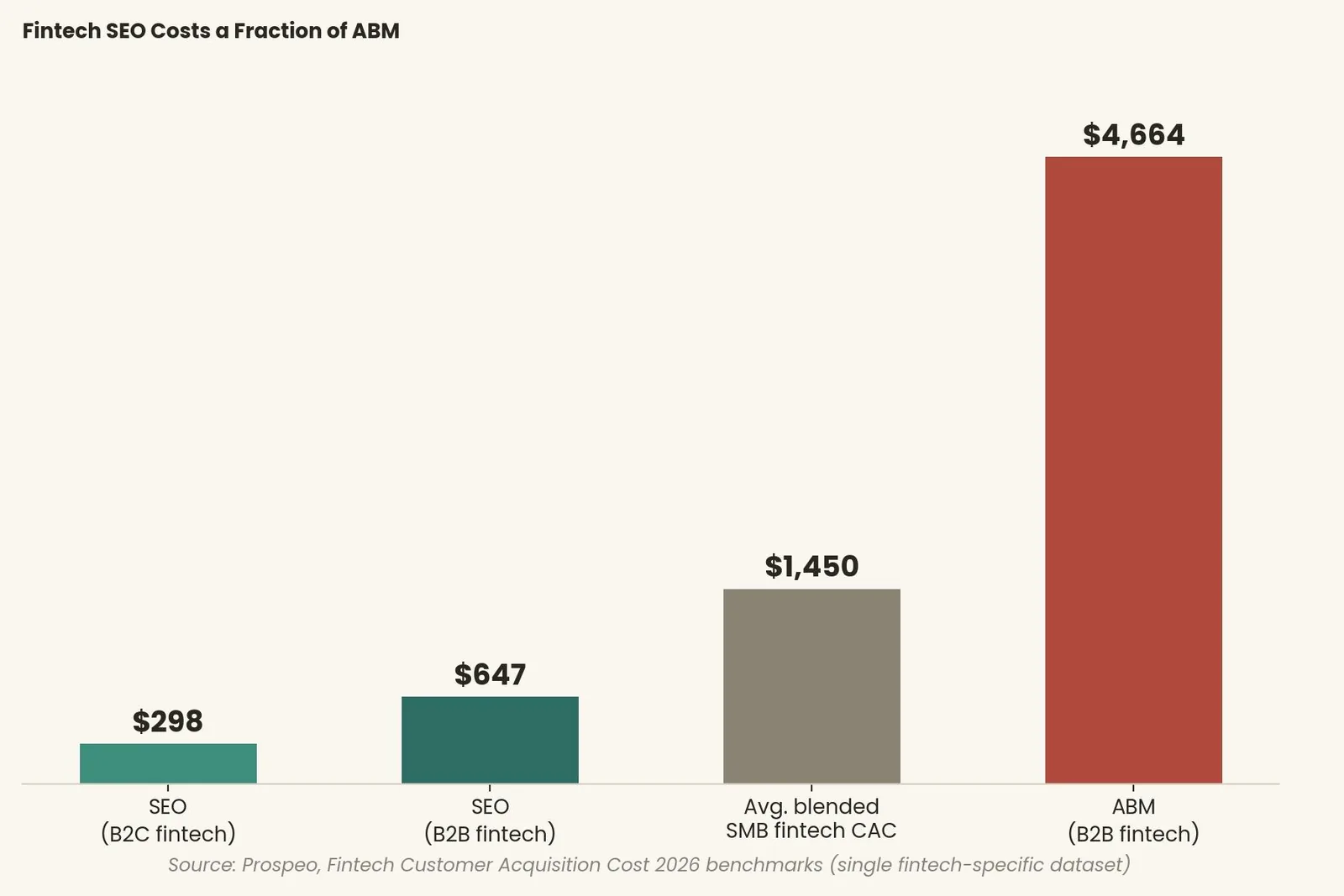
Fintech companies report among the highest customer acquisition costs of any industry — one industry analysis puts the average at $1,450 per new customer, and most fintech companies are still overpaying for it. SEO and content sit among the lowest-CAC channels for both B2B and B2C fintech, and the gap compounds every month a company delays building organic search visibility.
Search engine optimization for fintech isn't generic SEO with financial vocabulary swapped in. Google classifies fintech content under YMYL (Your Money or Your Life), which means every page is held to a compliance-aware, authority-heavy standard that a SaaS blog never has to clear. This playbook covers what actually moves rankings for financial services companies: technical foundations, E-E-A-T, user intent, and the emerging discipline of showing up in AI-generated answers, not just Google search console rankings.
Key Takeaways
- Fintech SEO takes 12–18 months to become a meaningful growth channel — far longer than the 3–6 months typical for SaaS, because YMYL scrutiny raises the trust bar.
- SEO and content are among the lowest-cost acquisition channels in fintech, running well below ABM on a cost-per-customer basis.
- Core Web Vitals failures are common and costly: under half of mobile pages pass all three metrics, and financial trust signals suffer when a site feels slow or unresponsive.
- AI Overviews now appear on over a quarter of financial-industry Google searches — generative engine optimization is no longer optional for fintech brands.
- A dedicated fintech SEO program typically runs $2,000–$10,000+/month; generalist freelancers who don't understand YMYL are a real compliance and ranking risk.
Why fintech SEO plays by different rules
Every ranking factor that applies to a normal website still applies here: content relevance, technical health, links from authority sites, and a clear read on user intent (informational, comparison, or ready-to-buy). What's different is the environment those mechanics operate in. Google's YMYL penalty for financial content is binary rather than gradual: pages that fall below the quality threshold become effectively invisible in search results regardless of keyword targeting, and new domains take two to three times longer to establish ranking authority for financial topics than for non-YMYL categories.
That means a fintech brand cannot run the same SEO strategies that work for an e-commerce brand. Author expertise has to be demonstrable rather than implied, and trust signals (security certifications, regulatory disclosures, transparent company information) factor directly into how Google evaluates a financial site. Citations and sourcing carry real weight, because an inaccurate claim about a lending product or a payment rail carries real financial risk for the reader.
A SaaS company might see meaningful organic traffic within three to six months of serious SEO; a fintech company should expect twelve to eighteen months before SEO becomes a significant growth channel. Domain authority takes longer to build in a category where compliance-driven trust matters this much, and where established financial services companies already carry decades of accumulated credibility within the fintech industry.
The technical foundation: Core Web Vitals, INP, and LCP
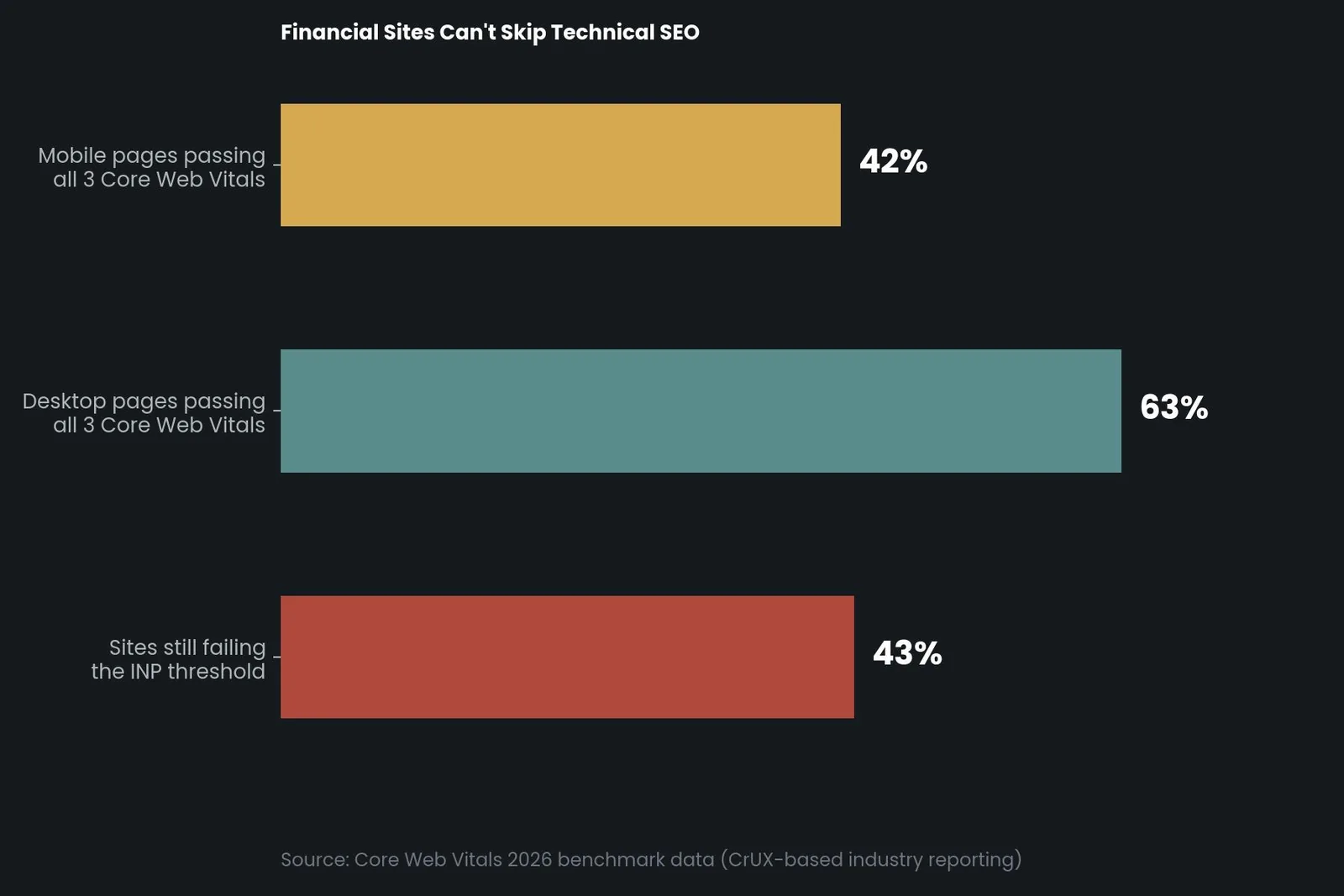
Only 42% of mobile pages and 63% of desktop pages currently pass all three Core Web Vitals thresholds, and INP is the metric most sites still fail: 43% miss the 200-millisecond responsiveness threshold. Technical SEO rarely generates rankings on its own, but for fintech it removes a ceiling that would otherwise cap everything else.
INP is the metric most sites still fail, which matters enormously for a fintech user trying to complete a transaction or check a balance without a laggy interface undermining their confidence in the platform.
LCP under 2.5 seconds is the highest commercial-impact fix. A slow-loading dashboard or pricing page signals unprofessionalism precisely where trust matters most, in a category where users are handing over sensitive financial information.
Mobile lags behind desktop. Fewer mobile pages pass all three Core Web Vitals thresholds than desktop pages, and mobile now carries the majority of fintech traffic, which makes the mobile performance gap a direct revenue problem, not just an engineering one.
Structured data extends beyond ranking. Schema markup for products and FAQs helps Google produce rich results, and it's increasingly what lets generative engine optimization systems extract clean, citable answers from your content.
Building E-E-A-T into fintech content
Experience, Expertise, Authoritativeness, and Trustworthiness are not a checklist item for financial content; they're the mechanism Google uses to decide whether a fintech page is safe to rank at all. In practice, this means:
- Named author bylines with real credentials. Anonymous or generic "Team" bylines are a red flag in YMYL categories; a credentialed author signals that a real subject-matter expert stands behind the claim.
- Primary-source citations. Linking to regulators, official data, and primary financial sources builds the trust that generic aggregation cannot.
- Long-tail keywords convert better than head terms. A phrase like "PCI-compliant payment API for marketplaces" signals far more purchase intent than "payment processing," and faces far less competition.
- Regular content review cycles. A March 2026 core update caused 40–60% traffic swings for financial sites lacking strong E-E-A-T signals, while well-credentialed sites saw gains of 15–25% over the same period, meaning the sites that had invested in authority signals were rewarded precisely when the sites that hadn't were penalized.
SEO vs. PPC: where fintech budgets should actually go
PPC has a real role in fintech: validating messaging, testing a new product launch, or capturing a small number of high-value commercial keywords while organic rankings build. What it isn't is a sustainable primary channel. Financial services keywords carry some of the highest average cost-per-click of any industry on Google, and using paid search as a permanent primary acquisition channel is rarely cost-effective for startups compared to investing that same budget into SEO and content over a 12-month horizon.
The cost math backs this up more broadly too. Across B2B tech generally, organic channels average $500–$1,500 per acquired customer versus roughly $802 for paid channels, with referrals the cheapest of all at $141–$200, though referrals alone don't scale the way a compounding organic content program does. The practical approach most fintech companies land on: PPC for immediate feedback and short-term demand capture, SEO for the compounding asset that keeps working after the ad budget stops.
Long sales cycles make this even more true for B2B fintech. A buyer comparing lending platforms or payment processors researches for weeks, sometimes months. Educational content, the kind that ranks organically, builds the trust that shortens that cycle in a way a paid ad rarely can.
Generative engine optimization: fintech's newest search surface
GEO (generative engine optimization) is the practice of structuring content so AI engines like ChatGPT, Google AI Overviews, and Perplexity cite it when generating answers, rather than optimizing purely for a ranked list of blue links. For fintech specifically, this has moved from experimental to structural.
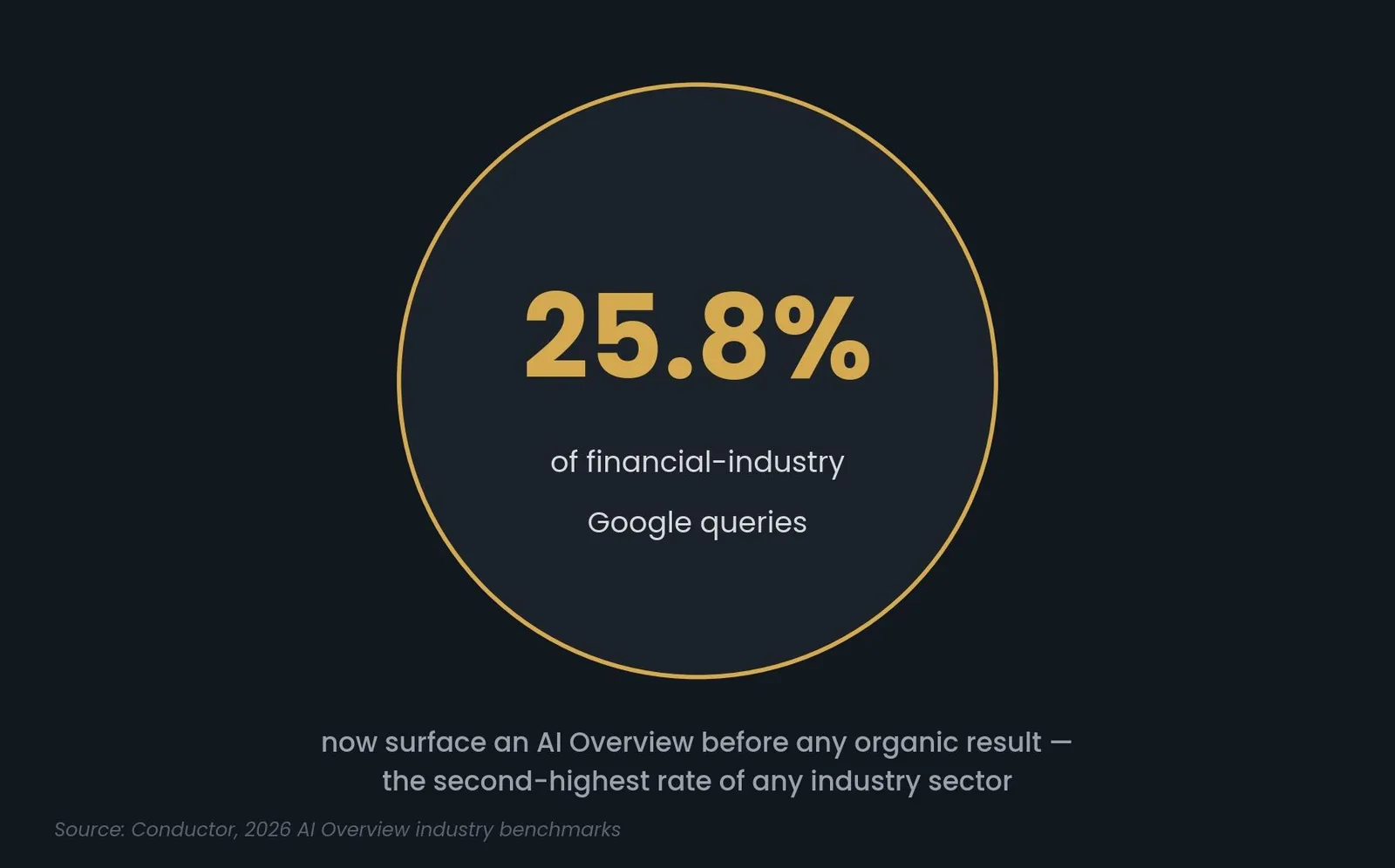
AI Overviews now appear in roughly 25.8% of all Google queries in the financial-services industry, the second-highest rate across all sectors, and LLM-sourced visitors typically convert at four to six times the rate of standard organic traffic. That conversion premium exists because a user arriving from an AI-generated recommendation has already received an implicit endorsement before they ever land on the page.
The YMYL classification carries over into AI search too. AI engines apply the same heightened scrutiny before citing financial content, so a consistent track record of accurate, well-structured content is a prerequisite for citation frequency to increase, though structural fixes like schema markup and FAQ implementation can produce first citations within 30–45 days for lower-competition queries.
Practical GEO steps that compound with traditional SEO: confirm AI crawlers aren't blocked in robots.txt, lead every section with a direct answer before supporting detail, implement Article and FAQ structured data, and prioritize earning mentions on third-party finance publications. AI engines tend to favor earned media over owned content.
What a fintech SEO program actually costs
| Approach | Typical Cost | What It Usually Covers | Best For |
|---|---|---|---|
| Generalist freelancer (non-specialized) | Variable, no fintech premium built in | Basic on-page fixes, general keyword research, without YMYL or compliance awareness | Not recommended for core fintech content; real ranking and compliance risk |
| Fintech-specialized SEO agency | $2,000–$10,000+/month | E-E-A-T content, technical SEO, Core Web Vitals fixes, GEO readiness, compliance-aware editorial | Most fintech companies building a durable organic channel |
| Specialized fintech link building (add-on) | $5,000–$10,000+/month | Editorial placements from finance-relevant publishers, digital PR | Companies with content foundations already in place, scaling authority |
Roughly 46% of fintech SEO professionals spend between $5,000 and $10,000 per month on link acquisition alone, reflecting how much more scrutiny link building requires in a YMYL category. A single low-authority backlink can actively damage a fintech site's credibility signals rather than help it.
Common mistakes to avoid
Treating fintech SEO like SaaS SEO is the most common one, expecting three-to-six-month results when the realistic YMYL timeline runs twelve to eighteen months, and abandoning the channel just as it was starting to compound.
Publishing content without visible author credentials causes just as much damage. A well-written article with no attribution and no update history will struggle to rank in this category regardless of keyword strategy or backlink count.
Skipping mobile Core Web Vitals is another frequent gap, optimizing the desktop experience while the majority of fintech traffic, and the majority of failing pages, sits on mobile.
Chasing generic backlinks instead of finance-relevant ones tends to backfire in a category this scrutinized, since a low-authority placement can actively hurt credibility signals rather than build them.
And ignoring AI search entirely is an increasingly expensive blind spot, given that a quarter of financial queries already surface an AI Overview before any organic result appears.
Interactive tool: how YMYL-ready is your fintech site?
Fintech SEO & YMYL Readiness Calculator
Google holds financial content to a higher bar than almost any other category. Check what already applies, then see where the biggest gap sits.
E-E-A-T & YMYL Signals
Technical Foundation
Content & Keyword Strategy
AI Search / GEO Readiness
Use the calculator above to score your current setup across E-E-A-T signals, technical foundation, content strategy, and AI search readiness. It won't replace a full audit, but it will show you where Google's YMYL bar is currently being missed.
Frequently asked questions
How long does fintech SEO take to show results? Most fintech websites see initial technical or on-page improvements within a few months, but meaningful organic growth typically takes 12–18 months given YMYL's elevated quality bar, longer than the 3–6 months common in less regulated categories.
Is GEO replacing traditional SEO for fintech? No. Traditional organic search still sends far more total traffic than AI platforms combined, but AI Overviews already appear on a meaningful share of financial queries, so the two need to run in parallel rather than as substitutes.
Should a fintech startup prioritize SEO or paid search first? Use PPC for fast validation of messaging and specific high-value keywords, but treat SEO as the primary long-term investment. It compounds and produces a materially lower cost per acquired customer over time.
Turning search visibility into pipeline
SEO for fintech rewards patience in a category that rarely offers any. The YMYL bar is real, the Core Web Vitals thresholds are non-negotiable, and the sales cycle is long, but the payoff is a channel that costs a fraction of paid acquisition once it compounds. Start with the technical foundation and genuine E-E-A-T signals, build content that demonstrates real expertise rather than generic financial explainer text, and treat generative engine optimization as a parallel track rather than an afterthought. London's 2,500+ fintech firms and every other market competing for the same search visibility aren't waiting; the compounding advantage goes to whoever starts building it first.
If your growth strategy also needs paid, creative, or lifecycle support alongside SEO, Web Tonic's growth marketing team works specifically with B2B software, fintech, and insurance clients to build attribution across every channel, not just organic.
More from Web Tonic: growth marketing services, data & analytics, performance creative.
Sources: trywebtec.com · prospeo.io · seofrancisco.com · fintechdigital.com · digitalapplied.com · itinfosys.uk · data-mania.com · wsa.design · rankz.co