Table of contents
A patient in Chicago searching for a new pediatrician doesn't call a friend first. They open Google, type "pediatrician near me," and choose from whichever three practices show up in the map pack. If your practice isn't one of them, that patient never even learns you exist.
SEO for doctors is the work of making sure your practice is the one that shows up: the Google Business Profile that's fully filled out, the reviews that build trust before a patient ever calls, and the website that loads fast and answers the question they searched. None of it requires becoming a marketer. It requires doing a specific, learnable set of things in the right order, which is exactly what this playbook walks through.
Key Takeaways
- 77 percent of patients begin their healthcare search on Google, and 84 percent check online reviews before choosing a new provider, making search visibility and reputation the two highest-leverage levers for patient acquisition.
- AI Overviews are now the most trusted section of Google for healthcare searches (37 percent), ahead of organic results, the local map pack, and sponsored listings, which means healthcare SEO now has to account for how AI systems summarize your practice, not just how you rank.
- A complete, accurate Google Business Profile (GBP), formerly Google My Business (GMB), is the single highest-impact asset for local SEO for doctors, since it directly drives map pack visibility.
- Consistent name, address, and phone number (NAP) details across your website, Google Maps, Healthgrades, and Zocdoc prevent patients from losing trust in your practice due to conflicting information.
- All patient-facing content needs a HIPAA compliance review before publishing. This is general marketing guidance, not legal advice, so check specifics with compliance counsel.
- Reviews carry outsized weight in healthcare: most patients read several before booking, and negative reviews can override a personal recommendation from a friend or family member.
What Is SEO for Doctors?
SEO for doctors is the practice of optimizing a medical practice's online presence so it ranks well in search results, appears in the local map pack, and earns patient trust before the first phone call. Some practices simply call this medical SEO or doctor SEO, same work either way. It covers the same core disciplines as any search engine optimization effort: technical health, content, local listings, and reviews, but weighted differently. For a medical practice, reputation and local visibility usually matter more than they do for other businesses, because choosing a doctor is a higher-stakes decision than choosing most other services.
That higher stakes bar is exactly why patients research so thoroughly before booking. Industry research notes that online search officially surpassed physician referrals as the leading way Americans find new doctors back in 2023, and that gap has only widened since. A medical practice website that doesn't show up in search engines, or shows up with outdated information, gets skipped in favor of the next practice on the list, regardless of how good the actual care is.
How Patients Actually Find Their Doctor
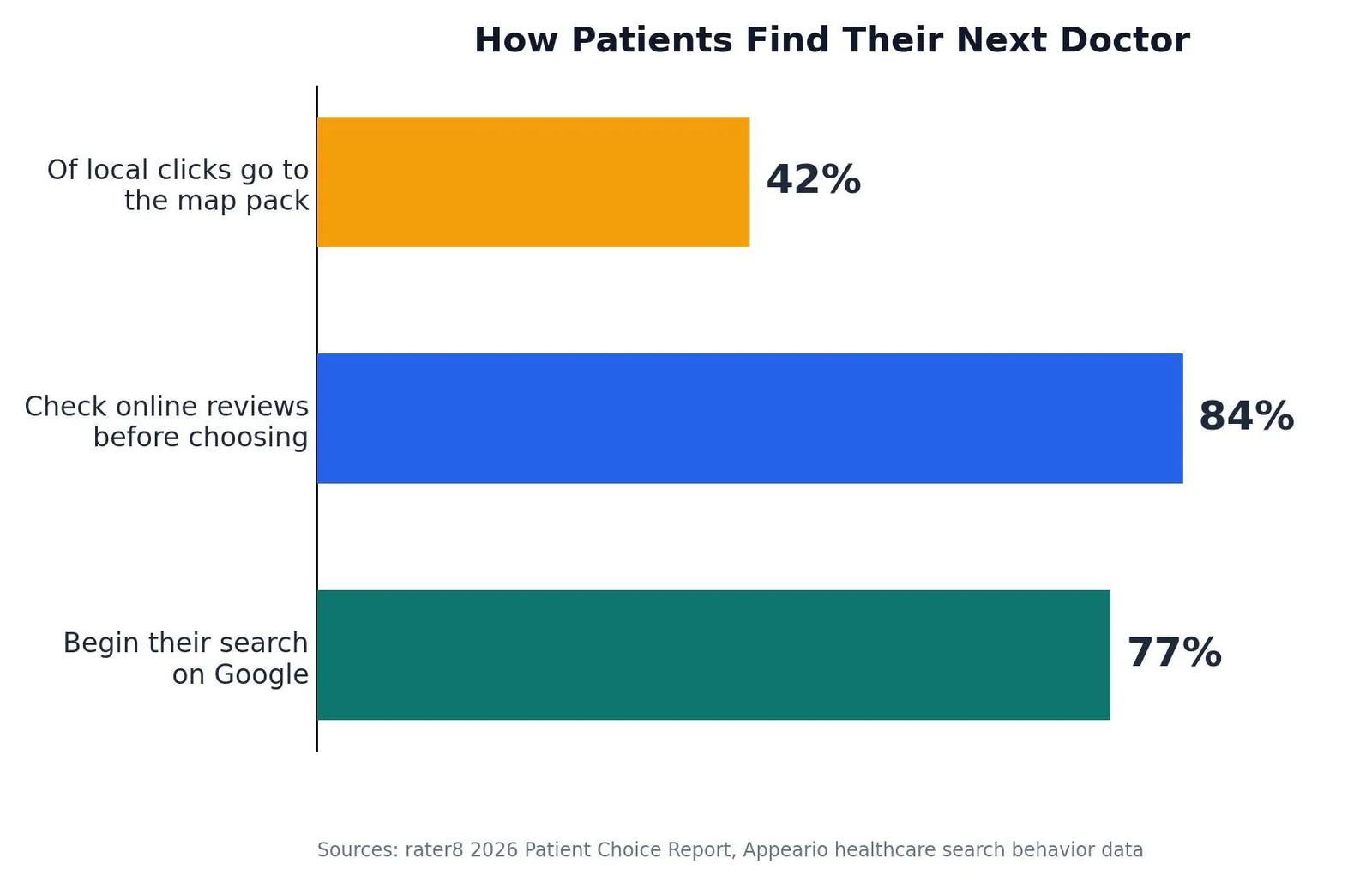
The numbers make the priority order clear. According to the rater8 2026 Patient Choice Report, 77 percent of patients begin their healthcare search on Google, and 84 percent check online reviews before choosing a provider. Separate research on healthcare search behavior found that getting into Google's local map pack accounts for 42 percent of all clicks on local medical searches.
Together, those numbers add up to the same warning: a practice that isn't visible on Google, isn't collecting reviews, and isn't showing up in the map pack is invisible to most patients before they've even had the chance to consider the quality of care.
Where Should Your Practice Show Up? Healthcare Directories Compared
| Directory | Monthly Visitors | Best For | Optimization Focus |
|---|---|---|---|
| Google Business Profile (GBP) | Not independently reported; reach follows Google's overall search volume | Local map pack visibility, "near me" searches | Complete profile, accurate hours, regular posts and photos |
| Healthgrades | ~100 million | Specialist searches (cardiology, orthopedics, etc.) | Complete provider bio, credentials, accepted insurance |
| Zocdoc | ~8 million | Online booking and insurance-based scheduling | Real-time availability, insurance accuracy |
| Vitals | ~10 million | Primary care research, detailed insurance info | Detailed profile, patient review responses |
Most practices only need to actively manage the top two or three, prioritized by where their specific patient base actually searches. A dermatology practice competing for elective procedures leans harder on Healthgrades and reviews; a primary care practice leans harder on GBP and insurance directory accuracy. Visitor figures above are drawn from 2026 healthcare search behavior research and will shift over time, so treat them as directional rather than exact.
The Patient Trust Funnel
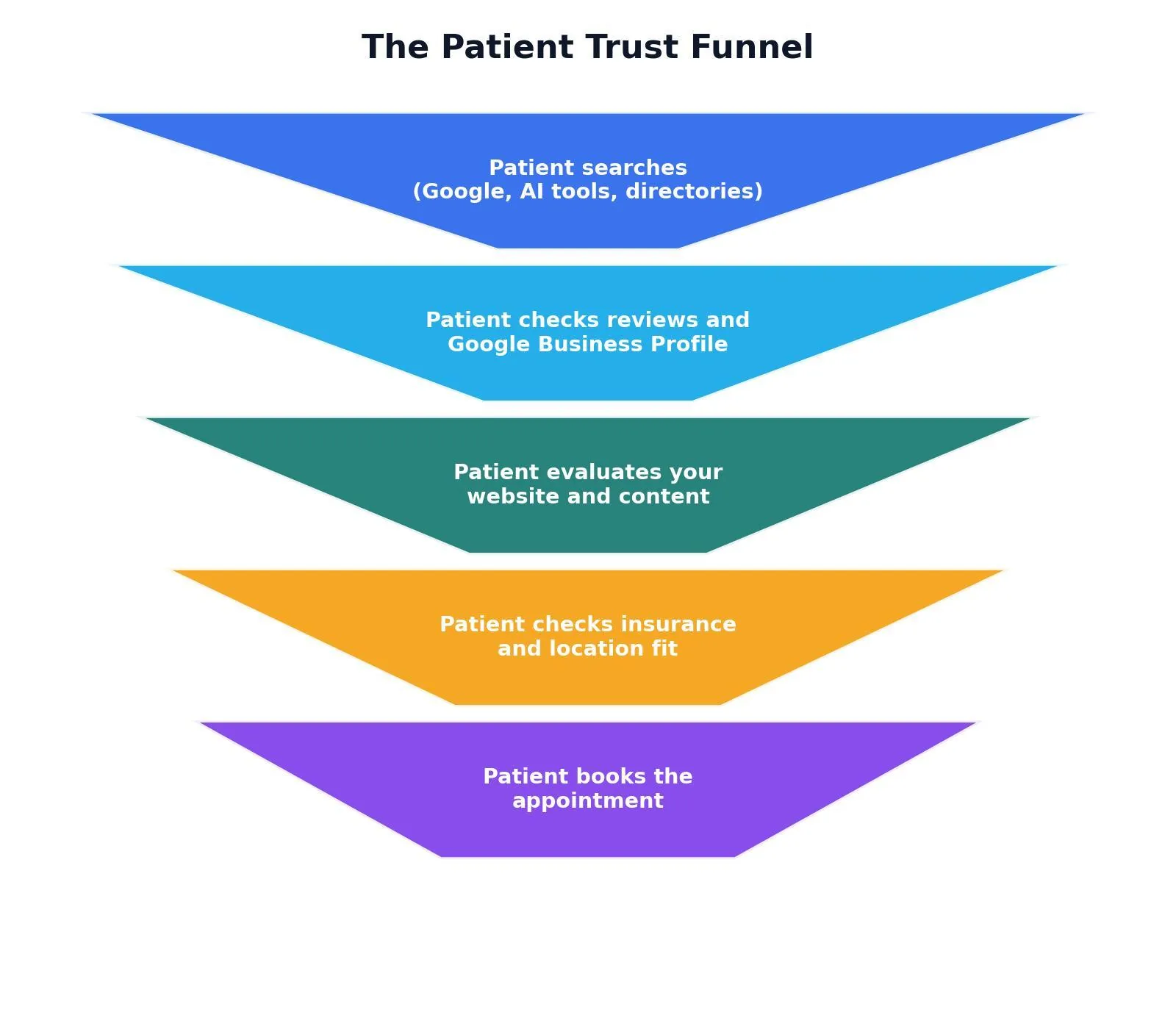
Every patient moves through roughly the same sequence before booking. They search, using Google, an AI tool, or a directory. They check reviews and your Google Business Profile for trust signals. They evaluate your website and content to confirm you actually treat what they need. They verify your practice accepts their insurance and is in a convenient location. Only then do they book. A weak link at any stage, an incomplete profile, thin reviews, a slow website, loses the patient regardless of how strong the other stages are.
Which Part of Google Do Patients Trust Most?
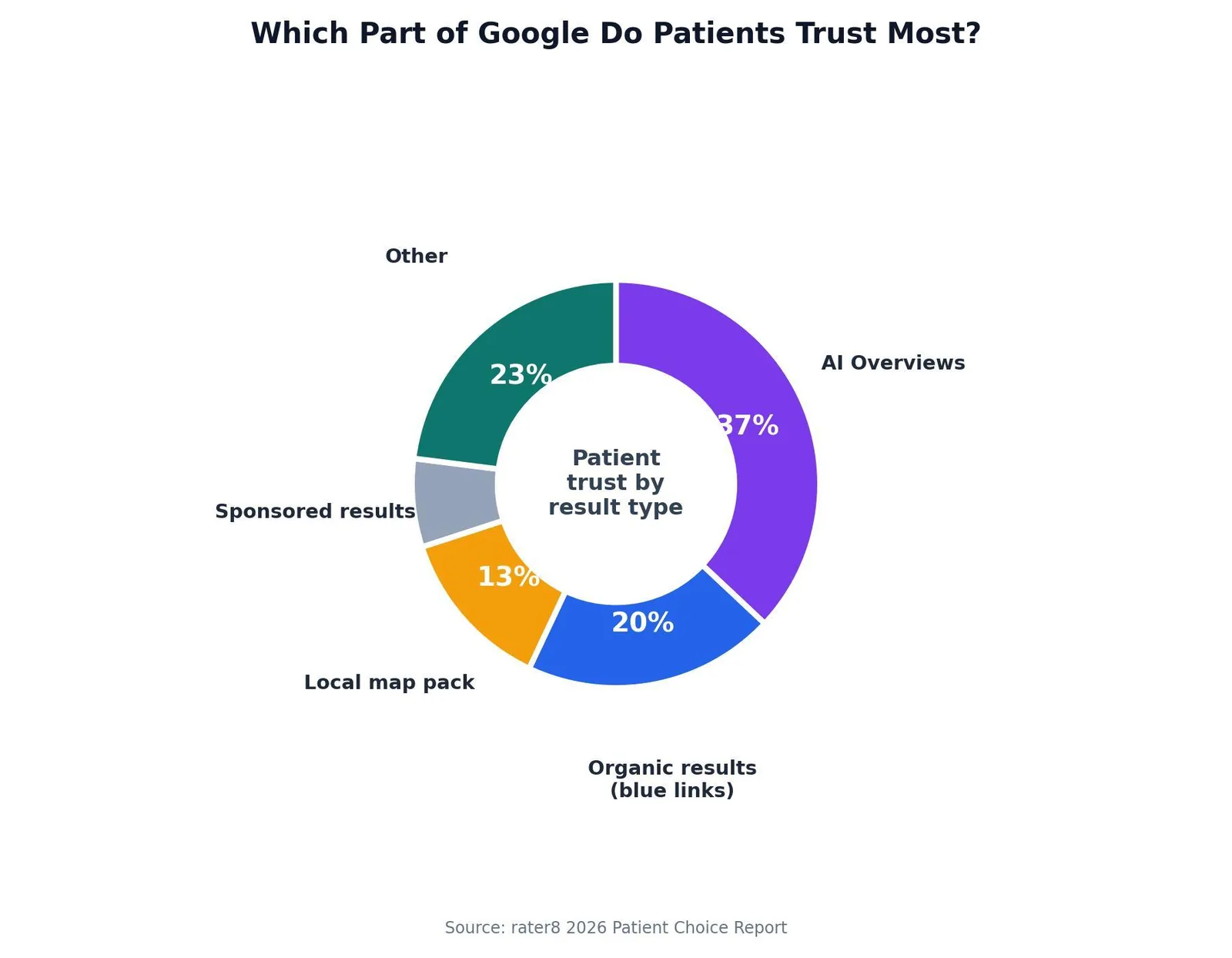
Search behavior for healthcare queries has shifted meaningfully. Per the same 2026 Patient Choice Report, AI Overviews are now the most trusted section of Google for healthcare searches at 37 percent, ahead of traditional organic results at 20 percent, the local map pack at 13 percent, and sponsored results at just 7 percent. AI tools like ChatGPT and Claude are increasingly cited as a direct influence on which doctor a patient chooses. rater8's 2026 research found AI tools cited as an influence by 36 percent of patients who'd recently switched providers, edging out Google search itself at 34 percent.
That shift builds on the fundamentals covered in this guide rather than replacing them. AI systems pull their summaries from the same signals this playbook already prioritizes: Google Business Profile accuracy, review content, and clearly structured, trustworthy website content. Social media presence factors in too. rater8's research found that over a third of patients have chosen a doctor partly based on social media presence, which makes it a real supporting signal worth building into the mix.
The SEO for Doctors Roadmap
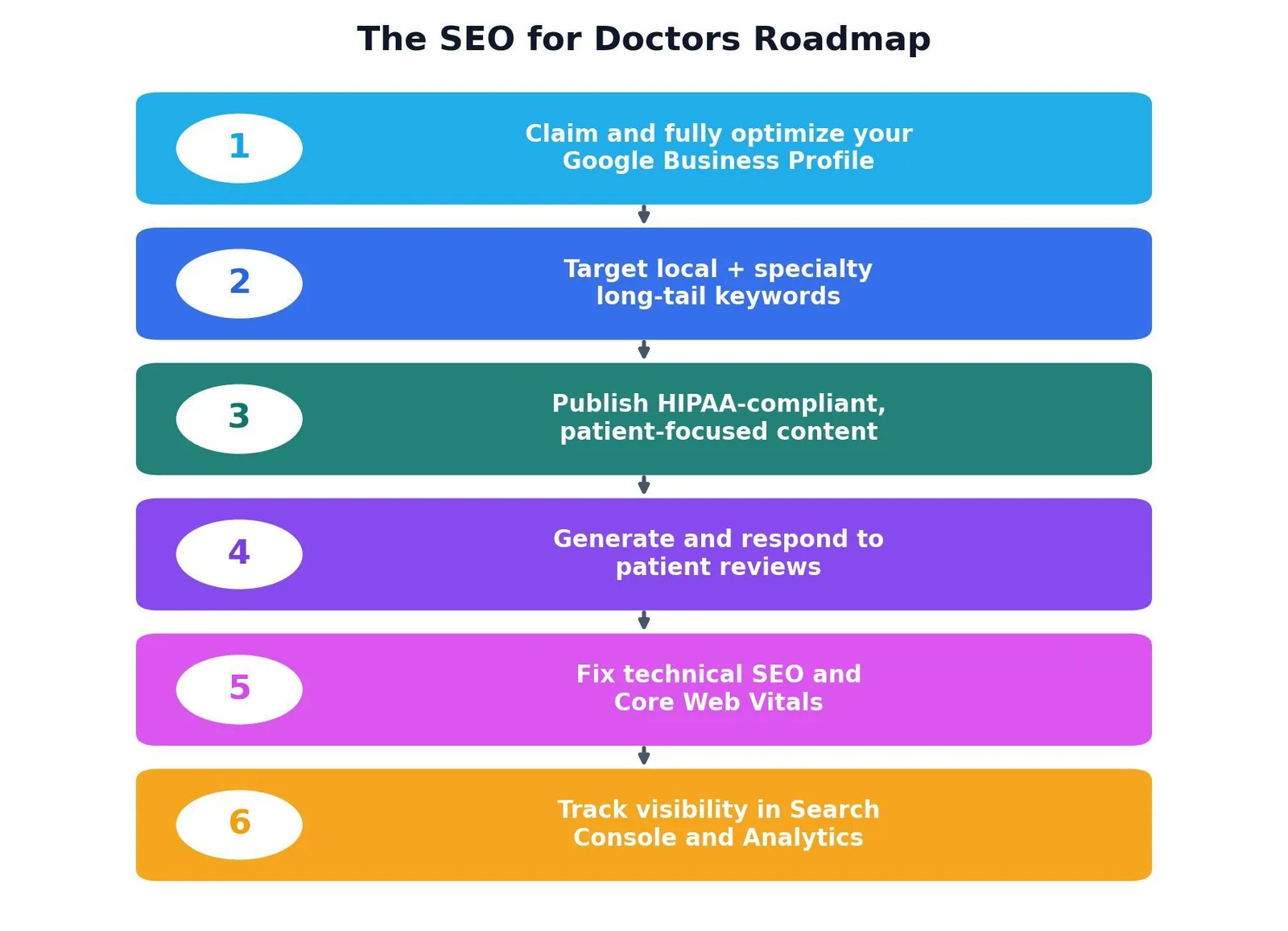
Step 1: Claim and fully optimize your Google Business Profile
This is the single highest-leverage action available. A complete Google Business Profile, accurate hours, correct address phone number, current photos, and the right practice categories, is what decides whether you appear in the map pack for "near me" searches. Google's own guidance confirms that local ranking comes down to relevance, distance, and prominence, and that businesses with complete, accurate information are more likely to show up in local search results at all.
Step 2: Target local and specialty long-tail keywords
Broad terms like "doctor" are unwinnable for most independent practices. Long tail keywords that combine specialty and location, like "pediatric dermatologist New York," give a practice a realistic shot at ranking while still reaching patients with real, specific intent.
Step 3: Publish HIPAA-compliant, patient-focused content
Practice SEO tool
Is your practice visible where patients search?
Check off what's already true for your practice. Your score updates as you go.
0 of 5
Check off items above to see how visible your practice really is.
Medical content needs to answer real patient questions clearly and accurately, and every piece needs a compliance check before publishing since HIPAA governs what can be shared, including in patient testimonials and case examples. HHS guidance is explicit that using a patient's protected health information in a promotional communication, a testimonial or case example included, generally falls under the Privacy Rule's definition of marketing and requires the patient's written authorization beforehand. Each page should also end with a clear CTA (call-to-action), a simple "book an appointment" or "call now" prompt, since content that ranks well but doesn't direct the reader anywhere wastes the visibility it earned. This is general guidance, not legal advice, so a compliance review by qualified counsel is worth doing before anything goes live.
Step 4: Generate and respond to patient reviews
Reviews are one of the strongest local seo signals available and the single biggest trust factor for potential patients comparing providers. BrightLocal's 2026 Local Consumer Review Survey found that 97 percent of consumers read reviews before choosing a local business, which underscores why a simple, consistent system for asking patients to leave a review after a good visit, and responding to every review, positive or negative, compounds over time.
Step 5: Fix technical SEO and Core Web Vitals
A medical practice website that loads slowly or breaks on mobile loses patients before they read a word of content. Google's own Search Central documentation confirms that Core Web Vitals, loading speed, responsiveness, and visual stability, are metrics its core ranking systems use to reward good page experience, alongside clean navigation and a simple online booking flow, all of which shape whether a visit turns into a booked appointment.
Step 6: Track visibility in Search Console and Analytics
Google Search Console and Google Analytics show exactly which searches bring patients to the site and which pages actually convert into booked appointments, which is the only reliable way to know whether the previous five steps are working.
Common SEO Mistakes Medical Practices Make
The most common one is leaving the Google Business Profile incomplete or outdated, which costs map pack visibility that's otherwise free to earn.
A close second is inconsistent name, address, and phone number details across directories. Patients and Google's local ranking algorithm both read that inconsistency as a trust risk, and it can quietly drag down search engine rankings across the board.
Reviews get ignored just as often, and not responding to negative ones is worse than ignoring them, since it hands control of the practice's online presence to whoever posts next.
Publishing content without a compliance check rounds out the list, and it creates real regulatory exposure under HIPAA well beyond the marketing cost of getting it wrong.
Frequently Asked Questions
How is SEO for doctors different from general local SEO?
The mechanics overlap heavily with any local seo effort: Google Business Profile, reviews, and consistent listings. What's different is the compliance layer. Healthcare SEO has to account for HIPAA in every piece of patient-facing content, and reviews and trust signals carry more weight given how high-stakes the decision is for patients.
Do I need to hire an SEO company, or can I do this myself?
Steps 1, 2, and 4 (Google Business Profile, keyword targeting, and review generation) are realistic for a practice manager to handle directly. Technical fixes and ongoing content strategy are where most practices benefit from outside SEO services or an agency with healthcare experience, particularly for the compliance review that catches the two failure points practices hit most often: an abandoned technical backlog and content that skips the HIPAA check.
How much should a medical practice budget for SEO?
It depends on practice size, competition in your specialty and city, and whether work is done in-house or outsourced, so there's no single number that applies broadly. Get a quote specific to your practice and location before committing budget, and treat any number quoted in USD as a starting point for negotiation, not a fixed rate.
Does paid search (PPC) help alongside SEO for doctors?
Yes, they serve different purposes. PPC can fill gaps immediately, such as launching a new location or service line, while SEO and reputation work build the durable visibility that keeps paying off long after any specific ad campaign ends.
The Bottom Line on SEO for Doctors
Patients research doctors the way they research almost everything else now: search, reviews, website, then a decision. A practice that shows up accurately in that sequence, complete Google Business Profile, consistent listings, active reviews, a fast and clear website, wins patients before a single phone call happens. United States healthcare is a trust-driven, high-stakes purchase decision, and visibility built the right way is what earns that trust before the first appointment.
Start with your Google Business Profile this week. It's free, it's the highest-leverage item on this list, and most practices haven't fully optimized it yet.
Ready to Grow Your Practice's Patient Pipeline?
Getting search visibility, reviews, and compliant content working together without in-house expertise is where most independent practices lose time they don't have. Web Tonic's growth marketing team handles the technical SEO, local optimization, and content work covered in this playbook as part of a full-funnel approach that also connects it to paid acquisition and reputation management, so your team can stay focused on patient care.
More from Web Tonic: growth marketing services, data & analytics.
Sources: netoneclick.com · rater8.com · appeario.co · support.google.com · hhs.gov · brightlocal.com · developers.google.com