



Table of contents
Fewer than 30% of franchise location pages rank in the top-3 local pack results for their primary service keyword, according to a 2026 study of 41 multi-location brands. For franchise operators competing across dozens or hundreds of territories, search engine optimization is no longer a nice-to-have — it is the channel that determines whether each location captures its share of high-intent local demand. The data below reveals where the gaps are, what top performers do differently, and how the economics of franchise SEO stack up against other acquisition channels in 2026.
Key Takeaways
- Less than 30% of franchise location pages appear in the top-3 map pack for their primary service term in their own territory (Authority Specialist, 2026).
- Google Business Profile signals account for 32% of local pack ranking weight — the single largest factor (Whitespark / BrightLocal, 2026).
- 72% of franchise systems now allocate at least 40% of their marketing budget to local SEO, making it the highest-ROI channel in the franchise mix (BizIQ, 2026).
- Well-optimized location pages reach 200–600 monthly organic sessions within 6–12 months in mid-competition markets (Authority Specialist, 2026).
- Locations with complete GBP profiles are 70% more likely to attract visits and 50% more likely to generate purchase consideration (Google / BizIQ, 2026).
- GBP actions rose 41% year-over-year across franchise networks, reflecting growing consumer interaction with local listing features (BizIQ, 2026).
| Metric | Benchmark | Source |
|---|---|---|
| Location pages in top-3 map pack | < 30% | Authority Specialist 2026 |
| GBP signal weight in local ranking | 32% | Whitespark / BrightLocal 2026 |
| Proximity weight in map ranking | ~55% | Clarity Digital 2026 |
| Review signal weight | 16–20% | Clarity Digital 2026 |
| Franchise systems prioritizing local SEO | 72% | BizIQ 2026 |
| GBP actions YoY increase | +41% | BizIQ 2026 |
| Organic sessions per location (6–12 mo) | 200–600 / month | Authority Specialist 2026 |
| Complete GBP → visit likelihood lift | 70% more likely | Google / BizIQ 2026 |
Local Pack Rankings: Where Franchise Locations Stand
The local map pack is the highest-visibility real estate in franchise search. Across the 41 multi-location brands analyzed by Authority Specialist in 2026, fewer than 30% of individual location pages rank in the top three for their primary service term within their own territory. That figure underscores a widespread optimization gap: most franchisees have a Google Business Profile but have not invested in the listing quality, review velocity, or on-page signals needed to crack the pack.
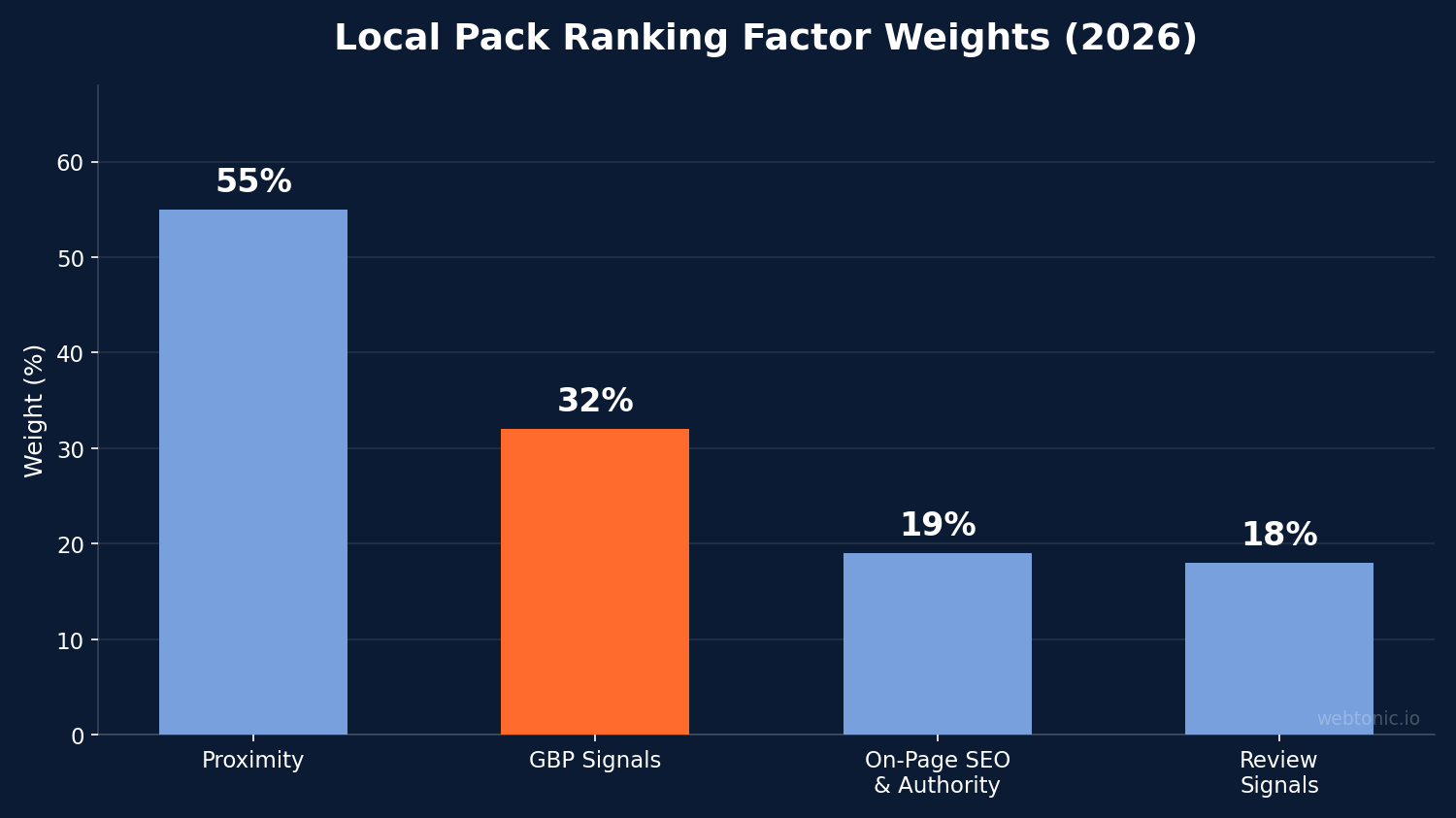
Ranking factors in 2026 continue to weight proximity most heavily at roughly 55% of the ranking decision, followed by GBP signals at 32%, review signals at 16–20%, and on-page SEO plus website authority at about 19% (Clarity Digital, 2026). For franchise networks, these percentages create a clear playbook: proximity cannot be changed, but GBP completeness, review generation, and localized content are controllable levers that separate top-performing locations from the rest.
Google Business Profile Performance Across Franchise Networks
Google Business Profile remains the single most influential local search asset for franchise operators. Locations with fully completed profiles — including categories, services, hours, and photo content — rank in the local pack at meaningfully higher rates than those with sparse listings. According to BizIQ's 2026 franchise marketing report, GBP actions grew 41% year-over-year across franchise networks, driven by direction requests, click-to-call, and website visits from the listing itself.
The data also shows that complete profiles are 70% more likely to attract visits and 50% more likely to generate purchase consideration than minimal ones. For networks managing hundreds of listings, centralized profile management — automating category selection, hours syncing, and photo distribution — separates scalable operations from the franchises that leave local visibility to chance. Engagement lift from consistent multi-location listing data runs 1.4–2.0× higher than inconsistent networks (BizIQ / industry research, 2025–2026).
Organic Traffic Benchmarks by Location Type
| Location Scenario | Monthly Organic Sessions (6–12 mo) | Context |
|---|---|---|
| Mid-competition market, optimized page | 200–600 | Subfolder / subdomain with active SEO |
| High-competition metro, established brand | 600–1,500+ | Requires link building + content depth |
| Low-competition rural, new franchisee | 80–200 | Smaller search volume ceiling |
| Unoptimized location page (baseline) | 15–50 | No schema, thin content, incomplete GBP |
Authority Specialist's 2026 franchise audit found that well-optimized location pages in mid-competition markets reach 200–600 monthly organic sessions within 6–12 months of active optimization. Higher-competition metros require deeper content investment and link building to break past the 600-session mark, while rural locations face lower ceilings due to smaller search volume pools. The gap between optimized and unoptimized pages — often a 10× difference — represents the clearest ROI case for franchise SEO investment.
Each location page that a franchise adds to its site also contributes to the brand's overall topical footprint in search, reinforcing domain authority and creating internal linking opportunities across territories. Franchise networks that treat location pages as thin directory entries rather than content assets leave significant organic traffic on the table.
Content Marketing and Organic Visibility
Franchise brands investing in content marketing generate more sustainable lead flow than paid-only strategies, according to Marketing LTB's 2026 analysis. Search engine visibility remains a top lead source for franchise systems, and content marketing improves long-term organic visibility by building keyword coverage across service and location queries.
The most effective franchise content strategies follow a hub-and-spoke model: a central resource hub supported by localized content for each territory. Vendasta's 2026 franchise SEO guide emphasizes tracking organic traffic per location (filtered by URL prefix in Google Search Console) and conversion rate per location landing page — form fills, phone calls, and booking completions — as the KPIs that connect SEO work to franchisee revenue.
Non-branded click traffic is under pressure from AI Overviews in 2026. Search Engine Journal reports that multi-location brands are seeing year-over-year drops in non-branded clicks as AI-generated answers capture informational queries. The defensive strategy: own the answer-box content with structured FAQ sections, and shift measurement toward branded search growth and direct conversion actions rather than raw click volume.
Budget Allocation: How Franchise Systems Invest in SEO
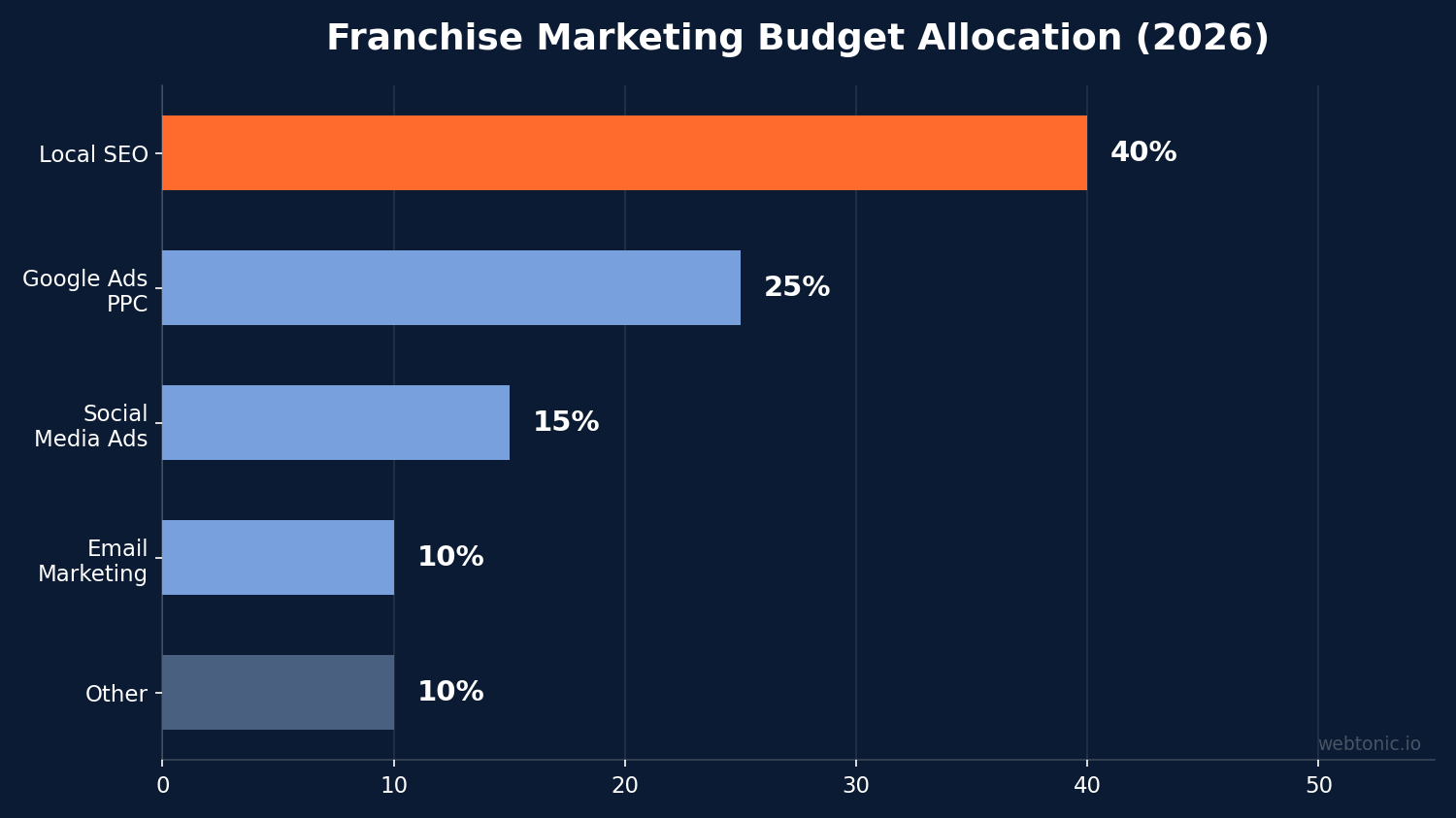
72% of franchise systems now allocate at least 40% of their total marketing budget to local SEO, making it the highest-ROI channel in the franchise mix (BizIQ, 2026). That share reflects the compounding economics of organic search: unlike paid channels where cost-per-lead increases with competition, SEO investment builds equity that reduces cost-per-acquisition over time.
BizIQ's data also highlights a 3.5× average ROI for franchise PPC campaigns, making paid search the second-most predictable lead channel. However, the long-term cost trajectory favors the sector's shift toward organic: franchise brands investing in both SEO and paid search report a blended cost-per-lead 35–45% lower than those running ads alone, because organic captures the re-search and branded queries that paid campaigns initially generate (Emulent, 2026).
Citation Building and NAP Consistency
Name-Address-Phone (NAP) consistency across directories remains a foundational local ranking signal. When the same NAP data appears consistently across Google Business Profile, Apple Maps, Bing Places, Yelp, and Facebook, Google treats it as a confirmation signal that strengthens the location's local authority. Inconsistent data — different phone numbers, outdated addresses, or mismatched business names — fragments ranking signals and can push a location out of the map pack entirely.
For franchise networks with dozens or hundreds of locations, citation management at scale requires automation. Core directories to maintain include Google Business Profile, Apple Maps, Bing Places, Yelp, Facebook, and industry-specific platforms. Vendasta's 2026 franchise SEO guide recommends tracking the top 50 citation sources per location and running quarterly audits to catch data drift from directory scrapers and aggregator updates.
Search Engine Optimization ROI Compared to Other Channels
| Channel | Avg. CPL (Franchise) | ROI Multiple | Time to Results |
|---|---|---|---|
| Local SEO | $25–$55 | 5–8× | 4–8 months |
| Google Ads PPC | $80–$150 | 3.5× | 1–2 weeks |
| Social Media Ads | $45–$90 | 2–4× | 2–4 weeks |
| Email Marketing | $15–$30 | 4–6× | Ongoing |
| Lead Aggregators | $65–$140 | 1.5–3× | Immediate |
Local SEO delivers the lowest cost-per-lead and the highest long-term ROI for franchise systems, though it requires the longest ramp-up period. The $25–$55 CPL range for organic leads reflects the compounding value of optimized location pages, GBP listings, and review profiles that continue generating leads without incremental spend. By contrast, paid search offers immediate results at a 3.5× ROI but with CPLs that climb as competitors bid up the same keywords.
Multi-Location SEO Strategy Best Practices
- Centralize GBP management — automate category selection, hours syncing, and photo distribution across all locations to maintain 32%-weight ranking signals at scale.
- Build unique location pages — each territory needs content specific to its service area, local landmarks, and competitive landscape, not duplicated boilerplate with a swapped city name.
- Monitor organic traffic per location — filter Google Search Console data by URL prefix to track individual location performance and identify underperforming territories.
- Pursue review velocity — review signals carry 16–20% weight in local rankings; systematic review request workflows yield more ranking impact than occasional one-off asks.
- Run quarterly citation audits — track NAP consistency across 50+ directories per location, catching data drift from aggregator updates and directory scraping.
- Use subfolder architecture — locations under the main domain (e.g.,
/locations/city-name) inherit domain authority, outperforming standalone microsites in most competitive verticals. - Defend against AI Overviews — add structured FAQ schema and answer-first content formats to maintain visibility as AI-generated answers absorb informational queries.
Franchise SEO Technology Stack
The franchise SEO technology landscape has matured significantly. Centralized listing management platforms — covering GBP, citations, reviews, and local rank tracking — are now table stakes for networks above 25 locations. The tools that move the needle for multi-location brands in 2026 include automated review response, AI-assisted content localization, and rank-tracking dashboards that surface territory-level performance without requiring each franchisee to log into separate analytics accounts.
Specialized franchise SEO tools saw publication rates jump from 15% to 80% when networks adopted centralized social and content management platforms (nPosts.ai, 2026). That same centralization principle applies to local search data: consolidating rank tracking, GBP insights, and conversion data into a single dashboard gives franchise leadership the visibility needed to allocate SEO resources across the network efficiently.
FAQ
What percentage of franchise locations rank in the local map pack?
Fewer than 30% of franchise location pages rank in the top-3 local pack results for their primary service keyword, based on a 2026 study of 41 multi-location brands by Authority Specialist. The gap is driven primarily by incomplete Google Business Profiles, low review velocity, and thin location page content.
How much should a franchise system invest in SEO?
In 2026, 72% of franchise systems allocate at least 40% of their marketing budget to local SEO. The exact investment depends on location count, market competition, and current organic baseline, but SEO consistently delivers the lowest cost-per-lead ($25–$55) and highest long-term ROI across franchise marketing channels.
What is the most important local ranking factor for franchise locations?
Google Business Profile signals account for 32% of local pack ranking weight — the single largest controllable factor. Proximity (55%) matters most overall but cannot be influenced. Completing all GBP fields, maintaining review velocity, and syncing accurate NAP data across directories yield the greatest ranking improvement for franchise operators.
How long does franchise SEO take to produce results?
Well-optimized location pages in mid-competition markets typically reach 200–600 monthly organic sessions within 6–12 months of active optimization. Higher-competition metros require deeper content investment and link building, while rural locations may see faster initial rankings but face lower traffic ceilings due to smaller search volume pools.
How do AI Overviews affect franchise SEO in 2026?
Multi-location brands are reporting year-over-year drops in non-branded click traffic as AI-generated answers capture informational queries. The defensive strategy involves structured FAQ schema, answer-first content formats, and shifting measurement toward branded search growth and direct conversion actions rather than raw click volume.
Sources
authorityspecialist.com/industry/professional/consultant/franchise-seo-statistics
biziq.com/blog/multi-location-seo-statistics
biziq.com/blog/franchise-marketing-statistics-2026
claritydigital.agency/blog/google-maps-ranking-playbook-multilocation-franchise-brands-2026
marketingltb.com/blog/statistics/franchise-marketing-statistics
vendasta.com/blog/seo-for-franchise-websites
emulent.com/resources/trends/franchise-marketing-trends
searchlab.nl/en/statistics/google-business-profile-statistics-2026
brightlocal.com/research/google-business-profile-insights


