Table of contents

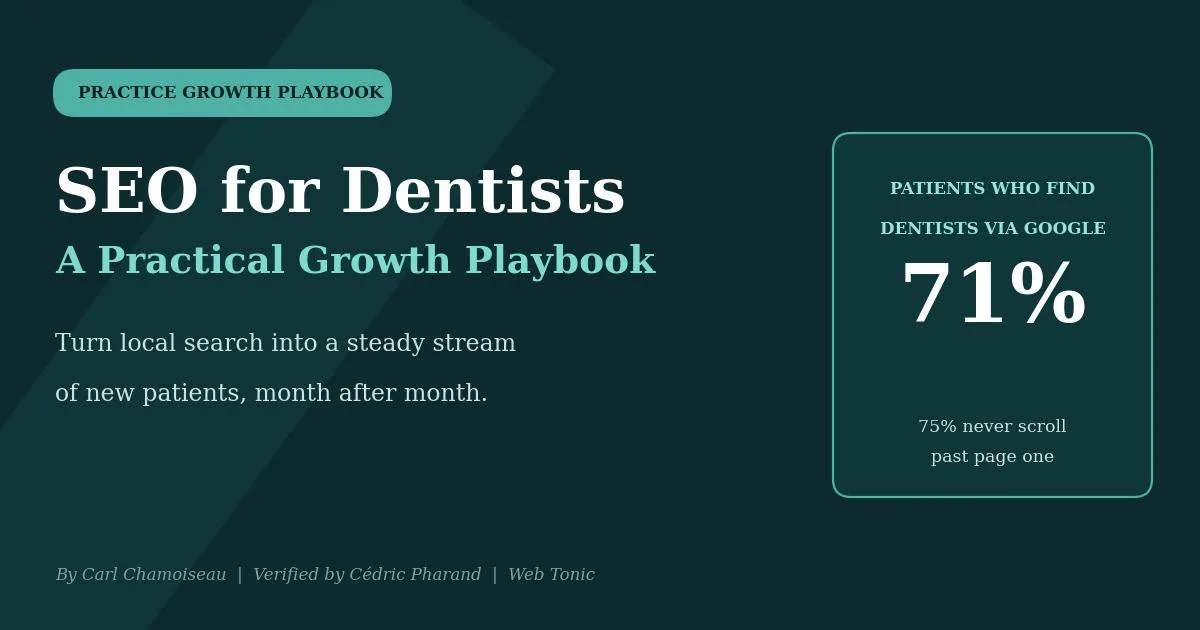
Most patients don't ask their neighbor for a dentist recommendation anymore. They open Google, type "dentist near me" or "emergency dentist [city]," and book with whoever shows up first, looks trustworthy, and has the reviews to prove it. 71% of patients use Google to find a dentist, and 75% never click past the first page of results, according to Rankfast's 2026 Dental SEO Services Pricing report. If a practice isn't ranking, it's effectively invisible to three out of four people searching for exactly the service it offers.
SEO for dentists is the process of optimizing a practice's website, Google Business Profile, and online reputation so it ranks for the searches real patients are making, both in traditional organic results and in the Google Maps "Local Pack" that most mobile searchers see first. Done properly, it turns into a compounding asset rather than a recurring expense: unlike paid ads, which stop producing the moment the budget stops, SEO keeps generating patient inquiries long after the initial work is done.
Key takeaways
- 71% of patients use Google to find a dentist, and 75% never scroll past page one, making search visibility the single biggest lever for new-patient volume.
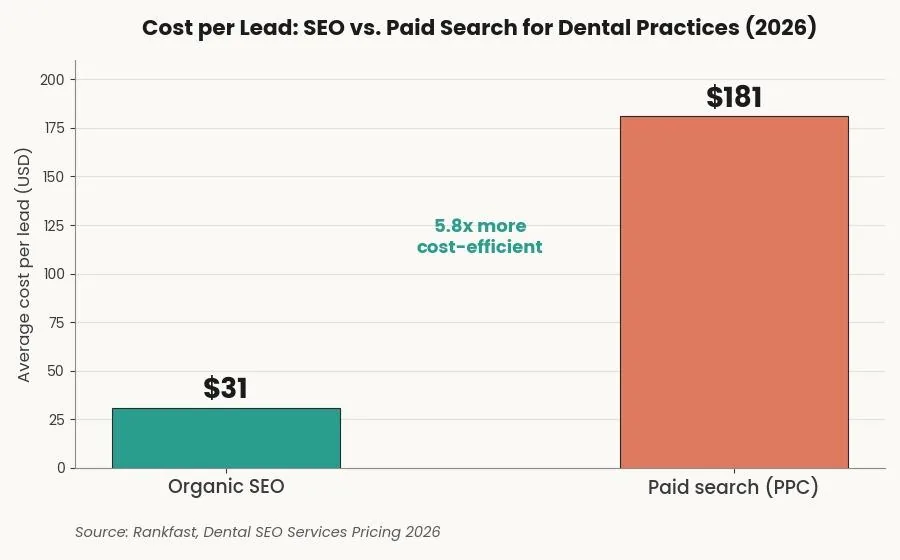
- Organic SEO delivers a cost per lead of about $31, compared to $181 for paid search, making SEO about 5.8 times more cost-efficient per lead.
- Dental SEO pricing in 2026 typically runs $900 to $3,500 a month for most growing practices, with a full range of $500 to $10,000+ depending on market competition.
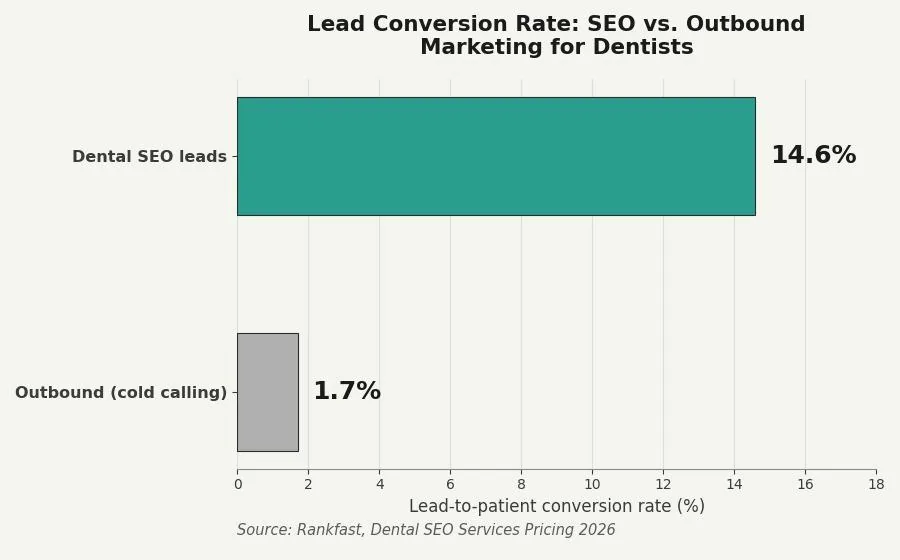
- Dental SEO leads convert at 14.6%, compared to just 1.7% for outbound methods like cold calling.
- Practices that own the top three Google Maps Local Pack positions capture 60-70% of new-patient clicks for that category.
- 97% of consumers rely on reviews to guide purchase decisions, and review recency is now a direct local ranking signal, not just a trust signal.
- Meaningful results typically take 3-6 months for early traction and 6-12 months for competitive terms, so SEO needs to be budgeted as a long-term investment, not a 30-day fix.
Why SEO matters more for dentists than most local businesses
Dental websites fall into Google's YMYL category, "Your Money or Your Life," which means Google holds them to a higher content bar than a typical local business. Search quality raters expect dental content to demonstrate real experience, expertise, authoritativeness, and trustworthiness (E-E-A-T), a standard Google lays out directly in its guidance on creating helpful, reliable, people-first content. In practice, that means blog content and service pages should be written or reviewed by a practicing dentist, not just optimized for keywords.
The competitive stakes are unusually high, too. A single new patient can represent thousands of dollars in lifetime value, and in major metro markets, established competitors typically hold a substantial head start in backlinks and domain authority that a brand-new practice hasn't built up yet. Closing that gap takes a sustained, correctly prioritized SEO program, not a few quick fixes.
What a real dental SEO program actually includes
A legitimate SEO program for a dental practice covers five areas working together, not any single tactic in isolation.
- Technical SEO: site speed, mobile performance, and schema markup, specifically LocalBusiness, Dentist, FAQPage, and Review schema, so Google understands exactly what the practice offers and where.
- Google Business Profile (GBP) optimization: the single most important asset for local visibility, since it controls Map Pack placement, review display, and "near me" results.
- On-page and content optimization: dedicated, in-depth service pages for each procedure, plus clinically reviewed blog content that answers the questions patients are actually typing into Google.
- Local citation building: consistent practice information across healthcare directories like Healthgrades, Yelp, and ZocDoc.
- Review generation and management: an ongoing, formal process for collecting new reviews, since review velocity (how consistently reviews arrive over time) is itself a ranking signal.
Google Business Profile and the Local Pack
For most dental searches, especially on mobile, the first thing a patient sees isn't the organic results below the fold. It's the Google Maps "Local Pack," the three map-pinned listings at the top of the page. 87% of consumers use Google to find local businesses, per BrightLocal's 2026 Local SEO Statistics, and an unoptimized or incomplete Google Business Profile is one of the fastest ways to lose that visibility entirely.
Getting GBP right starts with the basics: the primary category must be "Dentist" (with accurate secondary categories for specialties like cosmetic or pediatric dentistry), hours and contact information need to stay current, and photos should be recent and representative of the actual office. From there, review volume and review recency both factor into ranking. A practice with 200 reviews collected steadily over four years will typically outrank a practice with 250 reviews that mostly arrived in one initial burst, because Google's local algorithm weighs how recently reviews have been coming in, not just the total count.
Keyword research and content strategy for dental practices
Dental keyword research works in layers. High-competition, high-value terms like "cosmetic dentist [city]" or "emergency dentist [city]" carry real commercial intent but take longer to rank for and cost the most in paid channels, sometimes $10 to $20 per click for terms like "emergency dentist." Long-tail keywords, such as "pediatric dentist that accepts Medicaid in [small town]" or "sedation dentistry for anxious patients," are far less competitive and often the fastest path to early traction while the bigger terms build momentum in the background.
Every core procedure deserves its own dedicated service page rather than a single generic "Services" page. Each one should mention the city and nearby neighborhoods naturally, embed a map showing proximity to that area, and, where appropriate, feature a city-specific patient testimonial. Blog content plays a supporting role: clinically reviewed articles that answer real patient questions build the topical depth and E-E-A-T signals that YMYL content requires, while also capturing long-tail search traffic that service pages alone won't reach.
The economics: SEO vs. paid search for dentists
Paid search has a role, particularly for a new practice that needs visibility immediately or wants to promote a specific offer. But the long-term economics favor organic SEO clearly enough that most practices should treat paid ads as a supplement, not a primary strategy.
| Factor | SEO | Paid search (PPC) |
|---|---|---|
| Average cost per lead | ~$31 | ~$181 |
| Typical cost per click | N/A (organic) | $15-$50+, up to $10-$20 for "emergency dentist" |
| Typical monthly investment | $900-$3,500 for most practices ($500-$10,000+ range) | Scales directly with ad spend; no ceiling |
| Time to see results | 3-6 months initial traction; 6-12 months for competitive terms | Immediate, same-day visibility |
| Lead conversion rate | ~14.6% | Generally lower, varies by campaign quality |
| What happens if you stop paying | Results persist and keep compounding | Visibility stops immediately |
| Best fit | Long-term, sustainable patient growth | Short-term visibility gaps, new-practice launches, promotions |
Figures reflect 2026 U.S. market benchmarks; individual markets and competition levels will vary.
How to evaluate a dental SEO agency
Not every agency claiming "dental SEO expertise" is actually equipped to run a YMYL healthcare campaign. A few red flags are worth checking for before signing anything.
- Pricing under about $750/month for "comprehensive" SEO, which almost never covers real content, technical work, and GBP management at the same time
- No mention of Generative Engine Optimization or AI visibility, since only about a third of results overlap between Google search and generative AI answers in 2026, according to Winston Digital Marketing's 2026 dental SEO pricing guide
- Guaranteed rankings, which no legitimate agency can promise given how often Google's algorithm changes
- No clear mention of Google Business Profile management in the proposed scope
- Reporting tied only to rankings or traffic, with no connection to actual patient calls or booked appointments
Dental SEO tool
Agency proposal red-flag checker
Enter the monthly price you were quoted, then check off anything that's missing from the proposal.
Common SEO mistakes dental practices make
- Treating SEO as a 30-to-60-day fix. Meaningful, durable results typically take 6 to 12 months. Practices that abandon the strategy at month two are walking away right before it starts compounding.
- Letting the front desk lose the leads SEO generates. A practice can rank perfectly and still underperform if calls go unanswered or online booking requests sit unread. Calculating the lead-to-chair ratio is worth doing before blaming the SEO campaign itself.
- Treating all keywords as equally urgent. Chasing "cosmetic dentist [city]" before the practice has any content, reviews, or authority in place usually wastes months. Long-tail terms build momentum faster and support the bigger keywords later.
- Ignoring review recency. A large batch of five-star reviews from three years ago carries less local ranking weight than a smaller, steadier stream of recent reviews, per BrightLocal's 2026 Local Consumer Review Survey.
- Skipping schema markup. LocalBusiness, Dentist, FAQPage, and Review schema help Google understand exactly what a practice offers; skipping this step leaves ranking potential on the table for no real cost savings.
Frequently asked questions
How much does SEO for dentists cost in 2026?
Most growing practices should budget $900 to $3,500 a month, with the full market range running $500 to $10,000+ depending on location, competition, and scope. Pricing under $750/month for a genuinely comprehensive program is a common red flag.
How long does dental SEO take to show results?
Early traction, like initial ranking movement and Map Pack visibility, typically appears within 3 to 6 months. Page-one rankings for competitive terms usually take 6 to 12 months of consistent work.
Is SEO or Google Ads better for a dental practice?
They serve different purposes. Paid ads deliver immediate visibility but stop producing the moment spend stops, at a cost per lead of roughly $181. SEO costs more time upfront but averages close to $31 per lead and keeps generating patient inquiries even during slower marketing months. Many practices run both, using ads for immediate gaps while SEO builds.
Does Google Business Profile really matter that much?
Yes. It's often the first thing a patient sees before ever reaching the practice's actual website, and it directly controls placement in the Google Maps Local Pack, which is where most mobile "near me" searches convert, capturing 60-70% of new-patient clicks for practices in the top three positions, per Pexnet's 2026 dental SEO cost breakdown.
How many new patients can a dental practice expect from SEO?
A well-run local SEO campaign in a mid-sized market should aim for roughly 8 to 15 new patients a month from organic search, based on Rankfast's 2026 patient acquisition cost analysis. Given typical dental patient lifetime value, even a handful of new patients monthly can represent a substantial return.
Building a practice that gets found first
SEO for dentists comes down to the compounding result of a Google Business Profile that's actually optimized, service pages built around real patient search behavior, a steady review pipeline, and technical groundwork that lets Google fully understand what a practice offers. None of those pieces does much on its own. Together, they're what separates a practice patients find by accident from one that shows up first, every time, for the searches that matter most.
The practices winning in 2026 aren't necessarily the ones spending the most. They're the ones treating SEO as infrastructure rather than a campaign, one that keeps paying off long after the invoice is settled.
More from Web Tonic: growth marketing services, data & analytics, performance creative.
Sources: rankfast.co · developers.google.com · brightlocal.com · winstondigitalmarketing.com · pexnet.com