



Table of contents
Wealth management firms that appear in Google's local Map Pack receive 126% more traffic and 93% more calls than those ranked below the top three. With 88% of consumers who run a local search on mobile visiting or calling within 24 hours, local SEO delivers the shortest path from search query to client meeting for financial advisors — and the data below shows exactly what it takes to win those positions in 2026.
Key Takeaways
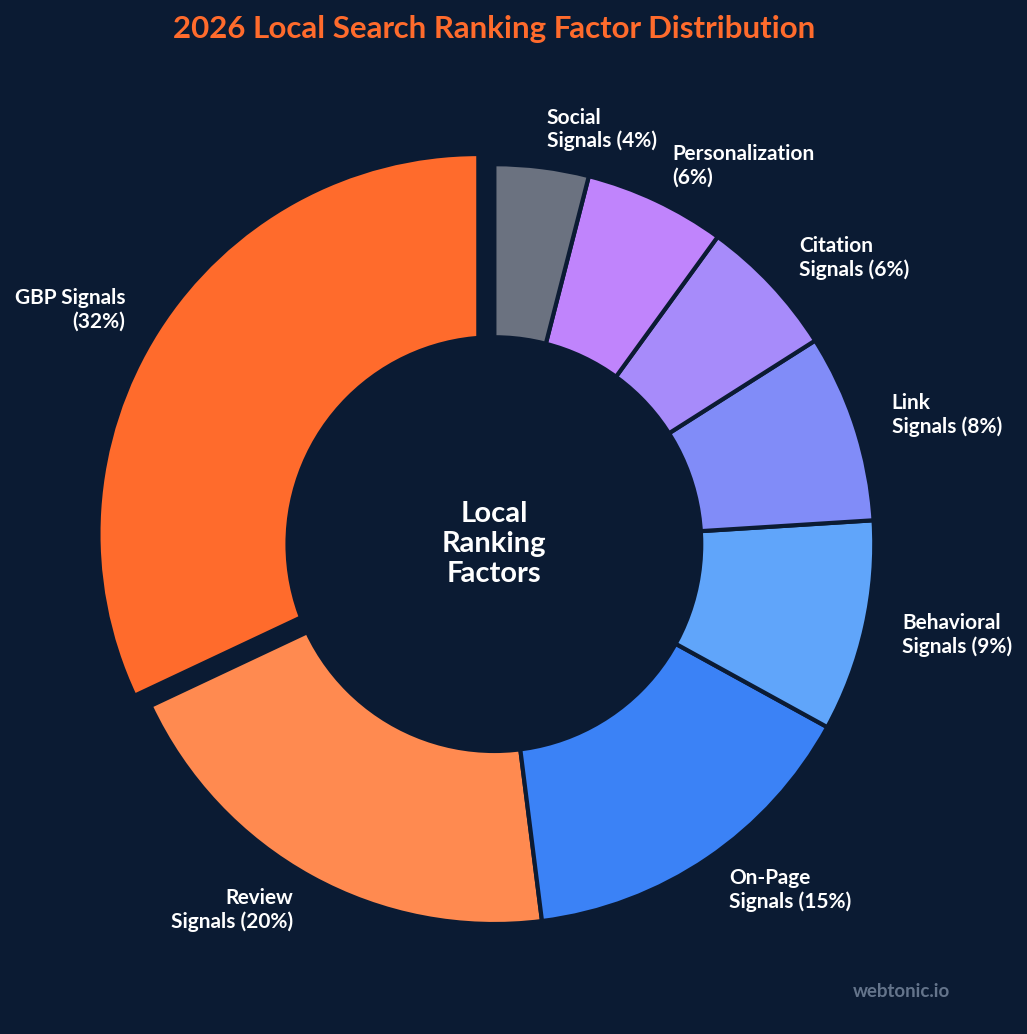
- Google Business Profile signals account for 32% of local ranking factors — the single largest category, followed by reviews at 20% (Local Search Ranking Factors, 2026).
- 86% of consumers use Google Maps to find a business, and "near me" searches have grown by 400% since 2020, rising approximately 35% per year (SOCi, Google Trends).
- "Financial advisor near me" generates 60,500 monthly searches at a $21.95 average CPC — local SEO captures this demand at a fraction of the paid cost (Softscotch).
- Top-3 ranked financial advisors average 45.6 Google reviews compared to just 18.67 for positions 4–5 (Advisor Rankings, 400+ listings across 100 US cities).
- Local SEO leads convert at 14.6% vs. 3.75% for PPC and cost $31 per lead compared to $181 for paid search (SEOScaleUp).
- Firms with complete Google Business Profiles receive 70% more location visits and are 2.7× more likely to be trusted by prospects (Google, SeoProfy).
- 25–45% of local Map Pack clicks result in a direct phone call or driving direction request for financial services (Authority Specialist).
Local SEO Benchmarks for Wealth Management at a Glance
| Metric | Financial Services | All-Industry Average |
|---|---|---|
| GBP signals (ranking weight) | 32% | 32% |
| Review signals (ranking weight) | 20% | 20% |
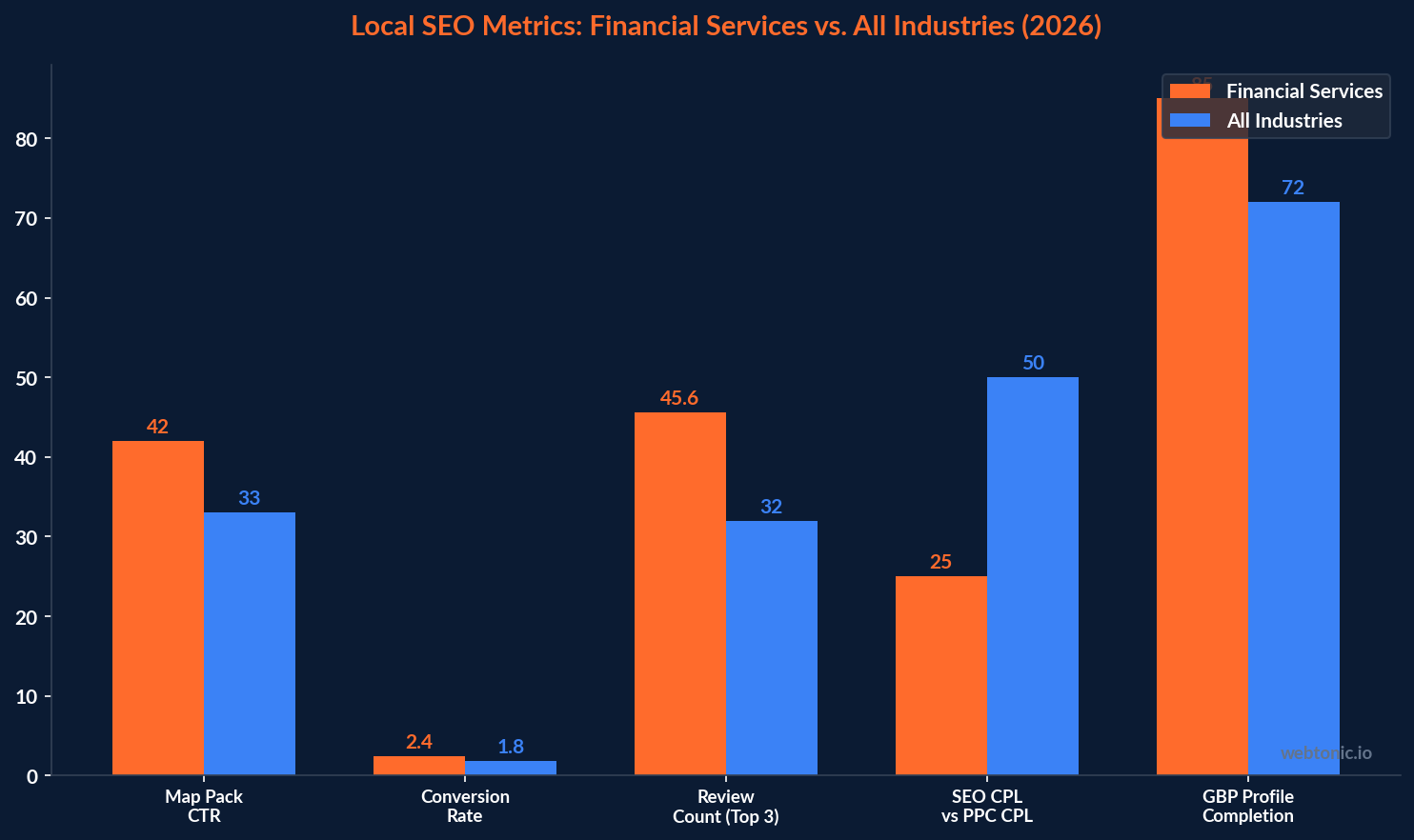
| Average conversion rate (local) | 2.4% | 1.8% |
| SEO cost per lead | $25–$45 | $31 |
| PPC cost per lead | $60–$181 | $181 |
| Avg reviews (top-3 local) | 45.6 | 32 |
| Map Pack traffic boost | 126% | 126% |
Google Business Profile: The Foundation of Local Visibility
For wealth management firms, Google Business Profile (GBP) is the single most impactful local SEO asset. Businesses with complete profiles receive 70% more location visits than those with incomplete profiles, and a verified listing generates approximately 200 interactions per month — clicks, calls, and direction requests combined.
Key GBP optimization priorities for financial advisors include:
- Primary category selection — "Financial Planner" or "Financial Consultant" delivers the strongest match. Adding secondary categories like "Investment Service," "Wealth Management Service," and "Retirement Planning Service" broadens visibility without diluting relevance (OJay Media).
- Profile completeness is binary — incomplete profiles are functionally invisible in the Map Pack. Google rewards firms that fill every field: services, hours, photos, description, and Q&A.
- GBP engagement signals (Q&A, posts) account for 9% of local ranking weight — weekly GBP posts and prompt responses to questions create a behavioral signal loop that competitors often neglect. For paid search strategies, see our Google Ads pricing guide (OJay Media).
Google Reviews: The Competitive Differentiator
Review signals carry 20% of local ranking weight — making them the second most influential factor after GBP signals. For financial advisors, the data reveals a clear threshold:
| Ranking Position | Average Review Count | Median Review Count |
|---|---|---|
| Positions 1–3 (Map Pack) | 45.6 | 20.5 |
| Positions 4–5 | 18.67 | ~12 |
| Minimum viable count | 10+ | — |
A study of 400+ financial advisor listings across the 100 largest US cities found that only 4 advisors ranking in the top 3 had zero reviews. Below 10 reviews, Google's local algorithm essentially treats the profile as invisible (Advisor Rankings).
Review velocity matters more than bulk quantity — a firm with 30 reviews where two were posted in the last month outperforms a firm with 50 reviews that hasn't received one in six months. Under SEC Marketing Rule 206(4)-1, advisors can ethically solicit reviews through private channels first, then publish only compliant responses (Stallion Cognitive).
"Near Me" Search Volume and Click Behavior
Local intent queries dominate wealth management discovery. The US saw more than 200 million "near me" searches per month in early 2026, with financial services keywords commanding some of the highest CPCs in the local search landscape:
| Keyword | Monthly Searches | CPC | Difficulty |
|---|---|---|---|
| financial advisor near me | 60,500 | $21.95 | Medium |
| financial planner near me | 18,100 | $16.50 | Low |
| wealth management near me | 6,600 | $28.40 | Medium |
| investment advisor near me | 4,400 | $19.80 | Low |
At $21.95 per click for "financial advisor near me" through paid search, a firm ranking organically in the Map Pack saves thousands per month. Since 46% of all Google queries carry local intent and 88% of mobile local searchers call or visit within a day, this organic position delivers high-intent prospects at effectively zero marginal cost. See our Meta Ads services for the paid social complement, and learn how Facebook Ads can complement local SEO for wealth management firms (Softscotch).
Local SEO ROI: Financial Services Lead Generation
The cost-per-lead advantage of local SEO over paid channels is dramatic in financial services:
- Local SEO cost per lead: $25–$45 for wealth management firms vs. $60.50 for Local Services Ads and $181 for standard PPC (Resourcera).
- SEO leads close at 14.6% — nearly 4× the paid search close rate of 3.75% — because organic visitors perceive the business as more trustworthy than ad-click visitors.
- Financial services SEO ROI runs 7.3× better than the PPC baseline over a 12-month horizon, with the gap widening as organic rankings compound.
- Page-one local ranking for a wealth management firm is worth $300K–$600K per year in equivalent paid traffic value — the organic position provides this value continuously without incremental spend (Searchlab).
Case Studies: Local SEO Results for Wealth Management Firms
| Firm | Challenge | Local SEO Results | Timeframe |
|---|---|---|---|
| Beacon Pointe Advisors | Low organic lead volume | 305% increase in organic leads; 23% organic traffic growth | 12 months |
| Fidelis Financial Planning | Invisible in local search (St. Louis Metro) | Average map ranking improved from ~15 to 2.2 (top 3) | 9 months |
| Colorado Capital Management | Minimal web presence | 35 inbound leads, 10+ converted to clients; $15–$20M new AUM | 12 months |
| AP Wealth Advisors | Low local authority | #1 ranking "Wealth Management Augusta"; $15M qualified leads | 18 months |
These results share a common pattern: NAP (Name, Address, Phone) consistency, GBP optimization, and review velocity produce measurable ranking improvements within 60–90 days, while the compounding effects of organic authority deliver exponential lead growth over 6–18 months (Trustworthy Digital).
AI Search and the Future of Local Financial Visibility
AI Overviews now appear in 26.6% of finance searches, and approximately 65% of Google searches end without a click. For wealth management firms, this shifts the local SEO playbook:
- Firm websites with city-specific pages outrank national media in AI-generated local results — Forbes "Best in State" rankings capture only 3–21.6% of AI mentions depending on the market.
- Proximity influences 55% of local ranking decisions for positions 1–21, while review count accounts for 19%. In the top 10, proximity drops to 36% but review keyword relevance rises to 22% (OJay Media).
- One AP Wealth lead explicitly mentioned discovering the firm through ChatGPT — a sign that AI search tools are becoming a direct source of wealth management referrals.
Firms that build local authority today will maintain visibility as AI-powered search engines increasingly prioritize local trust signals over generic national content.
Local Citations and Directory Signals for Wealth Management
Citation signals account for 6% of local ranking weight, but their impact extends beyond raw ranking influence. For wealth management firms, local citations serve as independent trust verification — a critical signal in the YMYL (Your Money or Your Life) environment that governs financial content.
The most valuable citation sources for financial advisors include:
- Financial industry directories — NAPFA (fee-only advisors), CFP Board's "Let's Make a Plan," FPA directory, XY Planning Network, FINRA BrokerCheck, and Garrett Planning Network. These carry institutional trust signals that generic directories cannot match.
- Local business directories — Chamber of Commerce listings, Better Business Bureau profiles, and local business associations. A single Chamber of Commerce citation can move local rankings 8–12 positions within 60 days when combined with NAP cleanup.
- Data aggregators — Foursquare (previously Factual), Data Axle, and Localeze distribute your NAP data across dozens of downstream directories. Inconsistencies here cascade into ranking suppression across the entire local ecosystem.
NAP consistency across all citation sources is non-negotiable. Studies show that firms with inconsistent Name, Address, or Phone listings across even a handful of directories experience measurable Map Pack ranking penalties within weeks of the discrepancy being detected by Google's indexing systems.
On-Page Local SEO for Wealth Management Websites
On-page signals carry 15% of local ranking weight — the third-largest factor. For wealth management firms, the highest-impact on-page tactics include:
- City-specific service pages — creating dedicated pages for each service area (e.g., "Wealth Management in Denver" or "Financial Planning in Scottsdale") captures long-tail local queries and provides Google with clear geographic relevance signals. Firms with city-specific pages outrank national media in AI-generated local results.
- Schema markup — LocalBusiness or FinancialService schema with complete NAP data, service areas, and advisor credentials provides structured data that Google uses for both traditional and AI search results.
- Content depth on local topics — articles addressing state-specific tax strategies, local retirement planning considerations, or regional economic outlooks naturally attract local backlinks and reinforce geographic authority.
Firms that combine GBP optimization with on-page local targeting see faster ranking improvements than those that focus on either channel in isolation. A comprehensive growth marketing approach integrates local SEO with broader digital acquisition channels for maximum lead generation impact.
Related reading
- 32+ Wealth Management Technical SEO Statistics Every Marketer Should Know
- Wealth Management SEO Statistics: 2026 Data & Benchmarks for Financial Advisors
- Car Dealership and Powersports Local SEO Benchmarks: CTR and Rankings
- Local SEO Services services at Web Tonic
Frequently Asked Questions
How important is Google Business Profile for wealth management firms?
Google Business Profile signals account for 32% of local ranking factors — the single largest category. Firms with complete GBP profiles receive 70% more location visits and generate approximately 200 monthly interactions. For wealth managers, GBP is the foundation of local visibility and typically the first optimization priority.
How many Google reviews does a financial advisor need to rank in the local pack?
Research across 400+ listings in the 100 largest US cities found that top-3 ranked financial advisors average 45.6 reviews, with a median of 20.5. The minimum viable threshold is 10+ reviews — below this, Google's local algorithm essentially ignores the profile. Review velocity (new reviews per month) matters as much as total count.
What is the ROI of local SEO for wealth management firms?
Local SEO delivers leads at $25–$45 per lead for financial services, compared to $181 for PPC. SEO leads close at 14.6% vs. 3.75% for paid search. Over 12 months, financial services SEO ROI runs 7.3× better than the PPC baseline, with organic rankings continuing to compound beyond the initial investment period.
How long does local SEO take to produce results for a wealth management firm?
GBP optimization and NAP cleanup can produce visible ranking changes within 60–90 days. Case studies show wealth management firms reaching top-3 local rankings within 9–18 months, with lead volumes increasing 100–305% in that timeframe. The first wins come from local-specific optimizations; broader competitive positioning takes 6–12 months.
Can wealth management firms rank locally even in competitive metro areas?
Yes. The Fidelis Financial Planning case study shows a firm moving from effectively invisible to an average map ranking of 2.2 across the St. Louis Metro in 9 months. The keys are GBP completeness, review velocity, local citations (Chamber of Commerce, financial directories), and city-specific content pages on the firm's website.
Sources
OJay Media — Local SEO for Financial Advisors: 2026 Playbook
Searchlab — Local SEO Statistics 2026
Resourcera — Local SEO Statistics 2026: Search, Maps and Review Data
Advisor Rankings — How Many Google Reviews Top-Ranked Financial Advisors Actually Have
Trustworthy Digital — Beacon Pointe Local SEO Case Study
Trustworthy Digital — Fidelis Financial Planning Case Study
Stallion Cognitive — Local SEO for Financial Advisors Compliance Guide
Softscotch — SEO Keywords for Financial Advisors (2026 Data)
SEO Design Chicago — Local SEO Performance Across 10 Industries
Advisor Rankings — Colorado Capital Management SEO Case Study


