Table of contents

Organic search generates over 50% of website traffic for top-performing restoration companies, and SEO produces a 5.3× higher long-term ROI than print advertising. In an industry where a single residential water damage job averages $2,500–$7,500, ranking on page one for high-intent keywords like "water damage restoration [city]" can be worth $300,000–$600,000 annually in organic traffic value alone.
Key Takeaways
- Organic search drives 50%+ of website traffic for top-performing restoration companies, with the remainder split between paid, direct, and referral channels (MarketingLTB).
- SEO produces 5.3× higher long-term ROI than print advertising for restoration companies, with compounding returns as domain authority builds over 6–12 months (MarketingLTB).
- A page-1 ranking for "water damage restoration [city]" can be worth $300,000–$600,000 per year in avoided ad spend, based on CPC equivalency modeling (DYB Digital).
- One restoration company grew from 12 ranked keywords to 340 in six months, tripling monthly revenue from $11,200 to $63,000 through organic search (Tygart Media).
- The average PageSpeed score across 267 restoration websites is just 55 out of 100, with LCP averaging 9.31 seconds — creating massive opportunity for technically competent competitors (BorahLabs).
- Restoration companies see organic results within 4–9 months on average, with ROI-positive lead flow typically arriving months 7–9 (MarketingLTB / PipelineOn).
Water Damage Restoration SEO Benchmarks at a Glance
| Metric | Benchmark | Source |
|---|---|---|
| Organic Traffic Share (Top Firms) | 50%+ of total traffic | MarketingLTB |
| SEO ROI vs Print | 5.3× higher long-term | MarketingLTB |
| Page-1 Value (Metro Area) | $300K–$600K/year | DYB Digital |
| Avg Job Value (Residential) | $2,500–$7,500 | AuthoritySpecialist |
| Organic Lead Close Rate | 14.6% | Ruler Analytics |
| SEO CPL at Maturity | $25–$45 | PipelineOn |
| Time to SEO Results | 4–9 months | MarketingLTB |
| Avg PageSpeed (267 sites) | 55/100 | BorahLabs |
| U.S. Market Size | $7.1 billion (2026) | IBISWorld |
| U.S. Restoration Businesses | 60,020 | IBISWorld |
SEO Growth Case Study: From 12 Keywords to 340
Tygart Media's detailed 6-month case study of a Southeast restoration company demonstrates the compounding returns of systematic SEO investment. The company went from 1,200 monthly organic sessions and 8–10 leads per month to 4,800+ sessions and 45–60 leads per month — a 3× revenue increase from approximately $14,000 to $63,000 in monthly organic revenue.
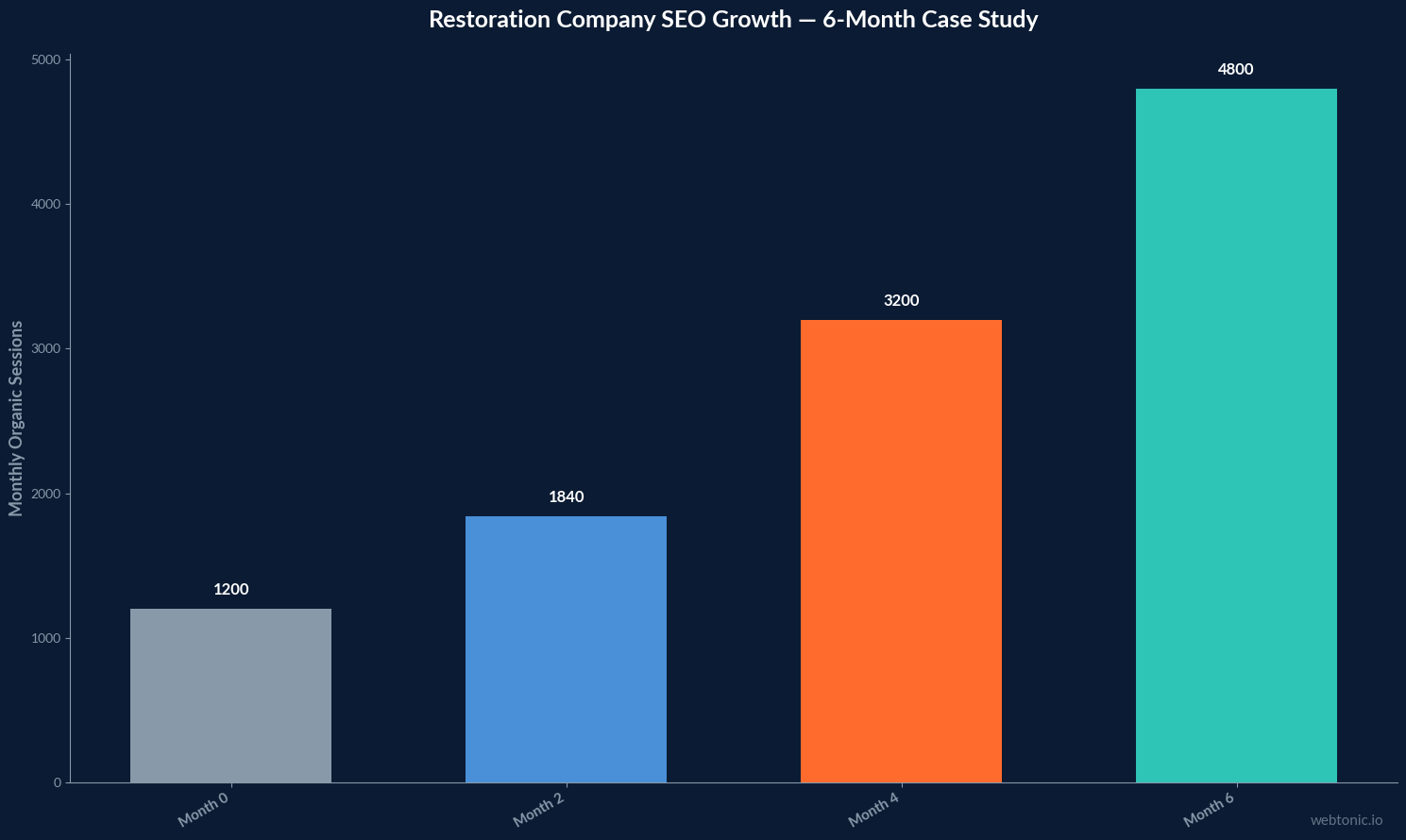
The strategy was not exotic — it consisted of topic cluster architecture, service-area pages referencing local landmarks, technical SEO optimization (LCP from 4.2s to 1.8s), and structured data implementation. The company expanded from an 8-page website to a comprehensive content hub covering water damage, mold, fire, and specialty services.
The Water Damage Restoration Market: $7.1 Billion and 60,020 Competitors
IBISWorld estimates the U.S. damage restoration market at $7.1 billion in 2026, with 60,020 businesses competing for local market share. The broader global disaster restoration services market reaches $48.9 billion in 2026, with Fact.MR projecting growth to $89.1 billion by 2036 at a 6.2% CAGR.
Water damage restoration leads the disaster restoration market by service type at 38.56% share (Mordor Intelligence, 2025 data), driven by aging infrastructure, climate-related weather events, and insurance-backed claims. The average claim cost stands at $15,400 (ProofCo), making each qualified lead substantially valuable.
With this many competitors and this much revenue at stake, search visibility determines which companies get the call. The competitive gap between page-one and page-two operators in dense metros has widened since Google's 2024 local algorithm updates (AuthoritySpecialist).
Search Demand: $72.50 CPCs and 27,100 Monthly Searches
"Water damage restoration near me" generates 27,100 monthly searches nationally with an average CPC of $72.50 (SerpWars). Localized variations drive hundreds to thousands of additional monthly searches per metro area, creating a massive pool of high-intent traffic for companies that can rank organically.
| Keyword Category | Example | Monthly Volume | Avg CPC |
|---|---|---|---|
| Primary Emergency | water damage restoration near me | 27,100 | $72.50 |
| Service-Specific | water damage restoration service | 14,800 | $67.98 |
| Emergency Qualifier | emergency water damage restoration | 4,200 | $38 |
| Related Service | water restoration | 9,900 | $71.38 |
| Localized | flood cleanup [city] | 500–3,000 | $28–$75 |
The CPC data tells the SEO story clearly. At $72.50 per click and a 7.33% conversion rate (LocaliQ home services benchmark), Google Ads delivers leads at roughly $989 per conversion for "water damage restoration near me." Organic rankings for the same keyword eliminate that per-click cost entirely.
Organic vs Paid: The Annual Cost Comparison
When modeled over a full year for a restoration company generating 30–40 leads per month, the cost differential between channels becomes staggering:

The SEO investment compounds. Year 1 involves higher upfront costs ($2,500–$7,500/month for quality SEO), but by year 2, the monthly spend decreases as organic rankings stabilize while paid channels continue to escalate. Google LSA costs rose 20% from 2023 to 2024 alone (Talk24.ai), and Google Ads CPC for restoration keywords has increased 35%+ since 2022 (MarketingLTB).
Technical SEO: The Industry's Biggest Competitive Gap
BorahLabs' analysis of 267 restoration company websites reveals an industry-wide technical deficit that creates opportunity for prepared competitors:
| Technical Metric | Industry Average | Google Target | Gap |
|---|---|---|---|
| PageSpeed Score | 55/100 | 90+/100 | 35 points below |
| Largest Contentful Paint | 9.31 seconds | ≤2.5 seconds | 3.7× slower |
| First Contentful Paint | 3.72 seconds | ≤1.8 seconds | 2× slower |
| HTTPS Adoption | 89.9% | 100% | 10.1% non-secure |
Websites with LCP under 1.8 seconds convert 2.3× more emergency calls than those above 3.5 seconds (DigiNebel). For a restoration company where each booked job is worth $2,500–$7,500, that conversion multiplier translates directly to revenue.
Restoration SEO Case Studies: Documented Results
Multiple documented case studies confirm the ROI trajectory for restoration SEO investments:
| Company | Timeframe | Key Result | Source |
|---|---|---|---|
| Southeast WDR Company | 6 months | 12→340 keywords, 3× revenue | Tygart Media |
| Total Restoration of Texas | 12 months | +380% organic traffic | CompleteSEO |
| 911 Restoration (National) | 6 months | +60% organic traffic, -35% bounce | ZenithPoint |
| OKC Restorations | 12 months | +181% organic clicks YoY | Outpace SEO |
| Social Cali WDR Client | 18 months | $890K→$4.2M revenue | Social Cali |
The common thread across every case study is timeline. No restoration company achieved meaningful SEO results in under 3 months. The companies that tripled or quadrupled revenue invested for 6–18 months with consistent content production, technical optimization, and link acquisition. The ones who quit at month 4 are still paying $91+ per lead on third-party platforms.
Photon SEO documented a 9× ROI from restoration SEO in their 2026 client analysis, while ShellbackSEO reported a +312% traffic increase for an HVAC contractor using the same local SEO methodology applicable to restoration companies. These results are achievable because the technical bar in the restoration industry remains low — most competitors have not invested in systematic SEO, creating a wide competitive gap for companies that do.
Content Strategy: What Top-Ranking Restoration Sites Do Differently
The restoration companies that dominate organic search share common content characteristics:
- Service pages average 1,800+ words versus the industry minimum of 400–600 words on underperforming sites (Tygart Media case study).
- Topic cluster architecture organizes content into pillar pages (broad topics like "water damage restoration") and cluster pages (specific subtopics like "burst pipe cleanup [city]").
- Companies with educational YouTube content generate 2× more organic search traffic (MarketingLTB), leveraging video for both YouTube and Google's video carousel.
- FAQ schema implementation across service pages drives rich snippet appearances in SERPs, with 911 Restoration's case study showing a 60% increase in organic traffic after schema and content optimization (ZenithPoint).
- Service-area pages that reference local landmarks and common weather patterns outperform templated "we serve [city]" pages because they demonstrate genuine local relevance (Tygart Media).
Link Building and Off-Page SEO for Restoration
96.55% of all web pages have zero backlinks (Affinco), which means the restoration companies that do invest in link building face minimal competition. AuthoritySpecialist's benchmark data shows that the #1-ranking page for any given query has an average of 3.8× more backlinks than pages ranking in positions 2–10.
For water damage restoration companies, the most effective link-building approaches include:
| Tactic | Avg Cost per Link | Typical DR | Effectiveness |
|---|---|---|---|
| Digital PR / Local Media | $300–$500 | DR 50–70+ | Highest authority, hardest to scale |
| Guest Posting | $77–$500 | DR 30–60 | Scalable, moderate authority |
| Local Directory Citations | $10–$50 | DR 20–50 | Foundation layer, high volume |
| Industry Partnerships | $0 (time only) | DR 15–40 | Best ROI, hardest to build |
MediaSpearhead's data shows 30–40 local backlinks create a 6–12 month competitive moat for local rankings. Ahrefs confirms that top-ranking pages gain 5–14.5% new backlinks per month, meaning link building is an ongoing process rather than a one-time project.
The average cost per link across all methods now sits at $508.95, up 45% since 2022 (Affinco), but 78.1% of companies report positive ROI from their link building investment. For an industry where a single job is worth $2,500–$7,500, even one additional monthly lead from improved organic rankings justifies the spend.
SEO Best Practices for Water Damage Restoration Companies
- Invest in technical SEO first — fix Core Web Vitals (target LCP under 2.5s), implement HTTPS, and optimize for mobile before creating content.
- Build topic cluster architecture — organize content around pillar service pages and supporting subtopic pages to establish topical authority.
- Write service pages of 1,800+ words with local specificity — reference city landmarks, weather patterns, and neighborhood-specific risks.
- Implement structured data consistently — LocalBusiness, Service, FAQ, and Article schema improve how Google surfaces your content.
- Earn 30–40 quality local backlinks — partnerships with local contractors, real estate firms, and insurance adjusters produce both links and referral leads.
- Publish educational content monthly — blog posts and guides build topical authority and capture informational queries that feed commercial conversions.
- Track organic lead attribution precisely — use call tracking and UTM parameters to demonstrate SEO ROI and justify continued investment.
Frequently Asked Questions
Is SEO worth it for water damage restoration companies?
Yes. SEO produces 5.3× higher long-term ROI than print advertising, and organic leads close at 14.6% versus 1.7% for shared platform leads. A page-1 ranking for core keywords in a metro area can be worth $300,000–$600,000 annually in avoided ad spend.
How much does SEO cost for a restoration company?
Most restoration companies invest $2,500–$7,500 per month in SEO. At maturity (12+ months), this delivers leads at $25–$45 each — roughly one-quarter the cost of paid alternatives. The investment compounds as domain authority grows.
How long does it take for restoration SEO to produce results?
Initial ranking signals appear in months 2–3, local search visibility builds in months 3–6, and ROI-positive lead flow typically arrives in months 7–9. One case study documented a 3× revenue increase within 6 months of systematic SEO work.
What keywords should water damage restoration companies target?
"Water damage restoration near me" (27,100 monthly searches, $72.50 CPC) is the primary target, along with localized variations, emergency modifiers, and long-tail service-specific terms. The total addressable search volume exceeds 3,757 high-intent keywords nationally.
How does restoration SEO compare to Google Ads?
Google Ads for restoration keywords averages $42–$75 CPC with cost per lead of $95–$280 depending on market. SEO at maturity delivers similar lead volume at $25–$45 CPL with a higher close rate, but requires 4–9 months of investment before reaching parity.
Sources
authorityspecialist.com — WDR SEO Benchmarks 2026
marketingltb.com — Restoration Marketing Statistics 2026
tygartmedia.com — Restoration Company SEO Case Study
dybdigital.com — Water Damage SEO Guide 2026
pipelineon.com — Local SEO for Home Service Businesses
restorationinbound.com — Restoration Industry Statistics 2026
borahlabs.us — Water Damage Restoration Website Analysis
diginebel.com — Technical SEO Audit for WDR
serpwars.com — Water Damage Restoration Keywords
zenithpoint.eu — 911 Restoration SEO Case Study