Table of contents

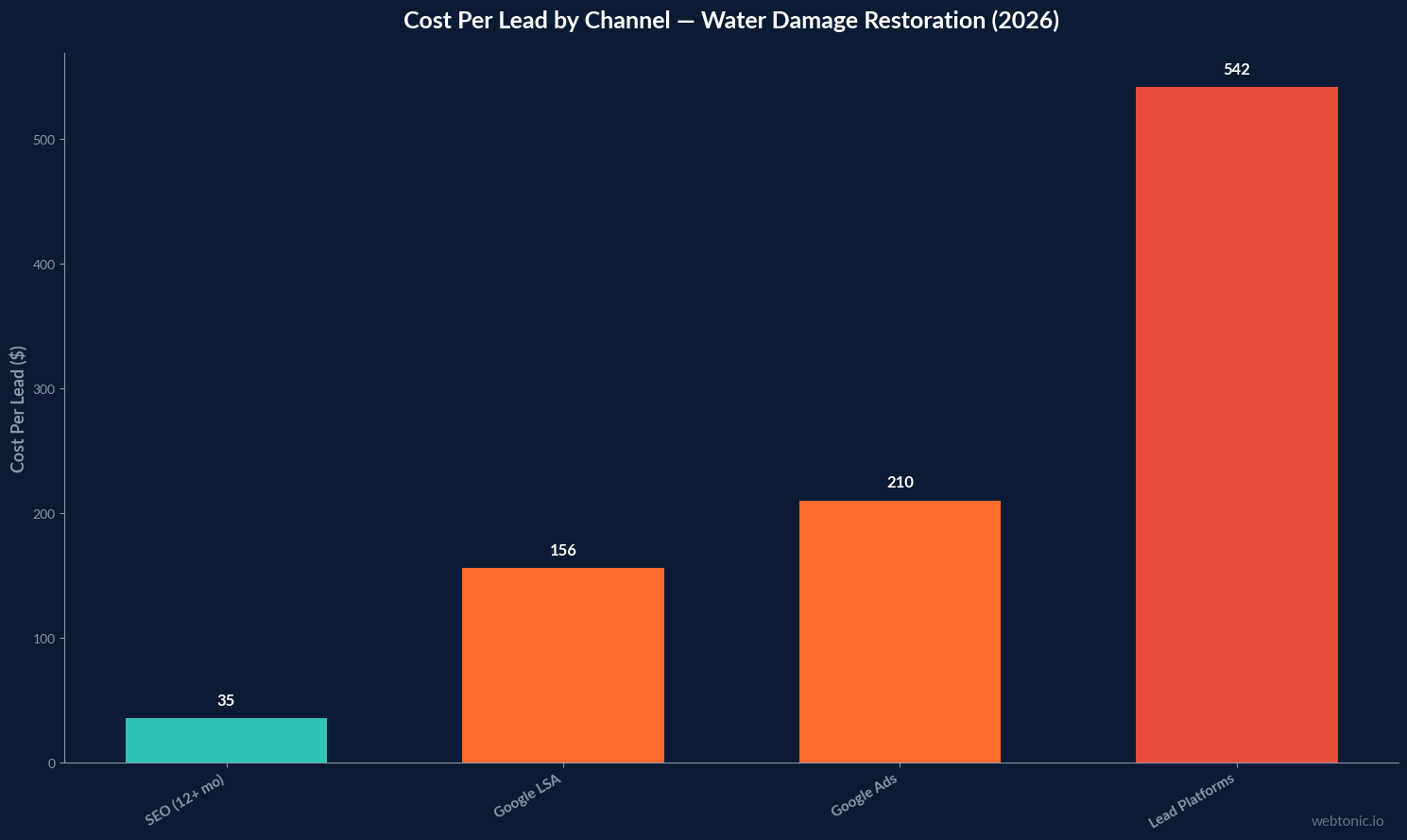
Local SEO generates 3× more qualified leads than broad national campaigns for water damage restoration companies, with cost per lead dropping to $25–$45 at maturity compared to $156+ for Local Services Ads and $210+ for Google Ads. For an industry where the average residential job ranges from $2,500 to $7,500, local search visibility directly determines which contractors get the emergency call.
Key Takeaways
- 57% of restoration companies rank Google Business Profile as their top lead source, with optimized profiles receiving 5× more direction requests (MarketingLTB).
- The Map Pack captures 60–70% of clicks for emergency service searches, making top-3 local placement the highest-value real estate in restoration marketing (DYB Digital).
- SEO leads close at 14.6% versus 1.7% for shared platform leads — an 8.6× difference in close rate that compounds as volume scales (PipelineOn / Ruler Analytics).
- Top-3 Map Pack restoration firms carry 50+ reviews with a 4.5+ average, and companies that respond to every review within 24 hours see measurably higher local rankings (AuthoritySpecialist).
- NAP consistency cleanup alone can push firms 8–12 positions in the local pack within 60 days — no content changes or link building required (Tygart Media).
- At 12+ months maturity, SEO costs $25–$45 per lead versus $91 average on lead-gen platforms, with ROI-positive lead flow typically arriving around months 7–9 (PipelineOn).
Water Damage Restoration Local SEO Benchmarks at a Glance
| Metric | Benchmark | Source |
|---|---|---|
| GBP as Top Lead Source | 57% of restoration companies | MarketingLTB |
| Map Pack Click Share (Emergency) | 60–70% of all clicks | DYB Digital |
| SEO Lead Close Rate | 14.6% | Ruler Analytics / PipelineOn |
| Platform Lead Close Rate | 1.7% | PipelineOn |
| Top-3 Map Pack Review Count | 50+ reviews, 4.5+ avg | AuthoritySpecialist |
| SEO CPL (12+ months) | $25–$45 | PipelineOn |
| Google LSA CPL | $60.50–$156 | Talk24.ai / 99calls.com |
| Google Ads CPL | $95–$280 | Tygart Media |
| Top-3 Map Pack Citations | 78 clean citations (avg) | DigiNebel |
| Time to ROI-Positive SEO | 7–9 months | PipelineOn |
Cost Per Lead by Channel: Why Local SEO Wins
The economics of lead generation in water damage restoration heavily favor local SEO at maturity. At 12+ months of consistent optimization, SEO-generated leads cost $25–$45 each, compared to $60.50 for Google LSA (up 20% from 2023), $95–$280 for Google Ads depending on market density, and $542 average for exclusive platform leads like Service Direct.
The kicker: platform leads close at just 1.7%. You are buying a contact name and phone number that five contractors call simultaneously. SEO leads, by contrast, close at 14.6% — an 8.6× higher conversion rate that compounds as organic traffic grows.
Google Business Profile Drives 57% of Restoration Leads
57% of restoration companies report Google Business Profile as their single top lead source, according to MarketingLTB's 2026 industry survey. Firms with optimized GBP listings receive 5× more direction requests and 3× more website clicks than those with basic profiles.
Google's local algorithm now weighs four signal categories: relevance, distance, prominence, and behavioral engagement. The fourth category — how users interact with your listing — is where most restoration companies lose rankings. If a searcher calls from your GBP listing, stays on the line, and books a job, Google registers that as a positive signal. If they click, bounce, and call the next result, your ranking drops.
Businesses that post weekly updates, respond to every review within 24 hours, and add new photos at least twice a month outperform inactive profiles by measurable margins. One contractor case study documented a 21% increase in local search impressions after three months of consistent GBP activity (Tygart Media).
Local Pack Ranking Factors for Restoration Companies
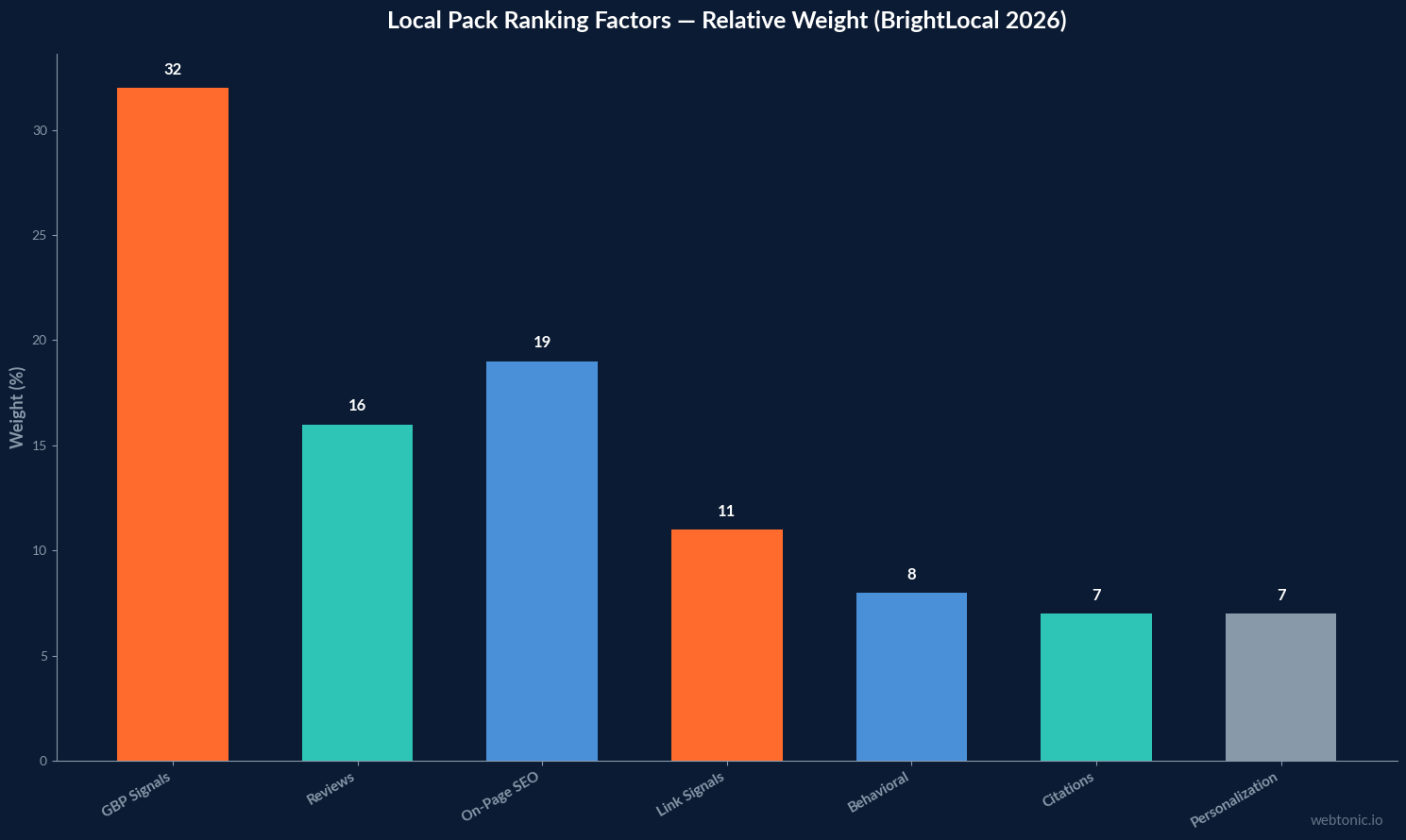
BrightLocal's 2026 Local Search Ranking Factors survey confirms that Google Business Profile signals account for 32% of the local pack ranking weight, making GBP optimization the single highest-leverage activity for restoration contractors. Reviews contribute another 16%, and on-page SEO signals add 19%.
For water damage restoration specifically, the emergency-intent nature of most searches amplifies the importance of behavioral signals. When 60–70% of emergency service searches result in Map Pack clicks rather than organic results (DYB Digital), the companies that earn those clicks — and convert them into booked calls — build a compounding ranking advantage.
Link signals contribute 11% to local pack rankings, and building a diversified acquisition strategy that combines organic visibility with paid campaigns creates resilience against algorithm shifts. AuthoritySpecialist's study found that restoration sites ranking in the top 3 local pack positions capture a disproportionate share of after-hours emergency calls, which represent the highest-value segment of the market.
Map Pack Dominance: 50+ Reviews at 4.5+ Average
AuthoritySpecialist's 2026 benchmark study of 34 multi-territory water damage restoration contractors found that most top-3 Map Pack firms in mid-size markets carry 50+ reviews with a 4.5+ average rating. The data is consistent across metros: review volume and recency directly correlate with Map Pack placement.
| Review Metric | Map Pack (Top 3) | Positions 4–10 |
|---|---|---|
| Avg Review Count | 50–120+ | 15–35 |
| Average Star Rating | 4.5–4.9 | 4.0–4.4 |
| Owner Response Rate | 90–100% | 30–60% |
| Recent Reviews (90 days) | 8–15+ | 2–5 |
Homeowners overwhelmingly choose restoration companies with the most recent reviews. In an emergency at 1 AM, trust signals — review count, recency, and star rating — determine which of the three Map Pack listings gets the call.
NAP Consistency and Citation Building
Name, Address, and Phone number (NAP) consistency remains one of the most undervalued local SEO factors in restoration. Tygart Media documented cases where cleaning up citation inconsistencies across 40+ platforms pushed companies 8–12 positions in the local pack within 60 days — no content changes, no link building required.
DigiNebel's analysis of 500 restoration businesses found that top-3 local pack results had an average of 78 clean citations versus 42 for positions 4–7. Quality beats quantity, but you need both.
The platforms that matter most for restoration companies include Google Business Profile, Yelp, BBB, Angi, HomeAdvisor, and industry-specific directories like the Restoration Industry Association member directory. Inconsistent business names across these platforms — "ABC Restoration Inc." on GBP versus "ABC Restoration" on Yelp — causes Google to treat them as separate entities.
MediaSpearhead's data confirms that 30–40 local backlinks create a 6–12 month competitive moat for restoration companies in their service areas. These backlinks from local contractors, insurance adjusters, and property management companies serve double duty — improving local rankings while also generating direct referral leads. Building these relationships is part of a comprehensive digital marketing strategy that extends beyond pure SEO.
Case Study: 12 Keywords to 340 in 6 Months
Tygart Media published a detailed 6-month SEO case study for a Southeast water damage restoration company that demonstrates the compounding nature of local SEO investment:
| Metric | Month 0 (Baseline) | Month 6 (After SEO) | Change |
|---|---|---|---|
| Keywords Ranked (Top 20) | 12 | 340 | +2,733% |
| Monthly Organic Sessions | 1,200 | 4,800+ | +300% |
| Organic Leads / Month | 8–10 | 45–60 | +500% |
| Revenue Attribution | $11,200–$14,000/mo | ~$63,000/mo | 3× increase |
| Page Load Time | 4.2 seconds | 1.8 seconds | -57% |
The company's strategy focused on content architecture (topic clusters and service-area pages), technical SEO (Core Web Vitals, schema markup), and internal linking. No exotic tactics — just relentless, precise execution of fundamentals. For companies starting from a similar baseline, this case study illustrates why combining organic SEO with paid channels during the ramp-up period ensures consistent lead flow while organic authority builds.
Technical SEO Benchmarks for Restoration Websites
BorahLabs' analysis of 267 restoration company websites in 2026 paints a sobering picture of technical SEO in the industry:
- Average PageSpeed score: 55 out of 100 — well below the threshold for competitive rankings (BorahLabs).
- Average Largest Contentful Paint (LCP): 9.31 seconds — nearly 4× the 2.5-second threshold Google recommends (BorahLabs).
- Only 89.9% of restoration sites use HTTPS — meaning 1 in 10 still shows "Not Secure" in the browser bar.
- Every 1-second delay in mobile load time reduces conversions by up to 20% for emergency services, and restoration websites with LCP under 1.8 seconds convert 2.3× more calls than those above 3.5 seconds (DigiNebel).
For restoration companies, these technical gaps represent a massive competitive opportunity. Most competitors have slow, poorly optimized sites — a company that fixes Core Web Vitals alone can leapfrog dozens of local competitors without writing a single new page.
Local Search Demand: Emergency Keywords Dominate
Search demand in water damage restoration is dominated by emergency, high-intent queries. "Water damage restoration near me" generates 27,100 monthly searches nationally (Semrush / SerpWars), while localized variations like "water damage restoration [city]" generate hundreds to thousands of searches per metro area.
| Keyword | Monthly Search Volume | Avg CPC | Intent |
|---|---|---|---|
| water damage restoration near me | 27,100 | $72.50 | Emergency / Local |
| water damage restoration [city] | 500–3,000 | $42–$75 | Emergency / Local |
| emergency water damage restoration | 4,200 | $38 | Emergency |
| flood cleanup near me | 2,900 | $35 | Emergency / Local |
| burst pipe repair [city] | 2,400 | $28 | Emergency / Local |
These searches spike sharply after weather events — hurricanes, flash floods, and winter pipe bursts can multiply search volume by 3–5× overnight. Firms with strong baseline authority maintain visibility even between peak events, while competitors who rely solely on paid ads get priced out during surges (AuthoritySpecialist).
Local SEO Best Practices for Restoration Companies
- Optimize Google Business Profile weekly — post updates, respond to every review within 24 hours, and add new job photos at least twice a month.
- Build service-area pages with local specificity — reference local landmarks, common weather patterns, and neighborhood-specific water damage risks rather than using templated content.
- Pursue 30–40 local backlinks as a foundation — MediaSpearhead data shows this volume creates a 6–12 month competitive moat for local rankings.
- Audit NAP consistency across 40+ directories quarterly — inconsistencies silently erode rankings even when other signals are strong.
- Implement LocalBusiness and Service schema markup — structured data helps Google surface your listing in rich results for emergency queries.
- Target LCP under 2.5 seconds on mobile — emergency searchers on phones at midnight will not wait for a slow site.
- Earn reviews consistently, not in bursts — 8–15 reviews per quarter maintains recency signals without triggering Google's review-gating filters.
Frequently Asked Questions
How long does local SEO take to produce results for restoration companies?
Initial ranking signals appear in months 2–3, Local Pack visibility typically comes in months 3–6, and ROI-positive lead flow usually arrives around months 7–9. Firms that invest consistently for 12+ months see cost per lead drop to $25–$45, compared to $91+ on lead-gen platforms.
How many Google reviews do I need to rank in the Map Pack?
AuthoritySpecialist's benchmark study found that top-3 Map Pack firms in mid-size markets carry 50+ reviews with a 4.5+ average rating. However, recency matters as much as volume — aim for 8–15 new reviews per quarter.
What is more important for local SEO: content or Google Business Profile?
Google Business Profile signals account for 32% of local pack ranking weight (BrightLocal 2026), making it the single highest-leverage asset. However, on-page SEO signals contribute another 19%, and content is essential for ranking in organic results below the Map Pack.
How much does local SEO cost for a water damage restoration company?
AuthoritySpecialist's data shows most restoration companies invest $2,500–$7,500 per month in SEO. At maturity, this delivers leads at $25–$45 each — roughly one-quarter the cost of paid alternatives and with an 8.6× higher close rate.
Does local SEO help during weather emergencies when search volume spikes?
Absolutely. Companies with strong baseline organic authority maintain visibility during search volume spikes of 3–5× that follow hurricanes, floods, and pipe-burst events. Competitors relying on paid ads get priced out as CPCs surge during emergencies.
Sources
authorityspecialist.com/industry/home/water-damage-restoration/seo-statistics
tygartmedia.com — Local SEO Playbook for Restoration 2026
tygartmedia.com — Restoration Company SEO Case Study
dybdigital.com/water-damage-seo
pipelineon.com — Local SEO for Home Service Businesses
marketingltb.com — Restoration Marketing Statistics 2026
diginebel.com — Local Citation Building for Restoration
diginebel.com — Technical SEO Audit for WDR
serpwars.com — Water Damage Restoration Keywords
borahlabs.us — Water Damage Restoration Website Analysis
authorityspecialist.com — WDR SEO Cost Breakdown