Table of contents
Cognism's 2026 dataset of more than 200,000 calls puts the industry-average cold-call success rate at 2.7%, while LinkedIn's own Forrester-audited study reports a 312% three-year ROI on Sales Navigator. Neither number replaces the other. This page puts both channels' actual 2026 data side by side for a pipeline budget decision.
Key Takeaways
- The industry cold-call success rate recovered to 2.7% in 2026, up from 2.3%.
- That is still below the 4.82% recorded in 2024, a partial recovery.
- Top-performing teams convert at 11.3%, over four times the industry average.
- It now takes 1.55 calls on average to reach a prospect, down from 2.9.
- 93% of eventual answers land by the third call attempt.
- 82% of B2B buyers accept meetings from proactive outbound sellers.
- 69% accepted a cold call from a new provider in the prior 12 months.
- Enterprise cold-call connect rates run 5% to 9%, SMB rates 15% to 22%.
- LinkedIn Sales Navigator returns 312% ROI over three years, per Forrester.
- Sales Navigator pays for itself in under 6 months.
- Reps with an SSI above 70 generate 45% more opportunities.
- Those same reps are 51% more likely to hit quota.
- 78% of active social sellers outperform peers who skip social prospecting.
- InMail response rates average 18% to 25%, against 3.4% for cold email.
- 80% of B2B social media leads originate on LinkedIn.
- 71% of sales professionals already use social selling tools.
- Sales Navigator users report 7% higher win rates and 18% larger pipeline.
- Revenue attribution to Sales Navigator grows from 20% to 30% over three years.
Cold calling's 2026 recovery, by the numbers
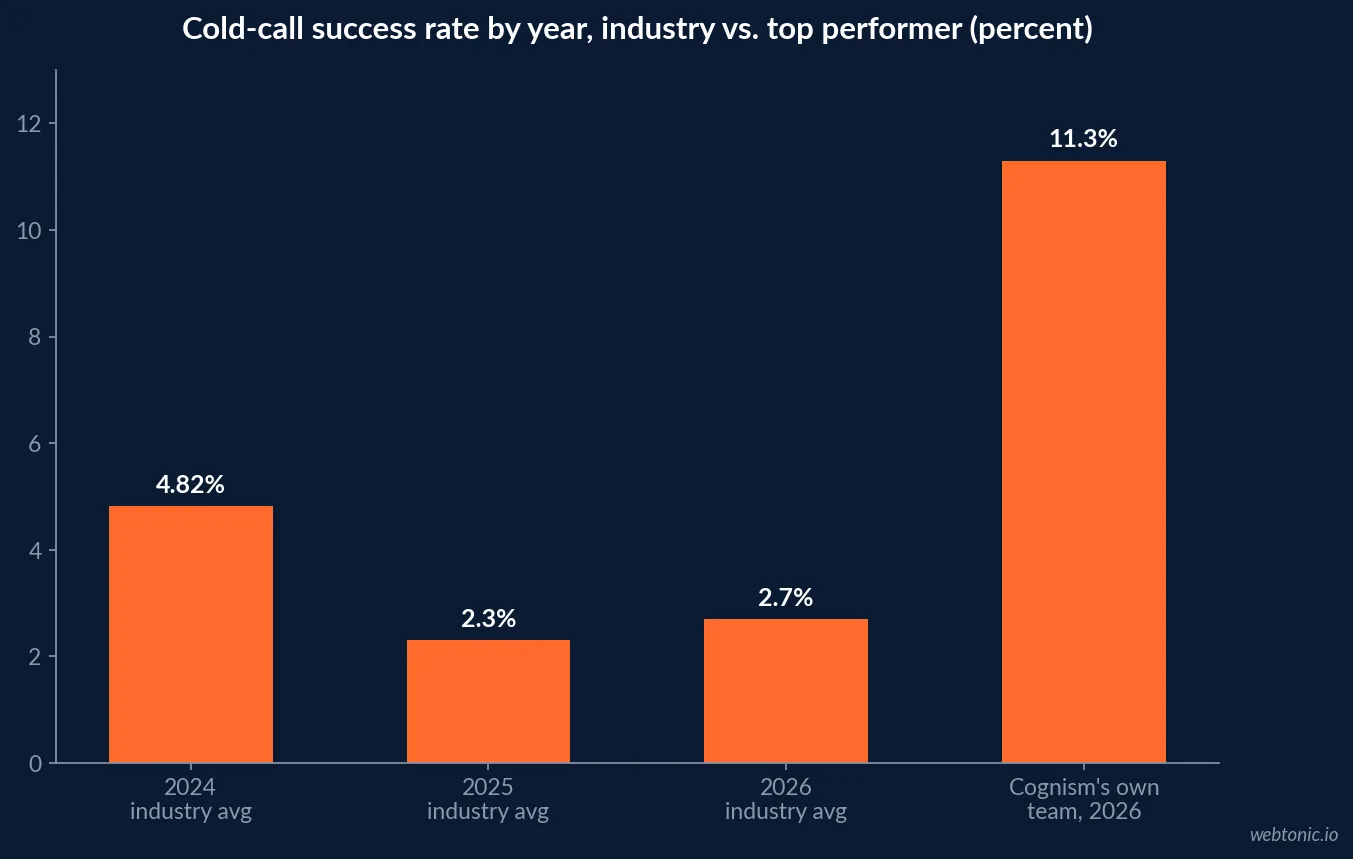
Cognism's State of Cold Calling 2026 report, built on more than 200,000 analyzed calls, puts the industry-average cold-call success rate at 2.7%, recovering from 2.3% the year before but still well short of the 4.82% recorded in 2024. Cognism's own sales team converts at 11.3%, more than four times the industry benchmark and up from 6.7% in the previous report, which the company attributes to strategy and data quality rather than dial volume. The average number of dials needed to reach a prospect has also fallen, from 2.9 to 1.55.
| Metric (Cognism, 2026) | 2024 | 2025 | 2026 | Top performer |
|---|---|---|---|---|
| Cold-call success rate | 4.82% | 2.3% | 2.7% | 11.3% |
| Average calls to reach a prospect | n/a | 2.9 | 1.55 | 1.55 |
| Calls analyzed in dataset | - | - | 200,000+ | - |
Where the connect rate actually lands, by segment
A single benchmark hides more than it reveals. Dialfyne's source-attributed review of the same landscape reports connect rates ranging from 5% to 9% for enterprise C-suite and senior VP contacts up to 15% to 22% for SMB managers and individual contributors, with verified mobile direct-dial data reaching 18% to 25%. It also cites RAIN Group survey research: 82% of B2B buyers accept meetings from proactive sellers, 69% accepted a cold call from a new provider in the prior 12 months, and 57% of C-level and VP buyers said they preferred phone contact over other channels.
Martal's synthesis of Prospeo data shows the industry average success rate breaks down unevenly by vertical: business services convert near 2.61%, financial services near 1.54%, and technology and software near 0.95% — a real spread that a single "industry average" number obscures.
| Segment | Connect rate range | Top-performer range |
|---|---|---|
| Enterprise (C-suite, senior VP) | 5-9% | 10-14% |
| Mid-market (directors, VPs) | 10-15% | 18-22% |
| SMB outbound (managers, ICs) | 15-22% | 25-30% |
| Verified mobile direct-dial | 18-25% | n/a |
| Generic database, manual dial | 5-8% | n/a |
| Vertical | Cold-call success rate (2026) |
|---|---|
| Business services | 2.61% |
| Consulting services | 2.43% |
| Real estate services | 2.20% |
| Financial services | 1.54% |
| Technology and software | 0.95% |
Social selling's ROI case, from LinkedIn's own study
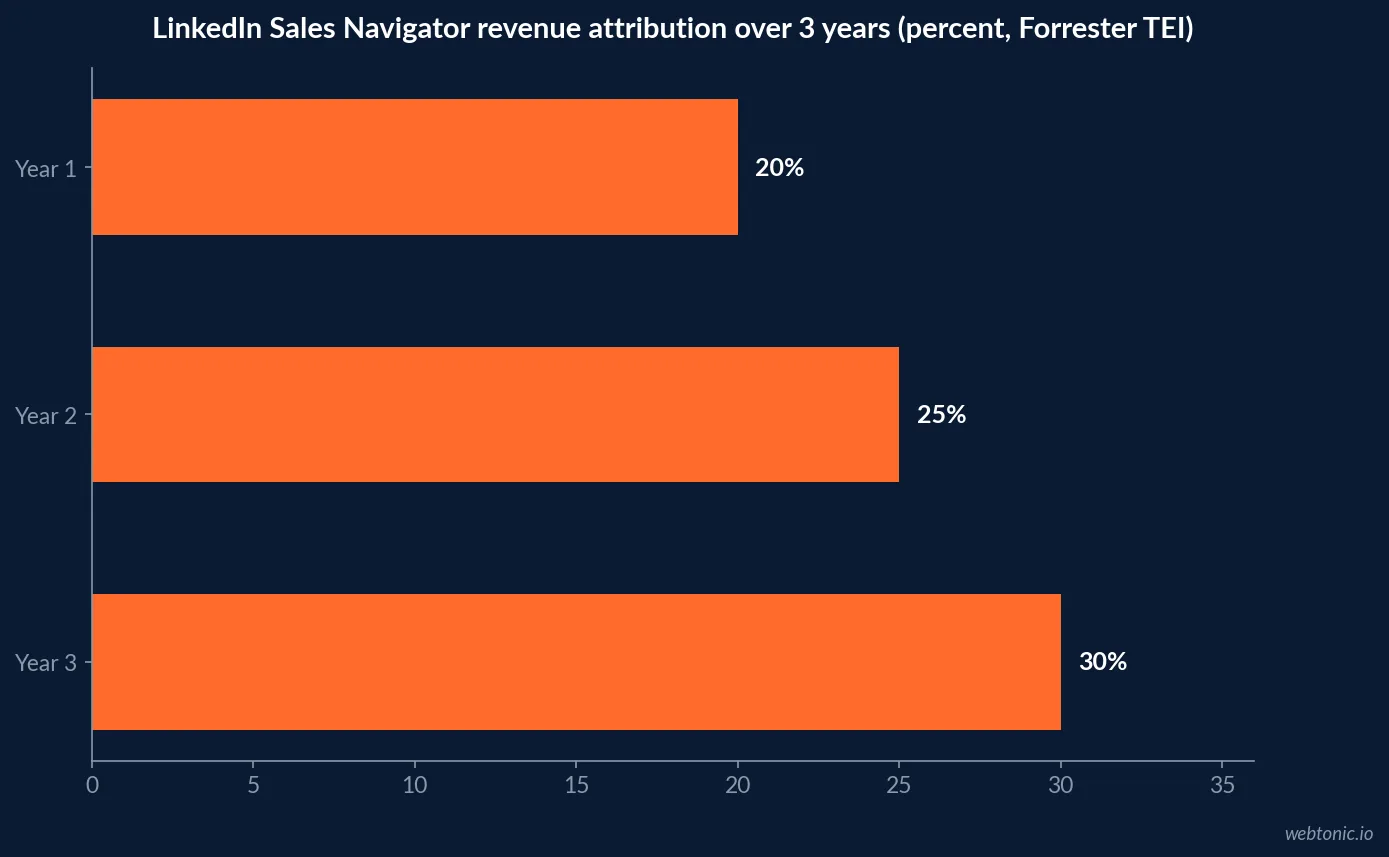
LinkedIn commissioned Forrester Consulting to run a Total Economic Impact study on Sales Navigator, finding a 312% ROI over three years with payback in under 6 months. Interviewees reported year-over-year revenue increases of 5% in year one, 8% in year two and 10% in year three, with the share of revenue attributable to Sales Navigator growing from 20% to 30% across the same period — modeled, on a composite USD 250 million-revenue business, as a USD 1.3 million gain in net operating profit.
The Social Selling Index correlation
LinkedIn Sales Solutions data compiled by Gangly reports that reps scoring 70 or above on the Social Selling Index generate 45% more opportunities and are 51% more likely to hit quota than lower-scoring peers, with 78% of active social sellers outperforming colleagues who skip social prospecting entirely. On outreach response rates specifically, InMail averages 18% to 25% against a platform-wide cold email average of 3.4%, while LinkedIn DM reply rates sit near 10.4% and connection-request acceptance averages 28.5%.
| Outreach type | Reported response/reply rate | Source |
|---|---|---|
| Cold email, platform-wide | 3.4% | Expandi, 13.2M data points |
| LinkedIn DM reply rate | 10.4% | Expandi, 13.2M data points |
| Connection-request reply rate | 3.0% | Expandi, 13.2M data points |
| Connection acceptance rate | 28.5% | Expandi, 13.2M data points |
| InMail response rate, average | 18-25% | LinkedIn Sales Solutions |
What ramp time and cost actually look like for each channel
Budget decisions live or die on ramp time as much as on conversion rate. ColdCalls.ca's 2026 benchmark, drawn from 184,302 on-shore B2B dials and 32,617 live conversations, found that reps with 5 or more years on the phone booked 2.3 times the AE-accepted meetings of reps under 18 months tenure — the single highest-leverage variable in their dataset, ahead of list quality or time of day. The same report found hybrid programs pairing AI research with human callers outperforming AI-only outreach programs by 4.1 times on AE-accepted meetings per dollar, and buyers citing "AI fatigue" as a reason to disengage in 23% of recorded calls, up from 6% in the 2024 dataset.
Social selling's ramp is different in shape: it compounds with tenure on the platform rather than with call volume. LinkedIn's own data shows Sales Navigator's revenue attribution climbing from 20% in year one to 30% in year three of use, meaning the tool's payoff is closer to a skill investment than a campaign that turns on and off.
| Ramp factor | Cold calling (ColdCalls.ca, 2026) | Social selling (LinkedIn, 2026) |
|---|---|---|
| Highest-leverage variable | Rep tenure (5+ years: 2.3x meetings) | SSI score building over time |
| AI's role | Research/enrichment only outperforms 4.1x | Recommends leads, doesn't replace outreach |
| Buyer fatigue signal | 23% cite "AI fatigue" to disengage | Not measured in this dataset |
| Payoff curve | Immediate per call, compounds with tenure | 20% to 30% revenue attribution over 3 years |
What each channel still delivers that the other cannot replace
CallHippo's analysis of 72,000 call attempts across 3,000-plus businesses found that 51% of B2B leads still originate from cold calling despite the digital-first narrative around go-to-market strategy, and that 82% of B2B decision-makers accept meetings from proactive outreach — corroborating the RAIN Group figure cited above from an independent dataset. On the social side, LinkedIn Daily's compilation reports Sales Navigator users seeing an 18% higher average win rate than reps relying on basic LinkedIn functionality, and that 60% of B2B buyers evaluate multiple vendors before a purchase decision — the research window a social-selling presence is built to win.
Reading the two data sets together
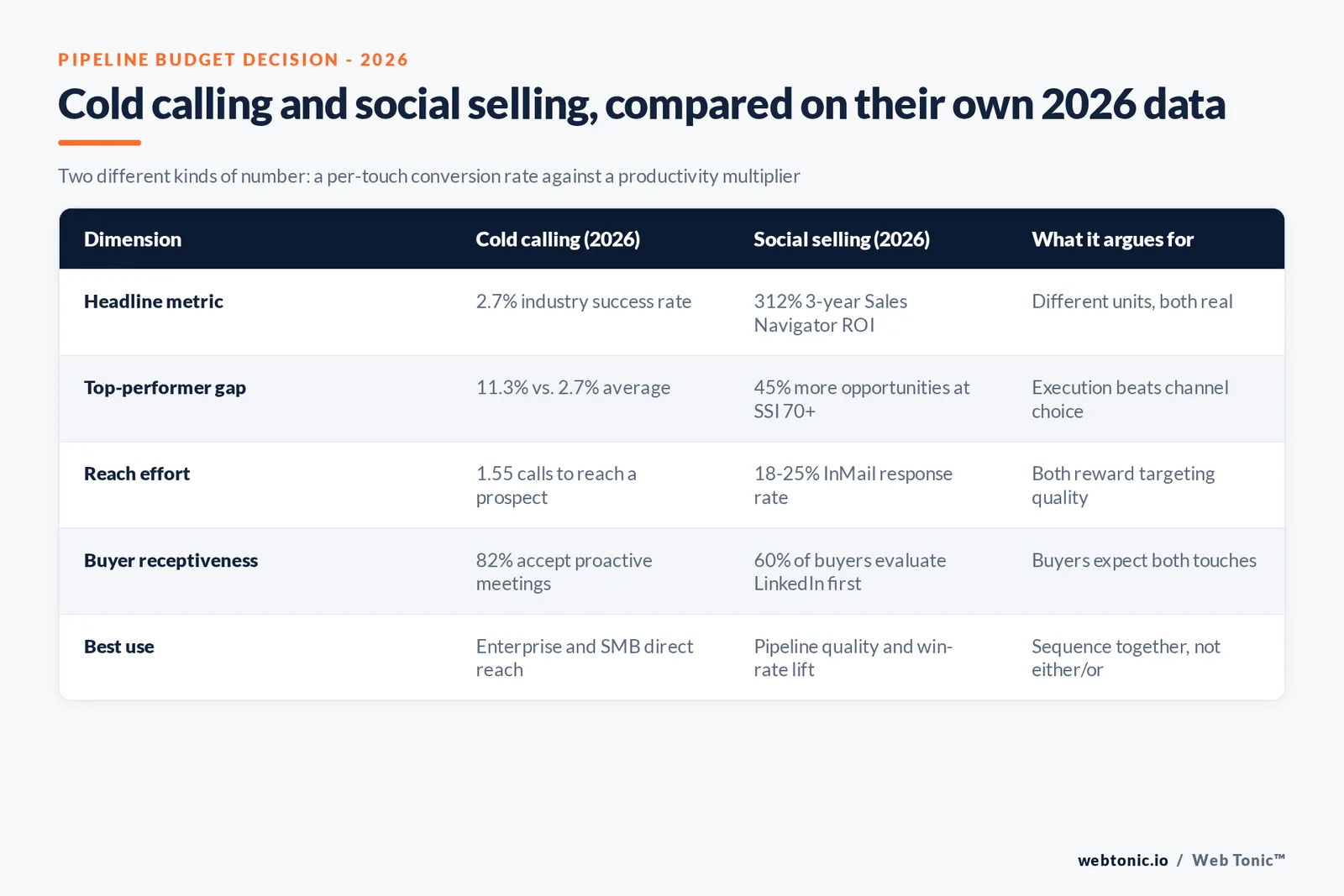
The two channels are not reporting the same kind of number, and that is the actual finding worth budgeting against. Cold calling's data is a conversion rate on a single touch — 2.7% of dials end in a booked meeting industry-wide, with segment and data quality moving that figure by a factor of five or more. Social selling's data is a productivity multiplier on reps already prospecting: a high Social Selling Index does not replace the first outbound touch, it changes how many opportunities and how much win rate a rep gets from the touches they already make.
A quota-planning consequence follows directly from both datasets: a manager setting activity targets off the industry-average 2.7% cold-call figure alone, without also tracking each rep's Social Selling Index, is measuring only half of what predicts who hits quota. The two metrics are not substitutes on a scorecard, they are complements — a rep can carry a below-average phone connect rate and still be a top performer if their SSI-driven pipeline quality is high enough, and the reverse is just as possible.
Put together, the two data sets argue for the same conclusion from different directions: invest in list and data quality before dial volume on the phone side, and invest in SSI-building activity (profile completeness, content engagement, warm connection requests) before adding InMail volume on the social side. Our growth marketing team builds that kind of channel-mix model when a sales organization is deciding where the next headcount or tool budget should go, our data practice instruments which touches actually influenced the close, and our guide to building a defensible channel strategy covers the same prioritization logic for paid channels.
Frequently Asked Questions
Is cold calling still worth doing in 2026?
The data says yes, with a caveat about direction. Cognism's 2026 State of Cold Calling report, built on more than 200,000 analyzed calls, puts the industry-average success rate at 2.7%, up from 2.3% the year before but still well below the 4.82% recorded in 2024. Cognism's own sales team converts at 11.3%, more than four times the industry average, which is the clearest evidence in the report that the channel itself is not broken, execution quality is what separates the two numbers.
Is social selling actually more effective than cold calling?
They are not measuring the same thing, which makes a direct percentage comparison misleading. LinkedIn's Forrester-audited study reports a 312% three-year ROI on Sales Navigator with payback in under 6 months, and reps with a Social Selling Index above 70 generate 45% more opportunities and are 51% more likely to hit quota. Cold calling reports a per-dial conversion rate; social selling reports a productivity and pipeline-quality multiplier on reps who are already prospecting. Both can be true and complementary at once.
What connect and response rates should a team actually plan around?
Plan around a range, not a single number, because segment and data quality move the outcome by a factor of five or more. Published cold-call connect rates run from 5% to 9% for enterprise contacts up to 15% to 22% for SMB outbound, with top performers reaching the high end of each band. On the social side, InMail response rates average 18% to 25% against a platform-wide cold email average of 3.4%, and LinkedIn DM reply rates sit around 10.4%.
How many calls does it actually take to reach a prospect?
Cognism's 2026 dataset puts the average at 1.55 calls to reach a prospect, down from 2.9 the year before, with roughly 93% of eventual answers coming by the third attempt. The practical implication is that a disciplined 3-attempt cadence across different days and times captures the bulk of reach; persistence beyond that point earns diminishing returns on the phone channel specifically.
Does a high Social Selling Index actually predict revenue outcomes?
LinkedIn's own data reports that reps scoring 70 or above on the Social Selling Index generate 45% more opportunities and are 51% more likely to exceed quota than lower-scoring peers, and that 78% of active social sellers outperform colleagues who do not use social media as part of their sales process. The correlation is consistent across LinkedIn's reporting periods, though it describes reps who are already prospecting actively, not a passive-profile effect.
Sources
Cognism - The State of Cold Calling in 2026
Dialfyne - State of Cold Calling 2026 Research (incl. RAIN Group data)
Martal - Is Cold Calling Effective in 2026? B2B Data & Benchmarks
LinkedIn - Is LinkedIn Sales Navigator worth it? (Forrester TEI study)
Gangly - LinkedIn Sales Statistics 2026
ColdCalls.ca - 2026 Human Outbound Benchmark Report
CallHippo - Cold Calling Statistics 2026, data from 72,000 real calls
LinkedIn Daily - LinkedIn Sales Statistics 2026: Social Selling ROI Data