Table of contents
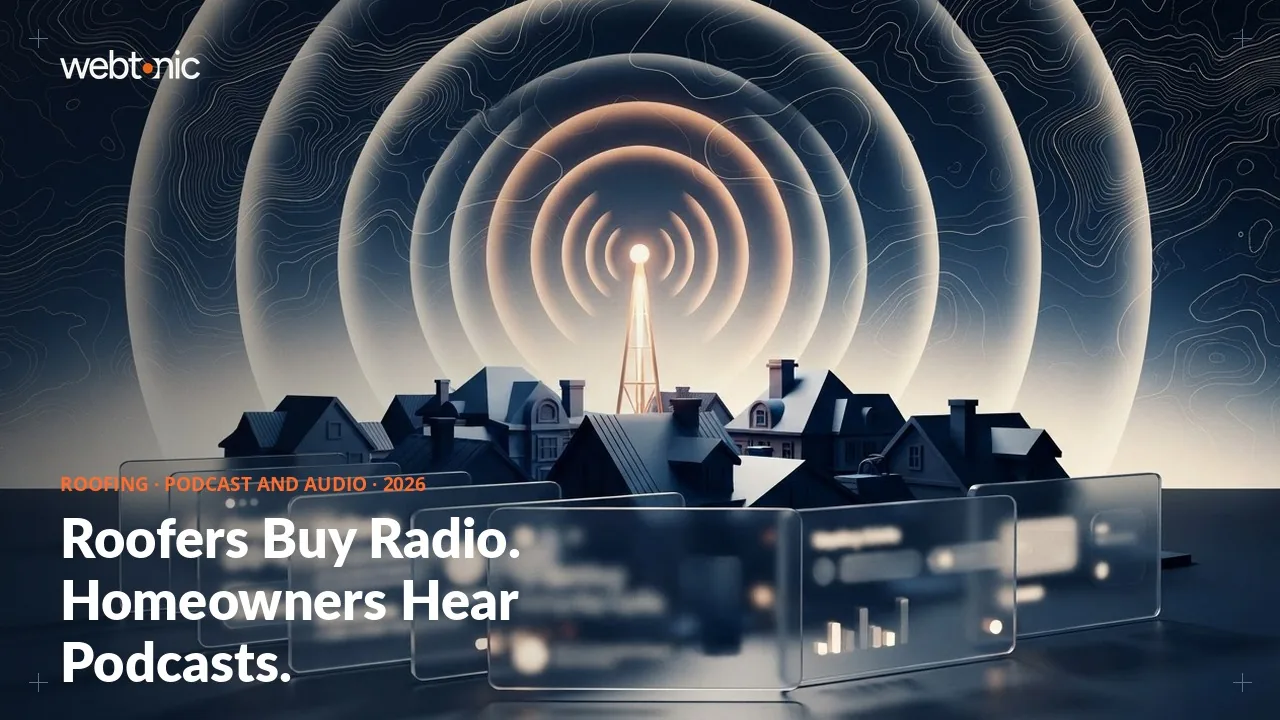
No published study gives roofing its own podcast or audio advertising benchmark in 2026, so every figure below is either cross-industry audio data, labelled as such, or roofing demand data from the trade's own surveys. The practical question for a roofer is host-read reach against programmatic reach, and the numbers show where each one fits.
Key Takeaways
- 58% of Americans 12+ consumed a podcast in the last month (Edison, 2026).
- 68% of Americans aged 35-54 are monthly podcast consumers, the peak homeowner age band.
- US podcast ad revenue reached USD 2.9 billion in 2025, up 17.6% (IAB/PwC).
- Home Improvement and Furnishings took 2.0% of 2023 podcast ad revenue.
- Host-read ads reached a 71% brand recall rate in Nielsen testing.
- Only 15% of roofing contractors advertise on radio and 17% on local TV (Roofing Contractor, 2026).
- 70% of roofers advertise on social media, the most-used channel in the same survey.
- Self-serve audio tests start around USD 250 on Spotify and SiriusXM's AudioGo.
- No roofing-specific podcast CPM, CTR, cost per lead or ROI has been published.
Roofing Podcast and Audio Advertising at a Glance
The table sets the channel's size and reach before any roofing assumption enters. Every row is national, cross-industry data; none of it is a roofing benchmark.
| Metric | Figure | Scope and year | Source |
|---|---|---|---|
| US podcast ad revenue | USD 2.9 billion | All advertisers, 2025 | IAB/PwC Internet Ad Revenue Report |
| Podcast revenue growth | 17.6% year over year | 2025 vs 2024 | IAB/PwC |
| Podcast share of digital ad revenue | 1% | 2025, of USD 294.6 billion | IAB/PwC |
| Monthly podcast consumers | 58% (167 million) | US 12+, January 2026 | Edison Infinite Dial 2026 |
| Weekly podcast consumers | 45% (130 million) | US 12+, January 2026 | Edison Infinite Dial 2026 |
| Host-read brand recall | 71% | Cross-industry ad tests | Nielsen |
Is There a Roofing-Specific Podcast Benchmark?
No. The IAB/PwC FY2023 podcast revenue study breaks revenue out by advertiser category, and roofing sits inside a wider bucket: Home Improvement and Furnishings at 2.0% of 2023 podcast ad revenue. For comparison, the same study put Pharmaceuticals at 3.4% and Health and Wellness at 3.5%. That is a share of spend, not a performance figure; it says nothing about the leads a roofer would get from a mid-roll.
Vendor benchmark reports do not fill the gap either. Magellan AI's Q4 2025 report (vendor) analysed 94,422 podcast episodes and named the fastest-growing advertiser industries, but it does not publish a roofing line. Treat any "roofing podcast CPM" you see quoted as unsourced unless it names a dataset.
How Big Is the Podcast Ad Market Roofers Would Buy Into?
According to IAB and PwC, US podcast advertising grew from USD 1.9 billion in 2023 (up 5%) to USD 2.43 billion in 2024 (up 26.4%) and USD 2.9 billion in 2025 (up 17.6%). It remains small next to search at USD 114.2 billion, which means inventory on home-improvement shows is limited and often sold show by show rather than at national scale.
| Year | US podcast ad revenue | Growth | What it means for a local roofer |
|---|---|---|---|
| 2023 | USD 1.9 billion | +5% | Soft market; mid-tier publishers lost revenue |
| 2024 | USD 2.43 billion | +26.4% | Political and brand money returned |
| 2025 | USD 2.9 billion | +17.6% | Still 1% of digital; niche shows stay negotiable |
Host-Read Reach vs Programmatic Reach
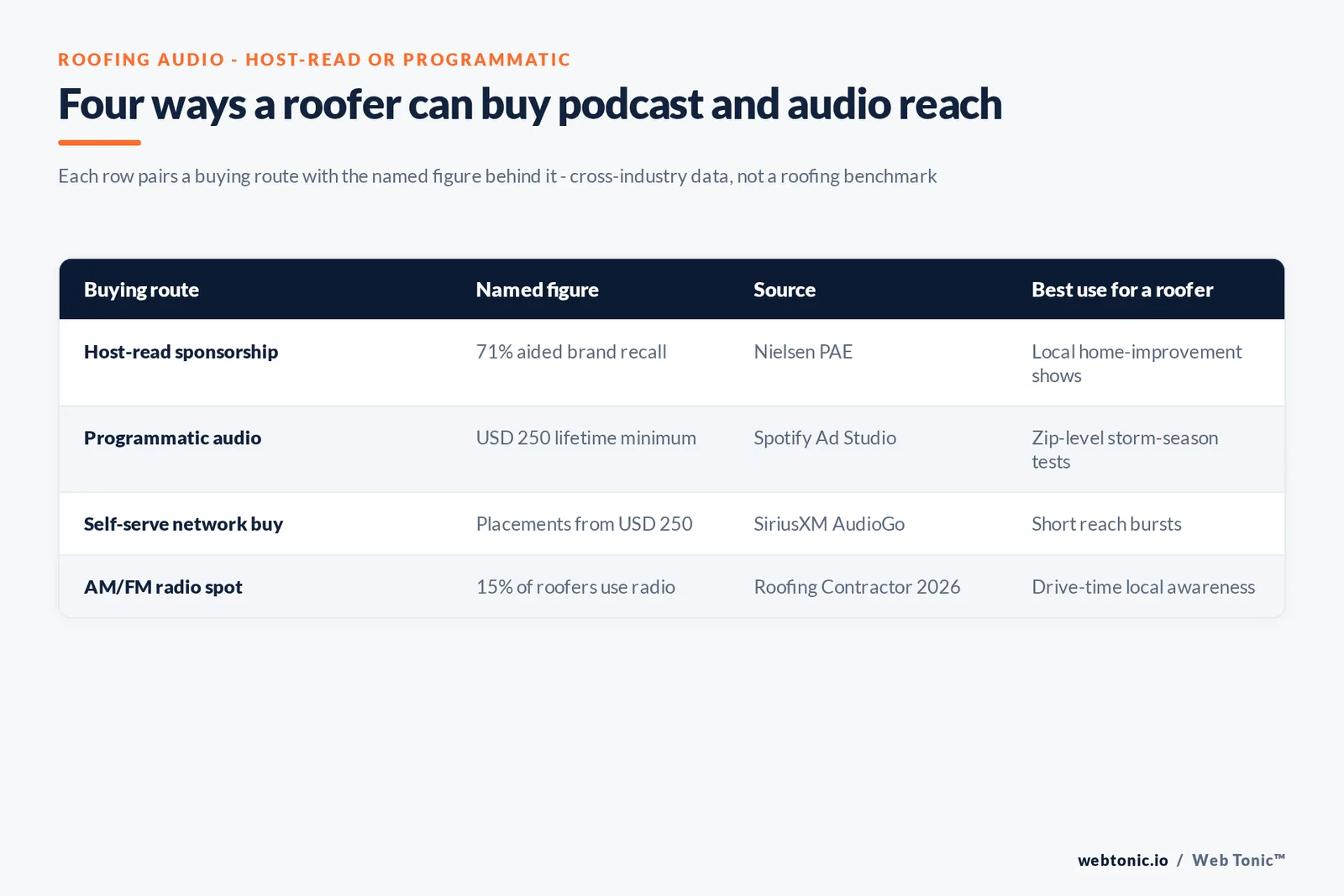
Host-read means the show's own host voices the ad; programmatic means a produced spot inserted by software across many shows or a streaming app. The cross-industry research favours host reads on persuasion, not on raw awareness. Nielsen's 2020 analysis reported an average 50% increase in purchase and recommendation intent for host-read ads against non-host-read ads, while Nielsen's 2023 update found host reads only slightly ahead on awareness.
| Format | What the research shows | Scope | Roofing fit |
|---|---|---|---|
| Host-read mid-roll | 71% brand recall; +50% purchase and recommendation intent | Nielsen, cross-industry | Home-improvement or local-news shows |
| Announcer-read | Cheaper and easier to scale than host reads | SiriusXM Media, vendor | Regional networks |
| Pre-produced programmatic | Most budget flexibility; you supply the creative | SiriusXM Media, vendor | Storm-season geo bursts |
| Longer spots (60s+) | 40% higher purchase-intent lift than shorter ads | Nielsen, cross-industry | Explaining inspections or insurance claims |
The format notes in the second and third rows come from SiriusXM Media's own buying guide, which says host-read ads "typically perform best" and cost more than announcer-read or pre-produced spots. That is a seller describing its product, so label it vendor data.
Where Roofers Advertise Today
Roofing Contractor's 2026 survey asked contractors where they advertise. 70% named social media, 55% rely on word-of-mouth referrals and 49% use Google Ads. Audio sits near the bottom: 15% use radio, behind local print at 41% and local television at 17%. Podcasts were not a listed answer.
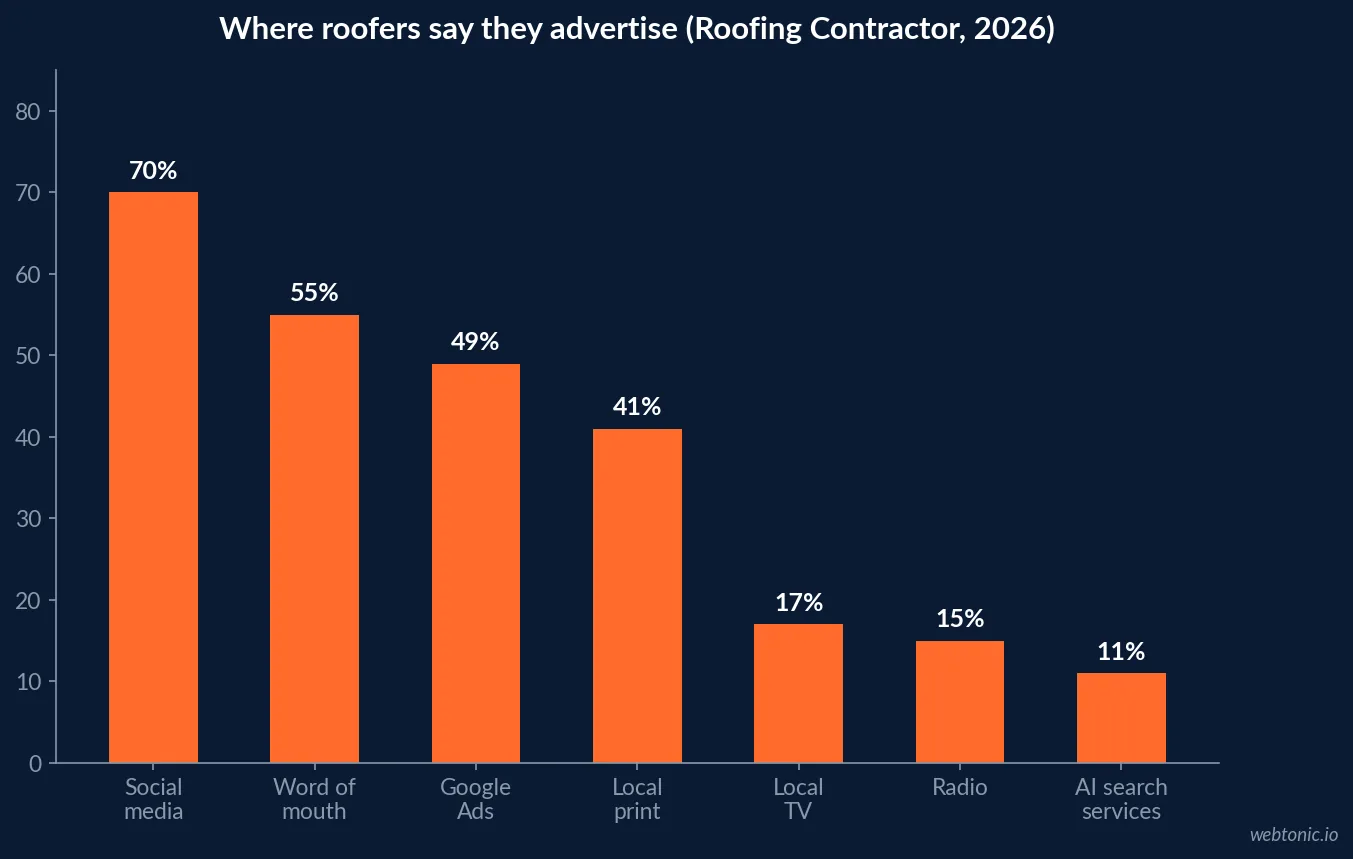
| Channel | Share of roofers using it | Audio implication |
|---|---|---|
| Social media | 70% | Clip host reads for social reuse |
| Word-of-mouth referrals | 55% | A trusted host is a paid referral; disclose it |
| Google Ads | 49% | Audio lifts branded searches you already pay for |
| Local print | 41% | Print budgets are the likeliest pool to test audio |
| Local television | 17% | Streaming audio reaches cord cutters TV misses |
| Radio | 15% | Audio is under-used; low competition for local spots |
| AI search services | 11% | Asked for the first time in 2026 |
Who Hears Roofing Ads: Listener Reach by Age
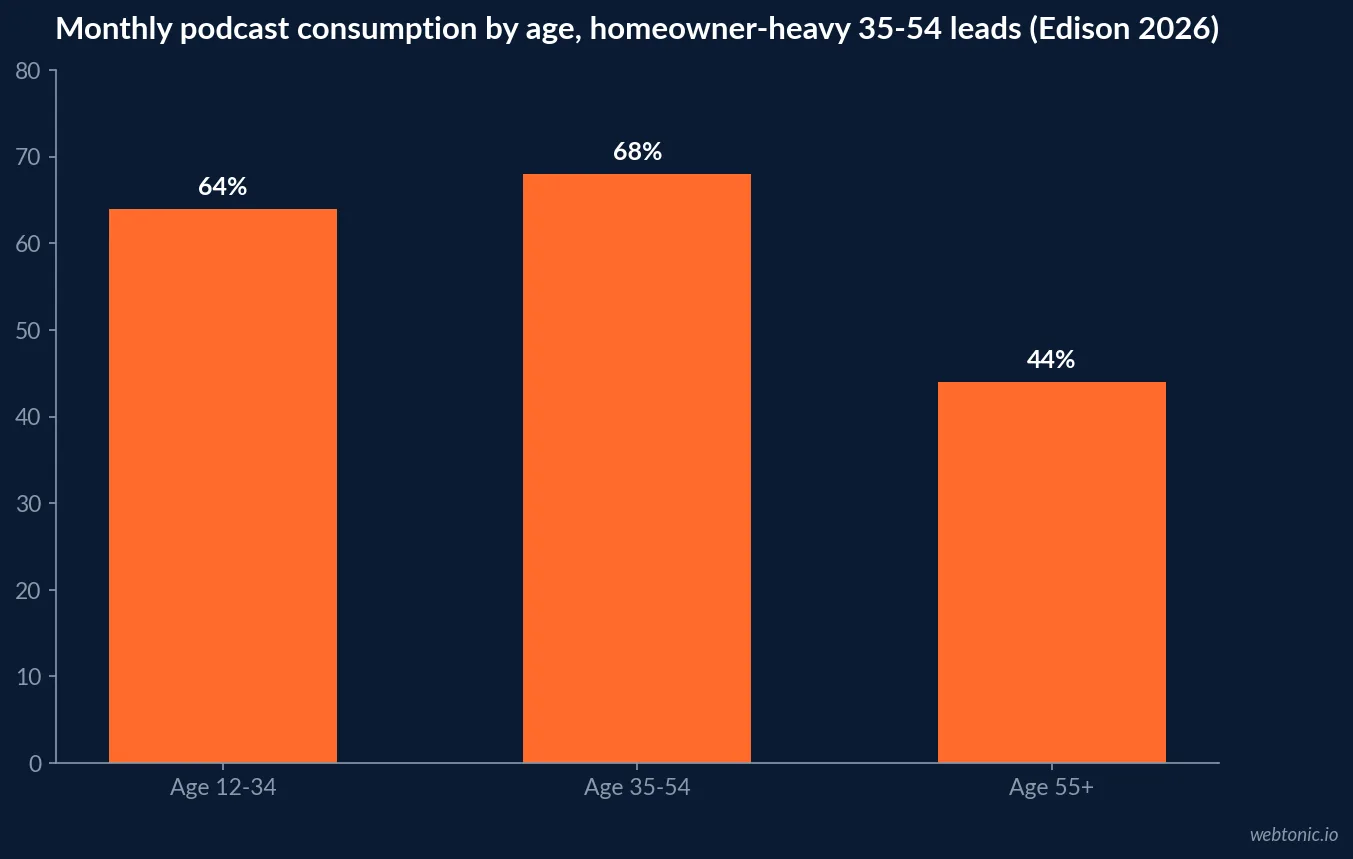
Roofing decisions skew older. Roofing Contractor's 2026 homeowner sample had a mean age of 58, and Edison's Podcast Consumer 2026 shows the audience has moved the same way: 68% of 35-54-year-olds and 44% of those 55+ are monthly podcast consumers, against 64% of 12-34-year-olds. Among those 55+, the figure was 38% in 2025.
What Homeowners Expect After They Hear the Ad
An audio ad only starts the job. The same Roofing Contractor homeowner survey shows what the call has to deliver, and each figure maps to a line in the script or the landing page.
| Homeowner finding (2026) | Figure | Script or landing-page response |
|---|---|---|
| More likely to call a roofer with pricing online | 65% | Say where pricing lives; do not read prices on air |
| Gather three quotes | 66% | Invite the comparison instead of fighting it |
| Expect contact within one to two days | 56% | Promise a callback window you can keep |
| Expect contact the same day | 39% | Staff the line during the flight |
| Choose on proven experience and certifications | 46% | Name the certification the host can verify |
Entry Points and Minimum Spends for a Roofing Audio Test
These are platform floors, not recommended budgets. Spotify's Ad Studio help centre states a minimum lifetime budget of roughly the equivalent of USD 250, and SiriusXM Media says AudioGo placements begin as low as USD 250. For show-level host reads, Libsyn Ads' marketplace (vendor) puts a typical 30-second spot at USD 10 to 50 CPM, meaning per thousand downloads.
Geo-targeting is the reason a roofer would choose programmatic over a national host read. Storms are local, and a produced spot can be limited to the affected area; a host read on a national show cannot.
Why Podcasts Reach Homeowners TV Misses
The Cumulus Media and Signal Hill Insights Podcast Download, Fall 2025 (vendor study, 603 weekly podcast consumers, October 2025) found 35% of weekly podcast consumers have no pay-TV subscription and they spend 41% of their video time on ad-free platforms. For the 17% of roofers buying local TV, that is audience the TV budget cannot reach.
Listening habits also decide how a roofing message should be built. The Spring 2025 edition of the same vendor series found audio is still the main way people consume podcasts, and that most weekly listeners hear new episodes within a day of release, which suits a short storm-response flight. Edison's Share of Ear data puts daily audio time at 3 hours 57 minutes for Americans 13+, and podcasts take 16% of ad-supported audio time across all listeners.
| Listening habit | Figure | Source and scope | Roofing script choice |
|---|---|---|---|
| Weekly consumers with no pay-TV subscription | 35% | Cumulus/Signal Hill, Fall 2025, n=603 (vendor) | Use audio where local TV cannot reach |
| Share of video time on ad-free platforms | 41% | Cumulus/Signal Hill, Fall 2025 (vendor) | Do not rely on streaming TV spots alone |
| Audio as main podcast mode | 58% | Cumulus/Signal Hill, Spring 2025 (vendor) | Write for the ear; the logo may never be seen |
| Daily time with all audio | 3 hrs 57 mins | Edison Share of Ear, Q1 2026, 13+ | Repeat the phone number or URL twice |
| Podcasts' share of ad-supported audio time | 16% | Edison Share of Ear, Q1 2026, 13+ | Pair podcasts with radio, not instead of it |
| Weekly listeners who paid to support a podcast | 21% | Edison Podcast Metrics, Q2 2025-Q1 2026 | Choose shows whose fans trust the host |
How to Measure a Roofing Podcast Campaign
With no benchmark to compare against, the only valid comparison is your own baseline. Edison's Podcast Consumer 2026 reports that 76% of weekly podcast consumers have acted after hearing a podcast ad, with actions ranging from visiting a website to using a promo code. That is self-reported and cross-industry; use it to justify a tracked test, not to forecast leads.
- Give each show its own vanity URL or phone number so calls are attributable.
- Record branded search volume for the flight weeks against the same weeks before.
- Ask "where did you hear about us" on every inspection booking.
- Keep flights at least four weeks; roofing sales cycles run longer than a single episode.
- Read our roofing influencer and UGC statistics for how creator trust data compares.
Disclosure Rules for Host-Read Roofing Ads
A host endorsement is still an endorsement. The FTC's Endorsement Guides, 16 CFR 255.5, require a material connection to be disclosed clearly and conspicuously when the audience would not expect it, and the rule names free or discounted products. On broadcast radio, 47 CFR 73.1212 requires the station to announce that the matter is sponsored and by whom at the time of broadcast.
Roofing Audio vs Other Roofing Channels
Audio is not a replacement for search. Most roofing budgets sit in Google Ads and social; see our roofing SMS marketing statistics for the follow-up side of the funnel and our advertising statistics hub for channel-wide spend. If you want a test plan built around your service area, our performance creative team scripts and tracks audio flights.
Frequently Asked Questions
Is there a published podcast advertising benchmark for roofing companies?
No. Neither the IAB/PwC podcast revenue study nor vendor benchmark reports publish a roofing-specific CPM, click-through rate, cost per lead or return figure. The closest category in the IAB/PwC FY2023 study is Home Improvement and Furnishings, which accounted for 2.0% of 2023 US podcast ad revenue. Anything more specific has to come from your own tracked campaigns.
Do host-read podcast ads work better than produced spots?
Nielsen's podcast ad effectiveness work found host-read ads reached a 71% brand recall rate, and a 2020 Nielsen analysis reported an average 50% increase in purchase and recommendation intent against non-host-read ads. Nielsen's 2023 update adds that for awareness alone host-read ads were only slightly ahead, with the bigger gap in mid- and lower-funnel actions. That data is cross-industry, not roofing-specific.
How many roofers already advertise on audio?
Roofing Contractor's 2026 survey found 15% of roofing contractors use radio and 17% use local television, against 70% on social media, 55% relying on word of mouth and 49% on Google Ads. Podcasts were not listed as a separate answer, so there is no published share of roofers buying podcast ads.
What is the smallest audio test a roofer can run?
Self-serve platforms publish their own floors. Spotify's Ad Studio help centre puts the minimum lifetime budget at roughly the equivalent of USD 250, and SiriusXM Media says placements on its AudioGo self-serve tool begin as low as USD 250. Host-read deals on individual shows are priced per thousand downloads and vary by show.
Does a roofer have to disclose a paid host endorsement?
Yes. The FTC Endorsement Guides at 16 CFR 255.5 require a material connection between an endorser and the seller to be disclosed clearly and conspicuously when the audience would not expect it, and that includes free or discounted products. A host who got a discounted roof and talks about it on air has a connection to disclose.
Sources
IAB/PwC - Internet Advertising Revenue Report, full year 2025
IAB/PwC - US Podcast Advertising Revenue Study, FY2023
Edison Research - The Infinite Dial 2026
Edison Research - The Podcast Consumer 2026
Nielsen - Podcast audiences broaden (2021)
Nielsen - Brand recall in emerging media (2023)
Roofing Contractor - The homeowner's roofing journey in 2026
SiriusXM Media - Podcast advertising costs (vendor)
Libsyn Ads - Podcast advertising marketplace (vendor)
Cumulus Media / Signal Hill - Podcast Download Fall 2025 (vendor)
eCFR - 16 CFR Part 255, FTC Endorsement Guides