Table of contents
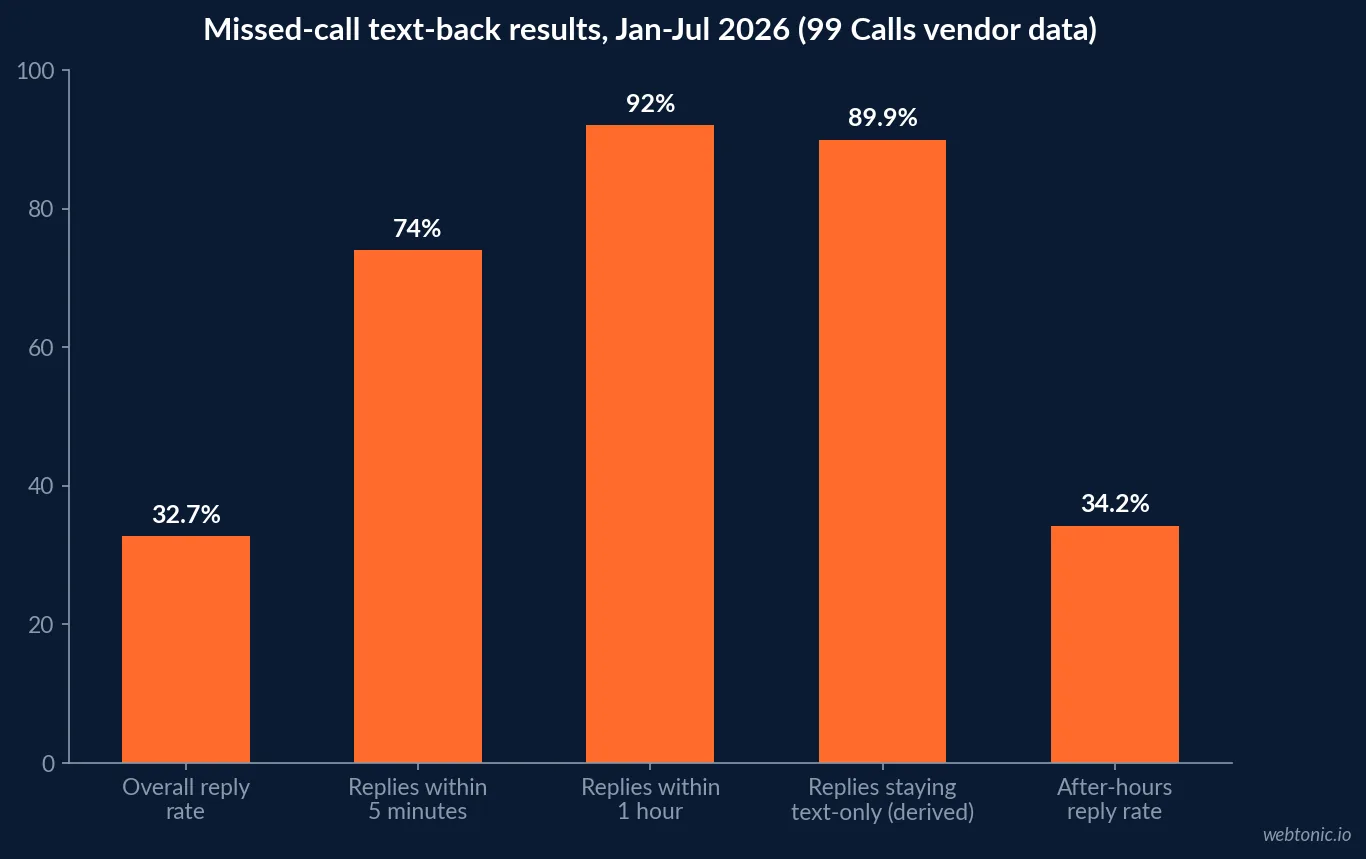
A 2026 study of 14,354 automated missed-call text messages sent for 192 home service businesses found a 32.7% reply rate, with three-quarters of replies landing inside five minutes. That is the baseline a roofing SMS campaign should be measured against, not the unsourced 45% or 98% figures that circulate without a named study.
Key Takeaways
- 32.7% of missed callers replied to an automated text (99 Calls, 2026).
- Monthly reply rates held between 31.3% and 34.9% across seven months.
- 74% of replies arrived within five minutes, 92% within an hour.
- Nine in ten recovered conversations stayed entirely in text, no call-back needed.
- Nearly one quarter of texts went out after hours and converted at 34.2%, matching daytime.
- More than 1,600 reply conversations became billable leads in the study.
- 75.3% of U.S. businesses used SMS marketing at the start of 2026 (SimpleTexting).
- 66.2% of businesses report a campaign click-through rate above 20%.
- Businesses that text have 4.99x higher odds of reporting overall marketing success.
- Twilio prices outbound U.S. SMS at USD 0.0083 per segment, plus carrier fees.
- 10DLC campaign vetting runs a flat USD 15 one-time fee on top of brand registration.
- Carrier fees add about USD 0.0025 per message in the U.S. (SimpleTexting schedule).
- A missed-call text-back program cost as little as a USD 25-39 monthly plan to run.
- 82% of consumers say they text every day, versus 72% for social apps.
- The FCC's one-to-one consent rule was vacated by the 11th Circuit in January 2025.
Benchmarks at a glance
Two datasets carry this page: 99 Calls' 2026 analysis of missed-call text-back traffic across home-service accounts, and SimpleTexting's 2026 survey of 1,000 U.S. consumers and 400 SMS marketers. Both are vendor data from each platform's own customers, and both name a sample and year.
| Metric | 2026 figure | Source | What it measures |
|---|---|---|---|
| Reply rate to missed-call text | 32.7% | 99 Calls (14,354 messages, 192 businesses) | Text sent right after an unanswered call |
| Reply within 5 minutes | 74% | 99 Calls | Speed of the customer's response |
| Reply within 1 hour | 92% | 99 Calls | Cumulative response speed |
| Conversation stayed text-only | 89.9% | 99 Calls vendor data (derived: 4,698 replies, 476 also took a call) | No follow-up phone call needed |
| Business SMS adoption | 75.3% | SimpleTexting (400 marketers) | Share of businesses texting customers in 2026 |
| Campaigns with CTR above 20% | 66.2% | SimpleTexting (400 marketers) | Click-through on marketing texts |
What "good" looks like for a missed-call recovery text
Roofing leads are won or lost in minutes - a homeowner with a leak calls three contractors back to back. The most directly applicable 2026 number here is not a generic SMS-industry average, it is 99 Calls' analysis of 14,354 automated texts sent for 192 home service businesses (vendor data from its own platform) between January and July 2026: a 32.7% reply rate, with monthly results never straying outside 31.3% to 34.9% even as the business count grew from 131 to 192. That consistency is the evaluation bar - a roofing account running meaningfully under 31% has a message or timing problem, not a channel problem.
| Response window | Share of replies | Source | Roofing read |
|---|---|---|---|
| Within 5 minutes | 74% | 99 Calls, 2026 | Customer is still holding the phone - reply fast or lose the window |
| Within 1 hour | 92% | 99 Calls, 2026 | Covers a technician finishing one job before the next |
| Within 24 hours | 99% | 99 Calls, 2026 | Near-total resolution inside a day |
| Followed by a phone call | 10.1% | 99 Calls, 2026 | A call is the exception, not the close mechanism |
After-hours performance did not fall off
Roofing calls spike during storms, and storms do not respect business hours. 99 Calls found that nearly one quarter of all automated texts in its dataset went out during evenings and weekends, and those after-hours messages converted at 34.2% - essentially matching daytime performance and recovering 1,186 customer conversations across the study window. A roofing campaign built only for office hours is leaving a quarter of its volume unmeasured.
| Segment | Volume share | Reply rate | Source |
|---|---|---|---|
| Daytime texts | About three quarters | Not broken out (32.7% overall) | 99 Calls, 2026 |
| After-hours texts | Nearly one quarter | 34.2% | 99 Calls, 2026 |
| Total study window | 100% (14,354 texts) | 32.7% | 99 Calls, 2026 |
Click-through and revenue attribution, at the channel level
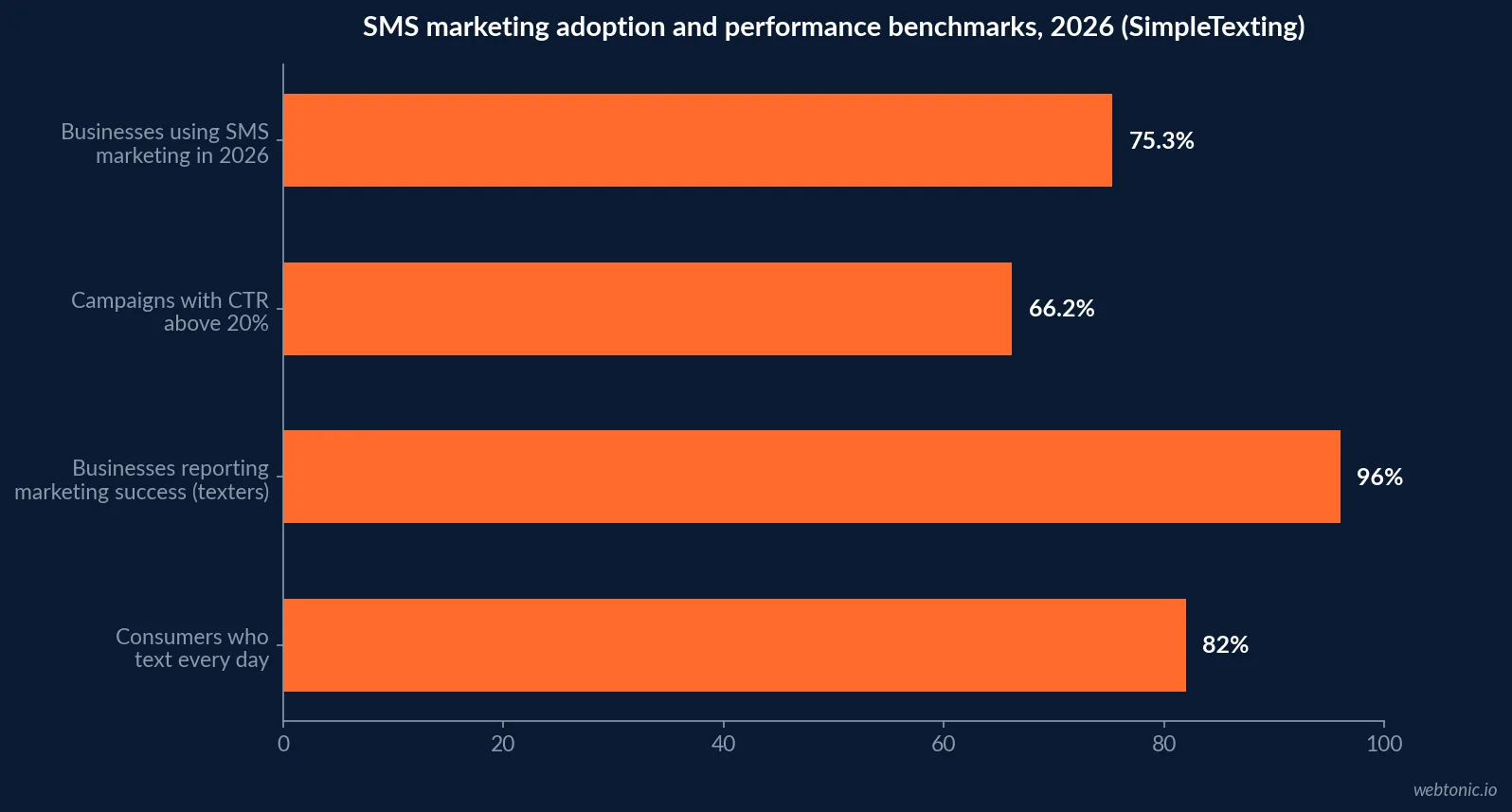
Outside the roofing-specific dataset, SimpleTexting's January 2026 survey of 1,000 U.S. consumers and 400 SMS marketers puts channel performance in context: 75.3% of businesses used SMS marketing at the start of 2026, up from 66% a year earlier, and 66.2% of texting businesses report an average campaign click-through rate above 20%. Businesses that text customers had 4.99x higher odds of reporting overall digital marketing success than those that do not.
Neither figure is roofing-specific, and this page does not claim it is. Read it as the ceiling a well-run trade campaign should be closing in on, with the 99 Calls numbers as the floor a missed-call program has to clear.
What a roofing SMS program costs to run
Evaluating performance only makes sense against a real cost base. Twilio's own U.S. pricing page lists outbound SMS at USD 0.0083 per segment, with an additional carrier fee SimpleTexting quotes at roughly USD 0.0025 per message in the U.S. A2P 10DLC registration - mandatory for business texting at volume - runs a USD 4 to 44 one-time brand fee plus USD 15 per campaign for vetting and USD 1.50 to 10 per campaign per month, per Twilio's own 10DLC page. Purpose-built platforms fold that into a flat plan.
| Vendor (own pricing page) | Entry plan / rate | What it includes | Notes |
|---|---|---|---|
| Twilio | USD 0.0083 per segment | Pay-as-you-go SMS API | Plus ~USD 0.0025 carrier fee and 10DLC fees |
| SimpleTexting | USD 39/mo (500 credits) | Local number, two-way texting, reporting | +USD 4 one-time carrier registration |
| EZ Texting | USD 25/mo (500 credits) | Local textable number, workflows | Overage credits at USD 0.04 each |
| Textedly | From USD 29/mo | Mass texting, unlimited contacts | Higher tiers scale to 300,000+ messages/mo |
| Twilio (10DLC, own page) | USD 4-44 brand + USD 15/campaign | Registration required for business texting | Plus USD 1.50-10 per campaign per month |
Consent, quiet hours and the vacated FCC rule
None of the performance above is worth much if the program is non-compliant. Every message has to sit inside CTIA's Messaging Principles and Best Practices (clear opt-in call-to-action, honored opt-outs) and 47 CFR 64.1200's delivery restrictions - which set quiet hours and require a working "STOP" mechanism.
On the consent question specifically: the FCC's 2023 order would have required a consumer to consent separately to each individual sender ("one-to-one consent") rather than to a list of partners. The 11th Circuit vacated that part of the order in Insurance Marketing Coalition Limited v. FCC (decided January 24, 2025), ruling the FCC exceeded its statutory authority. That restriction is not in force - the operative standard reverts to ordinary TCPA "prior express consent," and a roofing campaign should be built on documented opt-in, not on the now-vacated rule.
| Compliance layer | What it requires | Source | Currently in force? |
|---|---|---|---|
| TCPA prior express consent | Documented opt-in before the first marketing text | 47 U.S.C. 227 / ecfr.gov 64.1200 | Yes |
| FCC one-to-one consent (2023 order) | Separate consent per individual sender | 11th Cir., Insurance Marketing Coalition v. FCC | No - vacated Jan 24, 2025 |
| CTIA Messaging Principles | Clear call-to-action, honored STOP, no deceptive content | CTIA (own PDF) | Yes - industry best practice |
| A2P 10DLC registration | Brand + campaign registration before high-volume sends | Twilio / Campaign Registry | Yes |
How a text-first flow compares to a phone-only follow-up
The 99 Calls study is a useful natural experiment because it isolates conversations that would otherwise have gone to voicemail. Before automated texting, a missed call converted only if the customer left a voicemail and waited for a callback, or called back themselves. After texting, 32.7% of those same missed calls turned into an active conversation, and 89.9% of them never required a phone call at all. For a roofing office fielding storm-season call volume, that is capacity recovered without adding a phone line or a receptionist shift.
| Follow-up method | What happens to a missed call | Approximate conversion | Source |
|---|---|---|---|
| No automated response | Customer moves to the next search result | Baseline, unmeasured | 99 Calls framing |
| Automated missed-call text | 32.7% reply, 89.9% resolved entirely by text | 32.7% reply rate | 99 Calls, 2026 |
| Text plus a live follow-up call | 10.1% of replies also completed a call | Additive, not required | 99 Calls, 2026 |
Setting up a 90-day evaluation window
99 Calls tracked its dataset over seven months and still saw month-to-month reply-rate variance of roughly three points (31.3% to 34.9%). A roofing operator evaluating its own campaign should expect similar noise and give a new program at least 90 days before comparing it against the benchmarks on this page - one slow storm month or one badly worded template can move the number more than the channel itself does.
Track the same four fields 99 Calls measured: reply rate, time-to-reply, share of conversations resolved without a call, and after-hours share. Those four numbers, compared month over month, catch a template or timing problem well before a quarterly review would.
| Evaluation window | What to compare | Benchmark to beat | Why it matters |
|---|---|---|---|
| Month 1 | Reply rate | 31.3% (99 Calls' lowest month) | Confirms the automation is firing correctly |
| Month 2-3 | Time-to-reply distribution | 74% within 5 minutes | Flags a delay in the send trigger |
| Ongoing | Share resolved without a call | 89.9% | Tests whether the message answers the question |
| Ongoing | After-hours reply rate | 34.2% | Confirms coverage outside office hours |
Building the evaluation into a scorecard
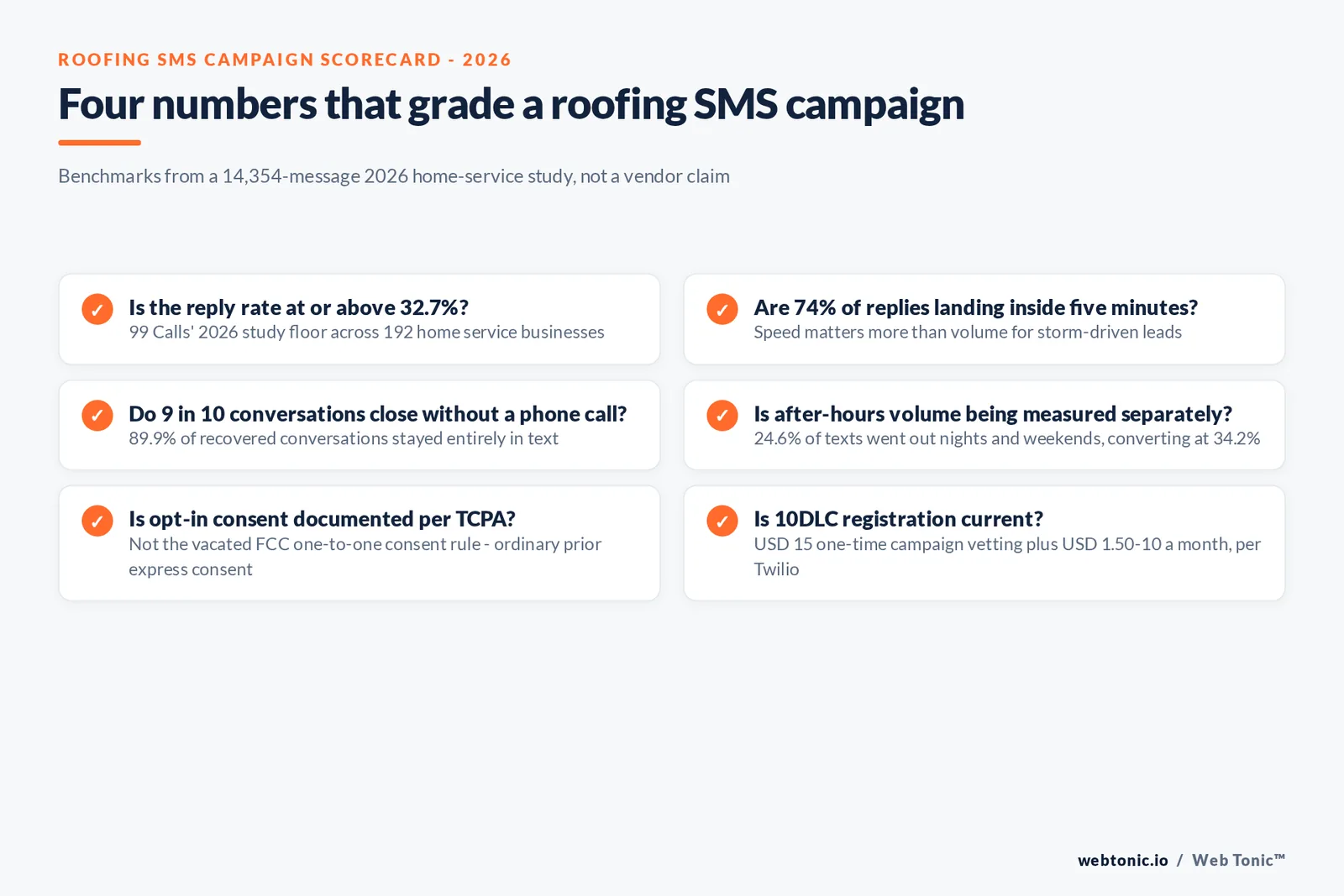
Score a roofing SMS program on four numbers pulled straight from the sources above: reply rate against the 32.7% floor, share of replies inside five minutes against 74%, share of conversations that close without a phone call against roughly 90%, and after-hours volume share against the nearly-one-quarter baseline. A campaign hitting all four is performing at the level the largest available 2026 home-service dataset describes as normal.
None of this replaces a compliance review. A high reply rate on a list built without documented consent is still a liability, not a win. See Web Tonic's growth marketing services, Web Tonic's team page, and the wider SMS marketing statistics hub for channel-level benchmarks beyond roofing, or get in touch to discuss a campaign audit.
Frequently Asked Questions
What reply rate should a roofing SMS campaign expect?
The clearest 2026 benchmark comes from 99 Calls, which measured 14,354 automated missed-call text messages sent for 192 home-service businesses (vendor data from its own platform; no roofing-only split) between January and July 2026: a 32.7% overall reply rate, holding steady in a 31.3% to 34.9% monthly range as adoption nearly doubled. A roofing campaign landing meaningfully below 31% points at message wording or timing, not the channel.
How fast do homeowners respond to a roofing text?
Fast. In the same 99 Calls dataset, 74% of replies arrived within five minutes of the text going out, 92% within an hour, and 99% within 24 hours. SimpleTexting's 2026 survey of 1,000 U.S. consumers backs this up at the channel level: 74% of consumers check a text notification within five minutes, and 47% check their phone for texts more than 10 times a day.
Does a roofing text campaign still need a phone call?
Usually not to restart the conversation. Of the 4,698 customers who replied to a missed-call text in the 99 Calls study, only 476 also completed a phone call in the following 24 hours - roughly nine in ten recovered conversations stayed entirely in text. Budget the campaign to close in text, and treat a resulting call as a bonus signal of urgency.
What does a roofing SMS campaign cost to run?
Twilio prices outbound U.S. SMS at USD 0.0083 per segment plus a roughly USD 0.0025 carrier fee (per SimpleTexting's published carrier-fee schedule), and A2P 10DLC registration through Twilio's own campaign-registry partner runs a USD 4-44 one-time brand fee plus USD 15 per campaign vetting and USD 1.50-10 per campaign per month. Platforms built for the trade - SimpleTexting, EZ Texting, Textedly - wrap that into a monthly plan starting near USD 25-39.
Is texting homeowners after a missed call compliant?
It has to run inside CTIA's Messaging Principles and Best Practices and 47 CFR 64.1200 - opt-in consent, a clear opt-out, and quiet hours. The FCC's January 2024 one-to-one consent rule that would have tightened this further was vacated by the 11th Circuit in Insurance Marketing Coalition v. FCC (January 24, 2025), so the operative consent standard is the pre-2023 TCPA reading, not that stricter rule - never describe it as in force.
Sources
99 Calls - Does Missed Call Text Back Actually Work? (2026 study, 14,354 messages)
SimpleTexting - SMS Marketing Statistics 2026 (1,000 consumers, 400 marketers)
Twilio - SMS Pricing in the United States
Twilio - A2P 10DLC Registration and Fees
SimpleTexting - SMS Marketing Pricing
EZ Texting - SMS Marketing Pricing
Textedly - SMS Marketing Pricing & Plans
CTIA - Messaging Principles and Best Practices
eCFR - 47 CFR 64.1200, Delivery Restrictions
11th Circuit - Insurance Marketing Coalition Ltd. v. FCC, No. 24-10277 (Jan. 24, 2025)