Table of contents
Roofing buyers already run on social proof - 74% follow a neighbor, friend or family recommendation - but no study publishes a roofing influencer benchmark. This page separates what the homeowner and marketplace data actually show from what it does not.
Key Takeaways
- 74% of homeowners follow a personal recommendation when finding a roofer (Roofing Contractor, 2026 edition).
- 62% rate online reviews very or extremely important, down from 67% in 2025.
- Only 9% say reviews are unimportant to the decision.
- About 20% say reviews and testimonials alone decide between two roofers; 46% pick on experience and certifications.
- 70% of roofing contractors advertise on social media, and more than 91% feature customer reviews on their websites.
- Skilled Trades creators average USD 309 per engagement, the priciest niche on Collabstr in 2026.
- Skilled Trades searches grew 103% year over year on the same marketplace.
- 47% of consumers skip businesses with fewer than 20 reviews (BrightLocal, 2026).
- 97% of shoppers consult multiple sources before buying (Bazaarvoice, cross-industry).
- No roofing-specific influencer engagement rate, CPM or ROI has been published.
Roofing influencer and UGC data at a glance
The table below pulls the figures that exist for roofing and labels the cross-industry ones. Roofing Contractor's 2026 homeowner and contractor study (published May 2026 from a survey fielded in summer 2025), run by BNP Media's research arm, is the only roofing-specific source; everything about creators themselves comes from marketplace or survey data covering all industries.
| Metric | Figure | Scope | Source |
|---|---|---|---|
| Homeowners following a personal recommendation | 74% | Roofing | Roofing Contractor 2026 |
| Rate online reviews very or extremely important | 62% | Roofing | Roofing Contractor 2026 |
| Contractors advertising on social media | 70% | Roofing | Roofing Contractor 2026 |
| Skilled Trades average price per engagement | USD 309 | All trades | Collabstr 2026 |
| Engagements under USD 300 | 80% | All niches | Collabstr 2026 |
| Consumers avoiding businesses with under 20 reviews | 47% | All local businesses | BrightLocal 2026 |
How homeowners actually find a roofer
In the 2026 survey, 74% of homeowners said they follow a recommendation from a neighbor, friend or family member, 62% said they would contact a roofer they had used before and exactly half use internet search engines. The respondents skew toward the people who buy replacement roofs: 93% live in single-family homes, more than half report household income of USD 150,000 or more and the mean age is 58. That profile matters for creator work. A roofing buyer is not the median TikTok viewer, and word of mouth - the offline version of user-generated content - still does most of the selling.
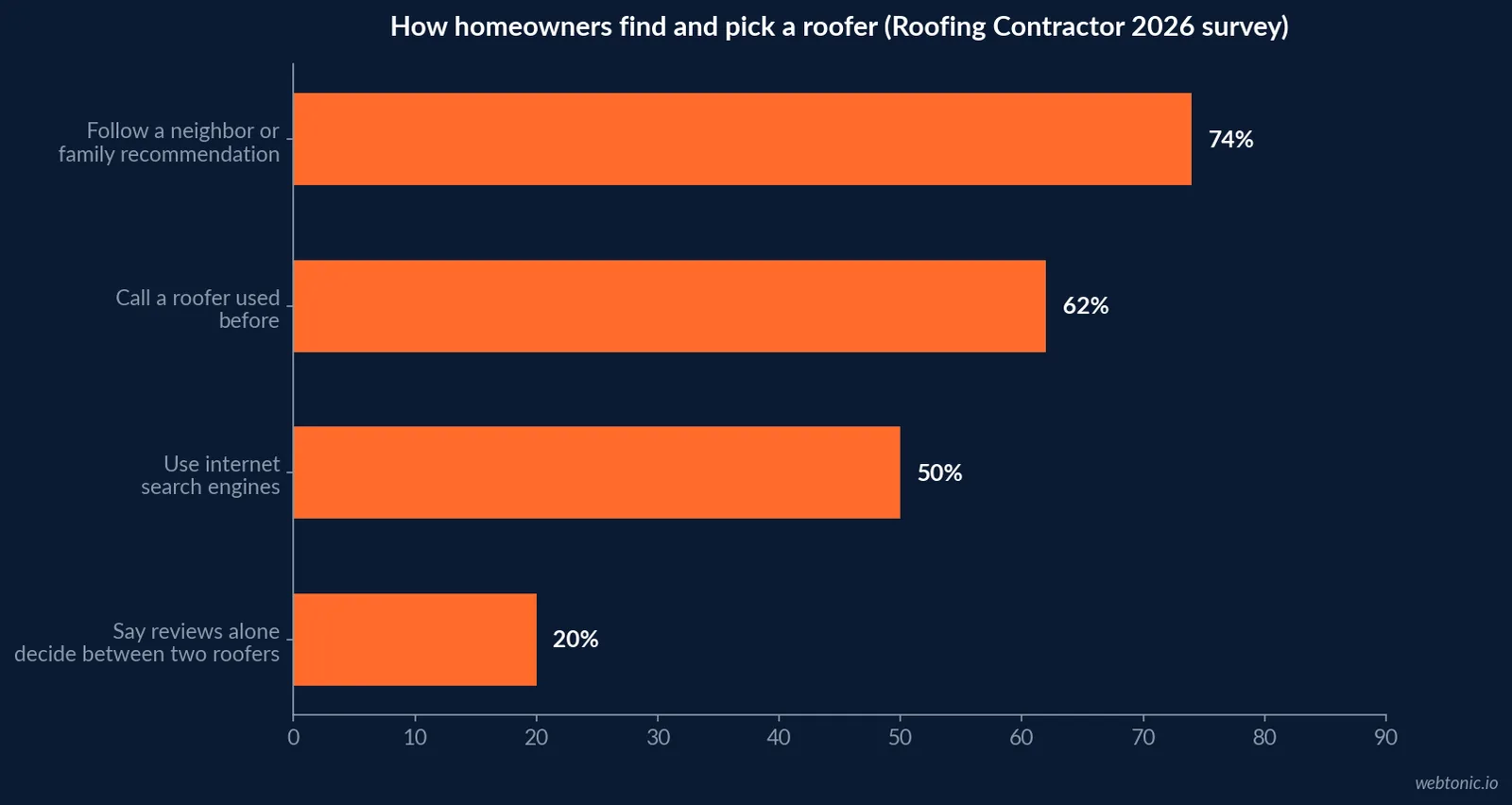
The 2025 wave of the Roofing Contractor homeowner survey showed the same order with different weights: referrals at 79%, internet search at 62% and past contractors at 54%. It also found millennial homeowners lead on social media use for finding a roofer, at 40%, against 27% for Gen X and 15% for boomers - the clearest sign in any roofing dataset that social content reaches a younger buyer segment first.
| Discovery channel | 2025 wave | 2026 wave |
|---|---|---|
| Word of mouth or personal recommendation | 79% | 74% |
| Internet search engines | 62% | 50% |
| Contacting a roofer used before | 54% | 62% |
| Home services websites (Angi, HomeAdvisor) | 34% | Not reported in 2026 summary |
| Social media, millennial homeowners | 40% | Not reported in 2026 summary |
Reviews are the UGC that already works
Before a roofer pays a creator, the cheapest user-generated content is the homeowner review. In 2026, 62% of homeowners said online reviews were very or extremely important, just under 30% said important, and only 9% called them unimportant. The 2025 wave put the top two boxes at 67%, and 74% of that year's respondents named online reviews as a way they measure trust, second only to referrals at 88%.
The local review bar is also rising. BrightLocal's 2026 Local Consumer Review Survey found 47% of consumers will not use a business with fewer than 20 reviews, 68% only use businesses rated four stars or more, and 74% only care about reviews written in the last three months. 89% expect the owner to respond. For a roofer with a few dozen jobs a season, recency is the binding constraint.
What roofing contractors say they already do
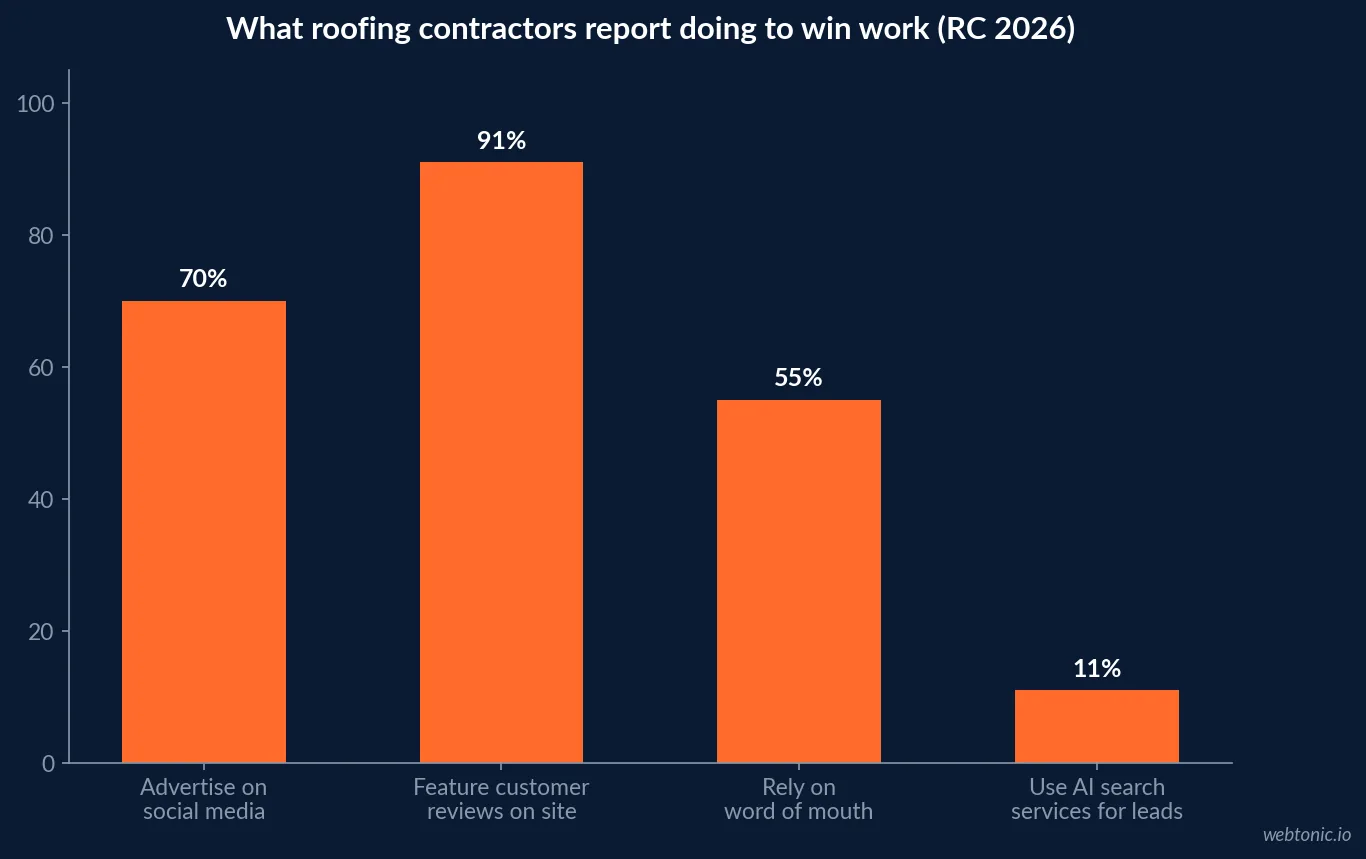
The contractor half of the 2026 study shows roofers are not absent from social channels. About 70% advertise on social media, 55% rely on word-of-mouth referrals, 49% use Google Ads to generate calls and 42% use home services websites. More than 91% feature reviews from satisfied customers on their own sites, and for the first time 11% said they use AI search services to generate leads.
| Contractor activity (RC 2026) | Share of roofers | What it implies for UGC |
|---|---|---|
| Feature customer reviews on the website | 91%+ | Written proof is table stakes |
| Advertise on social media | 70% | Most already pay for social reach |
| Rely on word-of-mouth referrals | 55% | Referrals are the offline form of UGC |
| Use Google Ads for calls | 49% | Search still carries intent |
| Use local print media | 41% | Older buyers still reached offline |
| Use local television | 17% | Broadcast is a minority channel |
So where is the missing social proof?
The gap the data shows is not a lack of reviews - it is a lack of visible, verifiable proof beyond the star rating. When choosing between two roofers, 46% of 2026 respondents said it comes down to proven experience and roofing-specific certifications, while about 20% said strong customer reviews and testimonials were enough and 17% pointed to the sales rep. That is the case for creator and customer video: content that shows the crew, the certification and the finished tear-off does work a text review cannot. It is an inference from the survey, not a measured lift - no study has tested roofing creator content against a control.
What a trades creator costs in 2026
Collabstr's 2026 Influencer Marketing Report analyzed more than 21,000 collaborations and 472,000 pricing packages on its own marketplace. Its most expensive niche is Skilled Trades at USD 309 per engagement, ahead of Education at USD 307, and the report explicitly describes the niche as creators covering DIY, home renovation, carpentry and plumbing. Skilled Trades was also the second-fastest-growing niche by search, up 103% year over year. Across all niches, 80% of engagements cost under USD 300, 18% land between USD 301 and 1,000 and only 2% exceed USD 1,000.
| Collabstr 2026 marker | Figure | Note |
|---|---|---|
| Skilled Trades average per engagement | USD 309 | Most expensive niche tracked |
| Skilled Trades search growth, YoY | +103% | Second-fastest-growing niche |
| Average UGC campaign cost | USD 197 | Down 5.7% from USD 209 |
| UGC share of engagements | 35% | Up from 15% a year earlier |
| Engagements under USD 300 | 80% | All niches |
| Engagements over USD 1,000 | 2% | All niches |
Those are marketplace averages for all trades, not a roofing quote. They also exclude the right to run the content as an ad, which is priced separately in most creator deals.
Turning customer video into paid reach
Platform mechanics decide whether a homeowner's clip can become an ad. TikTok's own Spark Ads help page says advertisers can publish ads using organic posts made by other creators with their authorization, that all views, comments and follows gained while boosting are attributed to the original post, and that videos up to a 10-minute maximum can be sparked, with up to 10,000 Spark Ads per ads account. For a roofer, the practical path is a customer or local creator posting the job, then granting the code so the company can put budget behind it in its storm-season market.
Why the review page still closes the job
Cross-industry shopper data explains why a creator post rarely closes a roof on its own. Bazaarvoice's Shopper Experience Index found 97% of shoppers consult multiple sources before buying, 60% need two or three sources and 48% identify as an "Influencer's Best Friend" at discovery, yet 38% immediately turn to search engines to hunt for negative reviews. That is retail data, not roofing, but it matches the roofing surveys: homeowners hear about a contractor socially, then verify on reviews and quotes - 66% of 2026 respondents gather three quotes.
The disclosure rule for roofing testimonials
The FTC's Endorsement Guides, codified at 16 CFR Part 255, treat a paid or incentivized testimonial as an endorsement. Section 255.5 requires a clear and conspicuous disclosure of any material connection, and section 255.2 says a consumer's experience in an ad will be read as typical unless the advertiser discloses the generally expected result. The FTC's Disclosures 101 guidance adds that a disclosure should not be mixed into a group of hashtags. For roofers, a discount off the next gutter cleaning in exchange for a video is a material connection. So is a free inspection for a local creator.
| Content type | Material connection? | What to do |
|---|---|---|
| Unprompted Google review | No | Reply; no disclosure needed |
| Review requested with no incentive | No | Ask every customer, not only happy ones |
| Video testimonial for a discount | Yes | Disclose the discount in the video and caption |
| Local creator paid or given free work | Yes | Clear paid-partnership disclosure |
| Customer clip boosted as a Spark Ad | Yes, if incentivized | Keep the disclosure in the ad itself |
Cross-industry context: where creator budgets are heading
Roofing has no budget-share data for creators, so the direction comes from all-industry surveys. Influencer Marketing Hub's 2026 Benchmark Report (600+ marketing professionals) found 87.49% of respondents expect influencer budgets to rise and only 5.55% expect a cut. Goldman Sachs research on the creator economy projects the market could reach USD 480 billion by 2027, up from USD 250 billion, with brand deals making up about 70% of creator revenue. None of that proves a roofer should spend; it shows the supply of creators - including trades creators - is growing.
A practical order of operations for roofers
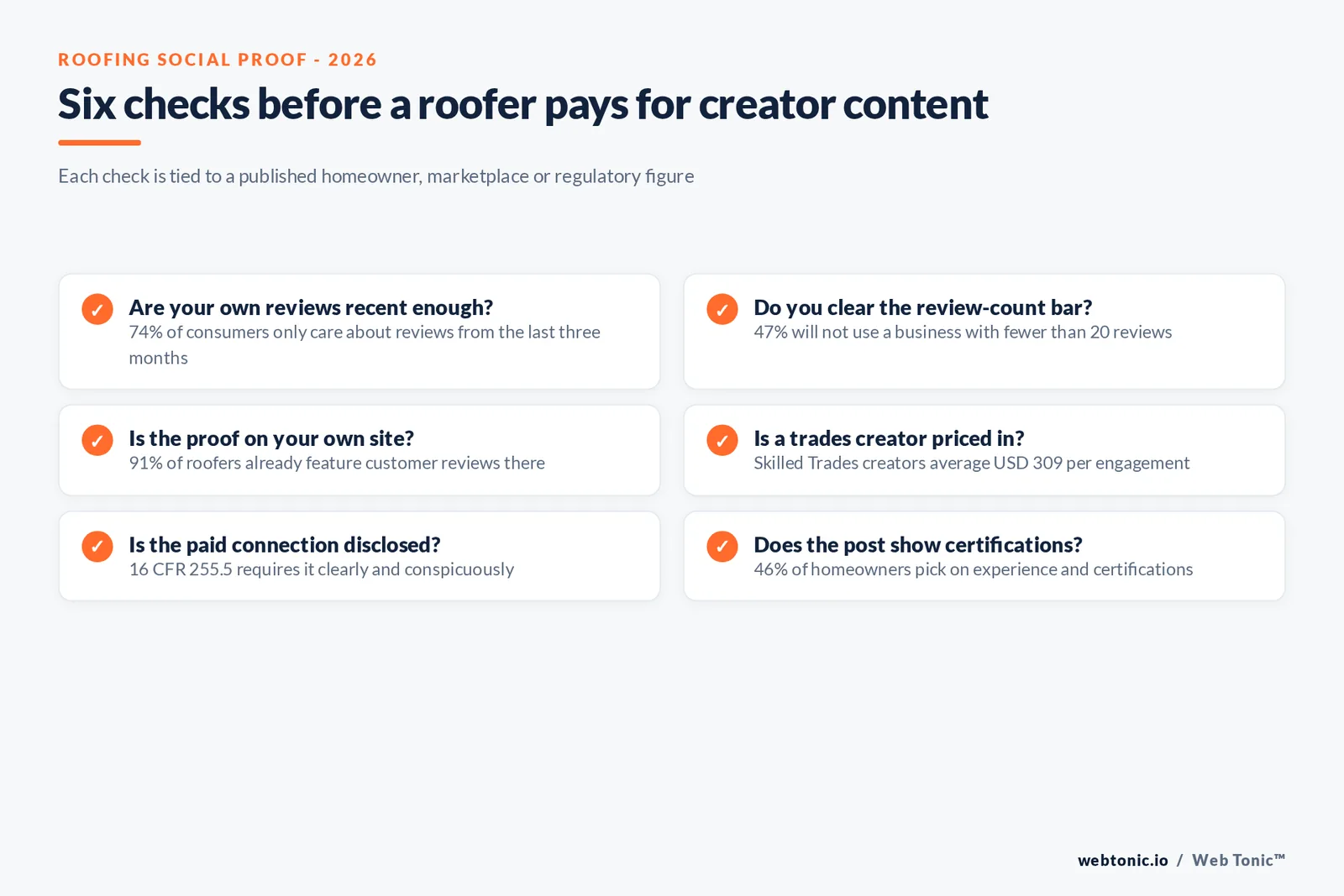
- Fix review volume and recency first - 47% of consumers skip a business with fewer than 20 reviews.
- Film the job, not the pitch - 46% of homeowners decide on experience and certifications.
- Test one local trades creator at marketplace rates before any retainer.
- Get authorization codes so the best customer clips can run as paid posts.
- Disclose every incentive in the post itself, per 16 CFR 255.5.
- Track calls and quote requests, not views, as the success metric.
For the wider cross-industry benchmarks, see our influencer marketing statistics hub. Follow-up after the quote is covered in our roofing SMS marketing data, and our performance creative team builds customer-video ads for paid social, including Meta ads.
Frequently Asked Questions
Is there a published influencer marketing benchmark for roofing companies?
No. None of the major 2026 influencer datasets - Collabstr's marketplace report, Influencer Marketing Hub's benchmark survey or Linqia's enterprise survey - breaks out roofing as its own category, and no roofing association publishes a creator engagement rate or ROI figure. The closest real data points are Collabstr's Skilled Trades niche, which averages USD 309 per engagement, and homeowner surveys such as Roofing Contractor's 2026 study, which measure how much reviews and referrals weigh in the hiring decision.
How important are online reviews when homeowners choose a roofer?
Very. In Roofing Contractor's 2026 homeowner survey, 62% rated online reviews very or extremely important and only 9% said they were not very or not at all important. The 2025 wave was higher at 67%. BrightLocal's 2026 Local Consumer Review Survey adds that 47% of consumers will not use a business with fewer than 20 reviews and 74% only care about reviews written in the last three months.
What does a roofing or trades creator cost?
Collabstr's 2026 report, built from more than 21,000 collaborations on its marketplace, puts the Skilled Trades niche at USD 309 per engagement on average - the most expensive niche it tracks - while 80% of all engagements across niches cost under USD 300. Those are marketplace averages across all trades, not a roofing-only rate card, and they exclude paid usage rights.
Do roofers have to disclose paid creator or customer content?
Yes. The FTC Endorsement Guides at 16 CFR Part 255 require a clear and conspicuous disclosure of any material connection - payment, a discount, free work or a gift - between the roofer and the person endorsing it. The FTC's Disclosures 101 guidance says not to bury the disclosure in a group of hashtags. A homeowner offered a discount for a video testimonial is a material connection.
Should a roofer run customer videos as paid ads?
It can, with permission. TikTok's own Spark Ads help page says brands can run organic posts made by other creators as ads with their authorization, and all engagement is attributed back to the original post. The same disclosure rules apply once the post is paid for, and the homeowner or creator has to grant the authorization code first.
Sources
Roofing Contractor - The Homeowner's Roofing Journey in 2026 (published May 2026, fielded summer 2025)
Roofing Contractor - 2025 Homeowner Roofing Survey (previous wave)
Collabstr - 2026 Influencer Marketing Report
BrightLocal - Local Consumer Review Survey 2026
Bazaarvoice - Shopper Experience Index
Influencer Marketing Hub - Influencer Marketing Benchmark Report 2026
Goldman Sachs - The creator economy could approach half a trillion dollars by 2027
TikTok Ads - About Spark Ads
eCFR - 16 CFR Part 255, Guides Concerning Endorsements and Testimonials
FTC - Disclosures 101 for Social Media Influencers