Table of contents

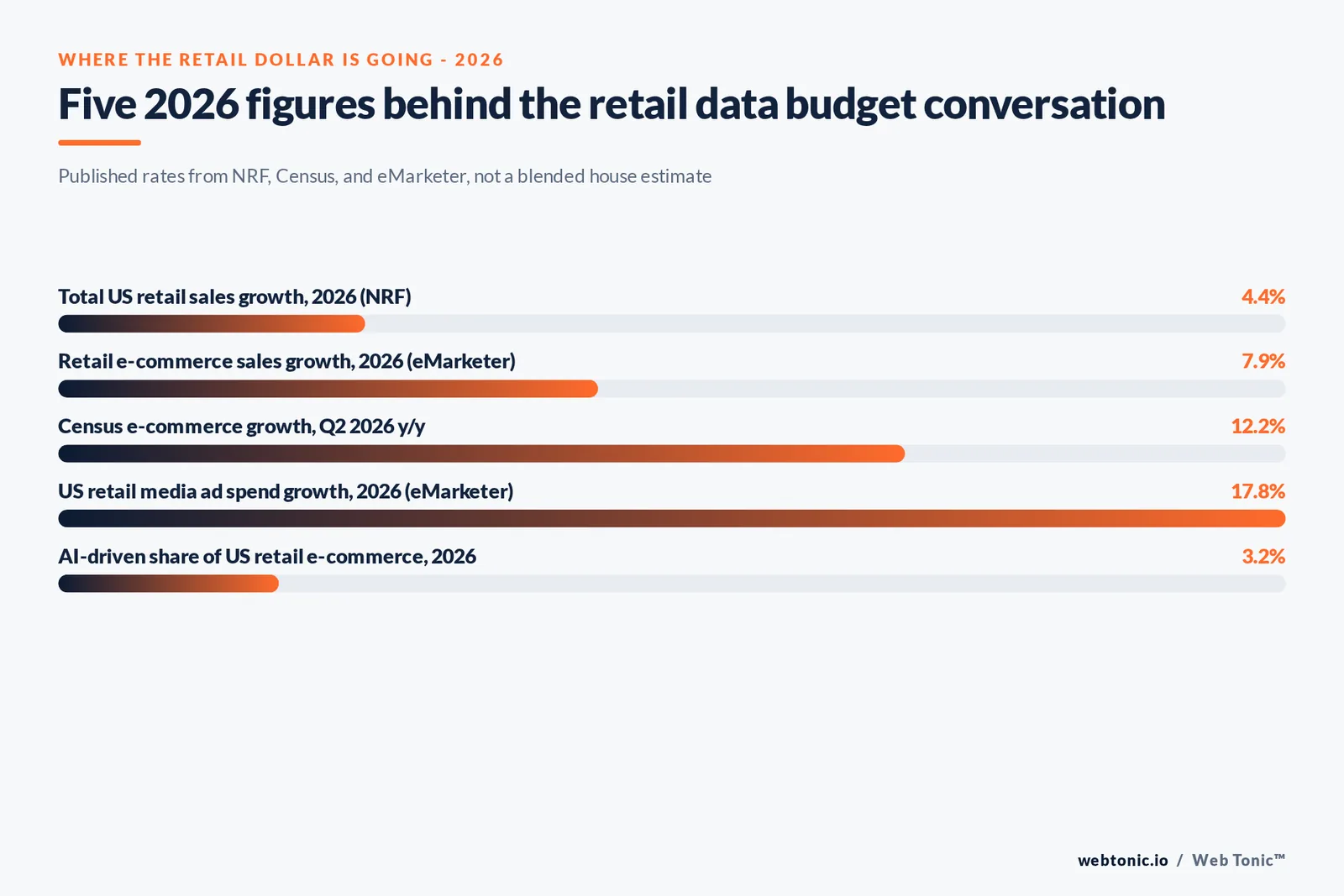
The National Retail Federation forecasts 4.4% total retail sales growth for 2026, but the budget line growing nearly four times faster is retail media advertising, up 17.8% to a projected USD 71.09 billion. The gap between how fast the store is growing and how fast the ad line inside it is growing is the entire story of where a 2026 retail data budget needs to sit.
Key Takeaways
- NRF forecasts 4.4% total US retail sales growth for 2026, to USD 5.6 trillion.
- That is above the 3.6% average annual growth of the last decade, pandemic years excluded.
- eMarketer forecasts 7.9% e-commerce sales growth for 2026.
- Census data showed e-commerce sales up 12.2% year over year in Q2 2026.
- That was the first double-digit e-commerce growth quarter in five years.
- Total Q2 2026 retail sales grew 6.7% year over year, the fastest since Q1 2023.
- Total retail sales rose by about USD 71.14 billion in Q2 2026 - the largest dollar jump since Q4 2021.
- E-commerce is about 17.1% of total US retail sales, up from 16.3% a year earlier.
- US retail media ad spend is forecast at USD 71.09 billion in 2026, up from USD 60.32 billion in 2025.
- That is 17.8% year-over-year growth, outpacing social and search ad spending.
- Amazon and Walmart will capture 89% of incremental retail media spend growth in 2026.
- AI-driven e-commerce is 3.2% of US retail e-commerce in 2026.
- That share is forecast to reach 15.8% by 2030, a five-fold increase.
- Unemployment is projected to stay below 4.5% through 2026, per NRF.
- Higher-income households are driving most spending growth, per NRF.
Retail sales growth at a glance, 2026
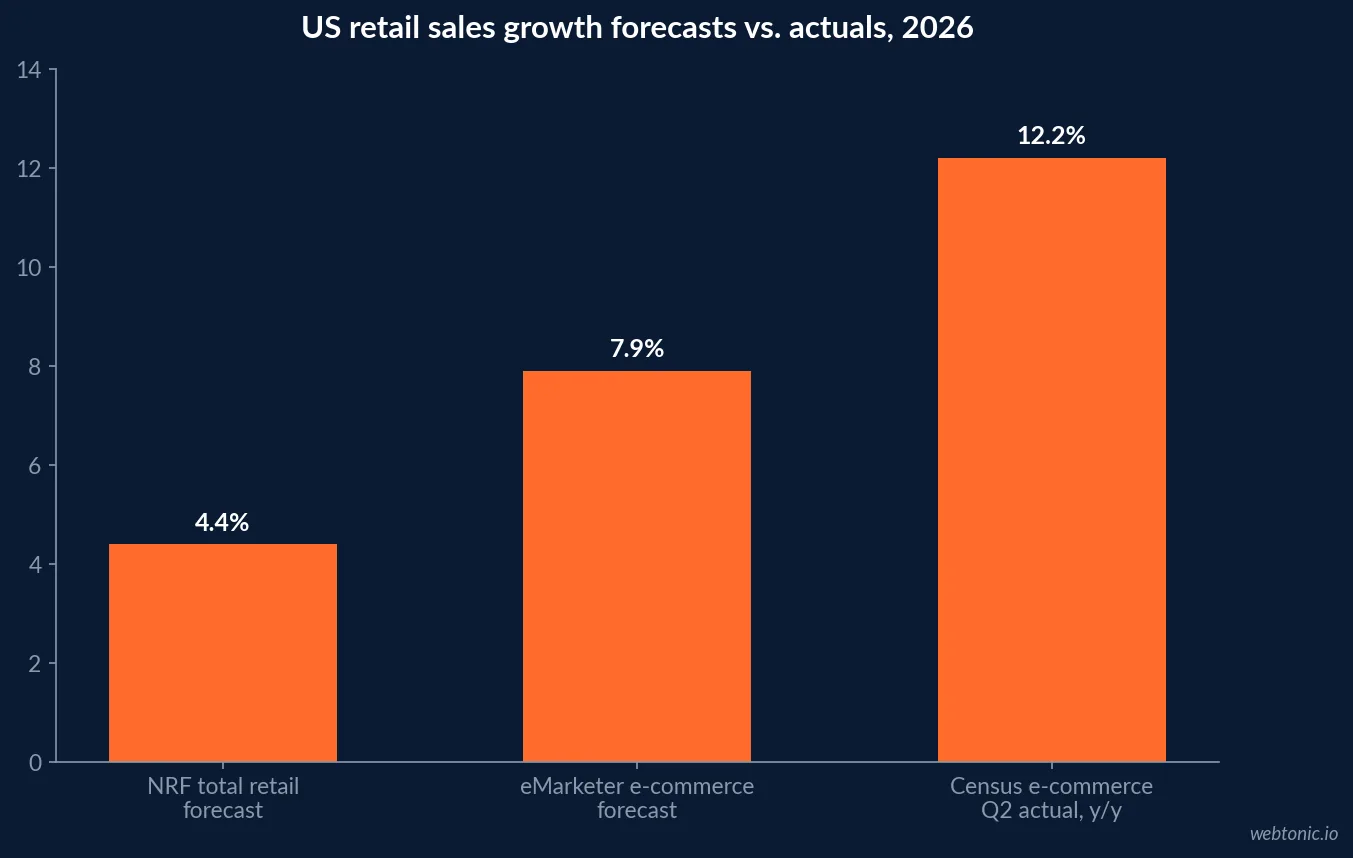
Two forecasts and one actual dataset agree on direction, if not magnitude. The National Retail Federation, working with Oxford Economics, forecasts total US retail sales will grow 4.4% in 2026 to USD 5.6 trillion - above the 3.6% average annual pace of the last decade, excluding the pandemic-distorted 2020-2022 window. eMarketer's 2026 US Ecommerce forecast puts online sales growth specifically at 7.9% for the year, describing US e-commerce as entering "a phase of mature and stable growth" with AI adoption as the main wild card that could still change the trajectory.
Actual Q2 2026 data from the U.S. Department of Commerce, reported by Digital Commerce 360, shows e-commerce running ahead of both forecasts: e-commerce sales grew 12.2% year over year - the first double-digit e-commerce growth quarter in five years - more than double the total retail sales growth rate of 5.3% in the same quarter, and total retail sales grew 6.7%, the fastest pace since Q1 2023.
| Retail growth measure, 2026 | Figure | Source |
|---|---|---|
| NRF full-year total retail sales forecast | +4.4% (to USD 5.6T) | National Retail Federation |
| eMarketer full-year e-commerce sales forecast | +7.9% | eMarketer |
| Census actual e-commerce growth, Q2 y/y | +12.2% | U.S. Census Bureau |
| Census actual total retail growth, Q2 y/y | +6.7% | U.S. Census Bureau |
| 10-year average annual retail growth (ex-pandemic) | +3.6% | National Retail Federation |
E-commerce's dollar share is still a minority, and that is the point
Even with double-digit e-commerce growth, online sales are 17.1% of total US retail sales by dollar value in Q2 2026, per the Census Bureau - up only modestly from 16.3% a year earlier. Total retail sales for the quarter reached USD 1,986.5 billion, of which USD 340.2 billion was e-commerce. The dollar increase in total retail sales - about USD 71.14 billion in the quarter - was the largest quarterly jump since Q4 2021, when total sales rose USD 141.91 billion.
The practical read for a data budget: e-commerce remains the faster-growing channel by rate, but the store is still where most of the dollar volume, and therefore most of the absolute growth, is recorded. A budget that chases the growth-rate headline while ignoring the dollar-volume reality risks under-resourcing the channel that still closes most sales.
| US retail sales, Q2 2026 (Census) | Figure |
|---|---|
| Total retail sales | USD 1,986.5 billion |
| E-commerce sales | USD 340.2 billion |
| E-commerce share of total | 17.1% |
| E-commerce share, Q2 2025 | 16.3% |
| Total retail sales, dollar increase y/y | ~USD 71.14 billion |
Retail media is the fastest-growing line in the budget
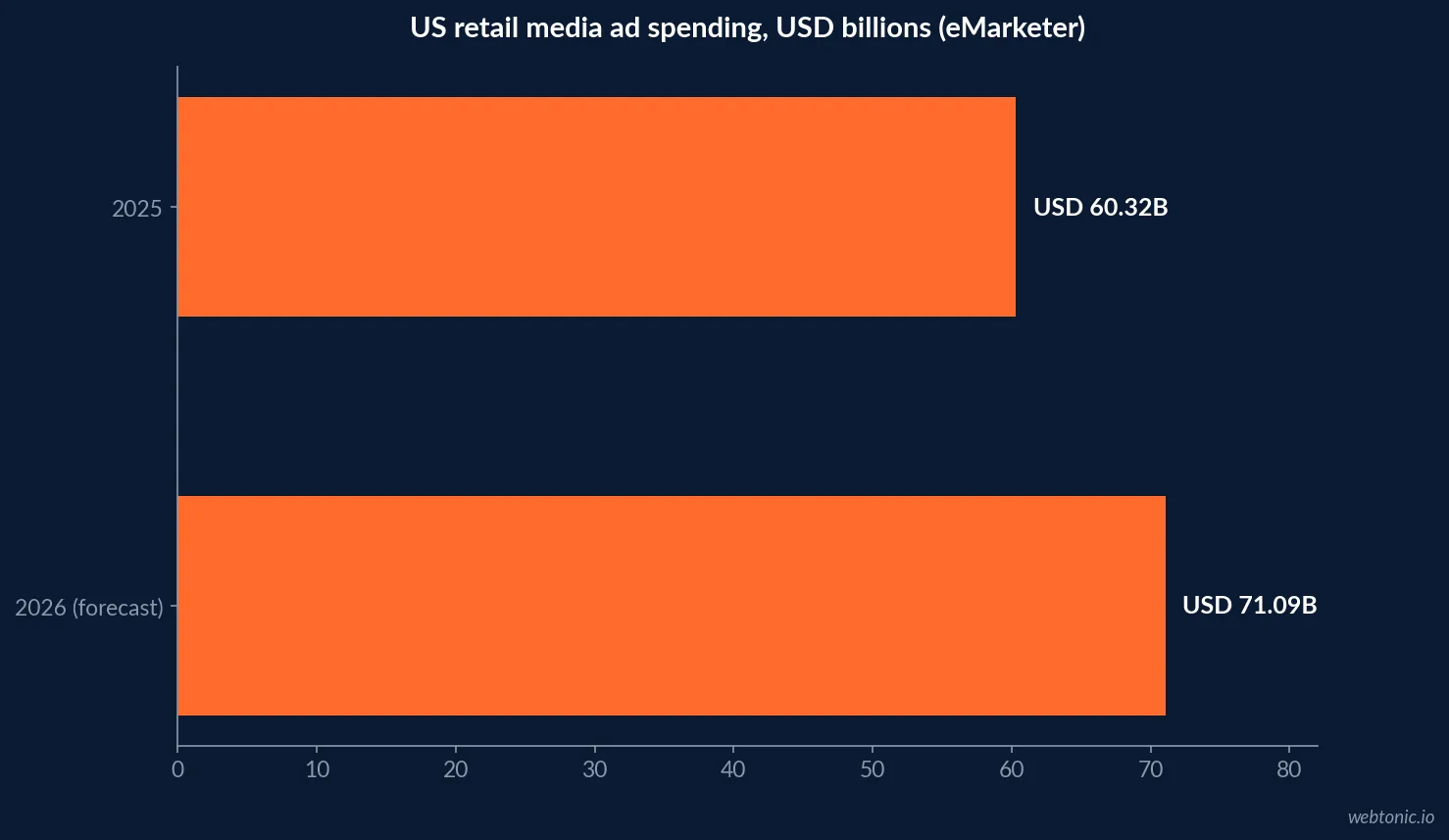
The part of retail actually accelerating fastest is not the store or the storefront - it is the advertising layer retailers now sell on top of both. eMarketer's retail media forecast puts US advertisers' 2025 spend at USD 60.32 billion, rising to USD 71.09 billion in 2026 - a 17.8% year-over-year growth rate that outpaces both social network and search ad spending growth for the same period. eMarketer's Q3 2026 benchmark deck tracks the same trend on a rolling basis for buyers trying to calibrate spend against the broader market.
That growth is not evenly distributed. Amazon and Walmart together are projected to capture 89% of all incremental retail media spending in 2026, leaving every other retail media network EMARKETER tracks fighting over a shrinking remainder that is forecast to stay flat or decline through 2027. A retailer without Amazon-or-Walmart-scale reach is competing for retail media budget inside an 11% slice of the growth, not the full market.
| Retail media ad spend, US | 2025 | 2026 (forecast) | YoY growth |
|---|---|---|---|
| Total US retail media spend | USD 60.32B | USD 71.09B | +17.8% |
| Amazon + Walmart share of incremental growth | n/a | 89% | Concentration rising |
| All other tracked retail media networks | n/a | Flat to declining share | Through 2027 |
The budget is growing faster than the ability to measure it
The gap between retail media dollars and retail media confidence is wide. Skai's 2026 State of Retail Media report, built with Stratably from a survey of 166 retail media advertisers spanning CPGs, non-CPGs, agencies and brands of every size, found only 15% of marketers say their organization is very or extremely effective at measuring retail media performance overall. The report's own diagnosis is not a data problem - Amazon reports at SKU level, Meta by audience and creative, Google Search by keyword and query - it is a fragmentation problem: media, ecommerce, analytics, finance and brand teams each view "performance" through a different lens, and a 17.8% year-over-year spend increase is landing on top of that same unresolved fragmentation, not a fixed one.
A retail data budget that only funds media spend without funding the measurement layer that reconciles SKU-level, audience-level and keyword-level reporting into one shared number is compounding the same capability gap Skai's 166 respondents already describe - the exact reconciliation problem our performance creative and reporting work is built to close before a retail media budget doubles again.
Store visits are still the base the whole forecast rests on
Foot traffic data confirms the store is not fading even as digital growth rates lead the headlines. Placer.ai's August 2026 Retail and Dining Index found brick-and-mortar retail visits rose 0.3% year over year, easing from 1.7% growth in July, while dining visits fell 2.4% in the same month. The pattern was regional, not uniform: retail visits grew across the West and parts of the South - led by Utah's fast population growth, plus Texas, Louisiana and Georgia - while declining across most of the Midwest and Northeast.
That regional unevenness is exactly why a single national growth number, whether NRF's 4.4% or eMarketer's 7.9%, needs a geography-aware budget underneath it rather than a flat national split.
| Store foot traffic signal, Aug 2026 (Placer.ai) | Figure |
|---|---|
| Brick-and-mortar retail visits, YoY | +0.3% |
| Retail visit growth, prior month (July) | +1.7% |
| Dining visits, YoY | -2.4% |
| Retail media measurement confidence (Skai/Stratably, 166 advertisers) | Only 15% very/extremely effective |
AI is the wild card eMarketer itself names
eMarketer's own 2026 forecast flags artificial intelligence as the single biggest source of uncertainty in its numbers, not a footnote. Under its base-case scenario, AI-driven e-commerce sales will grow from 3.2% of total US retail e-commerce in 2026 to 15.8% by 2030 - roughly a five-fold increase in four years. That range depends entirely on how fast consumers adopt AI shopping assistants and agentic checkout tools, which is exactly the kind of adoption curve that can outrun or undershoot a base-case model in either direction.
For a retail data budget, that uncertainty argues for building measurement flexible enough to capture an AI-attributed sale distinctly from an organic or paid one, well before that share becomes large enough to matter on its own. Waiting until AI commerce is a double-digit share to start tracking it separately means rebuilding the attribution model under pressure instead of ahead of it.
| AI-driven e-commerce forecast (eMarketer) | Share of US retail e-commerce |
|---|---|
| 2026 | 3.2% |
| 2030 (base case) | 15.8% |
| Four-year multiple | ~5x |
What NRF's consumer read means for how the budget should flex
NRF's own forecast narrative adds a caveat that changes how a retail budget should be phased across the year, not just sized for it. NRF expects consumer spending to stay a "steady and reliable engine of growth," but flags that the outlook is bifurcated between higher- and lower-income households, with higher-income spending driving the majority of growth across most categories. Inflation is projected to stay elevated through mid-year before easing by Q3, and labor market conditions are expected to soften with muted non-farm employment growth even as unemployment stays below 4.5%. A modest early-year consumer boost is expected from larger tax refunds tied to the Working Families Tax Cut Act.
None of that changes the annual 4.4% headline, but it does argue for a data budget that can flex by quarter rather than assuming a flat growth rate straight through the year - the same discipline our data intelligence team applies when building a retail client's forecast model around a bifurcated, not uniform, consumer base. If your retail reporting still treats 2026 as one flat growth number, talk to our team about building a quarterly-flexed version instead.
Frequently Asked Questions
How fast is US retail actually growing in 2026?
The National Retail Federation forecasts total US retail sales will grow 4.4% in 2026 to USD 5.6 trillion, above the 3.6% average annual growth of the last decade excluding the pandemic years. E-commerce is growing faster still: eMarketer's base-case forecast puts online sales growth at 7.9% for the year, and the U.S. Census Bureau's actual Q2 2026 data showed e-commerce sales up 12.2% year over year - the first double-digit e-commerce growth quarter in five years, more than double the 5.3% growth rate of total retail sales in the same quarter.
What share of retail sales happens online in 2026?
About 17.1% by dollar value, per the U.S. Census Bureau's Q2 2026 estimate - up from 16.3% a year earlier. That modest-looking share is why retail budgets increasingly separate 'e-commerce spend' from 'retail media spend': the transaction still mostly happens through a store's own channels or point of sale, even as more of the marketing budget that influences it shifts toward retailer-owned advertising platforms.
Where is the fastest-growing part of the retail budget going?
Retail media. eMarketer forecasts US retail media ad spending will reach USD 71.09 billion in 2026, up from USD 60.32 billion in 2025 - a 17.8% year-over-year growth rate that outpaces both social network and search ad spending growth. The concentration is extreme: Amazon and Walmart are expected to capture 89% of all incremental retail media spending growth in 2026, leaving every other retail media network competing for a small and shrinking remainder.
Is AI actually changing where retail sales happen?
It is starting to, and eMarketer treats it as the biggest wild card in its 2026 forecast. Under eMarketer's base-case scenario, AI-driven e-commerce sales will grow from 3.2% of total US retail e-commerce in 2026 to 15.8% by 2030 - a five-fold increase in four years. The pace of consumer adoption of AI shopping assistants and agentic checkout tools could meaningfully change that trajectory in either direction, which is why eMarketer frames 2026 as the start of a 'mature and stable' growth phase that AI could still disrupt.
Is total retail sales growth actually accelerating or slowing in 2026?
Both readings are defensible depending on which quarter is measured. NRF's full-year forecast of 4.4% is above the last decade's 3.6% average, and Q2 2026 total retail sales grew 6.7% year over year - the fastest quarterly pace since Q1 2023, adding about USD 71.14 billion in a single quarter, the largest dollar increase since Q4 2021. NRF itself flags a bifurcated consumer: higher-income households are driving most of the spending growth, while unemployment is expected to stay under 4.5% but non-farm employment growth stays muted through much of the year.
Sources
National Retail Federation - NRF Forecasts 4.4% Annual Retail Sales Growth, 2026
eMarketer - US Ecommerce 2026
Digital Commerce 360 - U.S. Ecommerce Sales in Q2 Grow Double Digits, First Time in 5 Years
U.S. Census Bureau - Quarterly Retail E-Commerce Sales, Q2 2026
eMarketer - FAQ on Retail Media Networks: How Marketers Should Allocate Budgets in 2026
eMarketer - US Retail Media Ad Spending Benchmarks: Q3 2026
Skai / Stratably - The 2026 State of Retail Media Measurement and Incrementality
Placer.ai - August 2026 Retail and Dining Index