



Table of contents
The current default — and only — ad format for paid search on Google, earns more impressions, more clicks, and more conversions than the static format it replaced. Below is everything you need to create, optimize, and scale RSAs, backed by performance benchmarks from studies covering over 20,000 accounts.
Key Takeaways
- RSAs drive 4× the impressions of expanded text ads, according to an Optmyzr study of 13,671 Google Ads accounts — even with a slightly lower conversion rate, that impression lift produces significantly more total conversions.
- Advertisers who improve Ad Strength from "Poor" to "Excellent" see 15% more conversions on average at a similar cost per conversion, per Google's own data.
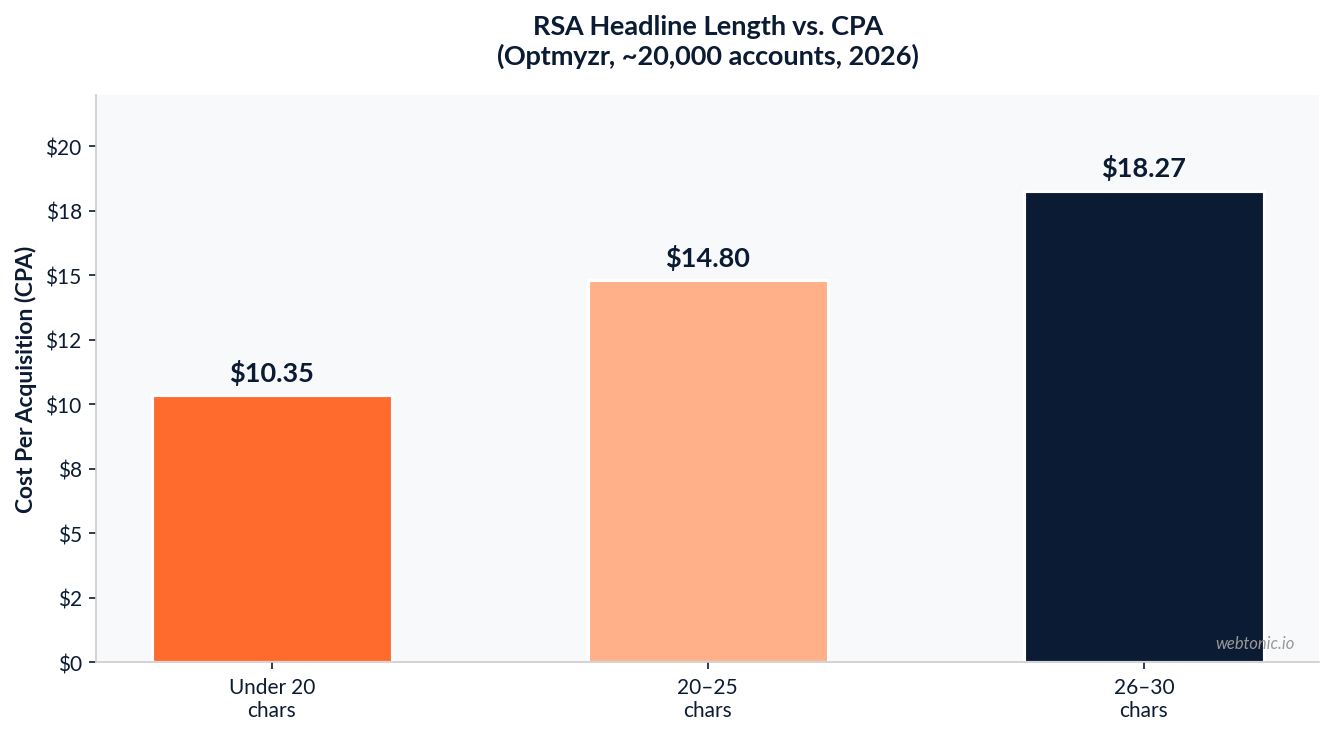
- Headlines under 20 characters deliver the lowest CPA ($10.35), nearly half the $18.27 CPA of longer headlines, based on a 2026 Optmyzr analysis of roughly 20,000 accounts.
- Partial pinning (pinning some headlines while leaving others flexible) outperforms both full pinning and no pinning on CPA, ROAS, and conversions per impression.
- Adding a second RSA to an ad group increases conversions by 6.6% at a similar cost per conversion, and a third RSA adds another 3.7% lift.
- Sentence case ad copy outperforms title case with the highest CTR (12.33%), best ROAS (307.58%), and a competitive CPA of $11.49.
- Descriptions between 61 and 70 characters produce the best efficiency metrics, including the highest conversion rate and lowest cost per acquisition.
Google retired expanded text ads in June 2022 and made responsive search ads the sole creation option for search campaigns. Instead of writing a single static ad, you provide up to 15 headlines and 4 descriptions, and Google's machine learning tests combinations in real time to find the best match for each search query. The result is a more relevant ad for the user and, in most cases, better performance for the advertiser. This guide walks through how RSAs work, what the latest benchmark data says, and the specific best practices that separate high-performing ads from wasted spend. For deeper campaign strategy, explore the growth marketing services at Web Tonic.
How Responsive Search Ads Work
The format lets you enter up to 15 unique headlines (30 characters each) and 4 descriptions (90 characters each). Google's AI then assembles combinations of up to 3 title lines and 2 body lines per impression, testing which arrangement resonates with each individual search query. Over time, the system learns which combinations deliver the best click-through rate and conversion rate for different audiences, devices, and contexts.
This dynamic approach is fundamentally different from the old static format, where you locked in a fixed set of copy assets. With this format, a single creative can adapt to thousands of query variations — Google can generate up to 43,680 unique combinations from a full set of 15 headlines and 4 descriptions. That flexibility is why RSAs qualify for more auctions and earn more impressions than static ads ever could. According to Google's Ads Help documentation, RSAs use real-time signals like device type, browsing history, and search intent to select the ideal asset combination for each user. WordStream found that advertisers who fill all 15 headline slots see an average 12% lift in click-through rate compared to those using fewer than 10.
The practical takeaway: you are no longer writing one creative — you are building an asset library that the platform assembles on your behalf. The quality and variety of those copy assets directly determines how many auctions you enter and how well you perform.
RSA Performance Benchmarks: What the Data Says
The largest independent study on RSA performance comes from Optmyzr, which analyzed 13,671 Google Ads accounts and found that RSAs consistently outperform expanded text ads on impression volume and click-through rate. The trade-off is a slightly lower conversion rate — but the net effect is still positive because the 400% impression lift more than compensates.
A 2026 follow-up study from Optmyzr's 20,000-account analysis dug deeper into which RSA elements actually drive efficiency. The findings challenge several common assumptions:
| RSA Element | Finding | Key Metric |
|---|---|---|
| Headline Length | Headlines under 20 characters deliver the lowest CPA | $10.35 CPA vs. $18.27 for longer headlines |
| Description Length | 61–70 character descriptions perform best | Highest CVR and lowest CPA in the bracket |
| Pinning Strategy | Partial pinning outperforms full pinning and no pinning | Better CPA, ROAS, and conversions per impression |
| Capitalization | Sentence case outperforms title case | 12.33% CTR, 307.58% ROAS, $11.49 CPA |
| Ad Strength | No correlation between Ad Strength rating and actual performance | CPA and ROAS do not improve with higher Ad Strength |
These benchmarks reveal an important tension: Google recommends maximizing Ad Strength, but the efficiency data does not support that recommendation. The Optmyzr study found zero correlation between Ad Strength scores and real-world efficiency metrics like CPA or ROAS. That does not mean Ad Strength is useless — it remains a useful checklist for asset variety — but chasing "Excellent" at the expense of message clarity is a mistake.
How to Create a High-Performing RSA: Step by Step
Building one of these ads takes less than five minutes, but making it convert requires deliberate creative strategy. Here is the workflow that produces consistently strong results across hundreds of campaigns we have managed. If you need hands-on support, reach out to our team:
- Start with keyword research. Identify 3–5 core keywords for the ad group. Each creative should have a unique final URL relevant to its target terms.
- Write 15 distinct headlines. Include the primary term in at least 3 title lines. Add benefit-driven copy, social proof (numbers, awards), and urgency elements. Keep each title line under 20 characters when possible — the data shows shorter title copy delivers lower CPA.
- Write 4 descriptions. Target the 61–70 character sweet spot. Lead with benefits, include a clear call to action, and make each body line stand alone — any two may appear together.
- Use partial pinning strategically. Lock your strongest keyword-match title to position 1 and your best CTA to position 2. Leave position 3 and all other slots flexible so the algorithm can optimize.
- Set the final URL. The landing page must match the ad's promise — relevance here directly affects Quality Score and conversion rate.
- Add all available asset types. Sitelinks, callouts, structured snippets, visuals, and business logo. Advertisers showing a business logo and name with search ads see an average 8% more conversions at a similar cost per conversion.
Headline and Description Best Practices
The quality of your ad copy assets is the single biggest lever you control in campaign performance. The algorithm will optimize the combination, but it cannot fix weak individual assets. Here is what the data and testing show about writing effective ad copy:
| Best Practice | Why It Works | Example |
|---|---|---|
| Keep headlines short | Under-20-character headlines cut CPA nearly in half (Optmyzr 2026) | "Free SEO Audit" (14 chars) |
| Use sentence case | Sentence case delivers 12.33% CTR vs. lower for title case | "Get your free quote today" |
| Include the keyword | Keyword insertion boosts relevance and Quality Score | "Responsive search ads guide" |
| Add social proof | Numbers and specifics build trust in limited character space | "Trusted by 2,000+ businesses" |
| Lead with benefits | Benefit-first copy outperforms feature-first copy in conversion tests | "Save 30% on ad spend" |
| Vary description length | 61–70 char descriptions hit the efficiency sweet spot | "Our team builds campaigns that convert. Get a free PPC audit today." (68 chars) |
| Make each headline independent | Any 3 headlines may appear together — each must make sense alone | Avoid sequential headlines like "Part 1…" / "Part 2…" |
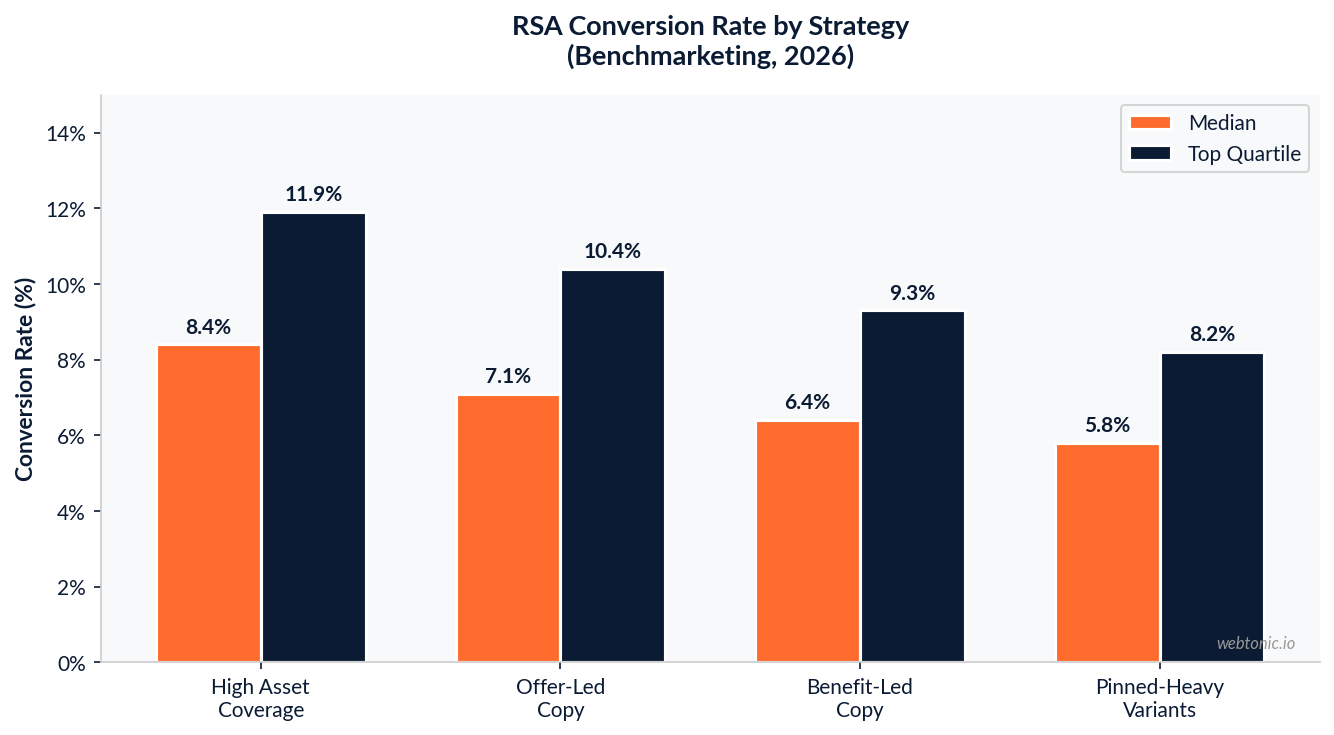
One underrated tactic: write at least 3 headlines that work without any keyword. These pure-benefit or pure-CTA headlines give Google flexibility to pair them with keyword-heavy headlines, producing ads that are both relevant and persuasive. According to Benchmarketing's 2026 RSA benchmarks, high asset coverage (diverse headlines spanning multiple angles) delivers a median conversion rate of 8.4% and a top-quartile rate of 11.9%, compared to just 5.8% median for pinned-heavy variants.
Pinning Strategy: When and How to Pin
Locking a specific asset to always appear in a particular position is called pinning. Google generally discourages heavy asset locking because it limits the algorithm's ability to test combinations. But the evidence tells a more nuanced story.
The 2026 Optmyzr study found that partial locking outperforms both full locking and zero locking on cost per acquisition, return on ad spend, and conversions per impression. The explanation is straightforward: selective locking ensures your most important message always appears (position 1 and 2) while still giving the system enough flexibility to optimize the remaining slots.
Here is a practical pinning framework:
- Lock position 1: Your strongest keyword-match title. This ensures the ad always leads with relevance to the search query.
- Lock position 2: Your best differentiator or CTA. This guarantees your value proposition is always visible.
- Leave position 3 open: Let Google test your remaining headlines here for maximum flexibility.
- Lock 1 body line: Assign your strongest benefit-driven copy to body position 1. Leave position 2 flexible.
This approach balances control with optimization. Compliance-sensitive industries (healthcare, finance, legal) may need more aggressive pinning for regulatory reasons, but even in those cases, pinning every slot reduces performance. The Benchmarketing data confirms this: pinned-heavy variants convert at a 5.8% median rate versus 8.4% for high-coverage variants.
Ad Strength: What It Really Means
Google's built-in quality indicator is rated from "Incomplete" through "Poor," "Average," "Good," to "Excellent." Google recommends aiming for "Good" or "Excellent" and reports that advertisers improving from "Poor" to "Excellent" see 15% more conversions on average at a similar cost per conversion, per their Ads Help documentation.
However, the independent evidence is less clear. The Optmyzr 2026 analysis of 20,000 accounts found no correlation between Ad Strength rating and actual CPA, ROAS, or conversion rate. The disconnect likely comes from what Ad Strength actually measures: it evaluates asset variety and relevance signals, not conversion performance. An ad with 15 generic headlines will score "Excellent" while an ad with 8 highly targeted headlines might score "Average" — yet the second ad often converts better.
The practical recommendation: use the rating as a checklist, not a scorecard. If your rating is "Poor" because you only have 5 title assets, adding more is worthwhile. But do not dilute strong messaging just to chase a better score. Focus on the metrics that matter — CPA, ROAS, conversion rate, and conversions per impression — and let the rating inform your creative strategy without dictating it.
RSA vs. Expanded Text Ads: The Complete Comparison
The older static format (ETAs) was retired in June 2022. You can no longer create new ones, but existing static ads continue to run. The question most advertisers still ask is whether the current format actually performs better. The data from Optmyzr's 13,671-account study provides a definitive answer:
| Metric | Responsive Search Ads | Expanded Text Ads | Difference |
|---|---|---|---|
| Impressions | 4× higher | Baseline | +300% |
| Click-Through Rate | Higher | Lower | RSA advantage |
| Conversion Rate | Slightly lower | Slightly higher | Small ETA edge |
| Total Conversions | Significantly higher | Lower | RSA wins on volume |
| Quality Score | Better auction-time QS | Fixed QS | RSA advantage |
| Auction Eligibility | Qualifies for more auctions | Limited | RSA advantage |
The key insight: RSAs win on volume, not on per-impression efficiency. The slightly lower conversion rate upsets advertisers who think in terms of a fixed impression pool, but impressions are not fixed. RSAs qualify for more auctions because of better Quality Scores, and the massive impression lift produces far more total conversions — even at a marginally lower conversion rate. HubSpot reports that advertisers who switched fully to this format saw average cost-per-click reductions of 5-15% within the first 90 days. For any data-driven advertising strategy, RSAs are the superior format.
Common RSA Mistakes and How to Fix Them
Most underperforming campaigns share the same set of avoidable errors in their ad copy. Here are the seven most common mistakes and the targeted fixes that resolve them:
- Too few headlines. Using only 5–8 headlines limits the combinations Google can test. Fix: fill all 15 slots with distinct angles — keyword variations, benefits, social proof, CTAs, and urgency.
- Duplicate messaging across headlines. Three assets saying "Best PPC Agency," "Top PPC Company," and "Leading PPC Firm" waste valuable slots. Fix: each headline should introduce a new idea or angle.
- Over-pinning. Pinning every position kills the system's ability to optimize, as documented by Search Engine Journal. Fix: pin only positions 1 and 2. Leave everything else flexible.
- Ignoring description length. Most advertisers either max out the 90-character limit or write overly brief fragments. Fix: target 61–70 characters, the documented performance sweet spot.
- Same final URL across all RSAs. Every RSA in an ad group should have a unique, relevant landing page. Fix: align each ad's final URL with its specific keyword cluster.
- No image assets. Image assets increase visual real estate on mobile and improve CTR. Fix: add at least 4 unique, relevant image assets to every campaign.
- Chasing Ad Strength over performance. Adding weak headlines just to reach "Excellent" dilutes your message. Fix: prioritize asset quality over Ad Strength ratings — use it as a minimum-coverage checklist, not a target metric.
Advanced RSA Optimization Tactics
Once your foundational RSA setup is solid, these advanced tactics can push performance further:
Text customization (formerly dynamic keyword insertion on steroids): Google's text customization feature automatically adjusts your headlines to be more relevant to each search query. According to Google Ads Help, opting into text customization improves Ad Strength and ad relevance. Unlike the old dynamic keyword insertion, text customization uses AI to generate contextually appropriate variations — not just swapping in the exact search term. Search Engine Land recommends enabling it for all campaigns where brand-specific wording is not legally required.
Multiple RSAs per ad group: The platform's data shows clear incremental value from running more than one ad variant. Adding a second RSA increases conversions by 6.6% at a similar cost per conversion. A third RSA adds another 3.7%. Each additional ad gives the system more combinations to test, and the incremental cost is near zero since you are only paying for the clicks you already want.
Business identity assets: Adding your business logo and name to paid search campaigns produces an average 8% conversion lift at a similar cost per conversion. This is one of the easiest wins available — it takes five minutes to set up and the performance data is unambiguous. Combine it with location and call assets if your business serves local customers.
A/B testing framework: Run at least 2 RSAs per ad group with deliberately different messaging angles (e.g., one benefit-led, one offer-led). After 30 days and at least 1,000 impressions per ad, compare conversion rates and pause the loser. Replace it with a new variant and repeat. This continuous testing loop is what separates top-quartile advertisers from the median, according to Benchmarketing's benchmark data.

Related reading
- Dynamic Search Ads: Complete Guide to DSA in Google Ads
- Gmail Ads: How the Placement Works Inside Demand Gen
- Online Ads Explained: Every Unit, Where It Runs and What It Costs
- Paid Search services at Web Tonic
Frequently Asked Questions
What is a responsive search ad?
An RSA is the platform's default paid search creative that lets you provide up to 15 headlines and 4 descriptions. The platform's machine learning then tests different combinations to find the best-performing arrangement for each query, device, and user context. They replaced expanded text ads as the only creatable format for paid search in June 2022.
How many headlines and descriptions should I use in a responsive search ad?
Use all 15 headline slots and all 4 description slots. More assets give the system more combinations to test, improving the odds of finding a high-performing match for each query. The data shows that high asset coverage produces a median conversion rate of 8.4%, compared to 5.8% for ads with heavy pinning and limited variety.
Does Ad Strength affect how often my RSA shows?
No. The platform explicitly states that this rating does not directly influence serving eligibility. It is a diagnostic tool that evaluates asset diversity and relevance during the creation stage. Independent data from Optmyzr confirms no correlation between Ad Strength rating and actual CPA, ROAS, or conversion rate. Focus on performance metrics instead.
What is the difference between responsive search ads and dynamic search ads?
RSAs show advertiser-written copy assets in AI-optimized combinations. Dynamic variants (DSAs) generate titles automatically from your website content and target queries based on your site's pages rather than keywords. RSAs give you full control over the messaging; DSAs automate targeting and headline creation. Most advertisers use both in complementary campaigns.
Should I still use pinning in responsive search ads?
Yes, but use partial pinning. The 2026 Optmyzr study of 20,000 accounts found that partial pinning — pinning positions 1 and 2 while leaving position 3 open — outperforms both full pinning and no pinning on CPA, ROAS, and conversions per impression. Only pin more aggressively if regulatory or compliance requirements demand it.
Sources
Google Ads Help — Best Practices for RSAs
Optmyzr — RSA Performance Study (13,671 Accounts)
Optmyzr — What Actually Drives RSA Performance (20,000 Accounts, 2026)
Google Ads Help — About Ad Strength
Benchmarketing — RSA Benchmarks 2026
WordStream — Responsive Search Ads
Search Engine Journal — How to Optimize RSAs
Search Engine Land — RSAs Explained
HubSpot — Responsive Search Ads Guide


