Table of contents
Snapchat is the only major platform whose audience profile lines up almost exactly with the group least likely to reach treatment: only 9.6% of 18- to 25-year-olds who needed substance use care received it in 2025, and Snapchat reaches 90% of 13- to 24-year-olds across more than 25 countries.
Key Takeaways
- Median Snapchat CPM runs $5.84 for Awareness to $27.10 for Conversions, with Traffic at $11.20.
- Median CPC is $0.84 (IQR $0.51 - $1.34) and median CTR is 1.04%.
- Awareness inventory is 30% to 40% cheaper than comparable Meta inventory.
- 956 million monthly and 483 million daily active users, both up 5% year over year.
- 18- to 24-year-olds are 35.4% of the audience and 25- to 34-year-olds another 25.2%.
- 47.2 million Americans aged 12+ needed SUD treatment in 2025 and 84% did not receive it.
- Stories carry 64% of impressions; Spotlight delivers the best CTR at 1.36%.
- Under-7-second vertical video earns 3.5x the CTR of repurposed landscape creative.
- The practical conversion-campaign floor is $50 to $100 a day, not the $5 self-serve minimum.
- Click-to-call converts at 18.5% in this vertical against 2.8% for forms - the metric Snapchat campaigns should feed.
Snapchat ad costs by objective in 2026
Objective, not industry, is the dominant cost variable on this platform.
| Objective | Median CPM | 25th - 75th percentile | Note |
|---|---|---|---|
| Awareness | $5.84 | $3.20 - $9.40 | Cheapest inventory on the platform |
| Traffic | $11.20 | - | Roughly 40% above Awareness |
| Lead Generation | $24.80 | $15.10 - $39.40 | Healthy CPMs, variable lead quality |
| App Installs | $23.40 | - | Not usually relevant to treatment |
| Conversions / Purchases | $27.10 | $17.40 - $41.80 | Comparable to Meta |
| CPC, all objectives | $0.84 | $0.51 - $1.34 | Below Meta's typical $1.10 - $2.00 |
| CPC, Traffic only | $0.71 | $0.43 - $1.12 | Cheapest reliable clicks |
| CPC, Conversions | $1.18 | $0.72 - $1.94 | Auction competition rises |
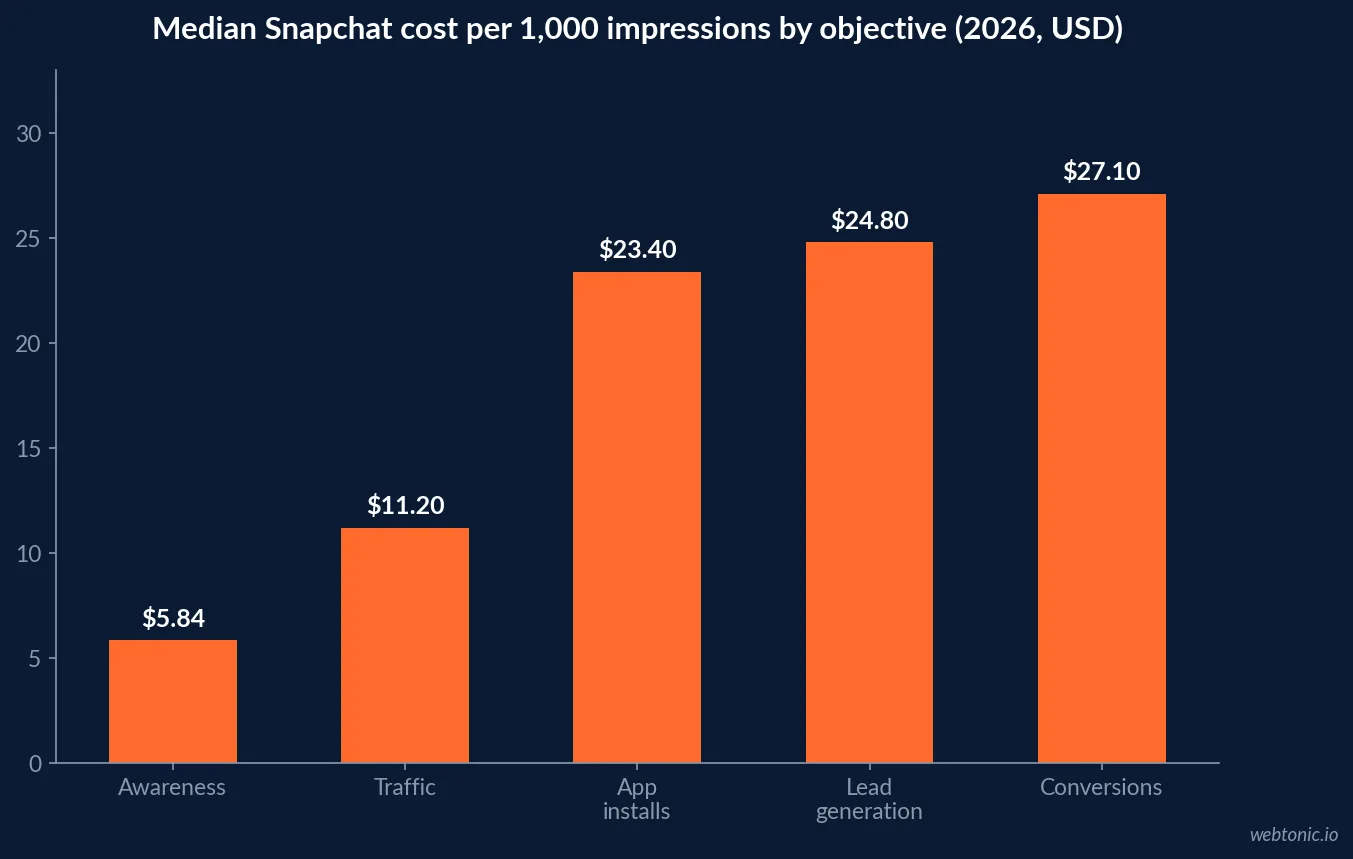
The objective-level benchmarks come from a 2,431-campaign dataset published in 2026 Snapchat ads cost benchmarks, with budget mechanics in Snapchat ads pricing analysis. Against an average $94.50 Google Ads CPC and $285 CPL in addiction treatment, an $0.84 Snapchat click is a rounding error - which is exactly why it should be bought as reach rather than as leads.
The audience: right age band, wrong decision-maker
| Audience attribute | 2026 figure | Relevance to treatment marketing |
|---|---|---|
| Monthly active users | 956 million | Up 5% year over year |
| Daily active users | 483 million | Up 5% year over year |
| Ages 18 - 24 | 35.4% of audience | Peak SUD onset years |
| Ages 25 - 34 | 25.2% of audience | Second-largest cohort |
| Under 18 | 18.3% of audience | Exclude from all treatment targeting |
| US adults 18 - 29 using Snapchat | 58% | Versus 31% of 30 - 49 and 13% of 50 - 64 |
| Reach of 13- to 24-year-olds | 90% in 25+ countries | Unmatched by any other platform |
| US gender split | 54.7% female / 44.8% male | Female-skewed in the US |
Platform scale is reported in Snap's Q1 2026 financial results, with audience composition compiled in 2026 Snapchat usage statistics and US age-band adoption in analysis of who uses Snapchat in 2026. The parent paying for a 30-day residential stay is mostly not here - which shapes both the creative and the KPI.
The treatment gap this channel actually addresses
The demand data explains why a young-adult awareness channel is worth buying at all.
- 47.2 million Americans aged 12+ needed SUD treatment in 2025, and 84% did not receive it.
- Only 9.6% of 18- to 25-year-olds who needed treatment received it in 2025, a decline of 1.7 points from 2024 - the widening end of the gap.
- Adults 18+ with an untreated SUD improved only marginally, from 95.6% in 2024 to 94.5% in 2025.
- Overall SUD prevalence fell by 3.8 million in a single year, largely driven by alcohol use disorder.
- Past-year cannabis use rose to 22.3% and cannabis use disorder to 7.1% - a young-adult weighted trend.
- Among 18.5 million adults with both an SUD and a mental illness, 42.6% received no services at all, and only 12.7% received both.
- Overdose deaths fell to 79,384, roughly 24.4% below the prior peak, with synthetic-opioid fatalities down 35.6%.
- 73% of people who ever had an SUD - about 22.3 million - consider themselves in recovery, down from 74.3%.
The national prevalence and treatment-gap figures come from analysis of SAMHSA's 2025 annual survey and key findings from the 2025 NSDUH. A platform that reaches nine in ten people aged 13 to 24 is the cheapest way to speak to the demographic the system is missing.
Placements, creative and what performs
| Placement / creative choice | Share or lift | Median CTR |
|---|---|---|
| Stories | 64% of impressions | 0.94% |
| Spotlight | 22% of impressions | 1.36% |
| Discover | 14% of impressions | 0.78% |
| Under-7-second vertical video | 3.5x CTR of landscape images | Highest tested |
| Native vertical still image | 1.5x CTR of landscape | Acceptable fallback |
| Landscape repurposed creative | Baseline | Lowest - avoid |
| Sponsored creator content | 87% of users open to it | Snapchatters 16% more receptive |

Placement and creative data are drawn from the same 2026 benchmark dataset, with creator-content receptivity reported in 2026 Snapchat marketing statistics. For behavioral health the implication is uncomfortable but clear: the polished institutional video that works in a referral meeting is the worst-performing asset on this platform. Our rehab landing page benchmarks cover what has to happen after the swipe.
Local reach: the geographic play most centres miss
- Snapchat monetises local inventory far less aggressively than Meta, which keeps CPMs in single metros low relative to demand.
- Median CPM in the cheapest local cells of the benchmark dataset falls below $3.50.
- Geographic and radius targeting is compliant by default - no condition or interest signal required.
- Snapchat reaches 75% of 13- to 34-year-olds in 25+ countries, which covers most alumni and family-of-patient recruitment.
- Only about 30% of companies maintain any Snapchat presence, while 75% of Gen Z and Millennial users interact with brand content weekly - a supply-demand gap.
- Snapchatters are 34% more likely to buy a product they see advertised there than the same ad elsewhere.
- Mobile is 72.4% of all addiction treatment site traffic, so Snapchat traffic behaves like the majority of the channel mix, not an exception.
The local-inventory argument is developed in analysis of Snapchat's local advertising inventory, and vertical traffic and conversion benchmarks in 2026 addiction treatment marketing benchmarks.
Where the funnel actually closes
Snapchat has to hand off to a phone call. These are the numbers it hands off into.
| Conversion step | 2026 benchmark | Implication |
|---|---|---|
| Click-to-call conversion | 18.5% | The channel that closes admissions |
| Landing page conversion | 5.2% | Strong for healthcare |
| Form-fill conversion | 2.8% | Weakest of the three |
| Google Ads CVR / CPL | 4.10% / $285 | Paid search comparison |
| Facebook Ads CPC / CPL | $1.85 / $115 | Closest paid-social comparison |
| Average CPA (admission) | $3,500 - $5,000 | Varies by level of care |
| Alumni engagement / referral | 28% / 14% | Cheapest admission source |
| Alumni lifetime value | $18,000 - $35,000 | Why retention beats reach |
Treat Snapchat as the top of that table's funnel, never the bottom. Our rehab dashboard benchmarks set out how to report a channel that assists admissions without closing them.
What a treatment centre should never do on Snapchat
- Never target by condition, symptom or inferred health interest - broad geographic and age targeting only.
- Never include anyone under 18 in a treatment audience, even though 18.3% of the platform sits there.
- Never send Snapchat pixel events that could reveal condition-level intent.
- Never run landscape creative repurposed from a website; it costs about 3.5x the CTR.
- Never launch a conversion objective at $5 a day - $50 to $100 is the learning floor.
- Never set a cost-per-admission target on this channel when CPA in the category is $3,500 to $5,000.
- Never route Snapchat traffic to a form-only page when calls convert at 18.5% and forms at 2.8%.
Measuring a channel that never gets the last click
Snapchat almost never appears as the final touch on an admission, which is not the same as contributing nothing.
- Track branded search volume and direct traffic during flights - the cleanest proxy for awareness spend in a category where the conversion is a phone call.
- Instrument calls, not forms: an 18.5% click-to-call rate versus 2.8% on forms means the call log is the conversion dataset.
- Expect a long lag: a young adult who sees an alumni video in March may not call until a crisis in August.
- Use view-through windows deliberately and report them separately from click-through, so nobody confuses the two.
- Never let condition-level data reach the pixel; measure page and call events, not diagnoses.
- Report cost per thousand of the 18-34 audience reached alongside cost per enquiry, since the first is what you are actually buying.
- Hold Snapchat to a share-of-voice target in its age band and let paid search own cost per admission.
Attribution design for assisted channels is covered in our rehab tracking and analytics benchmarks.
A 90-day Snapchat test plan for a treatment centre
| Window | What to run | Success signal |
|---|---|---|
| Days 1 - 14 | Awareness, 25 - 45 mile radius, ages 18 - 34, 3 vertical videos | CPM under $7, CTR above 0.9% |
| Days 15 - 30 | Traffic objective to a call-first landing page | CPC under $1.00, bounce under 65% |
| Days 31 - 60 | Split Stories versus Spotlight; refresh creative weekly | Spotlight CTR above 1.3% |
| Days 45 - 75 | Family-directed and alumni-voice creative variants | Call rate per session, not CPL |
| Days 60 - 90 | Retarget site visitors; test one lead objective at $50+/day | Cost per viable enquiry |
| Day 90 review | Compare branded search and call volume lift to spend | Assisted admissions, not last click |
Ninety days at $50 to $100 a day is roughly $4,500 to $9,000 - about the cost of one to two admissions in this category, which is the right frame for the decision. Creative production sits in performance creative and media buying in growth marketing.
Frequently Asked Questions
How much do Snapchat Ads cost in 2026?
Median CPM depends almost entirely on objective: $5.84 for Awareness, $11.20 for Traffic, $23.40 for App Installs and $27.10 for Conversions, based on a 2,431-campaign dataset. Median CPC across all objectives is $0.84, with an interquartile range of $0.51 to $1.34, and median CTR is 1.04%. The Awareness CPM is roughly 30% to 40% cheaper than equivalent Meta inventory, while the Conversions CPM is broadly comparable. Snapchat's official minimum is $5 a day; the minimum that actually produces learning on a conversion objective is $50 to $100 a day.
Does Snapchat's audience match addiction treatment demand?
It matches the patient age band better than any other platform and the payer band worse than most. Snapchat reaches 90% of 13- to 24-year-olds in 25+ countries, 18- to 24-year-olds are 35.4% of the audience and 25- to 34-year-olds another 25.2%. In the US, 58% of adults aged 18 to 29 use Snapchat versus 31% of 30- to 49-year-olds and 13% of 50- to 64-year-olds. That is exactly the group least likely to reach treatment - only 9.6% of 18- to 25-year-olds who needed SUD care received it in 2025.
Can treatment centres advertise on Snapchat compliantly?
With care. Snapchat allows health advertising but restricts sensitive-category targeting, so the workable model is broad geographic and age targeting with the qualification carried by the creative and the landing page, not the audience definition. Nothing in the pixel setup should transmit condition-level data, and licensing or certification requirements that apply to paid search in this category should be treated as applying here too. Practically, most centres run Awareness and Traffic objectives with family-and-alumni messaging rather than condition-targeted conversion campaigns.
What creative works on Snapchat for behavioral health?
Short native vertical video. Median CTR on under-7-second video is 3.5 times higher than on landscape images repurposed from other channels, and even native-vertical still images give up about 1.5 times the CTR of landscape. Spotlight is the most engaged placement at 1.36% median CTR but the most format-sensitive - only short vertical video performs there. For treatment, that favours alumni voices, family-directed reassurance and a single clear next step, not clinical brochure copy.
Should Snapchat carry an admissions target?
No. Treatment marketing converts on the phone: click-to-call converts at 18.5% in this vertical against 2.8% for form fills, and average CPA runs $3,500 to $5,000. A Snapchat lead-generation campaign with a $24.80 median CPM can produce cheap leads of poor payer quality very quickly. Judge Snapchat on reach into the 18-to-34 band, assisted conversions and branded search lift, and let paid search, referral partnerships and organic carry the admission target.
Sources
Snapchat ads cost benchmarks 2026
Snapchat ads pricing, CPM and daily budget
Snap Inc. Q1 2026 financial results
Snapchat usage statistics and trends 2026
Snapchat user, revenue and marketing statistics
Who is using Snapchat in 2026
SAMHSA 2025 annual report takeaways for SUD professionals
2025 NSDUH key findings
Snapchat local advertising inventory analysis
Addiction treatment marketing benchmarks 2026