Table of contents
Typical referral program ROI runs 5-8x in 2026, against a 2x return commonly cited for paid social spend, yet the gap between a median and a top-quartile referral program is wide enough that the same tactic can look like a rounding error or a growth engine depending entirely on execution. That gap is the whole argument for treating referral marketing as a measured line item rather than a goodwill gesture bolted onto a loyalty page.
Key Takeaways
- Typical referral program ROI sits at 5-8x in 2026, per ReferralCandy.
- Top-quartile programs can exceed 10x ROI and drive up to 30% of store revenue.
- Median referral conversion rate is 3-5%; top-quartile programs convert above 8%.
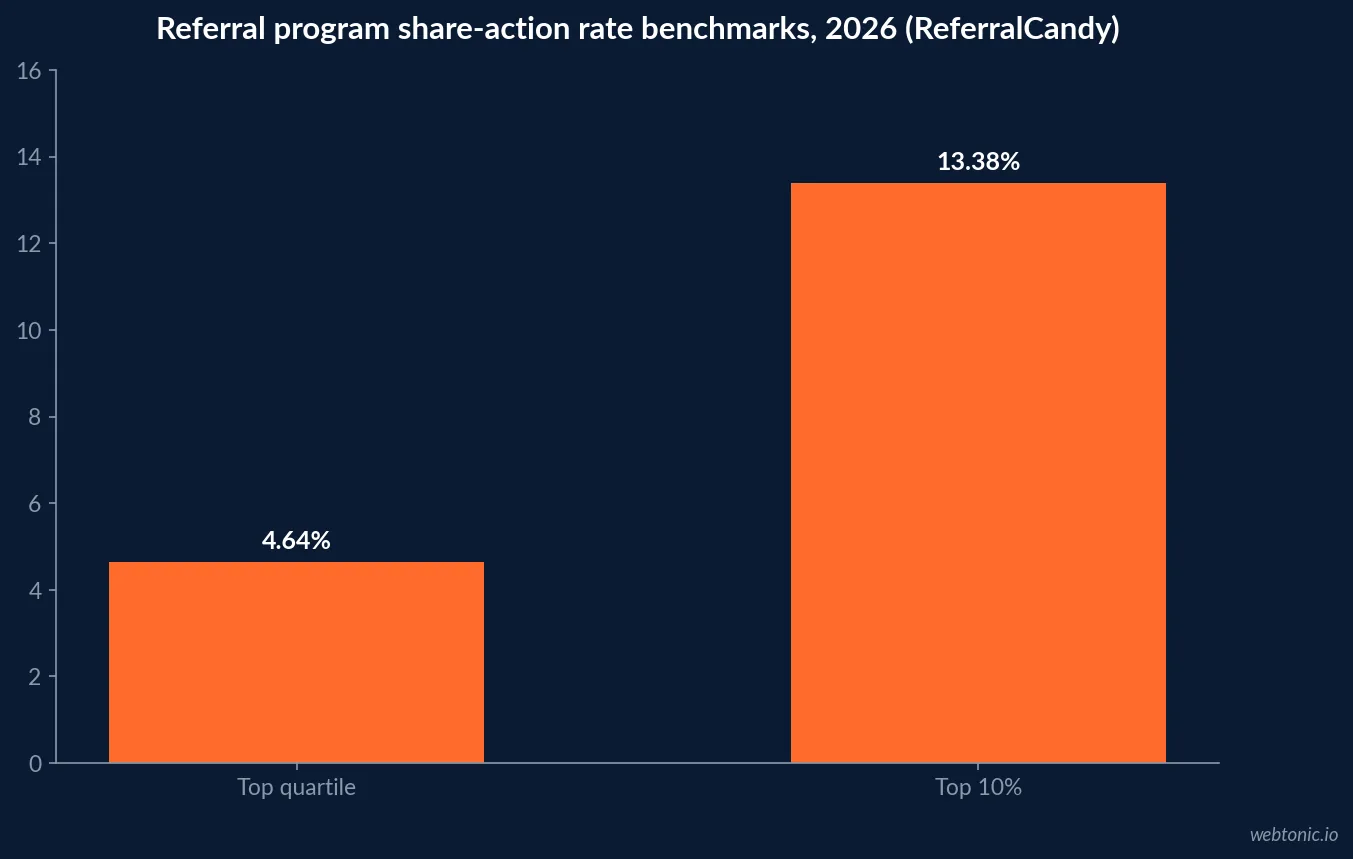
- Top-quartile share-action rate is 4.64%, and the top 10% starts at 13.38%.
- Referral revenue share ranges 10-30% of total store revenue across surveyed brands.
- Referred customers place about 20% more orders in pooled analysis, though the effect varies by merchant.
- Referred customers are 10.7x more likely to become advocates than non-referred customers.
- The typical first referred sale lands 14 days after a program goes live.
- 68% of programs reach a first referral within one month; 89% within 90 days.
- Employee referral apply-to-hire conversion is 28.2%, against 2-5% from job boards.
- Referred hires save employers roughly USD 1,634 per hire in recruiting cost.
- Referred hires reach 90-day retention at 87.7%.
- Referred hires are hired about 10 days faster than non-referred candidates.
- Referrals lead the lead-source mix at High Growth professional services firms, per Hinge's 2026 study.
- 39.5% of leads at those firms still come through referrals, per Hinge's 2026 study.
- Only 8% of No Growth firms have a visible expert publishing thought leadership, against 21% of High Growth firms.
- Median professional-services firm growth was 9.9% in 2026, the lowest since 2018.
Referral marketing benchmarks at a glance, 2026
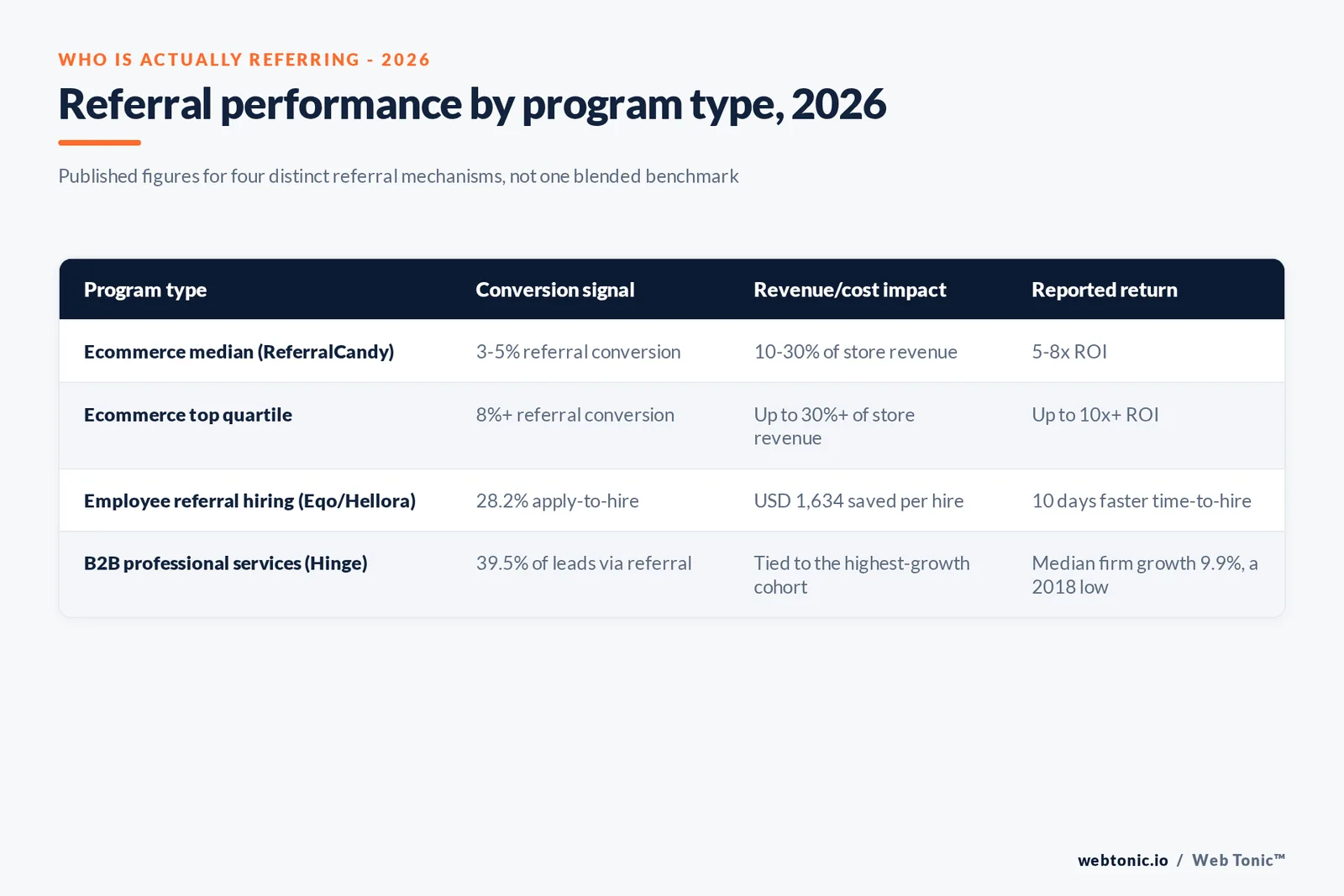
ReferralCandy's 2026 benchmark set, drawn from roughly 3,200 ecommerce stores, is the clearest published baseline for what a referral line item should return before a CFO signs off on it. The headline: a median referral conversion rate of 3-5%, a median program ROI of 5-8x, and a referral revenue share of 10-30% of total store revenue depending on how deliberately the program is run.
A second, separately run ReferralCandy study looked at share-action rate - the share of customers who actually share a referral link at all, a harder and earlier funnel stage than conversion. To enter the top quartile on that metric required a 4.64% share-action rate; the top 10% started at 13.38%, nearly three times higher, and that gap widens further down the funnel toward referral orders and revenue.
| Metric (ReferralCandy, 2026) | Median / typical | Top quartile | Top 10% |
|---|---|---|---|
| Referral conversion rate | 3-5% | 8%+ | Not separately reported |
| Share-action rate | Below 4.64% | 4.64%+ | 13.38%+ |
| Referral revenue share of total store revenue | 10-30% | Up to 30%+ | Highest tier of the sample |
| Referral order/revenue benchmark vs. typical | 1x (baseline) | ~2.5x typical | ~6x typical |
| Reported program ROI | 5-8x | 8-10x | 10x+ |
Why the trust transfer still beats the ad creative
The mechanism underneath every number above is trust, and it holds up better than most vendor folklore around it. WordStream's referral marketing guide cites Nielsen's 2021 Trust in Advertising study, based on 40,000 respondents across 56 countries, finding 88% of consumers trust a recommendation from someone they know more than any other advertising channel - not the 92% figure from a 2012 Nielsen report that still circulates. A 2024 Journal of Marketing Research study cited by WordStream found referred customers make 31-57% more referrals of their own than customers acquired through other channels, and that ignoring those downstream referrals causes a firm to undervalue a single referral by 20-36%.
Shopify's own 2026 referral marketing data adds the channel-efficiency comparison: referral traffic converts at 2.5-3.5%, against a 0.5-1% conversion rate Shopify cites for typical paid social traffic in the same period - a five-fold gap that explains why a referral line item survives budget cuts that hit paid acquisition first.
| Referral trust and value signal | Figure | Source |
|---|---|---|
| Consumers who trust a personal recommendation most | 88% | Nielsen 2021 Trust in Advertising, via WordStream |
| Additional referrals made by a referred customer | 31-57% more | Journal of Marketing Research 2024, via WordStream |
| Referral value understated when downstream referrals ignored | 20-36% | Journal of Marketing Research 2024, via WordStream |
| Referral traffic conversion rate | 2.5-3.5% | Shopify 2026 referral marketing data |
| Typical paid social traffic conversion rate | 0.5-1% | Shopify 2026 referral marketing data |
Why a 2x paid-social baseline makes referral ROI look so strong
ReferralCandy frames the 5-8x referral ROI figure against a roughly 2x return commonly reported for paid social spend, and treats anything above 4x as solid, 6-8x as strong, and 10x-plus as a top-performing program with healthy margins. That framing only holds if the referral incentive cost is tracked as honestly as the paid-media budget it is being compared against - a program that quietly discounts every order by 15% to fund rewards is not actually running at the ROI its dashboard reports.
The study also found predictable, recurring-revenue businesses see 1.5-2 percentage points more referral conversion than one-off purchase businesses, because trust in a subscription relationship transfers more cleanly through a referral link than trust in a single transaction does.
| Program lever | Reported effect | Source |
|---|---|---|
| Reward relevance tuned to the customer | Largest single lift on share-action rate | ReferralCandy 2026 |
| Program visibility at point of purchase | Drives most of the gap to top-quartile | ReferralCandy 2026 |
| Frictionless redemption flow | Reduces drop-off between share and conversion | ReferralCandy 2026 |
| Subscription vs. one-off purchase model | +1.5-2pp conversion for subscription merchants | ReferralCandy 2026 |
How fast a new program actually pays back
Budget conversations stall on an unanswered question: how long before this shows results. ReferralCandy's time-to-first-referral study answers it directly - the typical measurable first referred sale lands 14 days after a program activates. Among programs that produced a measurable referral at all, 68% reached that first sale within 30 days and 89% within 90 days, which puts a real ceiling on how long a "referrals aren't working yet" conversation should reasonably run.
The customer-quality signal is real but needs a caveat: referred customers were 10.7 times more likely to become successful advocates themselves than customers acquired through other channels, though referred customers are also exposed to the program from the moment they arrive, which inflates part of that gap. The spending picture was more modest - about 20% more orders in pooled analysis, but the lift disappeared when comparing merchants one at a time, and repeat-purchase rates and average order value looked similar to non-referred customers.
Employee referrals: the same math applied to hiring
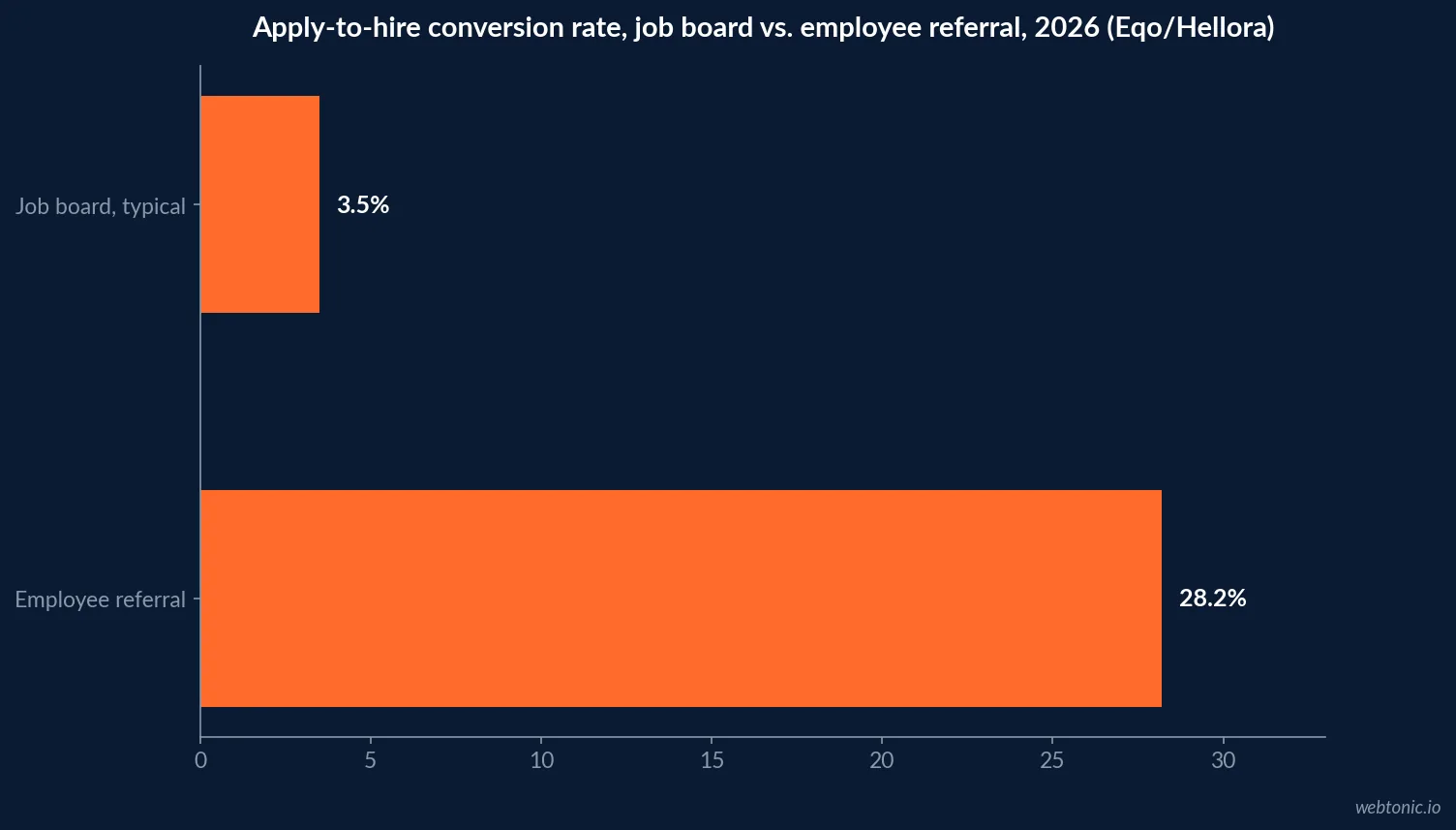
The referral mechanism performs at least as well inside recruiting. Aggregated data from Eqo, reported by Hellora, found employee referrals convert at a 28.2% apply-to-hire rate, against a typical 2-5% rate from job boards - roughly seven to fourteen times the baseline. Referred hires also cost about USD 1,634 less to recruit per hire, and one healthcare system reported saving USD 157,000 a year for every employee referral that replaced a single travel-nurse contract.
Retention compounds the case further: referred hires reach 96% retention at 30 days, 92% at 60 days, and 87.7% at 90 days, with annualized retention at 81.3%. Time-to-hire also improves by roughly 10 days, or nearly 50% faster in healthcare specifically. The employee side of a referral budget is arguably the easier internal sell, since it shows up directly in a recruiting cost line rather than a shared marketing-and-sales attribution model.
| Employee referral metric (Eqo/Hellora, 2026) | Value |
|---|---|
| Apply-to-hire conversion | 28.2%, vs. 2-5% job boards |
| Recruiting cost saved per referral hire | ~USD 1,634 |
| Time-to-hire improvement | ~10 days faster |
| 30 / 60 / 90-day retention | 96% / 92% / 87.7% |
| Referrals submitted per employee | 1.63 on average |
| Employees who repeat-refer | 29.4% make a second referral |
Why B2B referral programs stay informal despite the data
The B2B side of the picture is the biggest gap between opportunity and execution, and it is one our own data intelligence work runs into constantly when a client's CRM has no field for "how this lead actually found us." Hinge Marketing's 2026 High Growth Study, its 11th consecutive annual edition covering 495 firms across four industry groups, found referrals leading a diverse mix of lead sources at professional services firms - supplying 39.5% of leads even as median firm growth slowed to 9.9%, the lowest rate the study has recorded since 2018. In a slower growth year, referral leads are not a nice-to-have channel; they are propping up pipeline while other channels soften.
Hinge's study also names why a referral can still fail to convert once it arrives - what the firm calls "referral killers": generic messaging, an outdated website, a confusing offer, an unresponsive team, or inactive marketing channels that make a referred prospect quietly abandon a firm before ever making contact. High Growth firms close that gap with visible expertise: 21% have a "high activity" subject-matter expert publishing thought leadership, against just 8% of No Growth firms, and High Growth firms use significantly more "seller-doers" - the person who sells the work is also the one delivering it, which is exactly the trust signal a referral trades on.
| B2B referral signal, Hinge 2026 High Growth Study | Figure |
|---|---|
| Share of professional-services leads from referrals | 39.5% |
| Median professional-services firm growth, 2026 | 9.9%, a 2018 low |
| High Growth firms with a visible, active subject-matter expert | 21% |
| No Growth firms with a visible, active subject-matter expert | 8% |
| Study sample | 495 firms, 4 industry groups, 11th annual edition |
Where the referral budget conversation usually breaks down
Three recurring failure points show up across the ecommerce, employee and B2B data. First, programs measure the wrong funnel stage - a "conversion rate" on people who already clicked a referral link is a much easier number to hit than a referral order rate measured against the entire order book, and comparing the two inflates perceived performance. Second, incentive cost is rarely netted against the reported ROI, which is how a program can look like 8x while actually running closer to break-even once discounts are subtracted. Third, B2B teams treat referrals as a one-off ask rather than an NPS-driven, revenue-linked motion, which is exactly the gap the 9% of CX-linked B2B programs are exploiting against the 54% running nothing formal at all.
A referral program earns a durable budget line the same way a paid channel does: a stated conversion rate, a stated cost per acquisition net of incentive spend, and a review cadence that catches decay before it shows up as "referrals don't work here." That is also how High Growth professional-services firms outrun the 9.9% median in Hinge's study - not with a bigger incentive, but with the same referral-killer discipline applied consistently. Our growth marketing team treats referral as one acquisition channel among several, measured on the same unit economics, not a separate goodwill budget. If your referral numbers currently live in a spreadsheet nobody trusts, talk to our team about wiring referral tracking into the same reporting stack as paid acquisition.
Frequently Asked Questions
Is referral marketing still worth budgeting for in 2026?
The published data says yes, with a caveat. ReferralCandy's 2026 benchmark set puts typical referral program ROI at 5-8x, against a commonly cited 2x return for paid social spend, and top-quartile programs pull 10-30% of total store revenue through referrals. The caveat is that referral revenue share ranges 3-6x wider between the median and top-quartile program than most acquisition channels, so a referral line item only earns its keep with active management, not a set-and-forget widget.
What is a good referral conversion rate in 2026?
ReferralCandy's analysis of roughly 3,200 ecommerce stores puts the median referral conversion rate at 3-5%, with top-quartile programs converting above 8%. A separate share-action benchmark - the share of customers who actually share a referral link, not just the share who convert once shared - put the top quartile at 4.64% and the top 10% at 13.38%, nearly three times higher. The gap between an average and a well-run program compounds at every stage of the funnel.
Do employee referral programs perform differently than customer referral programs?
Yes, and the gap is larger. Aggregated data from Eqo, reported by Hellora, found employee referrals convert applicants to hires at 28.2%, against a typical 2-5% application-to-hire rate from job boards. Referred hires also reach 30-day retention at 96% and 90-day retention at 87.7%, and one healthcare system reported saving USD 157,000 a year every time an employee referral replaced a single travel-nurse contract.
Why do B2B referral programs get less budget than B2C ones?
Structure, not demand, is the gap. Hinge Marketing's 11th annual High Growth Study, covering 495 firms in 2026, found referrals leading a diverse mix of lead sources at professional services firms - supplying 39.5% of leads even as median firm growth slowed to 9.9%, the lowest rate the study has recorded since 2018. High Growth firms protect that referral flow with visible expertise: 21% run an active thought-leadership program against just 8% of No Growth firms, closing what Hinge calls 'referral killers' - the generic messaging and outdated sites that make a referred prospect quietly walk away before ever making contact.
How fast does a new referral program pay back?
ReferralCandy's time-to-first-referral study found the typical measurable first referred sale arrives after 14 days from activation. Of programs that produced a measurable referral at all, 68% reached that first sale within the first month and 89% within 90 days. Referred customers were also 10.7 times more likely to become advocates themselves than customers acquired through any other channel, though part of that gap reflects that referred customers already know the program exists the moment they arrive.
Sources
ReferralCandy - The Hidden ROI of Referral Programs in 2026
ReferralCandy - State of ecommerce referral programs 2026: what good looks like
Hellora / Eqo - The State of Employee Referral Programs in 2026
Hinge Marketing - 2026 High Growth Study webinar slides
WordStream - Referral Marketing Guide: Strategies, Examples & Free Tools
Shopify - 5 Referral Marketing Statistics for 2026