Table of contents
82% of marketers have worked on a rebrand, and the ones they run touch roughly 215 assets over seven months on average. This page sets out the 2026 benchmarks for rebrand scope, timeline and revenue case, sourced from named surveys rather than agency case studies.
Key Takeaways
- 82% of marketers have worked on a rebrand, per Bynder's 2026 survey data.
- 74% of S&P Global 100 companies rebrand within seven years of an acquisition.
- The average rebrand takes seven months, from talks to rollout.
- A typical rebrand touches 215 assets.
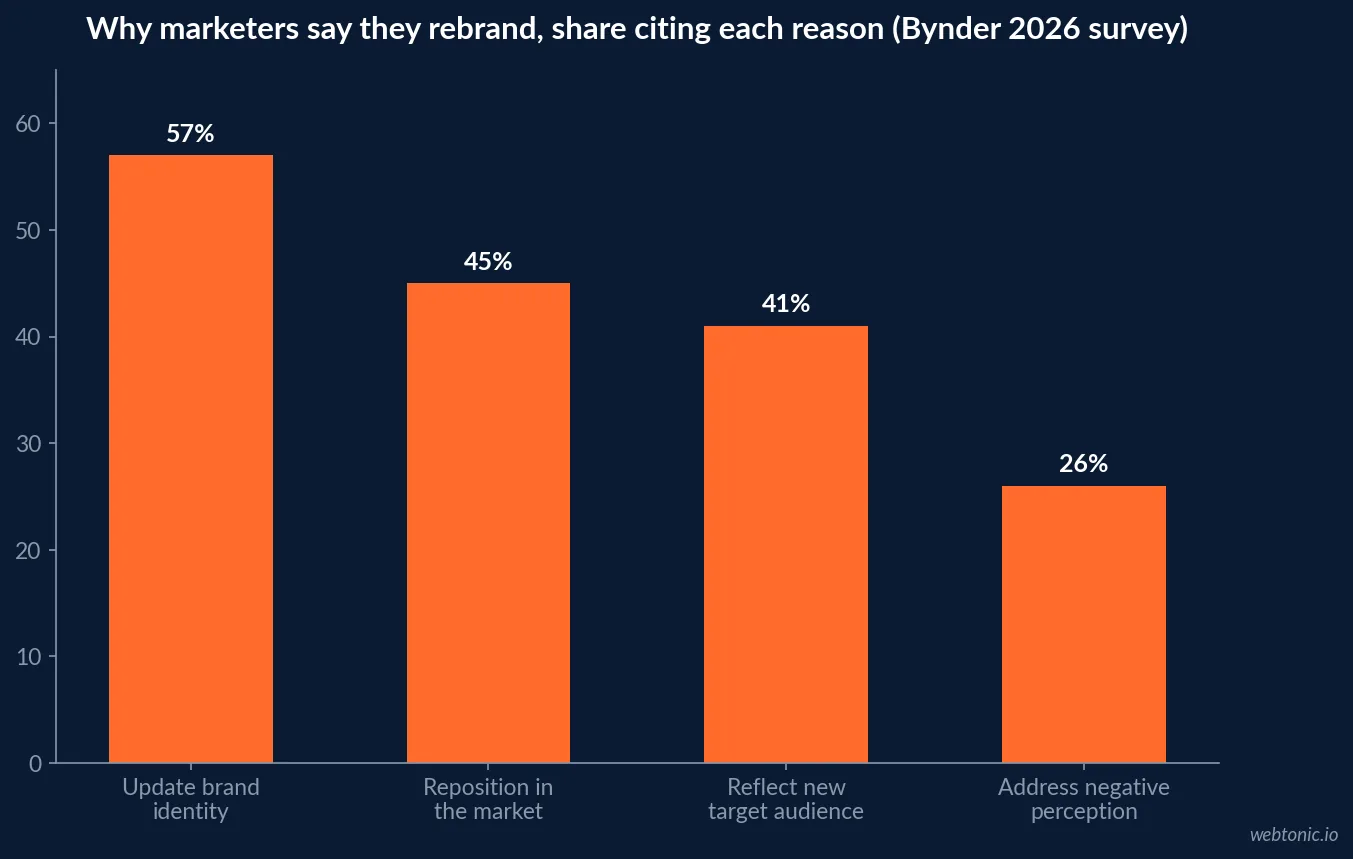
- 57% of marketers rebrand to update brand identity, the top reason cited.
- 45% rebrand to reposition in the market.
- 41% rebrand to reflect a changed target audience.
- 26% rebrand to address negative brand perception.
- Almost 1 in 10 rebrands run 1 to 2 years.
- Consistent branding can lift revenue by 10 to 20%, per Lucidpress/Marq's study.
- Strong brands show 3x the sales volume of weak brands, per Millward Brown.
- Businesses typically rebrand every 7 to 10 years, with smaller refreshes between.
- Online marketing materials are the hardest asset type to update.
- Updating marketing assets is marketers' single biggest rebrand challenge.
How common a rebrand actually is in 2026
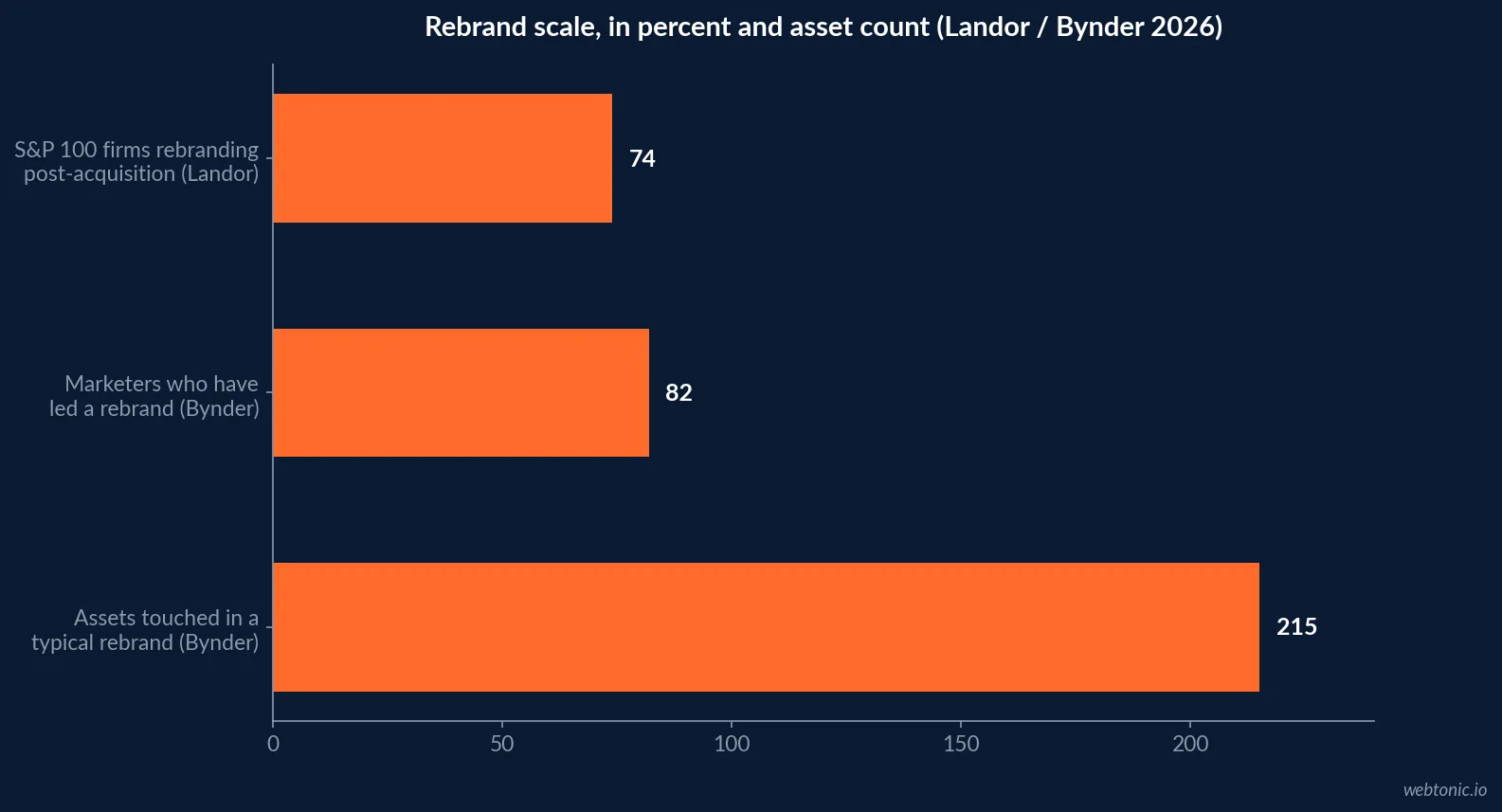
Rebranding is no longer a rare, headline-making event. Bynder's 2026 rebranding guide reports that 82% of the marketers it surveyed have worked on a rebranding project, and that 74% of S&P Global 100 companies rebrand an acquired asset within the first seven years of the deal, per Landor's quantitative M&A brand study. Between those two figures, a rebrand looks less like a strategic gamble and more like a predictable stage in a company's growth or M&A cycle.
| Rebrand reason (2026) | Share citing it | Source | Scope implication |
|---|---|---|---|
| Update brand identity | 57% | Bynder marketer survey | Smallest typical scope: visual refresh |
| Reposition in the market | 45% | Bynder marketer survey | Touches messaging and go-to-market, not just visuals |
| Reflect a change in target audience | 41% | Bynder marketer survey | Requires new research before design starts |
| Address negative brand perception | 26% | Bynder marketer survey | Often the highest-stakes, most-scrutinised rebrand |
The real timeline and asset count
Ask a stakeholder how long a rebrand takes and the honest answer, per Bynder's survey of 1,002 marketers, is seven months from initial talks to rollout, touching an average of 215 assets. Almost one in ten marketers reported a rebrand that ran between one and two years. Custom Logo Shop's separate tracking puts the typical rebrand cycle — how often a company rebrands at all, rather than how long one project takes — at every seven to ten years, with smaller refreshes filling the gaps.
The asset count is the number that most often blows a rebrand timeline: 215 assets is not a design problem, it is a production and rollout logistics problem, and most of the seven-month window is consumed there.
| Rebrand scope metric (2026) | Figure | Source | Planning note |
|---|---|---|---|
| Average project length, talks to rollout | 7 months | Bynder survey (1,002 marketers) | Budget contingency for the long tail |
| Average assets updated | 215 assets | Bynder survey | Drives most of the timeline, not the design phase |
| Rebrands lasting 1-2 years | ~10% of projects | Bynder survey | Large orgs should plan toward this end |
| Typical rebrand frequency | Every 7-10 years | Custom Logo Shop | Full rebrands are rare; refreshes fill the gap |
| Hardest asset type to update | Online marketing materials | Bynder survey | Sequence digital before print in the rollout plan |
The revenue case a rebrand has to clear
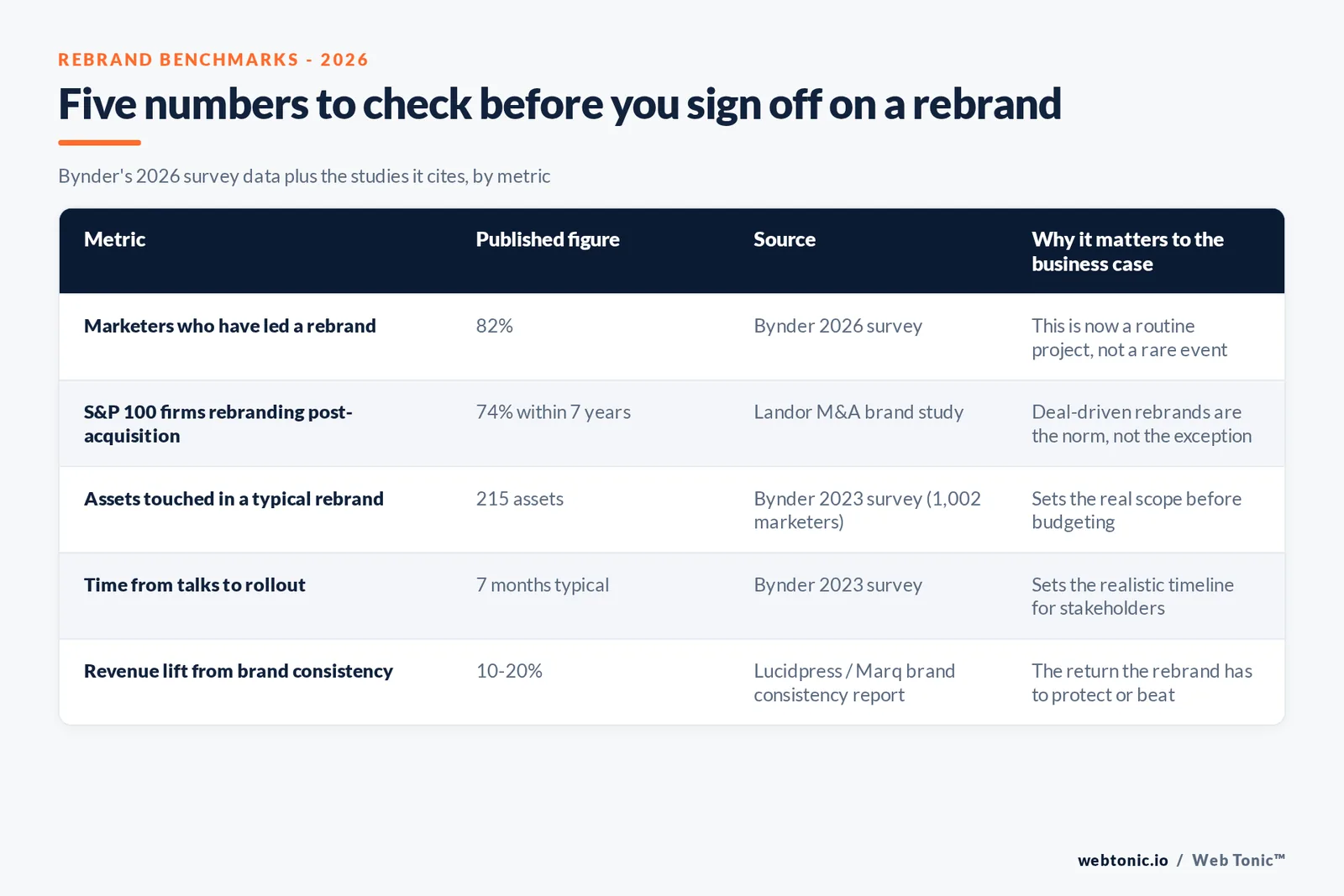
The figure most often used to justify a rebrand's cost is Lucidpress's State of Brand Consistency report, now published under Marq: consistently maintained branding is associated with a 10 to 20% revenue increase. A separate, older Millward Brown study, still cited because no comparable replacement has been published, found strong brands carry three times the sales volume of weak ones. Neither figure is new for 2026, and that is itself worth stating plainly: the rebrand-ROI conversation is still running on pre-2020 research because brand-consistency studies at this scale are rare and expensive to repeat.
That makes the honest brief for a 2026 rebrand business case: treat the 10-20% figure as the revenue the rebrand has to protect through execution, not a guaranteed uplift it will automatically deliver.
| Revenue benchmark | Figure | Source | How to use it |
|---|---|---|---|
| Revenue lift from brand consistency | 10-20% | Lucidpress / Marq State of Brand Consistency | Frame as the upside at stake, not a guarantee |
| Sales volume, strong vs. weak brands | 3x | Millward Brown study | Cite as directional, not a rebrand-specific figure |
| S&P 100 firms rebranding post-M&A | 74% within 7 years | Landor M&A brand study | Sets expectation for deal-driven rebrands |
| Marketers with rebrand experience | 82% | Bynder marketer survey | This is now a standard marketing competency |
What still trips up execution
Per Bynder's survey, marketers rank updating marketing assets as the single hardest part of running a rebrand, with online marketing materials the most difficult asset type to update, ahead of printed materials and then e-commerce sites. That ordering argues for sequencing: get the website, ad accounts and social profiles updated before the print run, because digital assets both take longer to fully propagate and are the first thing a customer or journalist checks after a launch date.
Our performance creative team handles exactly that kind of cross-channel asset rollout, our company overview covers how the wider studio supports a rebrand launch beyond the logo and guidelines themselves, and our growth marketing practice re-baselines the campaigns that have to carry the new identity once it ships. Get in touch before the launch date is locked, not after.
What a rebrand costs by tier
Scope drives the invoice more than anything else. Red Shoes' 2026 pricing breakdown, built from consistent market data across multiple branding sources, puts a standalone logo at USD 500 to 5,000, a visual refresh at USD 5,000 to 25,000, a small-business full rebrand at USD 15,000 to 50,000, a mid-market strategic rebrand at USD 50,000 to 150,000, and a complex multi-market rollout at USD 150,000 to 500,000-plus. The same source cites the widely used rule of thumb that companies spend roughly 5 to 10% of their annual marketing budget on a rebrand.
Cross-referencing that against the reason a company is rebranding, from the table above, gives a quick sanity check: an identity update (57% of rebrands) should land in the visual-refresh or small-business tier, while a full repositioning (45%) or audience shift (41%) usually justifies the mid-market or complex tier.
| Rebrand tier | Published 2026 cost | What it includes | Source |
|---|---|---|---|
| Standalone logo | USD 500–5,000 | A single mark, no broader system | Red Shoes 2026 pricing guide |
| Visual refresh | USD 5,000–25,000 | Logo update, palette, typography, templates | Red Shoes 2026 pricing guide |
| Small business full rebrand | USD 15,000–50,000 | Positioning, identity, messaging, website refresh | Red Shoes 2026 pricing guide |
| Mid-market strategic rebrand | USD 50,000–150,000 | Research, identity, website, sales assets, launch | Red Shoes 2026 pricing guide |
| Complex / multi-market | USD 150,000–500,000+ | Product, packaging, signage, full go-to-market | Red Shoes 2026 pricing guide |
The brand-value stakes behind the decision
The reason boards scrutinise a rebrand budget this closely is that brand value itself is compounding faster than ever. Kantar's 2026 BrandZ Most Valuable Global Brands report put the combined value of its Global Top 100 at a record USD 13.1 trillion, up 22% year on year, with three brands — Google, Microsoft and Amazon — simultaneously crossing the trillion-dollar threshold for the first time. Google's brand value alone surged 57% to take the number-one spot, and ChatGPT recorded the largest single-year brand-value increase in the ranking's history at 285%.
That volatility cuts both ways for a rebrand business case: it is easier than ever to argue that brand investment moves enterprise value quickly, and just as easy for a board to ask why a six-figure identity project should be funded instead of the AI-driven brand-building Kantar's report describes.
| Brand value context (2026) | Figure | Source | Relevance to a rebrand case |
|---|---|---|---|
| Kantar BrandZ Global Top 100 combined value | USD 13.1 trillion | Kantar BrandZ 2026 | Brand value is compounding faster than ever |
| Year-on-year growth of Top 100 value | 22% | Kantar BrandZ 2026 | Sets the bar a rebrand's ROI case has to clear |
| Google's brand value growth | 57% YoY | Kantar BrandZ 2026 | Shows how fast a brand can re-rank with the right story |
| Fastest brand-value growth in ranking history | 285% (ChatGPT) | Kantar BrandZ 2026 | AI-native brands are resetting expectations |
Frequently Asked Questions
How common is rebranding in 2026?
Very common. Bynder's 2026 survey of marketers found 82% have worked on a rebranding project before, and Landor's quantitative M&A brand study found 74% of S&P Global 100 companies rebrand an acquired asset within the first seven years of the deal. Rebranding has moved from an occasional strategic event to a recurring line item most marketing teams plan for.
How long does a rebrand actually take?
Bynder's 2023 survey of 1,002 marketers, still the basis for its 2026 rebrand guide, found the average rebrand takes seven months from initial talks to rollout, touching roughly 215 assets. Almost one in ten marketers reported a rebrand lasting between one and two years, so seven months is a median, not a ceiling, and larger organisations with more brand touchpoints should budget toward the long end of that range.
What is the most common reason companies rebrand?
Updating brand identity, cited by 57% of marketers in Bynder's survey, followed by repositioning in the market at 45%, reflecting a change in target audience at 41%, and addressing negative brand perception at 26%. That ordering matters for scoping: an identity refresh is a materially smaller project than a full repositioning, even though both get called a rebrand.
Does brand consistency actually move revenue?
The most-cited figure, from Lucidpress's State of Brand Consistency report (now published under Marq), is a 10 to 20% revenue increase tied to consistently maintained branding, with strong brands showing three times the sales volume of weak ones in a separate Millward Brown study. Those figures predate 2026 but remain the baseline the rebrand-ROI conversation is built on, because no comparably sized study has replaced them.
What are the most difficult parts of executing a rebrand?
Bynder's marketer survey found updating marketing assets is the single most difficult part of a rebrand, with online marketing materials the hardest asset type to update, ahead of printed materials and e-commerce sites. That is a scope problem more than a creative one: 215 assets is a production timeline, and most of the seven-month rollout window is spent there, not on the design itself.
Sources
Bynder — Rebranding in 2026: Key statistics, definitions and expert advice
Marq (formerly Lucidpress) — State of Brand Consistency report
PR Newswire / Lucidpress — Brand consistency and revenue study
Landor — First Quantitative M&A Brand Study of the S&P Global 100
Red Shoes — What a Rebrand Really Costs and What Drives the Price, 2026
Kantar BrandZ — Most Valuable Global Brands 2026