Table of contents
Real estate has no published influencer or UGC benchmark, but NAR's 2025 data shows 88% of buyers and 91% of sellers still hire an agent - which makes the agent's own content the deciding pitch. Creator format and rate data below is cross-industry and labelled as such.
Key Takeaways
- 88% of buyers and 91% of sellers used an agent (NAR 2025).
- For-sale-by-owner sales fell to a record low of 5%.
- First-time buyers hit a record low 21%; their median age is 40.
- Buyers searched a median 10 weeks; 92% were satisfied.
- 23% of REALTORS use AI tools daily (NAR 2026 Technology Report).
- YouTube videos lead engagement at 6%, Reels 5% (Collabstr, cross-industry).
- Instagram carries 40% of Collabstr campaigns and UGC 35%.
- YouTube pays the highest average at USD 255 per engagement.
- 65.9% of marketers expect influencer payback within a month (IMH).
- US creator ad spend is projected at USD 44 billion in 2026 (IAB).
- No real estate-specific creator engagement, cost or ROI benchmark exists.
Buyers and sellers still hire agents
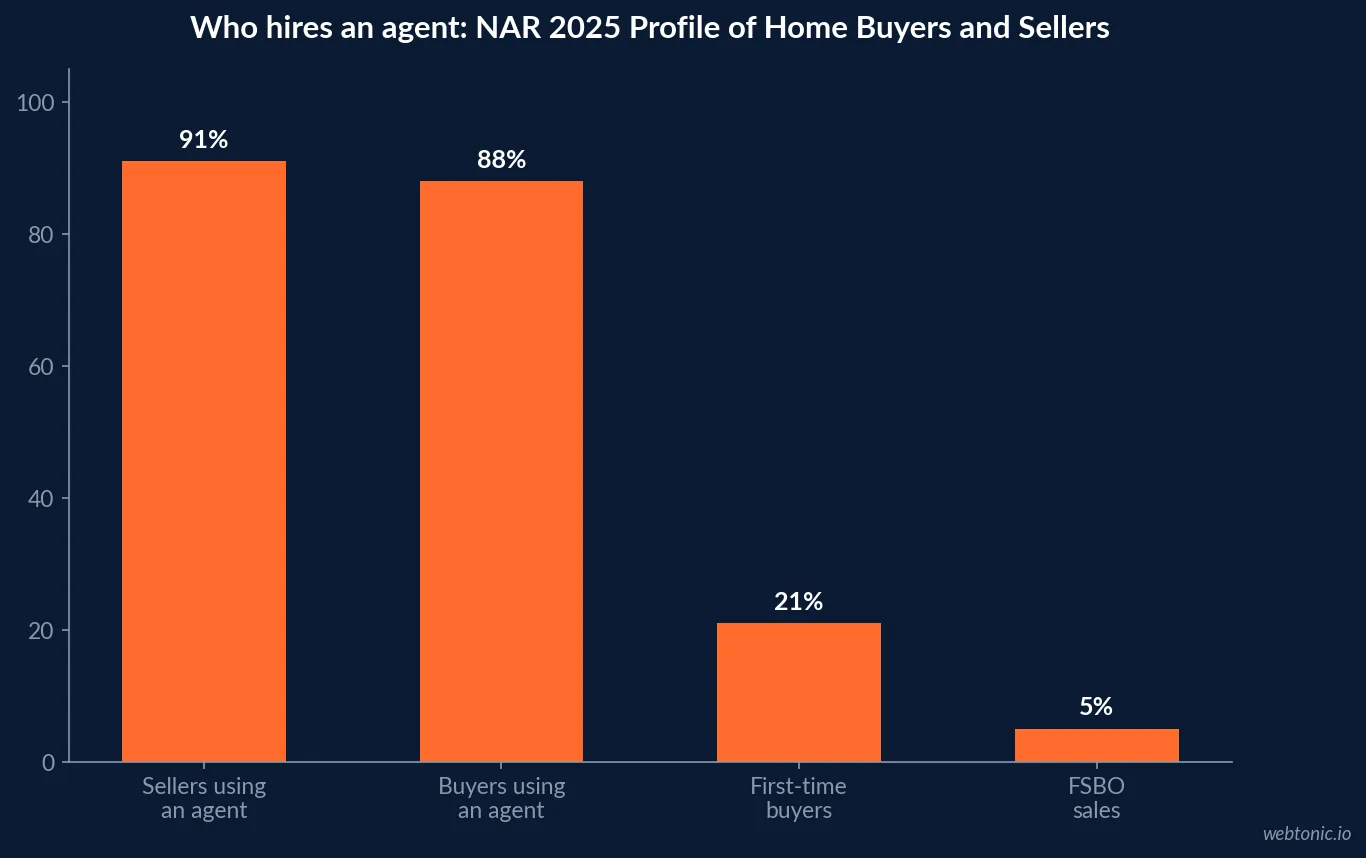
The NAR 2025 Profile of Home Buyers and Sellers surveyed 6,103 primary residence buyers who purchased between July 2024 and June 2025. 88% bought through an agent or broker and 91% of sellers sold with one, while for-sale-by-owner sales fell to 5%, an all-time low. Buyers mainly wanted help finding the right home (50%) and negotiating terms (13%).
Sellers put three tasks first: marketing the home to buyers, pricing it competitively and selling within a timeframe. Listing video is the most visible proof of the first one.
| NAR 2025 Profile metric | Figure | What it means for content |
|---|---|---|
| Buyers using an agent | 88% | The agent choice is the conversion |
| Sellers using an agent | 91% | Listing content wins appointments |
| FSBO share of sales | 5% | Record low |
| First-time buyer share | 21% | Record low since 1981 |
| Median first-time buyer age | 40 | Older audience than many creators assume |
| Median search length | 10 weeks | A long window for repeat exposure |
A buyer audience that is older and cash-heavy
NAR's top takeaways from the 2025 profile show first-time buyers at 21%, against a pre-2008 norm of 40%, all-cash buyers at a record 26%, and buyers with children under 18 at a record low 24%. Repeat buyers had a median age of 62.
That profile matters for creator selection. A local creator whose audience is mostly under 25 may deliver views but not buyers. Neighbourhood, downsizing and relocation content tends to fit the older, equity-rich audience the data describes.
The search itself is long. Buyers spent a median of 10 weeks looking, and NAR reports finding the right home was the hardest step. That is ten weeks in which the same buyer may see an agent's content many times, which favours a steady run of neighbourhood and listing videos over a single viral attempt. It also means repeat viewers can be retargeted: a buyer who watched a walkthrough in week two is still in the market in week eight.
Which listing-video formats engage
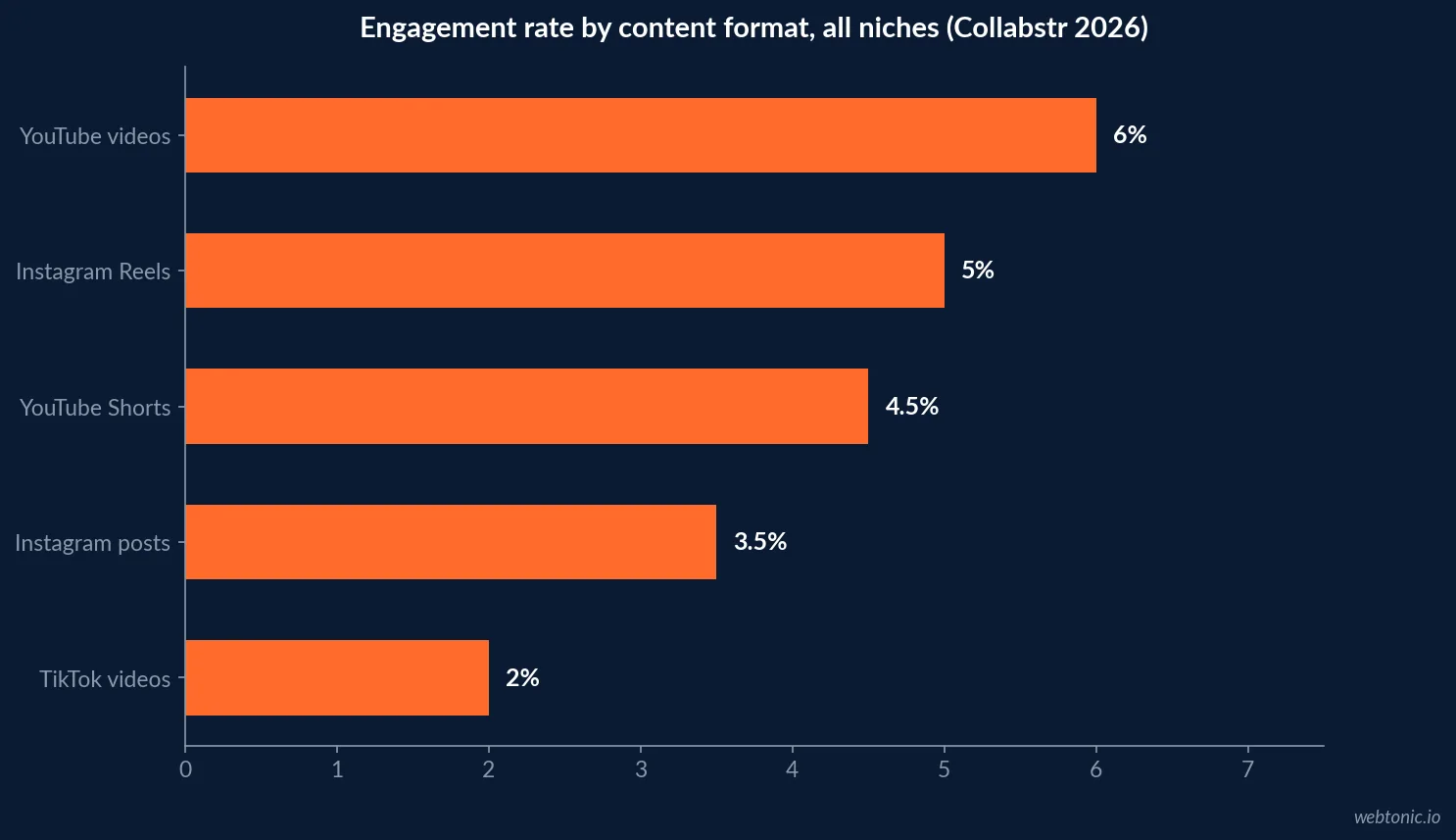
Collabstr's 2026 Influencer Marketing Report ranks content formats by engagement across its marketplace: YouTube videos 6%, Instagram Reels 5%, YouTube Shorts 4.5%, Instagram posts 3.5% and TikTok videos 2%. Reels and Instagram posts lead on reach. Long walkthroughs engage deepest; short clips travel furthest.
For a listing, that suggests one long-form tour for engagement and several short cuts for reach. These are all-niche averages; no dataset reports real estate engagement rates by format.
| Format (Collabstr 2026, cross-industry) | Engagement rate | Listing use |
|---|---|---|
| YouTube videos | 6% | Full walkthrough tour |
| Instagram Reels | 5% | Highlights and reveals |
| YouTube Shorts | 4.5% | Single-feature clips |
| Instagram posts | 3.5% | Photo carousels |
| TikTok videos | 2% | Neighbourhood and lifestyle |
Platform share and creator payouts
Collabstr's 2026 data shows where brands book creators: Instagram 40%, platform-agnostic UGC 35%, TikTok 21%, YouTube 3% and X 1%. TikTok's share halved from 41%. Average payouts run from USD 255 on YouTube and USD 193 on Instagram to USD 154 for UGC.
For brokerages hiring local creators rather than filming in-house, those payouts are the realistic reference for a single deliverable; 80% of all collaborations on the platform cost under USD 300.
| Platform (Collabstr 2026) | Share of campaigns | Average payout |
|---|---|---|
| 40% | USD 193 | |
| UGC (any platform) | 35% | USD 154 |
| TikTok | 21% | USD 186 |
| YouTube | 3% | USD 255 |
| X (Twitter) | 1% | USD 76 |
Agents are already producing content with AI
NAR's 2026 REALTORS Technology Report finds 23% of REALTORS use AI tools daily. The top use is writing listing descriptions, cited by 75% of AI users, while 56% use AI to create social media posts and 52% to draft emails. 40% said clients responded very positively to their use of technology.
AI-written captions make volume easy but raise the Article 12 stakes: every AI-drafted description still has to present a true picture of the property.
There is also a practical efficiency argument. If AI drafts the caption and the description, the agent's time goes into the shoot and the walkthrough itself - the part no tool or creator marketplace can supply. Brokerages that standardise a simple shot list per listing can hand the same footage to a local creator for short cuts, keeping style consistent while spreading distribution.
Article 12: the true-picture rule
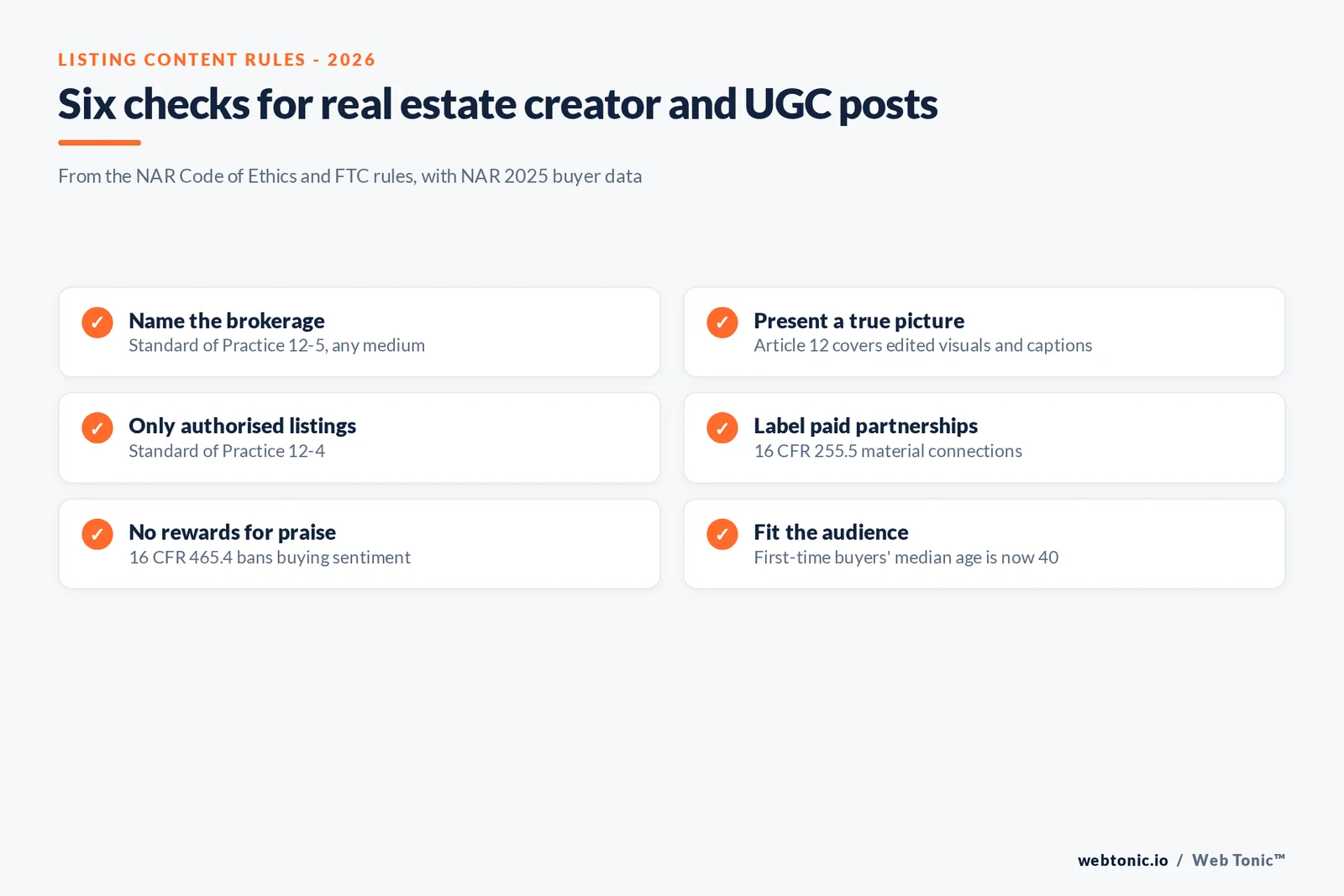
The NAR Code of Ethics Article 12 requires REALTORS to be honest and truthful in real estate communications and to present a true picture in advertising, marketing and other representations, with their status as real estate professionals readily apparent. Standard of Practice 12-5 requires the firm name in any advertising in any medium, and 12-4 bars advertising property without authority.
For creators hired by an agent, that means the brokerage name on the post, no property the agent is not authorised to market, and no edited visuals that misrepresent the home.
| Rule | Requirement | Creator-content check |
|---|---|---|
| NAR Article 12 | True picture in advertising | No misleading edits or claims |
| NAR SOP 12-5 | Firm name disclosed | Brokerage named on every post |
| NAR SOP 12-4 | Authority to advertise | Only listings you represent |
| 16 CFR 255.5 | Material connection disclosed | Paid creators label the post |
| 16 CFR 465.4 | No buying sentiment | No rewards for positive reviews |
Testimonials and the FTC review rule
Client video testimonials are UGC, and the FTC regulates them. The consumer reviews and testimonials rule (16 CFR 465) bans fake testimonials and any incentive conditioned on a review expressing a particular sentiment. The Endorsement Guides require material connections - including a referral fee or a closing gift tied to a post - to be disclosed, and the FTC's Disclosures 101 guide asks for that disclosure in the post itself.
Amplifying the listings that work
TikTok Spark Ads can run an agent's own organic post, or a creator's with authorisation, as a paid ad, keeping likes and follows on the original post. Influencer Marketing Hub's 2026 survey of 600-plus respondents reports 65.9% expect payback within a month, including 48.4% within two weeks - optimistic for a 10-week search. Linqia finds 79% of marketers struggle to measure ROI, and the IAB projects US creator ad spend at USD 44 billion in 2026.
How marketers track creator results
Measurement is where real estate differs most from the brands in these surveys: the conversion is a showing request or a listing appointment, not a checkout. Influencer Marketing Hub reports promo or discount codes as the most used tracking method at 45.9% of those answering, then affiliate links at 26.0% and native shop features at 25.0%. Brand awareness is the most selected KPI at 55.1%.
Codes and shop features rarely fit a home sale. Agents are better served by a unique landing page or phone number per creator and per listing, so a showing request can be traced back to the video that prompted it.
| Tracking method (IMH 2026) | Share using it | Real estate equivalent |
|---|---|---|
| Promo or discount codes | 45.9% | Unique showing-request link |
| Affiliate links | 26.0% | Referral partner tracking |
| Native shop features | 25.0% | Listing portal lead forms |
| Brand awareness KPI | 55.1% | Profile follows and saves |
What NAR data does not tell you
NAR's profile tells you who buys, how long they search and whether they use an agent. It does not measure social video, creator partnerships or UGC, and none of the influencer surveys on this page break out real estate. There is therefore no published real estate engagement rate, cost per lead or return on creator content, and any figure presented as one without a named sample should be treated with caution.
The practical response is to build your own benchmark: record views, saves, showing requests and listing appointments per video for a quarter, then compare them against the cost of each creator or shoot. Over a median 10-week search, that data will tell you more than any national average.
A content plan for one listing
- Shoot one long walkthrough and cut three to five short clips.
- Match the creator's audience to NAR's older buyer profile.
- Name the brokerage and label paid partnerships on every post.
- Never reward reviews conditioned on sentiment.
- Track showing requests and listing appointments, not views.
Read our real estate TikTok ads data, real estate SMS marketing statistics and the influencer and UGC hub. Our performance creative team can plan listing video, or contact us.
Frequently Asked Questions
Is there an influencer benchmark for real estate agents?
No. The 2026 influencer surveys from Influencer Marketing Hub, Linqia and Collabstr do not publish a separate engagement rate, cost or ROI for real estate. This page uses NAR's own buyer and seller data for demand and cross-industry creator data, labelled as such, for formats and rates.
Which video format earns the most engagement?
Across all niches, Collabstr's 2026 report puts YouTube videos at 6% engagement, Instagram Reels at 5%, YouTube Shorts at 4.5%, Instagram posts at 3.5% and TikTok videos at 2%. Reels and posts lead on reach. These are cross-industry figures, not real estate benchmarks.
What does NAR's Code of Ethics say about social media advertising?
Article 12 requires REALTORS to be honest and truthful and to present a true picture in their advertising, and to make their status as real estate professionals readily apparent. Standard of Practice 12-5 requires the firm's name to be disclosed in a reasonable and readily apparent manner in any medium - including creator and agent social posts.
Can agents reward clients for reviews or video testimonials?
Not for a particular sentiment. The FTC consumer review rule (16 CFR 465.4) bans compensation or incentives conditioned on reviews expressing a positive or negative view, and section 465.2 bans fake testimonials. Paid or gifted endorsements must also disclose the connection under the FTC Endorsement Guides.
Why does creator content matter if most buyers use an agent anyway?
Because it is how buyers choose the agent. NAR's 2025 profile shows 88% of buyers and 91% of sellers used an agent, and sellers ranked marketing the home among their top priorities. Content is where an agent shows that marketing before the listing appointment.
Sources
NAR - 2025 Profile of Home Buyers and Sellers, highlights
NAR - Top 10 takeaways from the 2025 Profile
NAR - 2026 REALTORS Technology Report
NAR - 2026 Code of Ethics and Standards of Practice
Collabstr - 2026 Influencer Marketing Report
Influencer Marketing Hub - Influencer Marketing Benchmark Report 2026
eCFR - 16 CFR Part 465, consumer reviews and testimonials
eCFR - 16 CFR Part 255, FTC Endorsement Guides
FTC - Disclosures 101 for Social Media Influencers
TikTok - About Spark Ads
Linqia - 2026 State of Influencer Marketing
IAB - 2025 Creator Economy Ad Spend and Strategy Report