Table of contents
Real estate texting is priced per segment and per credit, not per campaign, and the rules that govern consent changed in 2025. This page prices SMS from the platforms' own rate cards, states the current 10DLC registration cost, and separates what is actually required by law from what is still widely repeated without a source.
Key Takeaways
- Twilio charges USD 0.0083 per outbound SMS segment on a US long code, plus a USD 0.001 failed-message fee.
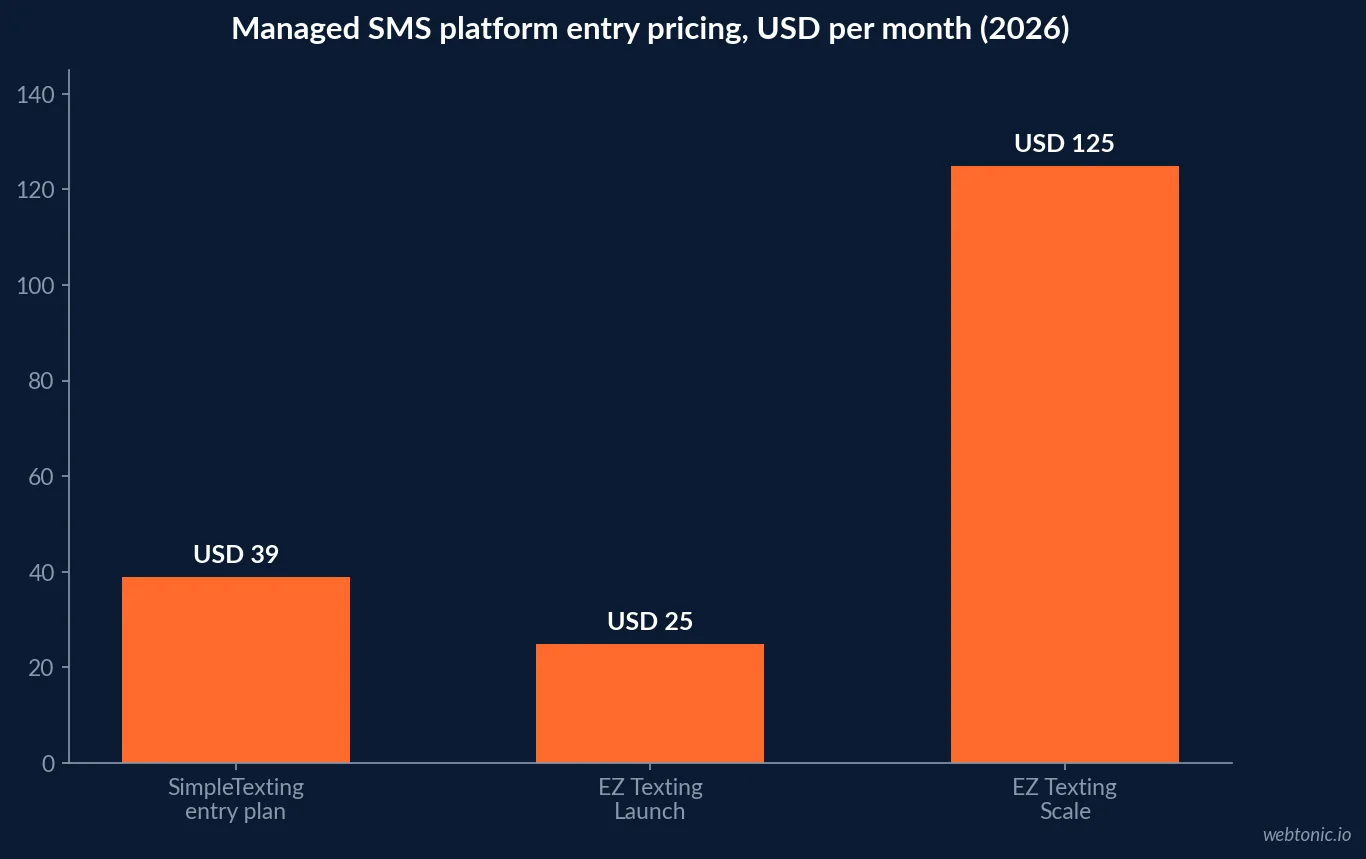
- SimpleTexting's entry plan is USD 39 a month for 500 credits with a local number.
- SimpleTexting charges roughly USD 0.0025 per message in pass-through carrier fees.
- EZ Texting's Launch plan starts at USD 25 a month (USD 20 billed annually) for 500 monthly credits.
- EZ Texting's Scale plan is USD 125 a month for teams sending 2,000 to 50,000 contacts.
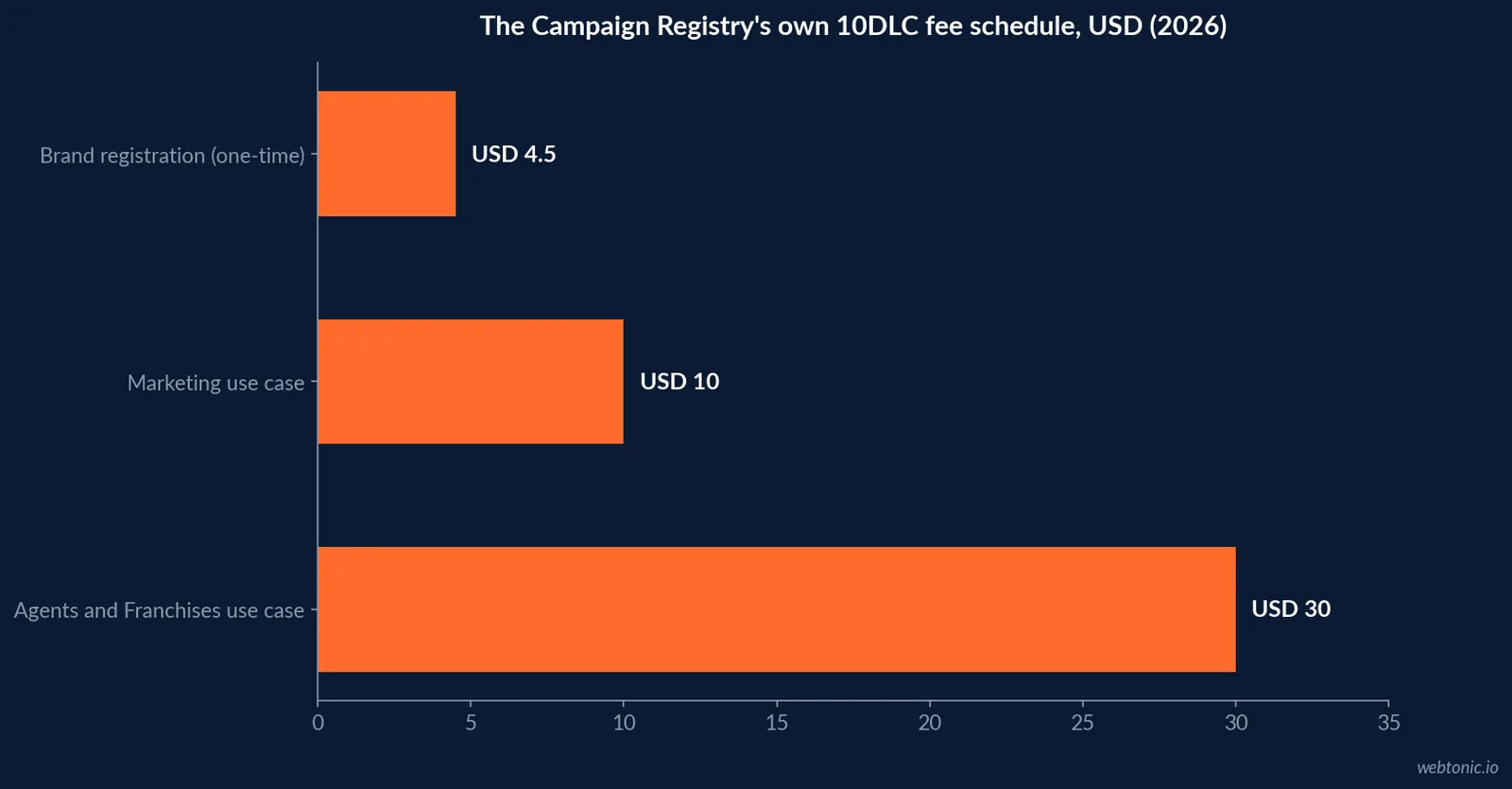
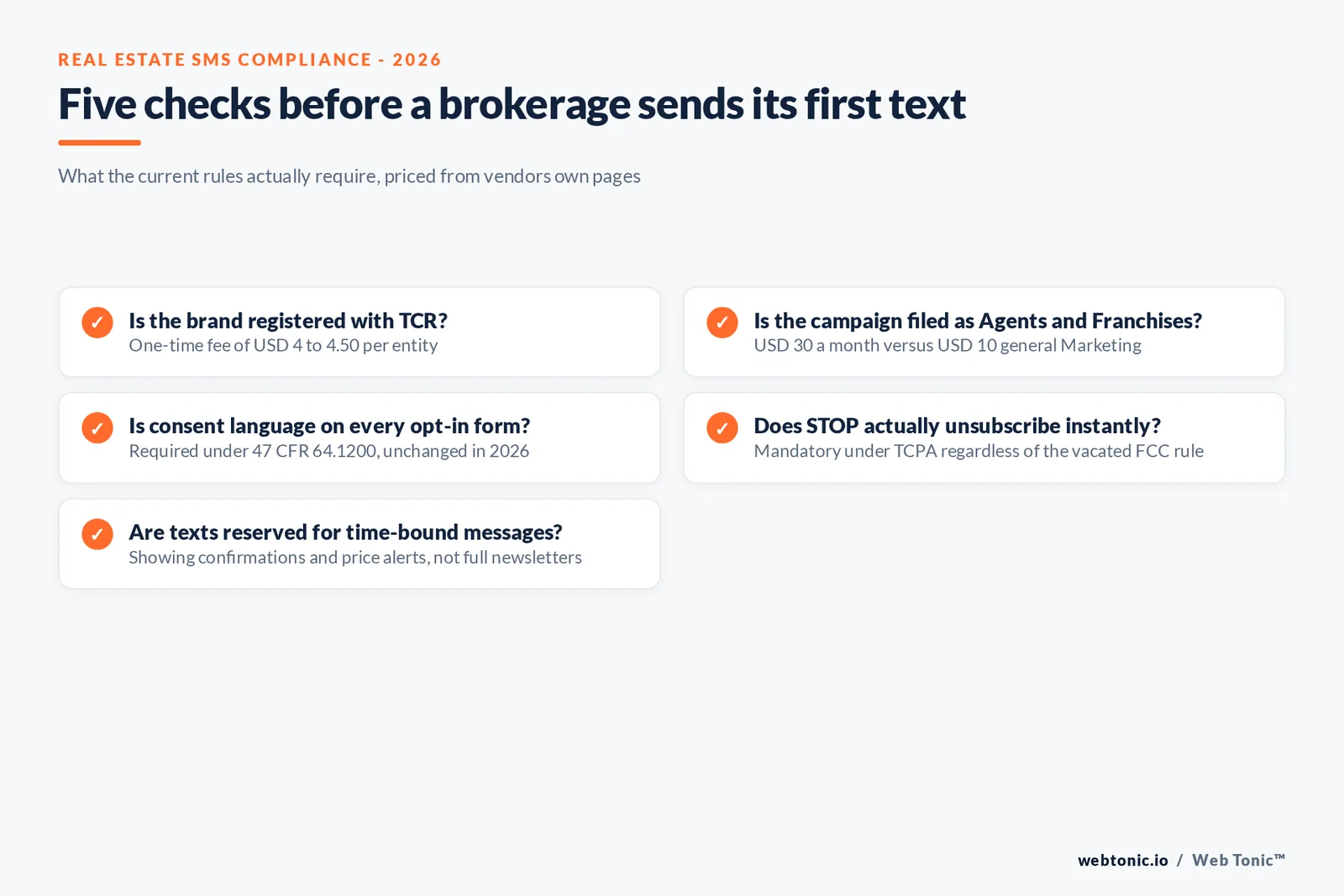
- TCR's brand registration fee is about USD 4 to 4.50, a one-time cost per entity.
- The "Agents and Franchises" 10DLC campaign fee is USD 30 a month per campaign.
- A general Marketing 10DLC campaign fee is USD 10 a month, a third of the agents rate.
- CSP registration itself costs USD 200, a one-time platform-level fee.
- The FCC's one-to-one consent rule was vacated in January 2025 and is not in force.
- TCPA (47 CFR 64.1200) still governs consent and quiet hours regardless of that vacatur.
- NAR reports a median 10-week buyer search - the practical window SMS follow-up has to work inside.
- 88% of buyers and 91% of sellers used an agent for their last transaction (NAR 2025).
- 68% of agents use showing-scheduling tools, the closest existing habit to time-sensitive texting.
- Additional SimpleTexting credits cost 5.5 cents each once the monthly allotment runs out.
- An extra SimpleTexting user seat costs USD 20 a month; an extra number costs USD 10 a month.
What sending a text actually costs, per message
Twilio's own pricing page lists USD 0.0083 per outbound SMS segment on a US long code (the same rate on toll-free and short code numbers), with inbound priced identically and MMS at USD 0.022 outbound. A failed-message fee of USD 0.001 applies only to messages that terminate in a failed state. That is the raw API rate a brokerage pays if it builds texting into its own CRM rather than buying a managed platform.
Most teams do not build on raw API pricing - they buy a managed sender, which bundles the per-message cost into a credit-based plan and adds compliance tooling on top.
| Rate (2026, US) | Price | Applies to | Source |
|---|---|---|---|
| Outbound SMS, long code | USD 0.0083/segment | Standard business texting | Twilio |
| Outbound MMS, long code | USD 0.022/message | Picture messaging | Twilio |
| Failed message fee | USD 0.001 | Messages that fail to deliver | Twilio |
| Carrier pass-through (typical) | ~USD 0.0025/message | US carrier surcharge, not marked up | SimpleTexting |
Managed platform plans, priced by the vendors themselves
SimpleTexting's own pricing page starts a local-number plan at USD 39 a month for 500 credits (USD 398.40 billed yearly), plus a one-time USD 4 carrier registration fee. Extra credits cost 5.5 cents each, an additional user seat is USD 20 a month, and an additional number is USD 10 a month. EZ Texting's own pricing page lists Launch at USD 25 a month (USD 20 annual) for up to 500 contacts with 500 monthly credits, Boost at USD 75 a month (USD 60 annual) for 500 to 2,000 contacts, and Scale at USD 125 a month (USD 100 annual) for 2,000 to 50,000 contacts, with overage credits priced from USD 0.04 down to USD 0.03 as plans scale up.
| Plan | Monthly price | Annual price | Included credits | Source |
|---|---|---|---|---|
| SimpleTexting entry (local number) | USD 39 | USD 398.40/yr | 500 credits | simpletexting.com |
| EZ Texting Launch | USD 25 | USD 20/mo billed annual | 500 credits/month | eztexting.com |
| EZ Texting Boost | USD 75 | USD 60/mo billed annual | 500 credits/month | eztexting.com |
| EZ Texting Scale | USD 125 | USD 100/mo billed annual | 500 credits/month | eztexting.com |
| EZ Texting Enterprise | USD 3,000 | USD 3,000 | 200k credits/month | eztexting.com |
The registration cost nobody prices upfront: 10DLC
Every business sending application-to-person SMS in the US now registers through The Campaign Registry. TCR's own Fees and Pricing guide (last updated August 2026) lists a one-time brand registration fee of USD 4.00 to 4.50 depending on entity type, and recurring monthly campaign fees that vary by use case. A general Marketing campaign runs USD 10 a month; the "Agents and Franchises" use case runs USD 30 a month per campaign - three times the general marketing rate, and the use case that fits most brokerage and franchised-office structures. CSP-level registration (the platform's own account setup) is a separate USD 200 one-time fee, usually absorbed by the platform rather than billed to each team.
None of these figures come from a texting platform's marketing page - they are on TCR's own fee schedule, the actual registry that carriers check before letting a message through.
| 10DLC fee (TCR, 2026) | Amount | Frequency | Notes |
|---|---|---|---|
| Brand registration (private/public profit) | USD 4.50 | One-time | Per legal entity |
| Brand registration (sole proprietor) | USD 4.00 | One-time | Includes OTP identity check |
| CSP registration | USD 200 | One-time | Usually absorbed by the platform |
| Marketing use case | USD 10/month | Recurring | General promotional campaigns |
| Agents and Franchises use case | USD 30/month | Recurring | Fits multi-agent/franchised structures |
What the law actually requires - and what it no longer does
The Telephone Consumer Protection Act (47 U.S.C. 227, via Cornell LII) and its implementing rule at 47 CFR 64.1200 require prior consent for marketing texts, enforce quiet hours, and mandate a working STOP opt-out. That layer is unchanged and still applies to every brokerage text sent in the US.
What changed is narrower: the FCC's 2023 "one-to-one consent" rule, which would have required a separate opt-in for each individual sender rather than a shared consent, was vacated by the Eleventh Circuit in January 2025 in Insurance Marketing Coalition v. FCC (opinion, 11th Cir. No. 24-10277). Coverage of the ruling from law firms including Venable is consistent: the rule is vacated, not merely delayed, and should not be described as in force. Industry-wide messaging conduct is still shaped by the CTIA Messaging Principles and Best Practices, which carriers use to police A2P traffic independent of any single FCC rule.
| Rule | Status in 2026 | What it requires | Source |
|---|---|---|---|
| TCPA, 47 U.S.C. 227 | In force | Prior consent for marketing calls/texts | Cornell LII |
| 47 CFR 64.1200 | In force | Quiet hours, opt-out (STOP), consent record-keeping | eCFR |
| FCC one-to-one consent rule (2023) | Vacated Jan 2025 | Would have required per-sender consent | 11th Circuit / Venable |
| CTIA Messaging Principles | Active industry standard | Carrier-level filtering criteria for A2P texting | CTIA |
Why the "98% open rate" claim does not belong in this article
None of the vendor pages reviewed for this piece - Twilio, SimpleTexting, EZ Texting - publish an SMS open-rate methodology, because there is no read receipt equivalent to an email open pixel for standard SMS. The widely circulated "98% open rate" and "90% read within three minutes" figures are repeated across marketing content without a named, dated study behind them. The defensible claim is narrower: delivery is fast and reply windows are short, which is a behavioral argument for using SMS for time-bound events, not a precise percentage to quote to a broker.
Where texting fits the real estate follow-up window
NAR's 2025 Profile of Home Buyers and Sellers puts the median buyer search at 10 weeks, with 88% of buyers and 91% of sellers working with an agent through that window. NAR's 2026 Technology Report separately shows 68% of agents already use showing-scheduling tools - the closest existing habit to the kind of time-sensitive, single-line message SMS is built for. A showing confirmation, a price-drop alert or an offer-deadline reminder fits a text; a market update or a listing description does not, and belongs on email or the agent's own site instead. Our creative team treats channel fit, not raw send volume, as the first filter for any SMS program.
Sizing a text program against a brokerage's own contact list
A useful budgeting exercise is to size credits against the transaction, not against a flat monthly guess. NAR's own 88% buyer/91% seller agent-attach rates mean a ten-agent brokerage closing forty transactions a month is realistically texting well under a thousand contacts a month once past clients and referral sources are added in - a volume that sits inside SimpleTexting's or EZ Texting's entry tier, not their mid-tier plans. Overbuying credits "just in case" is the most common way a brokerage pays for a plan two sizes larger than its actual list ever needs, and the fix is simply counting active leads before choosing a tier rather than after the first invoice arrives. Our data practice runs that sizing exercise before recommending any platform swap.
| Team size (agents) | Realistic monthly active contacts | Fitting SimpleTexting tier | Fitting EZ Texting tier |
|---|---|---|---|
| 1-2 agents | Under 500 | Entry local-number plan | Launch |
| 3-5 agents | 500-2,000 | Entry plan plus extra credits | Boost |
| 6-15 agents | 2,000-7,500 | Custom plan, talk to sales | Scale |
Frequently Asked Questions
How much does a text message cost a real estate team?
On the API side, Twilio's own pricing page lists USD 0.0083 per outbound SMS segment on a long code in the United States, plus a USD 0.001 failed-message fee. On a managed platform, SimpleTexting's own pricing starts at USD 39 a month for 500 credits with a local number, plus a one-time USD 4 carrier registration fee and roughly USD 0.0025 in carrier pass-through cost per message, which the platform states it does not mark up.
What is 10DLC and does a brokerage have to register?
10DLC (10-digit long code) is the US carriers' registration system for application-to-person texting, run by The Campaign Registry. TCR's own fee schedule lists a one-time brand registration fee of roughly USD 4 to 4.50 depending on entity type, plus a recurring per-campaign fee - USD 10 a month for a general Marketing use case, or USD 30 a month for the 'Agents and Franchises' use case that fits most brokerage and team structures. Skipping registration risks carrier filtering, not a fine.
Is the FCC's one-to-one consent rule for texting in effect?
No. The FCC's 2023 one-to-one consent rule, which would have required a separate opt-in per sender, was vacated by the Eleventh Circuit in Insurance Marketing Coalition v. FCC (January 24, 2025). The underlying TCPA (47 U.S.C. 227, via Cornell LII) and its implementing rules at 47 CFR 64.1200 remain in force - consent, quiet hours and STOP-based opt-out still apply - but the stricter one-to-one standard does not.
Do the viral '98% open rate' texting stats hold up?
Treat them as unsourced. No platform in this research publishes an open-rate methodology for SMS the way email platforms do, because read receipts are not tracked the way email pixels are. The figure is widely repeated in marketing content without an underlying study; the honest claim is that SMS delivery is fast and read quickly, not a precise percentage.
What should a brokerage text about, versus email?
NAR's 2026 Technology Report shows agents already lean on quick, time-bound communication - 68% use showing-scheduling tools and 52% of AI users apply it to follow-up messages. Texting fits the same logic: showing confirmations, price-drop alerts and time-sensitive offer updates, where a same-day reply matters, while longer nurture content stays on email.
Sources
Twilio SMS pricing, United States (vendor page)
SimpleTexting pricing (vendor page)
EZ Texting pricing (vendor page)
The Campaign Registry, Fees and Pricing (2026)
47 U.S.C. 227 (TCPA), Cornell LII
47 CFR 64.1200, eCFR
Venable: Eleventh Circuit vacates FCC one-to-one consent rule
CTIA Messaging Principles and Best Practices
NAR 2025 Profile of Home Buyers and Sellers
NAR 2026 REALTORS Technology Report
Web Tonic performance creative services
Web Tonic: SMS marketing statistics hub