Table of contents

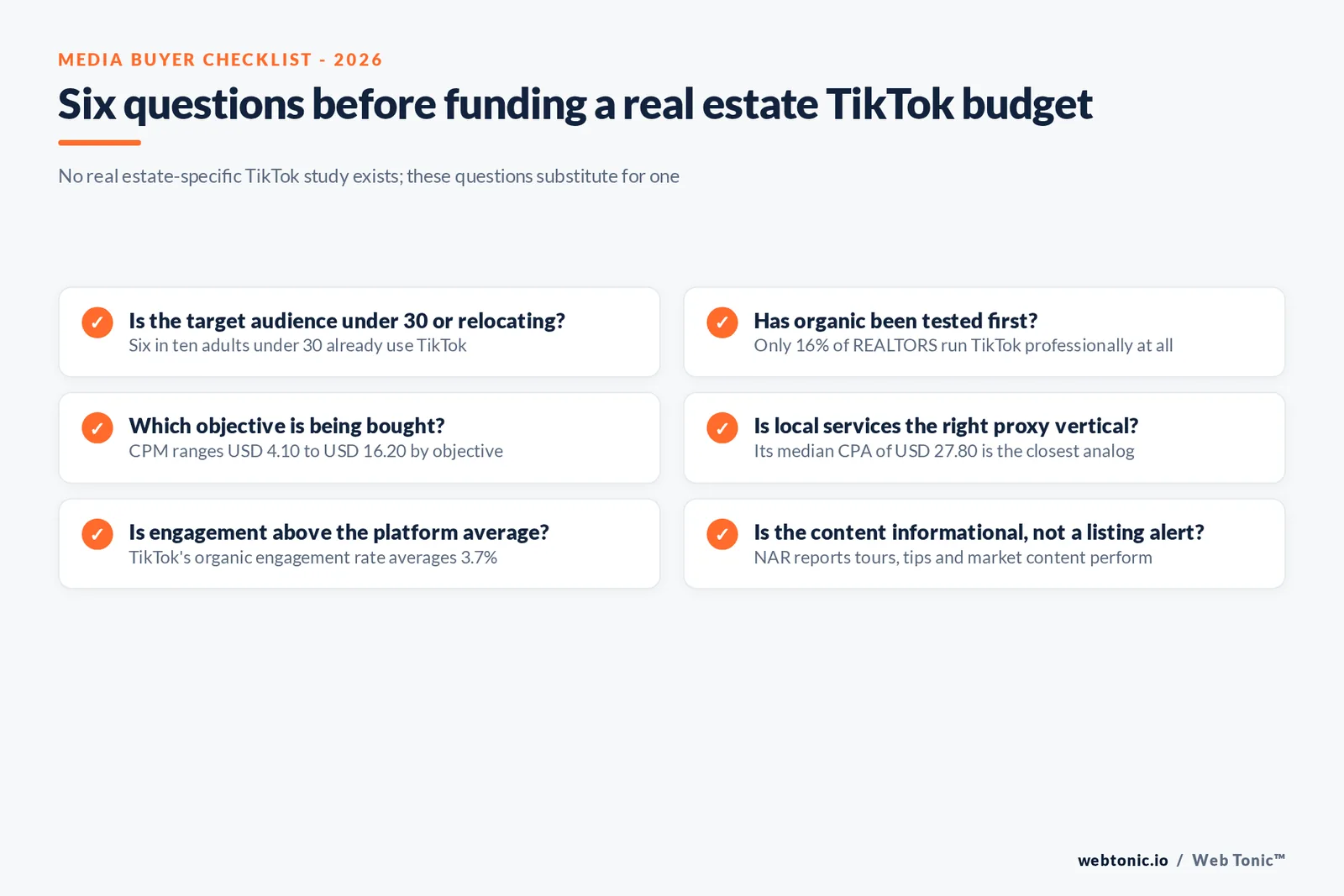
No published benchmark prices TikTok ad campaigns specifically for real estate, so this page builds the budget from two honest inputs: cross-industry 2026 TikTok cost data, and NAR's real numbers on who in real estate is actually using the platform. The short version: TikTok is a minority channel for agents (16% professional adoption) reaching a majority audience among under-30 buyers, which makes it a targeted bet, not a default line item.
Key Takeaways
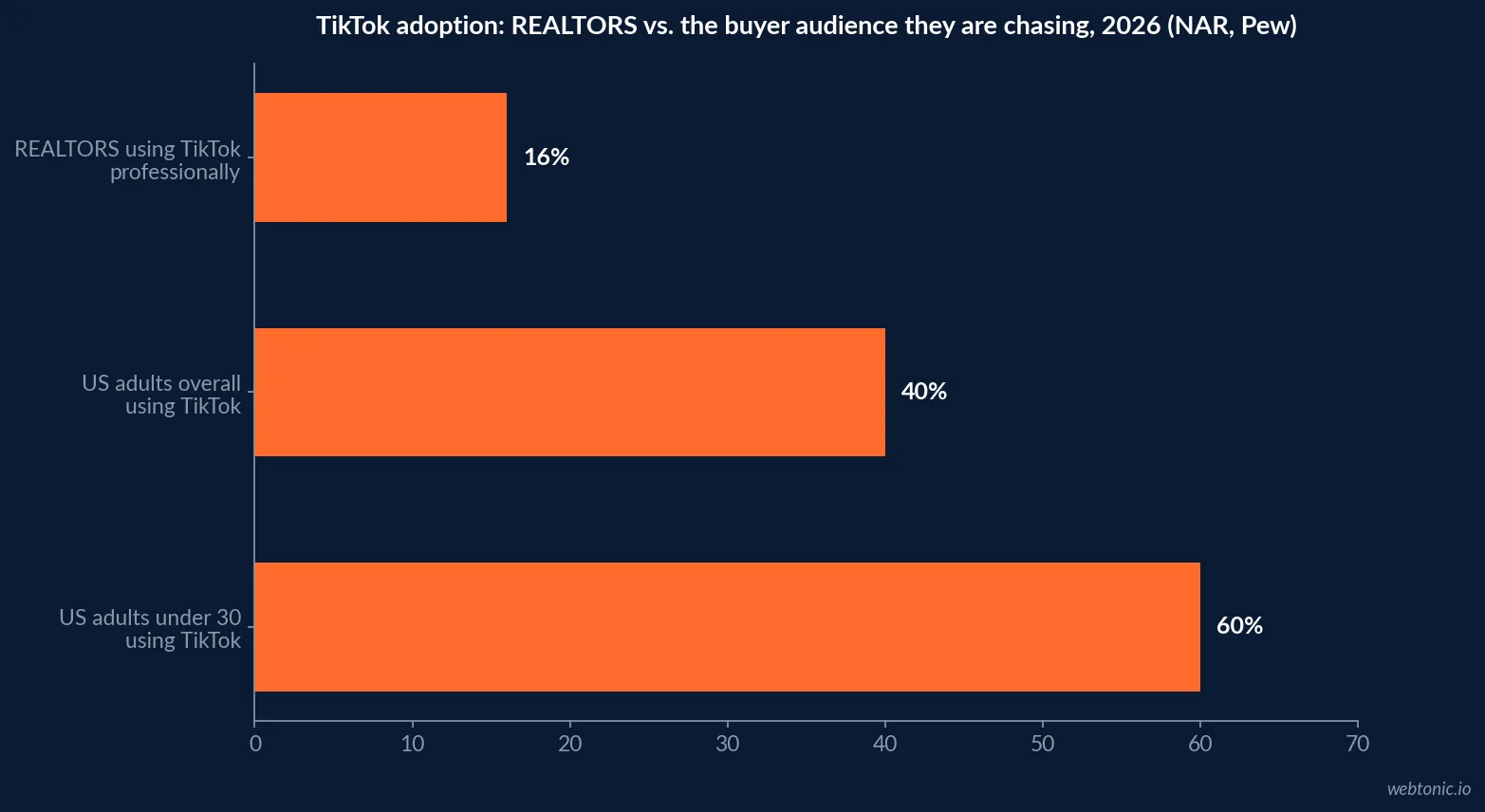
- Only 16% of REALTORS report using TikTok professionally.
- That compares with 87% on Facebook and 62% on Instagram.
- An earlier NAR survey put professional TikTok use even lower, at 15%.
- Roughly 40% of US adults use TikTok, per Pew Research data cited by NAR.
- Usage rises to about six in ten adults under 30.
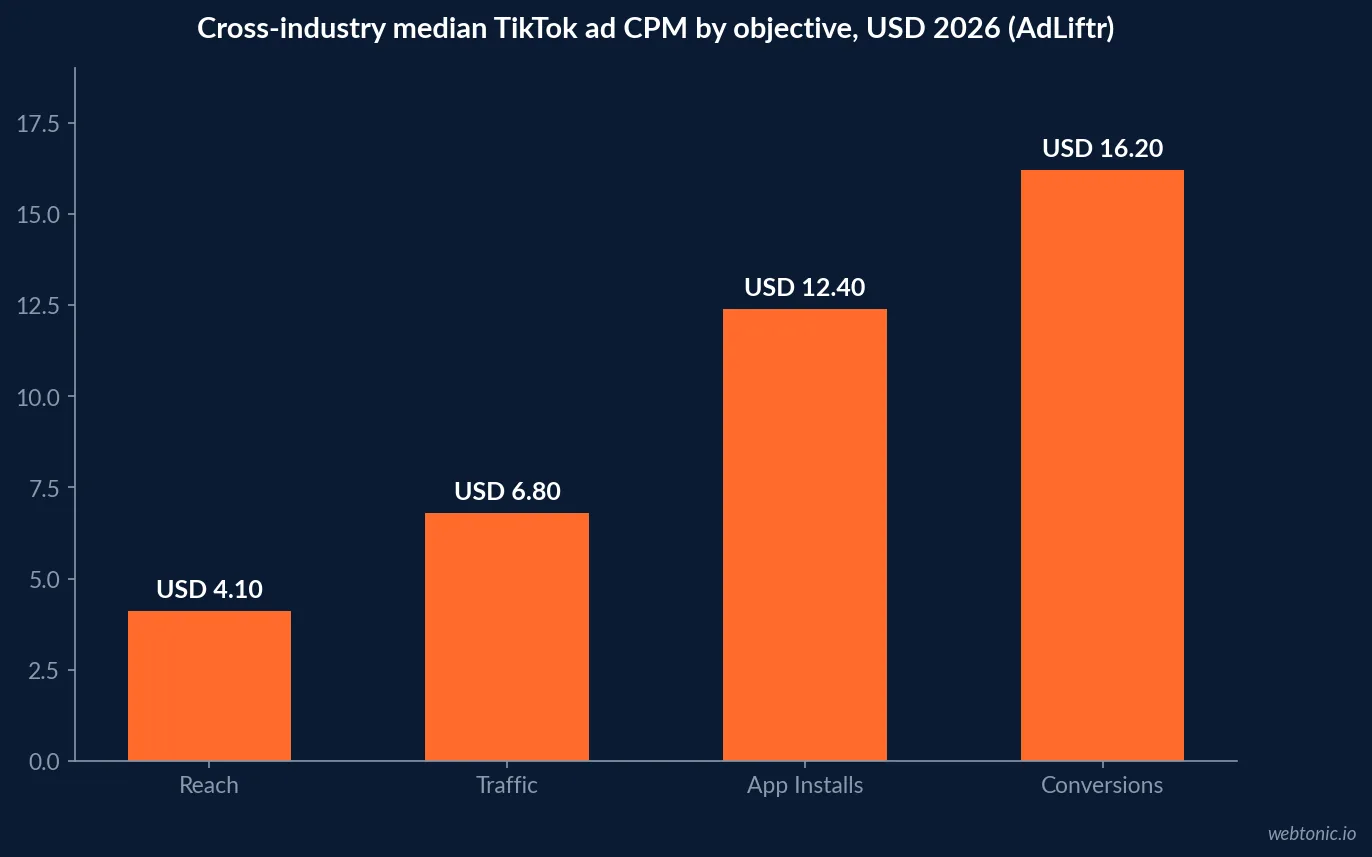
- Median cross-industry TikTok CPM for Reach objectives is $4.10 in 2026.
- Traffic-objective CPM rises to $6.80; Conversions to $16.20.
- App Install CPM sits at $12.40 in the same 2026 dataset.
- Median cross-industry TikTok CPC across all objectives is $0.62.
- The interquartile CPC range runs from $0.38 to $1.04.
- Local services, the closest proxy vertical, carries a median CPA of $27.80.
- TikTok's average organic engagement rate is 3.7%, per Sprout Social.
- Only 26% of marketers overall report using TikTok in their strategy.
- TikTok's own research with Dentsu reports a short-term ROI of 11.8.
- 75% of advertisers in that study saw their highest ROI on TikTok among channels tested.
- 36% of consumers say they turn to TikTok when ready to make a social purchase.
Why there is no real estate TikTok ads benchmark
Search advertising has category-level real estate data because platforms like Google and Microsoft carry enough real estate ad volume for a vendor such as LocalIQ to segment by subcategory. TikTok's ad volume, by contrast, is concentrated in DTC ecommerce, mobile apps and subscription media. AdLiftr's 2026 benchmark, built from 3,127 campaigns and $18.7M in ad spend across 548 advertisers, breaks results into six verticals - DTC beauty, DTC apparel, DTC food and beverage, DTC health, mobile apps, local services, B2B SaaS lead-gen and media/publishing - and real estate is not one of them.
That absence is itself a data point for a media buyer: the platform has not accumulated enough real estate spend for a vendor to justify a dedicated line, which tracks with NAR's finding that only 16% of agents use it at all.
| Metric | Cross-industry 2026 figure | Source |
|---|---|---|
| Median CPM, Reach objective | $4.10 | AdLiftr (3,127 campaigns) |
| Median CPM, Traffic objective | $6.80 | AdLiftr |
| Median CPM, App Installs objective | $12.40 | AdLiftr |
| Median CPM, Conversions objective | $16.20 | AdLiftr |
| Median CPC, all objectives | $0.62 | AdLiftr |
| CPC interquartile range | $0.38-$1.04 | AdLiftr |
The closest real proxy: local services
Of AdLiftr's named verticals, local services is the closest structural match to a residential agent's own brand and listing campaigns - geographically bound, high consideration, not a one-click purchase. Local services carried a median cost per acquisition of $27.80 in the 2026 dataset, better than Snapchat's equivalent figure but worse than Meta's for older audiences, per AdLiftr's own framing. That number should inform a media buyer's expectations, not be quoted to a client as "the real estate TikTok CPA" - it is a proxy from an adjacent vertical, not a real estate figure.
| Adjacent vertical (AdLiftr 2026) | Median CPA | Why it is the closest proxy |
|---|---|---|
| Local services (US) | $27.80 | Geographic, high-consideration, not one-click |
| B2B SaaS lead-gen | $38.40 | High consideration, longer sales cycle |
| Media/publishing (subscriptions) | $8.10 | Content-discovery algorithm fit |
| DTC beauty & cosmetics | $12.80 | Best-performing major DTC vertical, not comparable |
Who is actually on the platform, by adoption and age
The demand side of the budget question is about audience overlap, not cost. NAR's own article on the platform, "Why Real Estate Pros May Not Want to Overlook TikTok," cites Pew Research figures putting TikTok use at roughly 40% of US adults overall, rising to about six in ten among adults under 30. Meanwhile only 16% of REALTORS use the platform professionally, per NAR's 2026 Member Profile - a gap between where the audience already is and where most agents have shown up.
That gap is the actual budget argument for TikTok in real estate: not that it converts better than Facebook broadly, but that it reaches a first-time-buyer and relocation audience that most competing agents are not yet advertising to.
| Group | TikTok usage | Source |
|---|---|---|
| US adults overall | ~40% | Pew Research, via NAR |
| US adults under 30 | ~60% (six in ten) | Pew Research, via NAR |
| REALTORS, professional use (2026 Member Profile) | 16% | NAR |
| REALTORS, professional use (prior technology survey) | 15% | NAR |
| REALTORS on Facebook, for comparison | 87% | NAR |
Who is actually scrolling when the ad shows up
The audience a real estate TikTok budget reaches skews younger than the platform's overall base suggests at first glance. Statista's TikTok topic data puts the 18-24 age band at 30.7% of users and the 25-34 band at 35.3%, together accounting for two-thirds of the platform. Compare that with NAR's separate finding that the median age of a first-time home buyer is now 40, and the mismatch is obvious: most of a real estate TikTok audience is not yet the median buyer, which is exactly why the content that performs is educational and aspirational rather than a direct listing pitch aimed at someone ready to sign today.
| TikTok age band | Share of users (2026) | Real estate relevance |
|---|---|---|
| 18-24 | 30.7% | Renters, early research, education content |
| 25-34 | 35.3% | Approaching first-time buyer years, highest-value segment |
| 35-44 | 16.4% | Closer to repeat-buyer and move-up audience |
| 45-54 | 9.2% | Smaller reach, lower priority for this platform |
| 55 and above | 8.4% | Smallest reach on TikTok specifically |
Organic first, paid second
With adoption this low, most agents have not built the organic library a paid campaign normally boosts. Sprout Social's 2026 data puts TikTok's average organic engagement rate at 3.7%, ahead of most other platforms, and separately finds only 26% of marketers overall are using TikTok in their strategy at all. TikTok's own research with Dentsu reports a short-term ROI of 11.8 and 75% of advertisers in that study achieving their highest ROI on TikTok compared with other channels - numbers a media buyer should treat as directional and platform-sourced rather than a guarantee, but consistent with the low-competition argument above.
Timing the test around relocation seasonality
Relocation and first-time-buyer search activity is not evenly distributed across the year, which matters for a media buyer trying to make a small TikTok test budget count. Lease and moving activity concentrates around the summer months in most US markets, driven by school calendars, and a first content push timed six to eight weeks ahead of that window gives organic video time to accumulate views before a paid boost is layered on. A test that launches in a slow season risks reading as a platform failure when the real issue is timing against a dataset - AdLiftr's local-services CPA proxy of USD 27.80 - that was not built around a seasonal business in the first place.
| Budget phase | Suggested spend share | Objective | Success signal |
|---|---|---|---|
| Month 1: organic only | 0% paid | Build a video library | Engagement above the 3.7% platform average |
| Month 2: light boost | 20-30% of test budget | Amplify proven organic hits | CPM near the USD 4.10-6.80 Reach/Traffic range |
| Month 3: scale winners | 70-80% of test budget | Drive leads on relocation content | CPA approaching the USD 27.80 local-services proxy |
Setting the actual budget
A defensible starting budget treats the AdLiftr local-services CPA of $27.80 as a ceiling to test against, not a target, spends the first month on organic content aimed at relocation and first-time-buyer education, and only adds paid boost once a handful of videos show engagement above the 3.7% platform average. Given how small the professional adoption base is, a modest test budget can still outreach most local competitors' current TikTok presence.
For the channel most agents already run well by comparison, our Facebook ads ROI analysis covers the more mature paid-social budget most teams already have in place. Our performance creative team can help build the organic library before any paid spend goes live - talk to us.
Frequently Asked Questions
Is there a real estate-specific TikTok ads benchmark?
No published study prices TikTok ad campaigns by real estate subcategory the way LocalIQ does for Google and Microsoft search. AdLiftr's 2026 dataset of 3,127 TikTok campaigns breaks results out by objective and by vertical - DTC ecommerce, mobile apps, local services, B2B SaaS - but real estate is not one of the named verticals. Local services is the closest analog for an agent's own listing and brand-awareness campaigns, and it should be treated as a proxy, not a real estate number.
Who is actually buying real estate TikTok ads?
Mostly agents chasing a younger, relocating or first-time buyer audience, not the median client. NAR reports only 16% of REALTORS use TikTok professionally, well behind Facebook's 87% and Instagram's 62%. But Pew Research data cited by NAR puts TikTok usage at roughly 40% of US adults overall and about six in ten among adults under 30 - the exact demographic overrepresented among first-time and relocating buyers.
What does TikTok advertising cost in 2026, broadly?
AdLiftr's aggregated 2026 data across 3,127 campaigns and $18.7M in spend puts median TikTok CPM at $4.10 for Reach objectives, $6.80 for Traffic, $12.40 for App Installs and $16.20 for Conversions, with a median CPC of $0.62 across all objectives. These are cross-industry figures, not real estate-specific, and should be treated as a floor a real estate campaign is unlikely to beat given the platform's B2C skew toward DTC ecommerce.
Should a residential agent run TikTok ads or an organic TikTok strategy?
The adoption gap suggests organic first for most agents. With only 16% of REALTORS using TikTok professionally at all, most competitors have not built an organic presence to advertise against, which lowers the bar for cheap organic reach before committing paid budget. Sprout Social's 2026 data separately shows TikTok's average organic engagement rate at 3.7%, higher than most other platforms, which supports testing organic video before paying to boost it.
Which real estate niches does TikTok fit best?
Relocation, first-time buyer education, and rental-market content aimed at renters under 30. NAR's own reporting on the platform notes real estate TikTok content skews toward property tours, mortgage and home-inspection tips, and neighborhood information - exactly the informational content a first-time or relocating buyer searches for before they are ready to contact an agent, rather than the bottom-of-funnel listing-alert content that performs better on Facebook.
Sources
AdLiftr - TikTok Ads Cost 2026: CPM, CPC, CPA Benchmarks
NAR - Why Real Estate Pros May Not Want to Overlook TikTok
NAR - The Feature Sheet: 2026 Member Profile
National Association of REALTORS - Technology Survey
Pew Research Center - Social Media Fact Sheet
Sprout Social - 46 TikTok Stats to Inform Your Strategy in 2026
Sprout Social - Social Media ROI Statistics 2026
Statista - TikTok, Statistics and Facts