Table of contents

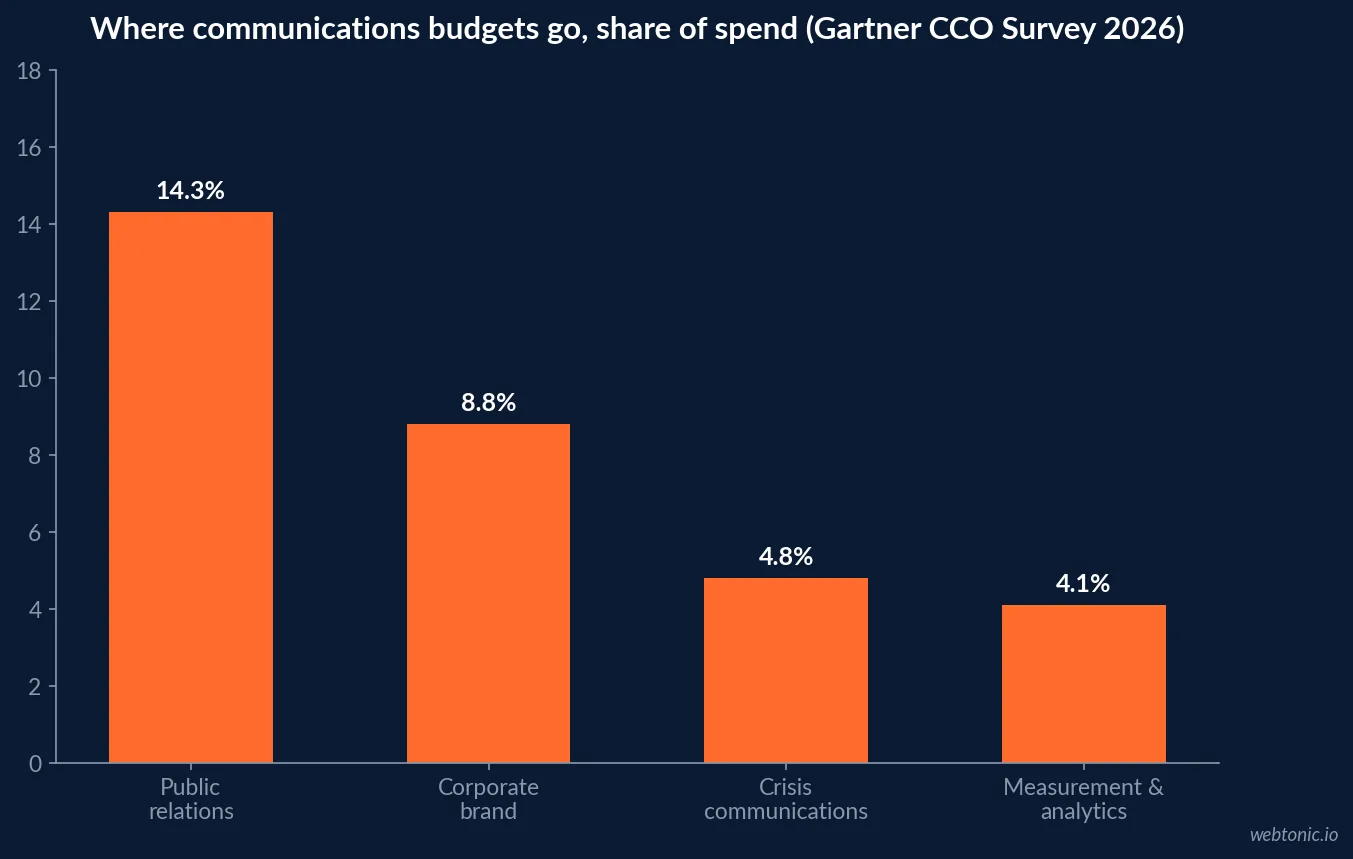
Gartner's 2026 CCO Spend Survey puts public relations at 14.3% of the average communications budget — the single largest line item, ahead of corporate brand and crisis communications. This page turns that and eight other named 2026 studies into a budget an agency can actually defend to a client.
Key Takeaways
- Public relations takes 14.3% of the average comms budget in 2026.
- Corporate brand takes another 8.8%, crisis communications 4.8%.
- Overall communications spend runs near 0.5% of company revenue at most firms.
- 46% of chief communications officers report a 2026 budget cut.
- 44% say their function lacks the budget to execute its strategy.
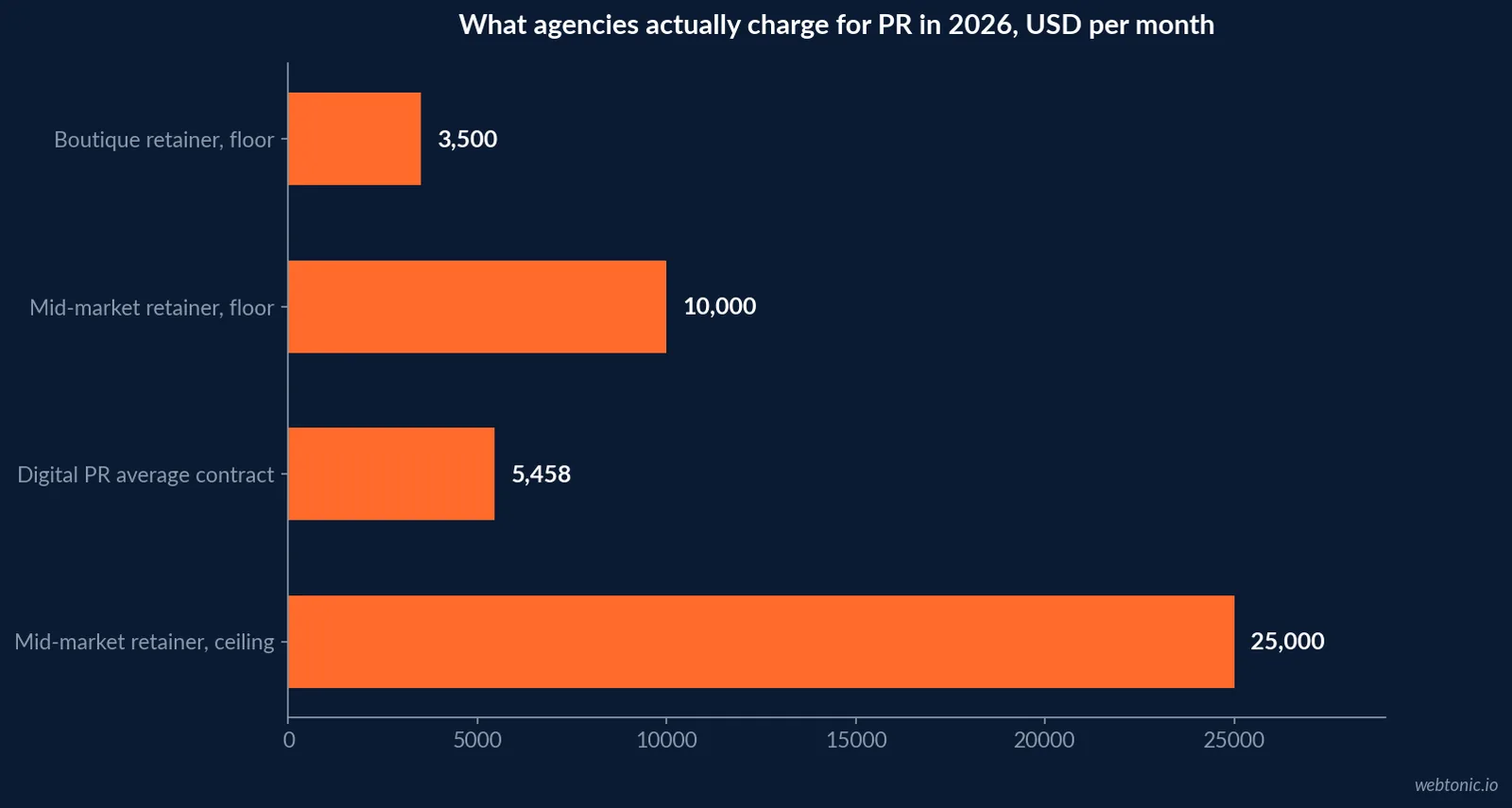
- Boutique PR retainers run USD 3,500 to 25,000 a month.
- Mid-market programs run USD 10,000 to 25,000 a month.
- Tier-one global agencies start at USD 50,000 and scale past USD 250,000.
- Digital PR averages USD 5,458 a month, billed more on outcomes than time.
- Global PR agency revenue reached USD 75.1 billion in 2026.
- PRWeek recorded 3% global agency revenue growth, 1% in the US.
- 57% of journalists now get 50-plus pitches a week.
- 86% of journalists reject a pitch that misses their beat.
- 84% of journalists still welcome a no-story introductory email.
- GenAI communications spend is forecast to rise 54% year on year.
- Measurement and analytics get only 4.1% of the comms budget, up from 2.9%.
- 82% of communications leaders say their strategy must evolve quickly.
The 2026 baseline: what a comms budget actually looks like
Before setting a PR number, an agency needs the shape of the whole communications budget it sits inside. Gartner's 2026 CCO Spend Survey, covering 200 senior communications decision-makers at firms with at least USD 1 billion in revenue, found labour absorbs 40.3% of the typical communications budget, agencies and services 23%, operational costs 17.3%, and technology 16.8%. Most organisations spend around 0.5% of revenue on communications overall, with smaller firms spending a higher share and very large ones benefiting from scale.
That agencies-and-services line is where an outside PR retainer competes for budget against creative, translation and event spending — which is exactly why Gartner frames 2026 as a reallocation year, not a growth year.
| Comms budget line (2026) | Share of spend | Source | Agency implication |
|---|---|---|---|
| Labour (in-house staff) | 40.3% | Gartner CCO Spend Survey | The floor the outside retainer competes against |
| Agencies and services | 23% | Gartner CCO Spend Survey | Where a PR retainer physically sits |
| Operational costs | 17.3% | Gartner CCO Spend Survey | Events, travel, production — first to be trimmed |
| Communications technology | 16.8% | Gartner CCO Spend Survey | Rising 35% of leaders plan to increase it |
| Public relations | 14.3% | Gartner CCO Spend Survey | Largest single external-facing line item |
Why PR is growing while the rest of the budget shrinks
Gartner's survey reports that 46% of chief communications officers had their current-year forecast cut for company-wide cost reasons, and 44% say their function lacks the budget to execute its strategy. Yet PR and corporate brand still command the largest shares of what is left, because the same survey ties reputation management to how large language models now surface and cite companies — a fight over what Gartner calls “answer engine visibility.” 82% of communications leaders say their strategy needs to evolve rapidly to keep up.
That is a structural argument for holding the PR line even in a flat-to-down year: cutting it to fund a new martech seat is, per Gartner's own recommendation, the trade the survey explicitly warns against.
| Budget pressure signal (2026) | Figure | Source | What it means for the PR line |
|---|---|---|---|
| CCOs reporting a budget cut | 46% | Gartner CCO Spend Survey | Expect a defence of the number, not an increase |
| CCOs saying budget can't fund strategy | 44% | Gartner CCO Spend Survey | Scope has to be prioritised, not padded |
| Leaders who see comms needing to evolve fast | 82% | Gartner CCO Spend Survey | AI-search visibility now competes for the PR budget |
| GenAI comms spend growth, year on year | 54% | Gartner CCO Spend Survey | New spend, not a straight PR-vs-AI trade-off |
| Measurement and analytics allocation | 4.1% | Gartner CCO Spend Survey | Still underfunded against marketing's 8% |
What agencies are actually charging clients
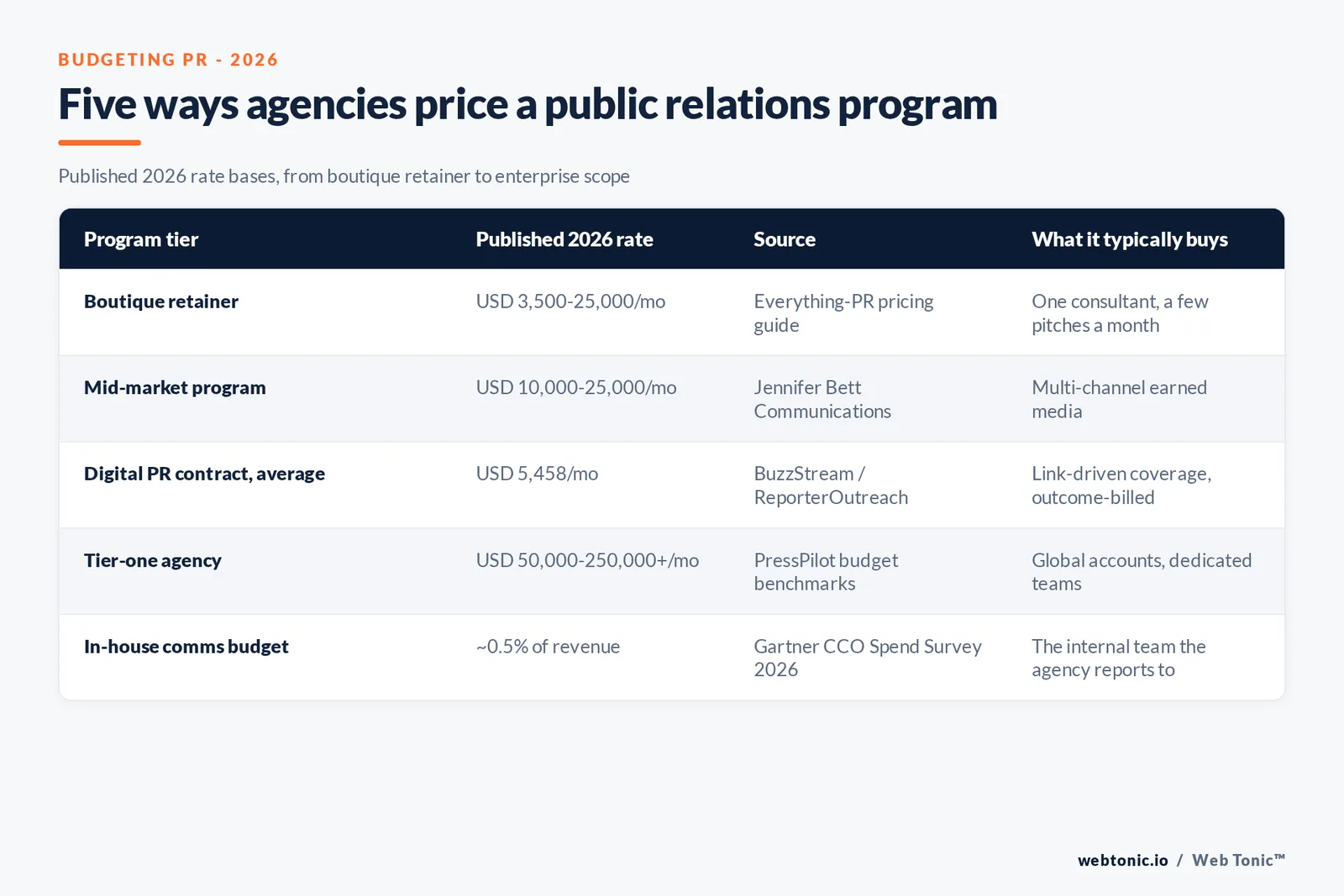
On the vendor side, Jennifer Bett Communications' 2026 pricing guide puts a boutique retainer at USD 5,000 to 10,000 a month for early-stage or niche accounts and a mid-market program at USD 10,000 to 25,000 for funded, multi-channel work. PressPilot's stage-based benchmarks add the top end: tier-one agencies such as Edelman or Weber Shandwick start at USD 50,000 and scale to USD 250,000-plus for global accounts. Digital-PR specifically, which Reporter Outreach's 2026 retainer benchmarks price against BuzzStream's dedicated survey, averages USD 5,458 a month and increasingly bills for placements rather than hours.
The spread is wide because the deliverable is not standard. A boutique retainer buys a relationship with a handful of trade reporters; a tier-one retainer buys a crisis-ready global team on permanent standby.
| Program tier | Published 2026 monthly rate | Source | Typical buyer |
|---|---|---|---|
| Boutique / early-stage | USD 5,000–10,000 | Jennifer Bett Communications | Pre-seed to seed startups |
| Mid-market | USD 10,000–25,000 | Jennifer Bett Communications | Series A/B, multi-channel programs |
| Digital PR (outcome-billed) | USD 5,458 average | Reporter Outreach / BuzzStream | Link-driven, SEO-adjacent coverage |
| Tier-one / global | USD 50,000–250,000+ | PressPilot | Late-stage, IPO prep, enterprise |
The industry the budget is buying into
IBISWorld's 2026 industry analysis puts global public relations agency revenue at USD 75.1 billion, expanding at a 4.6% CAGR through the year with growth accelerating to 7.1%. That growth is uneven at the agency level: PRWeek's 2026 Agency Business Report recorded total agency revenue up 3% globally and only 1% in the US, as AI adoption and agency consolidation reshape the sector faster than headline revenue is growing.
For a client, that gap between industry-level growth and individual-agency revenue growth is a useful negotiating fact: budget increases are not automatically buying more capacity at the same firm.
| Market fact (2026) | Figure | Source | Reading for the budget |
|---|---|---|---|
| Global PR agency revenue | USD 75.1 billion | IBISWorld | The industry a retainer buys into |
| Industry CAGR through 2026 | 4.6%, accelerating to 7.1% | IBISWorld | Demand is not slowing |
| Global agency revenue growth, 2025-26 | 3% | PRWeek Agency Business Report | Slower than industry-level growth |
| US agency revenue growth, 2025-26 | 1% | PRWeek Agency Business Report | Consolidation is squeezing margins |
What the budget is actually paying reporters to do
The other half of the budget question is whether the pitching it buys still lands. Cision's 2026 State of the Media Report, surveying more than 1,800 journalists globally, found 57% now receive 50 or more pitches a week and 86% will reject one that lacks relevance to their beat. The same report found journalists are not closed to outreach: 84% welcome a simple introductory email with no story attached, and 79% say they engage more with a pitch backed by compelling data.
That reframes what a monthly retainer is buying: not volume of outreach, but the research and targeting that makes each pitch worth one of a reporter's shrinking attention slots.
| Journalist behaviour (2026) | Figure | Source | Budget implication |
|---|---|---|---|
| Journalists receiving 50+ pitches a week | 57% | Cision State of the Media | Volume-based pitching is wasted spend |
| Journalists rejecting off-beat pitches | 86% | Cision State of the Media | Pay for targeting, not distribution |
| Journalists open to a no-story intro email | 84% | Cision State of the Media | Relationship-building still has ROI |
| Journalists favouring data-backed pitches | 79% (47% want compelling data) | Cision State of the Media | Original research is worth budgeting for |
| Journalists citing misinformation as top challenge | 50% | Cision State of the Media | Accurate, sourced pitches build long-term trust |
Setting the number for a specific account
Put together, the defensible process is: start from Gartner's 14.3% comms-budget share as a sanity check against the client's total marketing spend, then price the actual program against the stage-based tiers above rather than a flat percentage. A seed-stage brand rarely needs more than a boutique retainer; a firm mid-raise or entering a new market is closer to the mid-market tier; and a firm managing reputation risk across markets is the one client that should be quoted at tier-one rates.
Whatever the number, tie a portion of it to the research and data work Cision's journalists say they actually want — our growth marketing team builds that kind of first-party data alongside PR programs, our agency overview covers how that work is staffed, and our breakdown of what paid channels cost is a useful cross-check when a client asks why earned media isn't free. A quick call is the fastest way to size a program against a specific account.
The AI-search wrinkle no 2026 PR budget can skip
The USC Annenberg 2026 Global Communication Report found 81% of PR professionals rate political and social polarisation as high or extremely high, against 69% of the general public — a gap that is pushing more of the budget toward careful, sourced statements rather than reactive commentary. Combined with Gartner's finding that PR is now expected to support answer-engine visibility, the 2026 budget increasingly has to fund two jobs at once: the traditional media list and a defensible, citable body of owned content.
Agencies that quote PR as a single undifferentiated retainer line are underselling both halves of that job. Split the quote, and the client can see exactly what the 14.3% figure is actually buying.
Frequently Asked Questions
How much of a marketing budget should go to public relations in 2026?
There is no universal rule, but Gartner's 2026 CCO Spend Survey found public relations takes the single largest slice of a communications budget at 14.3%, ahead of corporate brand at 8.8% and crisis communications at 4.8%. Communications overall runs close to 0.5% of company revenue at most organisations, so PR alone lands around 0.07% of revenue at the median firm surveyed. Agencies planning a client's PR line should treat that figure as a floor for a functioning program, not a ceiling for an ambitious one.
What does a PR retainer actually cost in 2026?
Published 2026 pricing guides cluster around three tiers: boutique retainers from USD 3,500 to 25,000 a month, mid-market programs from USD 10,000 to 25,000, and tier-one global agencies from USD 50,000 up to 250,000-plus for a full account team. Digital PR, which is billed more on outcomes than time, averages USD 5,458 a month according to BuzzStream's dedicated 2026 pricing survey, with agencies charging roughly 50% more than solo freelancers for comparable scope.
Why is PR budget growing faster than other communications line items in 2026?
Gartner's CCO Spend Survey attributes it to reputation risk and AI-mediated discovery: 46% of chief communications officers report a budget cut this year, yet PR and corporate brand still absorbed a growing share of what remained, because large language models are changing how audiences find and trust information. The survey's own language is that earned media now supports "answer engine visibility," not just press coverage, which is why the recommended move is reallocating from paid media toward owned and earned content rather than cutting PR to fund it.
Are journalists actually responding to pitches PR budgets pay for?
Cision's 2026 State of the Media Report, based on a global survey of more than 1,800 journalists, found 57% now receive 50 or more pitches a week and 86% will reject one that is not relevant to their beat. The same report found 84% are still open to an introductory email with no story attached, and 79% engage more with pitches backed by data. That is the return a PR budget is actually buying: fewer, better-targeted pitches, not a higher volume of outreach.
Should a startup budget the same PR line as an enterprise account?
No. PressPilot's 2026 stage-based benchmarks put seed-stage PR spend at USD 5,000 to 10,000 a month, Series B and growth-stage programs at USD 20,000 to 50,000, and enterprise accounts with tier-one agencies such as Edelman or Weber Shandwick starting at USD 50,000 and scaling past USD 250,000 for global coverage. The budget should track the number of markets and the seniority of the media list being worked, not a flat percentage of revenue.
Sources
Gartner (via Quantum PR) — 2026 CCO Spend Survey
PRWeek — Agency Business Report 2026
IBISWorld — Global Public Relations Agencies Industry Analysis 2026
Cision — 2026 State of the Media Report
USC Annenberg — 2026 Global Communication Report
Jennifer Bett Communications — How Much Does PR Cost in 2026
PressPilot — PR budget benchmarks by stage
Reporter Outreach — Digital PR Pricing: 2026 Retainer Benchmarks