Table of contents
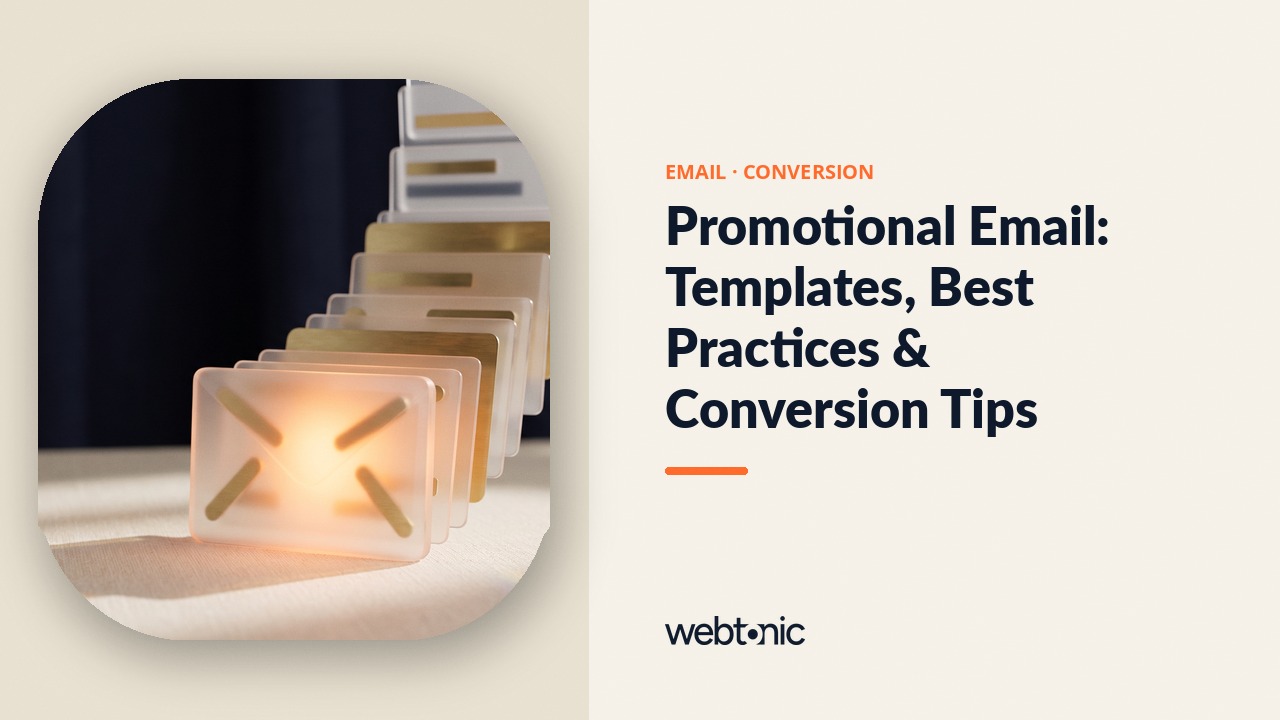
A well-crafted promotional email turns a quiet inbox into a revenue channel, driving purchases, signups, and engagement at a fraction of the cost of paid ads. The numbers back it up — email marketing delivers an average return of $36 for every $1 spent, and promotional campaigns account for the majority of that return when they are targeted, timed, and designed correctly.
Key Takeaways
- Email marketing ROI averages $36 per $1 spent, making it the highest-returning digital channel according to Litmus benchmark data.
- Promotional emails with personalized subject lines see 26% higher open rates than generic subject lines, per Campaign Monitor research.
- Cart abandonment emails recover 4–8% of lost revenue on average, with top performers reaching recovery rates above 15%.
- Segmented promotional campaigns generate 760% more revenue than one-size-fits-all blasts, according to data from the DMA.
- The optimal send frequency is 2–3 promotional emails per week — sending more increases unsubscribes by 34% without proportional revenue gains.
Promotional emails are the workhorses of email marketing strategy. Unlike transactional messages (order confirmations, password resets) or purely editorial newsletters, promotional emails exist to drive a specific action: buy a product, claim a discount, register for an event, or activate a trial. This guide covers the types of promotional emails that actually perform, proven templates you can adapt, and the data-backed practices that separate high-converting campaigns from inbox clutter. For broader marketing insights, explore the Web Tonic blog.
What Is a Promotional Email
A promotional email is any marketing message sent to subscribers with the primary goal of driving a commercial action — a purchase, signup, download, or event registration. It differs from transactional emails (triggered by user actions like purchases or password resets) and relationship emails (newsletters, updates, welcome sequences) in that its core purpose is conversion, not information or relationship-building.
Promotional messages typically include a clear offer (discount, free trial, new product), a deadline or urgency element, and a prominent call-to-action (CTA) button. According to Stripo.email, promotional campaigns convert at 0.5–2.5% on average, with significant variation by industry and offer strength. That may sound low compared to cart abandonment emails (4–8%), but the volume of promotional sends means they typically generate the largest total revenue pool in any email program.
The distinction matters for strategy. If you treat every email as promotional, you will burn through subscriber patience. If you never send promotional content, you leave revenue on the table. The best email programs follow a 70/30 rule: roughly 70% value-driven content (tips, guides, stories) and 30% direct promotional messages. This ratio keeps engagement high while maintaining a consistent conversion pipeline.

Types of Promotional Emails That Convert
Not all promotional emails are created equal. Each type serves a specific stage of the customer journey and performs best when matched to the right audience segment and timing.
Welcome Offer Emails
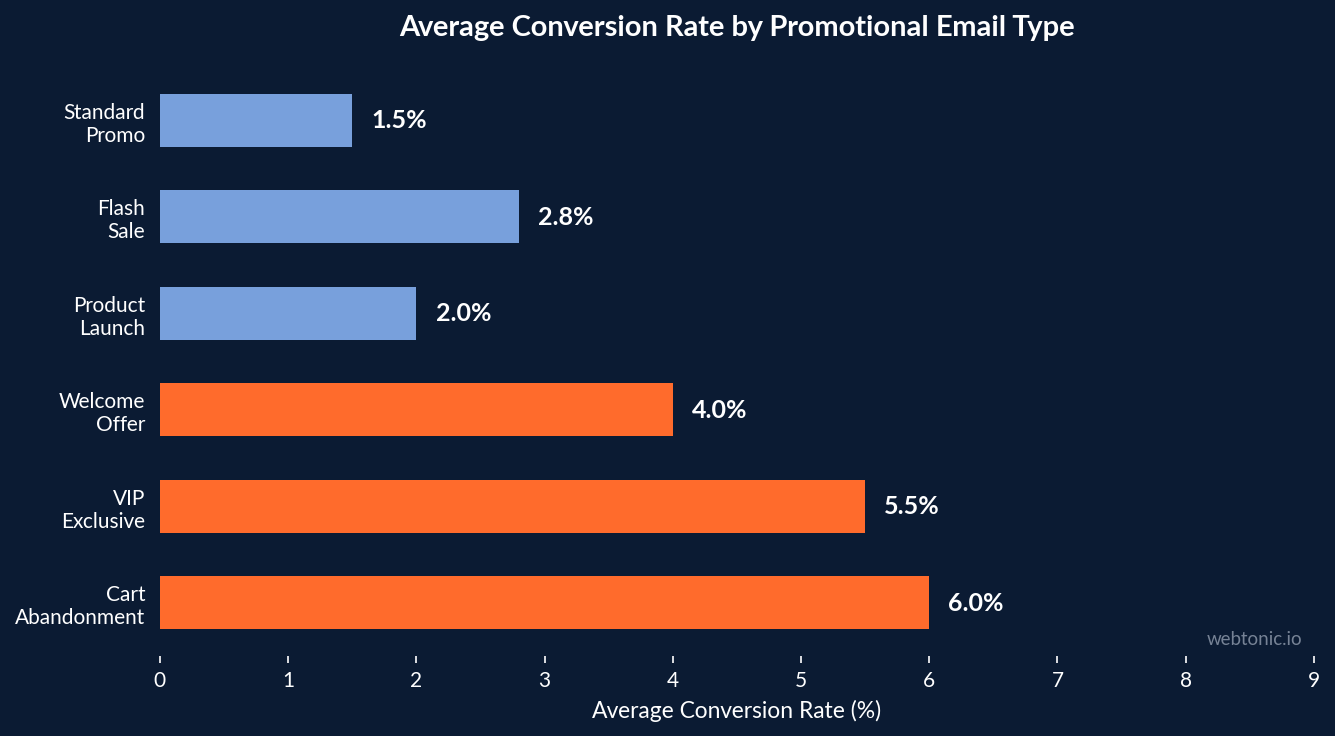
Welcome emails sent to new subscribers are the highest-performing promotional message type. They achieve open rates of 50–60% — roughly 3× higher than regular campaigns — because they arrive when subscriber interest is at its peak. Including a first-purchase incentive (typically 10–15% off) in the welcome email capitalizes on this attention window. According to MailerLite's analysis of 300 million emails, welcome sequences that include a promotional offer convert at 3–5%, well above the average campaign rate.
Flash Sale and Limited-Time Offers
Scarcity and urgency are the most powerful psychological triggers in email marketing. Flash sale emails that include a countdown timer or explicit deadline ("Ends tonight at midnight") consistently outperform open-ended promotions. The key is authenticity — if every email claims to be a "last chance," subscribers stop believing it. Reserve genuine time-limited offers for 2–4 occasions per quarter to maintain credibility and impact.
Product Launch Announcements
New product or feature announcements combine promotional intent with genuine news value. They perform best when the email leads with the problem the product solves rather than listing features. A strong product launch email follows this structure: hook (the problem) → solution (the product) → proof (social proof or early results) → CTA (shop now, learn more, pre-order). Including an early-access incentive for existing customers strengthens loyalty and drives first-day sales.

Cart Abandonment Recovery
While technically triggered (not scheduled), cart abandonment emails are promotional in nature because they include incentives to complete a purchase. They recover 4–8% of abandoned carts on average, and top performers using multi-step sequences (reminder → incentive → final urgency) reach recovery rates above 15%. The first email should arrive within 1 hour of abandonment, with the discount offer reserved for email 2 or 3 in the sequence. Offering the discount too early trains customers to abandon deliberately.
Seasonal and Holiday Campaigns
Holiday promotions (Black Friday, Valentine's Day, back-to-school) are the highest-volume promotional emails most brands send. The challenge is standing out in an inbox flooded with competing offers. Data from Pushwoosh shows that brands sending holiday promotions 5–7 days before the event see 22% higher conversion rates than those who wait until the day-of rush. Early sends also avoid deliverability issues caused by inbox provider throttling during peak send periods.
VIP and Exclusive Deals
Segmenting your most engaged or highest-spending subscribers into a VIP tier and sending them exclusive offers creates a powerful retention loop. VIP emails have 3–4× higher engagement rates than standard blasts because they leverage exclusivity and recognition. The "exclusive" label matters psychologically even when the discount is identical — subscribers respond to feeling valued. Combine VIP offers with data intelligence to identify your most profitable customer segments.
| Email Type | Avg. Open Rate | Avg. Conversion Rate | Best Send Timing |
|---|---|---|---|
| Welcome Offer | 50–60% | 3–5% | Within 5 minutes of signup |
| Flash Sale | 20–30% | 1.5–4% | Tuesday or Thursday, 10 AM |
| Product Launch | 22–28% | 1–3% | Mid-week morning |
| Cart Abandonment | 40–45% | 4–8% | 1 hour after abandonment |
| Seasonal/Holiday | 18–25% | 1–3.5% | 5–7 days before the event |
| VIP Exclusive | 35–45% | 4–7% | Personalized based on engagement data |
How to Write Promotional Emails That Convert
The difference between a promotional email that earns revenue and one that earns an unsubscribe comes down to five elements: subject line, design, copy, CTA, and timing.
Subject Line Best Practices
Your subject line determines whether the email gets opened. 33% of recipients decide to open an email based on the subject line alone, according to ConversionStudio. Keep it under 6–10 words, include the key benefit or offer, and use personalization tokens when possible. Subject lines with the recipient's first name see 26% higher open rates. Avoid all-caps, excessive punctuation, and overused trigger words like "FREE!!!" that increase spam filter risk.
Here are subject line formulas that perform consistently:
| Formula | Example | Why It Works |
|---|---|---|
| Number + Benefit | 5 New Arrivals You Will Love | Specificity creates curiosity and sets expectations |
| Question | Ready for 20% Off Everything? | Opens a mental loop the reader wants to close |
| Urgency + Offer | Last Day: Free Shipping Ends Tonight | Time pressure triggers immediate action |
| Personalized | [Name], Your Exclusive Offer Inside | First-name recognition increases perceived relevance |
| Social Proof | 10,000+ Customers Love This Product | Numbers build credibility and reduce risk perception |
Email Design and Layout
Promotional emails perform best with a single-column layout, one primary CTA, and minimal navigation. According to email platform data, emails with a single CTA generate 371% more clicks than emails with multiple competing CTAs. Use high-quality product images, sufficient white space, and a clear visual hierarchy that guides the reader from headline to offer to button. Mobile optimization is non-negotiable — over 60% of email opens now happen on mobile devices, and emails that render poorly on phones see abandonment rates above 70%.
Copywriting That Drives Action
The body copy of a promotional email should be concise, benefit-focused, and scannable. Lead with the offer ("Get 25% off all winter styles"), follow with a brief supporting reason ("Our biggest clearance of the season"), and close with a clear CTA. Avoid long paragraphs — use bullet points for feature lists and bold text for key benefits. The entire email should be readable in under 11 seconds, which is the average time subscribers spend reading a marketing email. For help with performance creative, explore how Web Tonic approaches conversion-focused design.
CTA Button Optimization
Your CTA button is where conversion happens. Use action-oriented text ("Shop the Sale," "Claim My Discount," "Get Started Free") instead of generic labels ("Click Here," "Submit"). Button color should contrast with the email background — high-contrast CTAs improve click rates by 21%. Position the primary CTA above the fold and repeat it at the end of the email for scanners who scroll before deciding.
Promotional Email Templates You Can Steal
Here are five proven templates adaptable to virtually any industry. Each follows the principles above and is designed for maximum conversion with minimum subscriber fatigue.
Template 1: The New Arrival. Subject: "Just Dropped: [Product Name] Is Here." Structure: hero image of the product → one-sentence benefit statement → 3 bullet points (key features) → CTA "Shop Now" → secondary text linking to the full collection. This template works because it treats the email like a product launch event, creating excitement around a single item.
Template 2: The Flash Sale. Subject: "48 Hours Only: [Discount]% Off [Category]." Structure: countdown timer → offer details (what, how much, when it ends) → best-selling product grid (3–4 items) → CTA "Shop the Sale." The countdown timer is the critical element — it provides a real deadline that compels action now rather than later.
Template 3: The VIP Exclusive. Subject: "[Name], This Deal Is Just for You." Structure: personalized greeting → exclusive offer (early access, extra discount, free gift) → reason for the exclusivity ("You're one of our top 100 customers") → CTA "Unlock My Offer." This template leverages reciprocity and recognition to drive above-average conversion rates.

Template 4: The Social Proof Email. Subject: "See Why 10,000+ Customers Chose [Product]." Structure: customer testimonial or star rating → product image → 2–3 review quotes → CTA "Join Them." This template works best for considered purchases where trust is the primary conversion barrier.
Template 5: The Re-Engagement Offer. Subject: "We Miss You — Here's 20% Off to Come Back." Structure: personal tone acknowledging the lapse → exclusive return incentive → best new products since they last purchased → CTA "Shop My Offer." Send this to subscribers who have not opened or clicked in 60–90 days to recapture attention before they go fully dormant.
Measuring Promotional Email Performance
Tracking the right metrics separates data-driven email programs from guesswork. Here are the KPIs that matter most for promotional campaigns.
Conversion rate is the primary metric. A 2% conversion rate falls within the standard margin of 2–5% for promotional sends. Track this at the campaign level and by segment to identify which audiences and offers drive the highest returns.
Revenue per email (RPE) gives you a dollar value for every message sent, making it easy to compare campaign effectiveness across different list sizes. High RPE with a small list often beats low RPE with a massive list because it indicates strong targeting and offer-audience fit.
Click-to-open rate (CTOR) measures how compelling your content is for people who actually open the email. A low open rate with high CTOR suggests a subject line problem, not a content problem. A high open rate with low CTOR suggests the opposite. Use CTOR to diagnose where in the funnel your campaigns are losing subscribers.
Unsubscribe rate acts as a health check on your send frequency and relevance. If unsubscribes spike after a campaign, you either sent too many messages too quickly or the offer did not match subscriber expectations. An experienced marketing team monitors unsubscribe trends weekly to catch problems before they damage deliverability.
Related reading
- Cold Emails vs Newsletters: Family Law Email Marketing Numbers
- How Immigration Law Email Marketing Statistics Shifted Since 2024
- Cold Email vs Paid Ads: Criminal DUI Law Marketing Statistics
- Email Marketing services at Web Tonic
FAQ
How often should I send promotional emails?
The optimal frequency for most brands is 2–3 promotional emails per week, interspersed with value-driven content. Exceeding this threshold increases unsubscribe rates by up to 34% without proportional revenue gains. Test frequency with your specific audience — some niches tolerate daily sends, while others prefer weekly.
What is a good conversion rate for promotional emails?
A 2–5% conversion rate is standard for promotional campaigns, though this varies by industry. Cart abandonment emails convert at 4–8%, while welcome offers reach 3–5%. Track conversion rate alongside revenue per email to get a complete picture of campaign effectiveness.
How do I avoid the spam folder with promotional emails?
Maintain a clean list by removing hard bounces and inactive subscribers, authenticate your domain with SPF, DKIM, and DMARC, avoid spam-trigger words in subject lines, and keep your complaint rate below 0.1%. Sending consistently from a verified domain builds sender reputation over time.
Should promotional emails include images or be text-only?
Image-rich promotional emails outperform text-only for ecommerce and product-based businesses because they showcase the product visually. However, always include alt text for images and ensure the email is readable even when images are blocked. For B2B or service businesses, a hybrid approach with a clean design and minimal images often performs better.
What is the best day and time to send promotional emails?
Tuesday and Thursday mornings between 9–11 AM in the recipient's local time zone consistently show the highest open and click rates across industries. However, optimal timing varies by audience — B2C brands often see strong evening performance, while B2B campaigns perform best during business hours. A/B test send times quarterly to refine your schedule.
Sources
stripo.email/blog/email-conversion-rate-statistics
mailerlite.com/blog/email-marketing-conversion-rate
pushwoosh.com/blog/promotional-emails
conversion.studio/blog/ecommerce-email-subject-lines
litmus.com/blog/email-marketing-roi
campaignmonitor.com/resources/guides/email-marketing-benchmarks