Table of contents
No published study reports a cold-email or newsletter benchmark specific to criminal DUI defense firms. What is verified is how law firms handle inbound contact once it arrives, and what the paid-ad alternative costs per lead - so this page prices email against those two anchors rather than inventing an email-specific legal conversion rate that no primary source publishes.
Key Takeaways
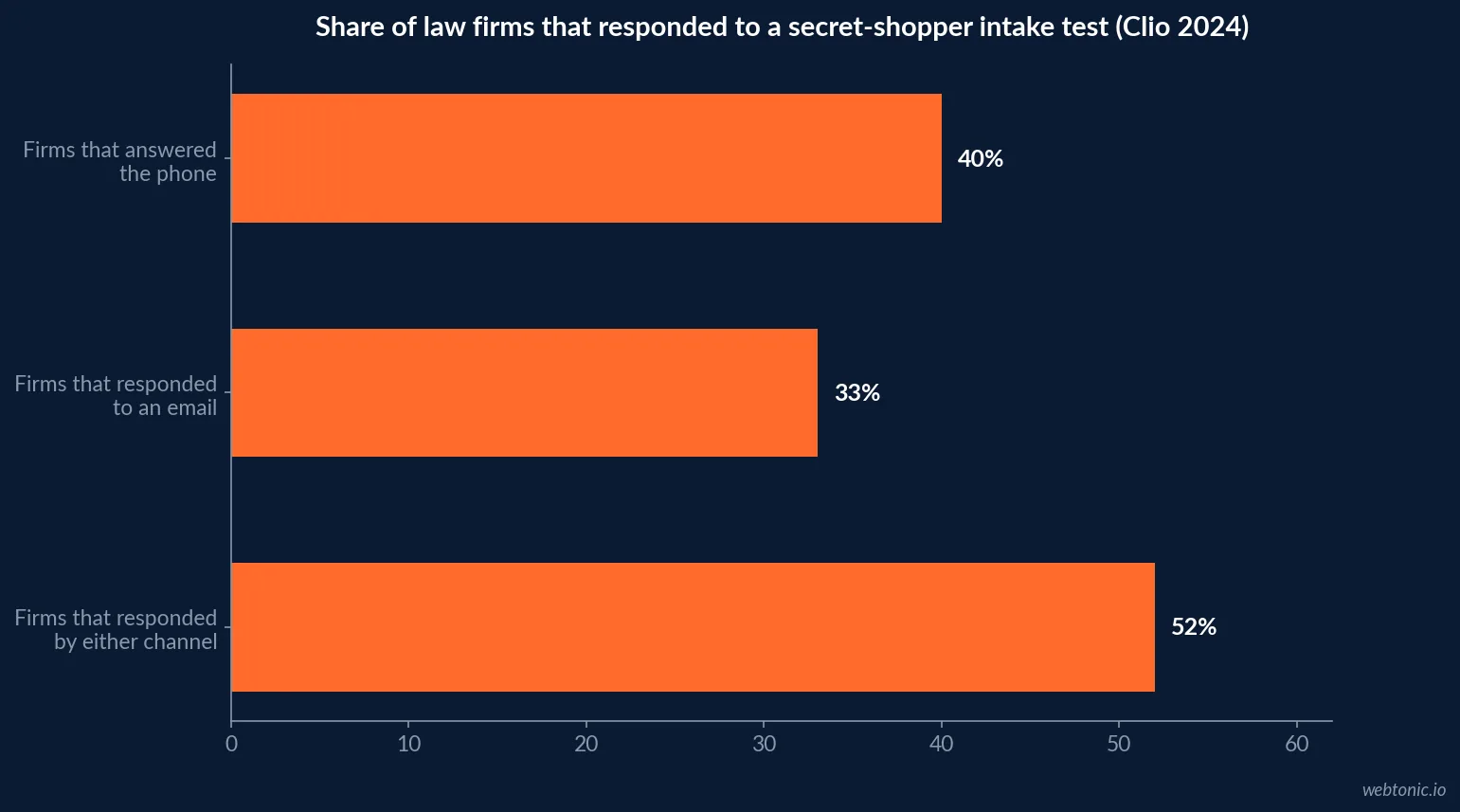
- Only 33% of law firms responded to a secret-shopper test email, Clio found.
- 40% answered a test phone call in that same 2024 test.
- 52% of firms responded by either channel, leaving 48% unreachable.
- 79% of legal consumers expect a reply within 24 hours.
- 59% of solo and small firms name referrals their top lead source, not email.
- No public Mailchimp benchmark breaks out a Legal Services row.
- Cross-industry average open rate is 35.63% on Mailchimp's current page.
- Cross-industry average click rate is 2.62% on the same page.
- Business + Finance, the closest proxy category, opens at 31.35%.
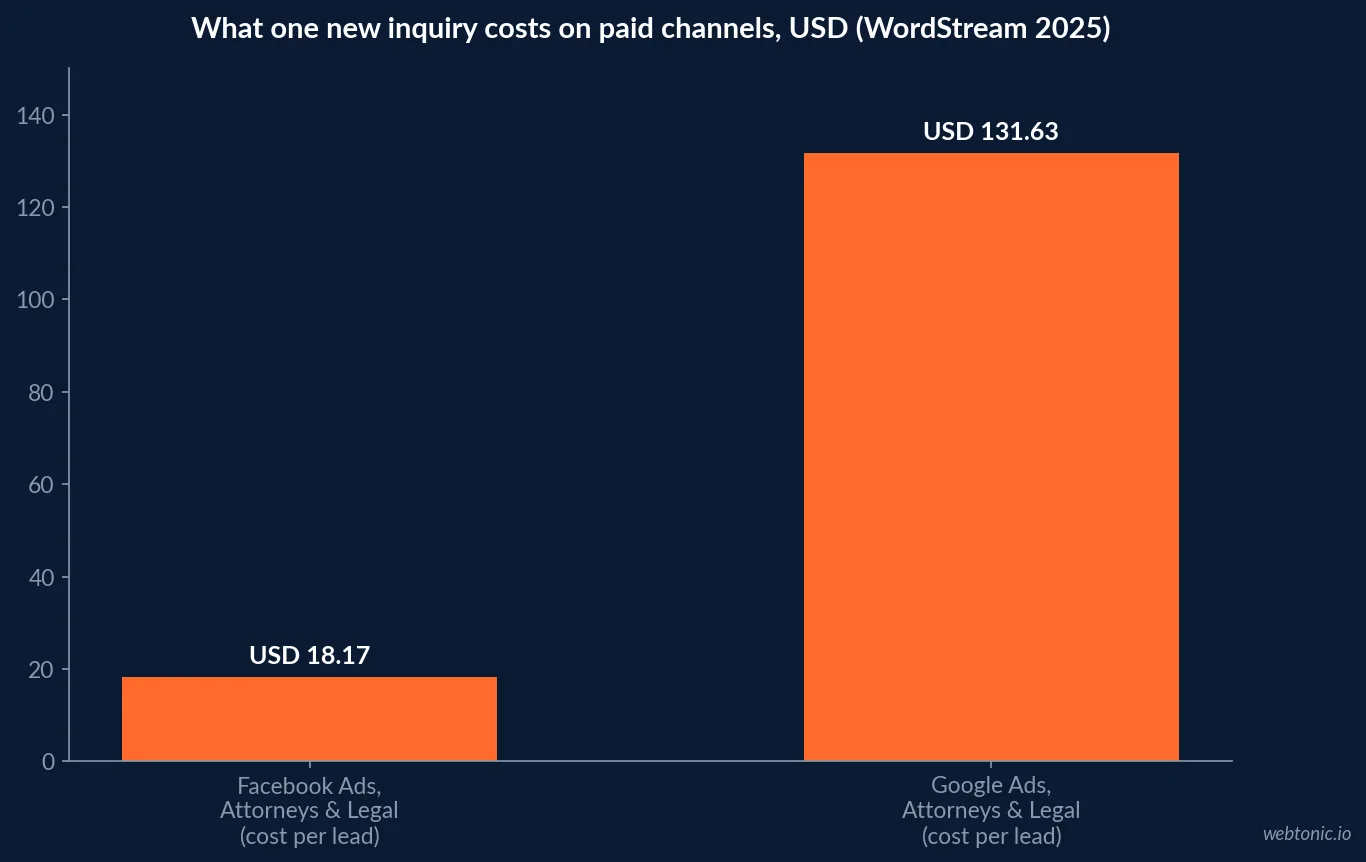
- Facebook cost per lead for legal advertisers is $18.17 in 2025.
- Google Ads cost per lead for the same category is $131.63.
- Legal Google Ads CPC of $8.58 is the highest of any industry WordStream tracked.
- Marketers put 14.25% of budget into social today, per The CMO Survey 2026.
- ABA Rule 7.3 restricts direct solicitation of a person known to need a specific service.
- 80% of law firms keep a social media presence, versus far fewer with structured email programs.
- Non-Profits open at 40.04% on Mailchimp's page, the highest category shown.
- Facebook lead-campaign CVR for legal advertisers is 10.53%, WordStream 2025 shows.
Why this page compares email against paid, not against itself
Mailchimp, Constant Contact, and every other major email platform publish cross-industry benchmarks, but none of the current, dated pages checked for this article carry a dedicated Legal Services row. Rather than borrow an unrelated industry's number and call it a legal benchmark, this page uses the closest published proxy category and puts it beside two things that are verified for legal advertisers specifically: WordStream's 2025 cost-per-lead data on Meta and Google, and Clio's intake-response research. The comparison that matters for a DUI defense firm choosing where to put the next marketing dollar is cost per reply, not open rate in isolation.
| Email metric (Mailchimp, current page) | All Users | Business + Finance |
|---|---|---|
| Average open rate | 35.63% | 31.35% |
| Average click rate | 2.62% | 2.78% |
| Average unsubscribe rate | 0.22% | 0.15% |
What the paid alternative actually costs
WordStream's 2025 Facebook Ads Benchmarks put Attorneys and Legal Services at an $18.17 median cost per lead on lead-objective campaigns, while WordStream's 2025 Google Ads Benchmarks puts the same broad category at $131.63 per lead and the highest cost per click of any industry tracked, $8.58. Email has no equivalent per-lead auction cost - the marginal cost of one more send is close to zero - but it is not free: it costs whatever the firm spends building and maintaining a list large enough to matter, and answering what comes back.
That is the honest trade a DUI defense firm is actually making: paid ads buy reach and intent on a per-lead price; email buys near-zero marginal cost against an unclear, unbenchmarked reply rate for this specific industry.
| Channel | Cost structure | 2025 benchmark figure | Source |
|---|---|---|---|
| Cold email / newsletter | List-building + response labor | No legal-specific benchmark published | n/a |
| Facebook Ads, lead campaigns | Per-lead auction | $18.17 cost per lead | WordStream 2025 |
| Google Ads, search | Per-lead auction | $131.63 cost per lead | WordStream 2025 |
| Referrals | Relationship maintenance | 59% of firms' top lead source | Clio 2025 |
The number that actually caps email's value: the reply
Whatever a cold-email or newsletter campaign generates in replies is only worth as much as the firm's ability to answer them fast. Clio's 2024 Legal Trends Report ran a secret-shopper test across real firms and found only 33% responded to a test email and 40% answered a test call, a combined 52% response rate - meaning 48% of the firms tested were effectively unreachable by either channel. Clio's separate consumer research also found 79% of legal consumers expect a response within 24 hours of first contact.
A cold-email program that lands in the same inbox those firms are already failing to answer inherits that 48% failure risk regardless of how well the email itself is written. Fixing intake response time is the higher-leverage move before scaling any outbound send volume.
| Clio 2024 secret-shopper result | Figure | Applies equally to |
|---|---|---|
| Firms that answered a test call | 40% | Phone-based intake |
| Firms that responded to a test email | 33% | Email-based intake |
| Firms responding by either channel | 52% | Combined intake capacity |
| Consumers expecting a same-day reply | 79% | Every inbound channel, including email |
The list-building cost nobody prices into "free" email
Email's near-zero marginal send cost hides a real upfront cost: building a list worth emailing. For a DUI defense firm, that list realistically comes from three sources - people who already called and did not retain the firm, referral partners such as bail bondsmen or other attorneys who opt in to updates, and past clients who might refer someone else later. None of those lists build themselves for free; each one requires the same intake capacity that Clio's secret-shopper data already shows half of firms are not staffing well enough to convert on the first contact, let alone the second.
Buying a cold list from a third-party data broker changes the compliance profile entirely. ABA Rule 7.3 restricts real-time and targeted solicitation of a person known to need a specific legal service, and several state bars apply that logic to purchased lists built around arrest or booking records specifically. A firm considering a bought list for DUI-specific outreach should clear that against its own state's advertising rules before the first send, not after.
Where email realistically fits the budget
Given the data above, email is best positioned as a low-marginal-cost channel for two specific jobs a DUI defense firm already needs done: nurturing people who called but were not ready to hire immediately, and staying visible to the referral sources that Clio's 2025 data shows are still the biggest lead source for 59% of solo and small firms. Neither job needs to beat WordStream's Meta or Google cost-per-lead numbers to be worth running, because it is not competing in the same auction. ABA Rule 7.3 still applies to any direct solicitation content, including email aimed at someone known to need a specific legal service, so subject lines and opening lines need the same scrutiny a Meta or Google ad would get.
Our growth marketing practice builds intake and follow-up sequences around exactly this response-time gap, and our guide to choosing an email marketing partner is a useful next read before scaling send volume. Get in touch to review a specific intake funnel.
What a realistic pilot looks like
A defensible way to test email against the paid benchmarks above is to run it as a complement, not a substitute, for 90 days: build the list only from people who already contacted the firm and consented to follow-up, measure reply rate against Clio's 79% same-day expectation rather than an industry-generic open rate, and track cost per reply against the $18.17 Facebook and $131.63 Google figures so the comparison stays apples to apples. If the reply rate lags the response-time bar the market has already set, the fix is almost always staffing the inbox faster, not writing a better subject line.
The same 90-day window is long enough to see whether referral partners - the channel Clio's data says still wins for 59% of solo and small firms - engage with a recurring update at all. A partner newsletter that goes unread for three straight sends is a signal to redirect that budget toward direct outreach or paid channels instead of assuming persistence alone will fix it.
It is also worth separating two very different email use cases that get lumped together under "email marketing." A transactional intake follow-up - the message a prospective client gets minutes after calling - is closer to customer service than marketing, and its speed is what Clio's 79% same-day expectation is actually measuring. A recurring newsletter to referral partners or past clients is a slower, relationship-maintenance play, closer in spirit to the 59% referral figure than to a paid-media funnel. Reporting both under one open-rate number, as many benchmark pages do, hides which one is actually underperforming when results disappoint.
Measure the two separately going forward, with separate targets and separate owners inside the firm, so a slow newsletter does not get blamed for a missed intake call, and a missed intake call does not get quietly absorbed into a vague "email marketing isn't working" conclusion.
Frequently Asked Questions
Is email marketing cheaper than paid ads for a DUI defense firm?
Per contact, almost certainly, since email has no per-click or per-lead auction cost. But no published benchmark reports a legal-specific email conversion rate to compare against WordStream's $18.17 Facebook cost per lead or $131.63 Google cost per lead for Attorneys and Legal Services in 2025. Email's real cost is the list-building and response-handling work behind it, which the numbers below help size.
What is a realistic email open rate to expect?
Mailchimp's current cross-industry benchmarks, the closest published proxy since no attorney-specific row exists on their public page, show an average 35.63% open rate and 2.62% click rate across all users, with the Business and Finance category - the nearest available comparison - at 31.35% open and 2.78% click. Treat those as a starting range, not a legal-industry guarantee.
Why does response speed matter more than the channel itself?
Because Clio's own consumer research found 79% of legal consumers expect a response within 24 hours of first contact, and Clio's 2024 secret-shopper test found only 33% of firms actually responded to a test email and 40% to a test call. A cold email campaign that generates replies into an inbox nobody checks promptly is competing with that 79% expectation and losing.
Do referrals still beat both channels for DUI defense leads?
For solo and small firms generally, yes. Clio's 2025 Legal Trends Report found 59% of solo and small law firms name referrals their top source of leads, ahead of any paid or email channel. That does not make email or paid ads worthless - it means both are usually filling the gap referrals don't cover, not replacing them.
What does Mailchimp say about legal industry email specifically?
Nothing specific. Mailchimp's public benchmarks page lists Business + Finance, Non-Profits, Education + Training, Ecommerce, and an All Users average, with no dedicated Legal Services row. Any figure claiming an exact legal-industry email rate from Mailchimp should be treated skeptically unless it links to a dataset that actually shows that breakout.
Sources
Mailchimp - Email Marketing Benchmarks and Metrics
WordStream - Facebook Ads Benchmarks 2025
WordStream - Google Ads Benchmarks 2025
Clio - 2024 Legal Trends Report
Clio - 2025 Legal Trends for Solo and Small Law Firms
American Bar Association - Model Rule 7.3
The CMO Survey - Topline Report 2026