Table of contents
No published benchmark study prices a legal-services email open rate, so the honest answer starts with that gap. What is measurable: email ranks as the single most common channel law firms plan to increase spend on in 2026, named by 51% of firms surveyed by CallRail, and state bar advertising rules draw a hard line between a newsletter a past client opted into and a cold email built from a public record. This page treats those two facts as the real starting point, not a manufactured legal-industry open rate.
Key Takeaways
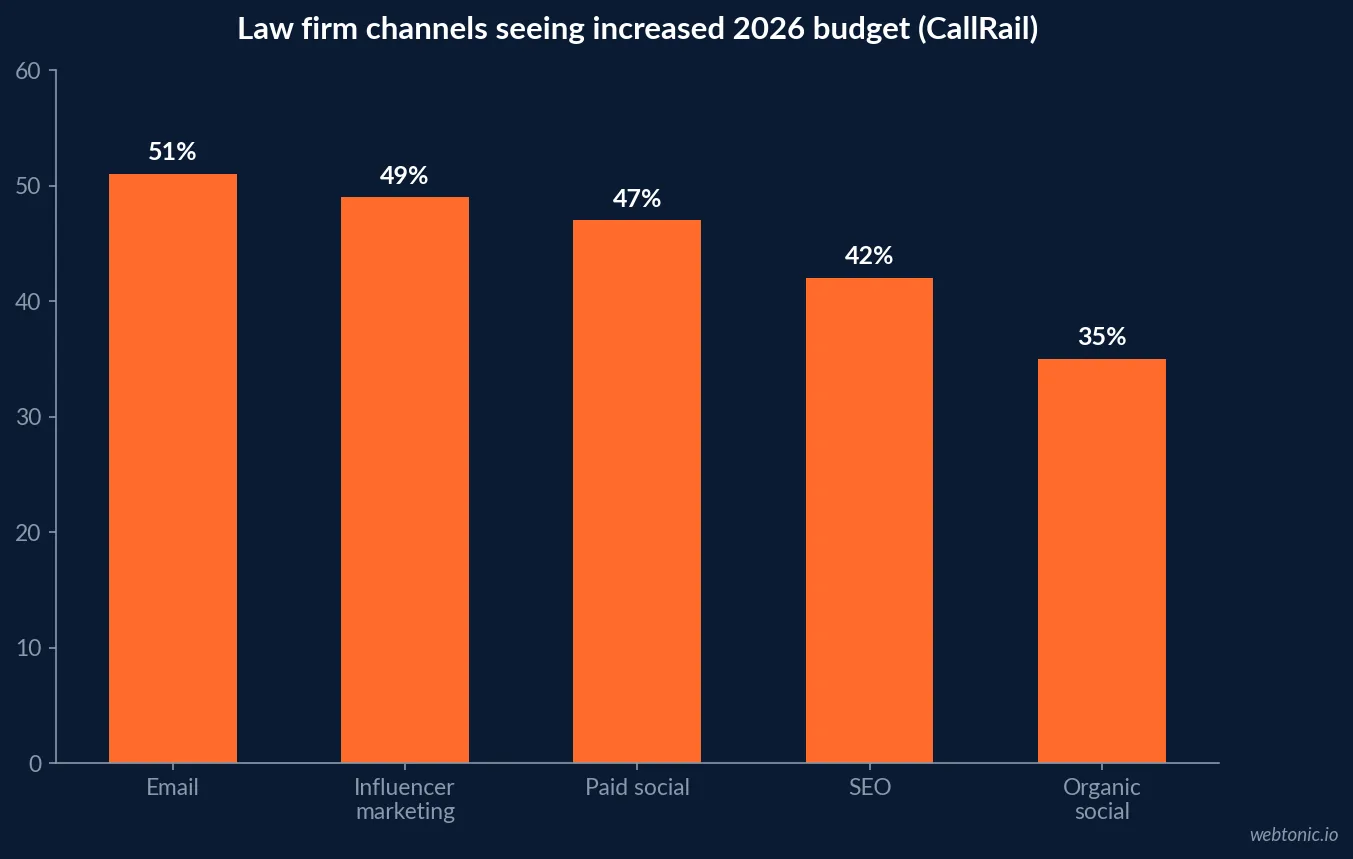
- Email is the top budget-growth channel for law firms in 2026, named by 51% of firms, per CallRail.
- 50% of firms added email as a new marketing channel in the past year.
- No dedicated "Legal Services" category exists in Mailchimp's industry benchmark table; the nearest proxy is Business and Finance.
- Business and Finance open rate: 31.35%, click rate 2.78%, per Mailchimp.
- All Users average open rate: 35.63%, click rate 2.62%, per Mailchimp.
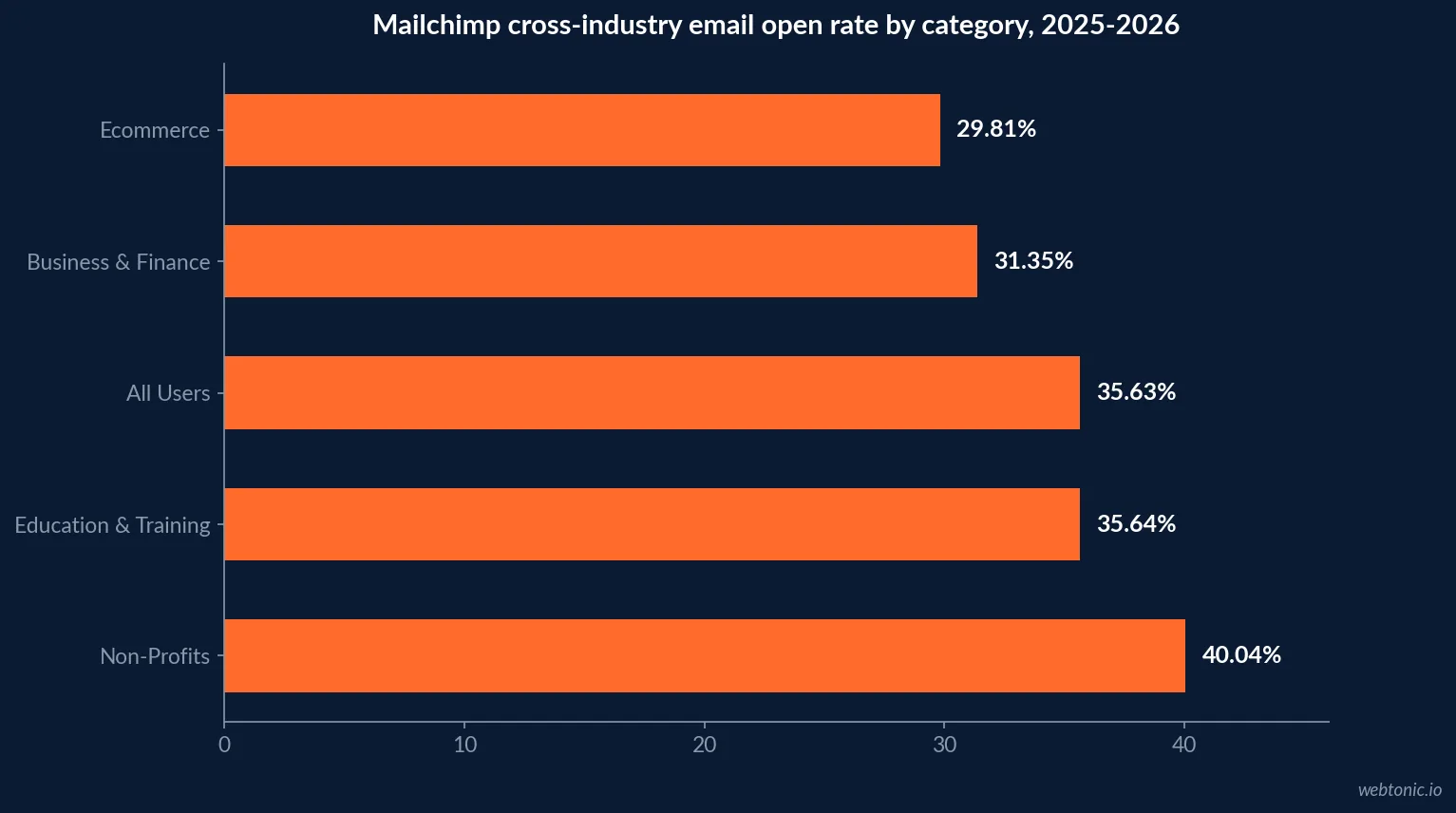
- Non-Profits average the highest open rate tracked, at 40.04%.
- State bar Rule 7.3 restricts targeted solicitation of a specific prospective client about a specific matter, unlike a general newsletter.
- 70% of consumers say finding and hiring a lawyer was easy, largely through referral and search, which limits cold email's marginal value further.
- 28% of firms plan influencer marketing increases and 35% plan organic social increases in 2026, both behind email's 51%.
- 68% of law firms now use AI to personalize marketing, including email sequencing, per Clio's 2025 Legal Trends Report.
- Under Rule 7.2, a lawyer cannot pay for referrals outside narrow, disclosed exceptions, which limits list-buying as a growth tactic.
Why "cold email" and "newsletter" are not the same compliance question
State bar advertising rules, built on the same framework as the ABA's Model Rules 7.1 through 7.3, treat general advertising and targeted solicitation very differently. The California Bar's current Rules of Professional Conduct, Chapter 7, permits a lawyer to advertise broadly through any written, recorded, or electronic means under Rule 7.2, which covers a standard opt-in newsletter cleanly. Rule 7.3's direct-solicitation restrictions are the tighter gate, aimed at real-time or targeted contact with a specific person known to need help with a specific legal matter, which is precisely the profile of a cold email pulled from, say, a public custody filing.
The practical dividing line: a newsletter someone opted into, or a past client's contact list, sits comfortably inside Rule 7.2's general-advertising lane. A purchased or scraped list targeting people by inferred legal need sits closer to Rule 7.3's restricted territory, and every state's exact language differs, so this is a direction, not a substitute for state-specific counsel.
| Email approach | Governing rule (state-bar framework) | Compliance posture |
|---|---|---|
| Newsletter to opted-in subscribers | Rule 7.2 (general advertising) | Low risk, broadly permitted |
| Nurture sequence to past consultations | Rule 7.2 (general advertising) | Low risk, with clear opt-out |
| Referral-partner / professional network email | Outside Rule 7.3's core scope | Low risk, not a prospective-client solicitation |
| Cold email to a purchased or scraped list | Rule 7.3 (direct solicitation) | Elevated risk, state-specific review needed |
| Paid referral arrangement via email list broker | Rule 7.2(b) (no paying for referrals) | Prohibited outside narrow, disclosed exceptions |
Where the real budget is going in 2026
CallRail's 2026 Legal Marketing Outlook Report, surveying 100 legal professionals in October 2025, found email tops the list of channels seeing increased spend at 51%, ahead of influencer marketing (49%), paid social (47%), SEO (42%), and organic social (35%). Separately, 50% of firms implemented email as a brand-new channel in the past year, tied with video for the second-most-added channel behind paid social.
| Channel | Share of firms increasing 2026 spend | Source |
|---|---|---|
| 51% | CallRail 2026 Legal Marketing Outlook | |
| Influencer marketing | 49% | CallRail 2026 Legal Marketing Outlook |
| Paid social | 47% | CallRail 2026 Legal Marketing Outlook |
| SEO | 42% | CallRail 2026 Legal Marketing Outlook |
| Organic social | 35% | CallRail 2026 Legal Marketing Outlook |
The benchmark gap, and the closest honest proxy
Mailchimp's published industry benchmark table does not break out a Legal Services category at all; it tracks a small set of broad categories. The closest professional-services proxy is Business and Finance, which averages a 31.35% open rate, a 2.78% click rate, and a 0.15% unsubscribe rate. The cross-industry All Users average sits at 35.63% open, 2.62% click, 0.22% unsubscribe. Every number in this section is a cross-industry benchmark, stated plainly as such, not a legal-services figure.
| Mailchimp benchmark category | Avg. open rate | Avg. click rate | Avg. unsubscribe rate |
|---|---|---|---|
| Non-Profits | 40.04% | 3.27% | 0.18% |
| Education and Training | 35.64% | 3.02% | 0.18% |
| All Users (cross-industry average) | 35.63% | 2.62% | 0.22% |
| Business and Finance (nearest professional-services proxy) | 31.35% | 2.78% | 0.15% |
| Ecommerce | 29.81% | 1.74% | 0.19% |
A second benchmark set tells the same story
HubSpot's compiled 2025 email benchmark table, sourced from named vendors including Klaviyo, MailerLite, and ZeroBounce, likewise has no legal-services line. Its nearest proxy, B2B Services, averages a 39.48% open rate and a 2.21% click-through rate, against an All Industries Average of 42.35% open. Read next to Mailchimp's numbers, the pattern holds: two independent compilers, two different proxy categories, and both land in the high-30s-to-mid-40s open rate range for professional and B2B services, meaningfully above e-commerce.
That convergence is useful even without a legal-specific figure: a family law newsletter opening somewhere in the 31% to 40% range is tracking with the closest available proxies from two separate benchmark providers, not underperforming some invented legal-industry standard.
| Cross-industry benchmark provider | Nearest professional-services proxy | Open rate | Click rate |
|---|---|---|---|
| Mailchimp | Business and Finance | 31.35% | 2.78% |
| HubSpot (compiled) | B2B Services | 39.48% | 2.21% |
| Mailchimp | All Users (cross-industry) | 35.63% | 2.62% |
| HubSpot (compiled) | All Industries Average | 42.35% | 2.30% |
Why cold outreach underdelivers even where it's allowed
Beyond the compliance question, Clio's 2025 Legal Trends Report found 70% of consumers who recently hired a lawyer say they had an easy time finding and hiring one, mostly through referrals and online search, not cold outreach of any kind. A cold email arriving unsolicited into that already-easy decision path has a structurally weak reason to convert, on top of the compliance exposure. The report also found 68% of firms now use AI to personalize marketing, which for email means more relevant nurture content for people already in a firm's orbit, referral partners, past clients, newsletter subscribers, rather than colder list-building.
| Dimension | Cold email (purchased/scraped list) | Newsletter (opted-in list) |
|---|---|---|
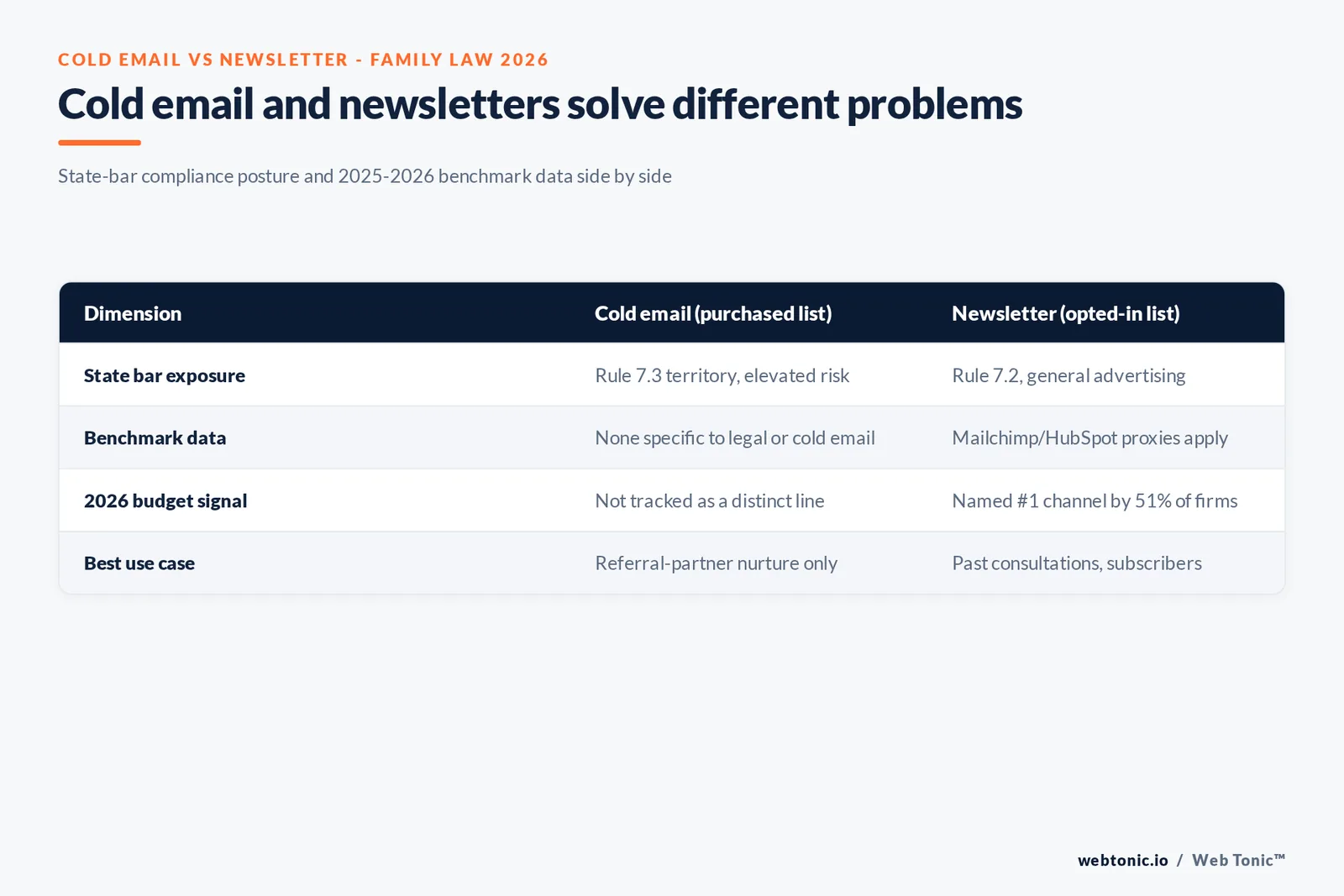
| State bar exposure | Elevated, Rule 7.3 territory | Low, general advertising under Rule 7.2 |
| Benchmark data available | None specific to legal, and little cross-industry cold-email data either | Mailchimp's cross-industry table applies directly |
| 2026 budget direction | Not tracked as a distinct spend line by CallRail | Named the #1 growth channel by 51% of firms |
| Competes against | 70% of clients who already find hiring a lawyer easy via other channels | Existing relationship, referral, or past-consultation context |
Building a compliant newsletter program
Given the data above, the workable program for most family law firms centers on three lists: past consultations who did not retain, referral-source professionals (other attorneys, therapists, financial advisors who see divorce and custody clients), and organic newsletter subscribers who opted in through the firm's own site. None of these require Rule 7.3-level scrutiny the way a purchased list does, and all three can be benchmarked honestly against Mailchimp's Business and Finance or All Users figures rather than an invented legal-specific number.
Our data and analytics practice sets these programs up with the segmentation that Clio's AI-personalization data suggests is now standard practice among growing firms, and our guide to choosing an email marketing partner covers what a compliant nurture program should include beyond the platform itself.
What a realistic cadence looks like
Most family law newsletters that hold their open rate near the proxy benchmarks above run on a predictable, low-frequency cadence, typically monthly or every three weeks, rather than a high-volume drip that pushes the list toward the 0.15% to 0.22% unsubscribe range both benchmark providers report at the low-frequency end. Content mixing a short legal-update note with a soft, single call to action (book a consultation, download a custody-basics guide) tracks with what a Business and Finance or B2B Services audience responds to, since a family law newsletter's actual subscriber base, past clients, referral partners, and prospective clients researching options, behaves more like a professional-services audience than a consumer retail one.
The one number worth setting internally, since no external one exists: a target consultation-request rate from the newsletter list itself, tracked over a full quarter, is a far more useful KPI than matching a borrowed open rate exactly.
What to measure instead of a borrowed open rate
Rather than chasing a legal-industry open rate that does not exist as a published figure, most firms get more value tracking consultation-request rate from the newsletter list specifically, and referral-partner engagement (opens and forwards) as a leading indicator of the professional network relationships that, per Clio's data, still drive the majority of family law client acquisition. Our broader email marketing benchmark data covers the cross-industry picture in more depth, and firms ready to build a compliant program can talk to our team about segmentation and cadence.
Frequently Asked Questions
Can a family law firm cold-email people who haven't asked to hear from it?
Generally no, or only under narrow conditions. State bar rules modeled on ABA Model Rule 7.3 restrict targeted solicitation of a specific person known to need legal services for a particular matter, especially by real-time or targeted written communication. The California Bar's current Rule 7.3, for example, permits many forms of general advertising but keeps direct, individualized solicitation on a tight leash. A cold outreach list built from, say, a public court filing carries real compliance risk and should be reviewed against the specific state's bar rules before it is sent.
What email open rate should a family law firm expect?
No benchmark study publishes a dedicated legal-services open rate. Mailchimp's industry benchmark table, the most-cited cross-industry source, tracks a small set of categories: Business and Finance at 31.35%, Non-Profits at 40.04%, Education and Training at 35.64%, Ecommerce at 29.81%, and an All Users average of 35.63%. A professional-services newsletter, which is the closest proxy available, should be benchmarked against the Business and Finance figure or the All Users average, not treated as having its own published number.
Is email actually a priority channel for law firms in 2026?
Yes, more than any other channel by one measure. CallRail's 2026 Legal Marketing Outlook Report found email is the single most common area firms plan to increase spend in, named by 51% of firms, ahead of influencer marketing (49%) and paid social (47%). Separately, 50% of firms added email as a new channel in the past year.
What should a compliant family law newsletter actually contain?
Content that informs rather than solicits a specific person's specific matter: general updates on custody law changes, what to expect from mediation, or how a consultation works. That keeps the communication inside Rule 7.1's truthful-advertising standard and away from Rule 7.3's tighter solicitation restrictions, while still nurturing a list of past consultations and referral sources toward a future need.
Cold email or newsletter: which one should get the marketing budget?
For most family law firms, the newsletter, by default, since it reaches people who already opted in or previously consulted, and it avoids most of the compliance exposure that targeted cold outreach carries. Cold email has a narrower, legitimate use case: firm-to-firm referral relationships and professional network nurture, which are not solicitations of a prospective client and sit outside Rule 7.3's core restriction.
Sources
CallRail - 2026 Legal Marketing Outlook Report
Mailchimp - Email Marketing Benchmarks & Industry Statistics
State Bar of California - Rules of Professional Conduct, Chapter 7
Clio - 2025 Legal Trends Report
HubSpot - Email Marketing Benchmarks by Industry