Table of contents

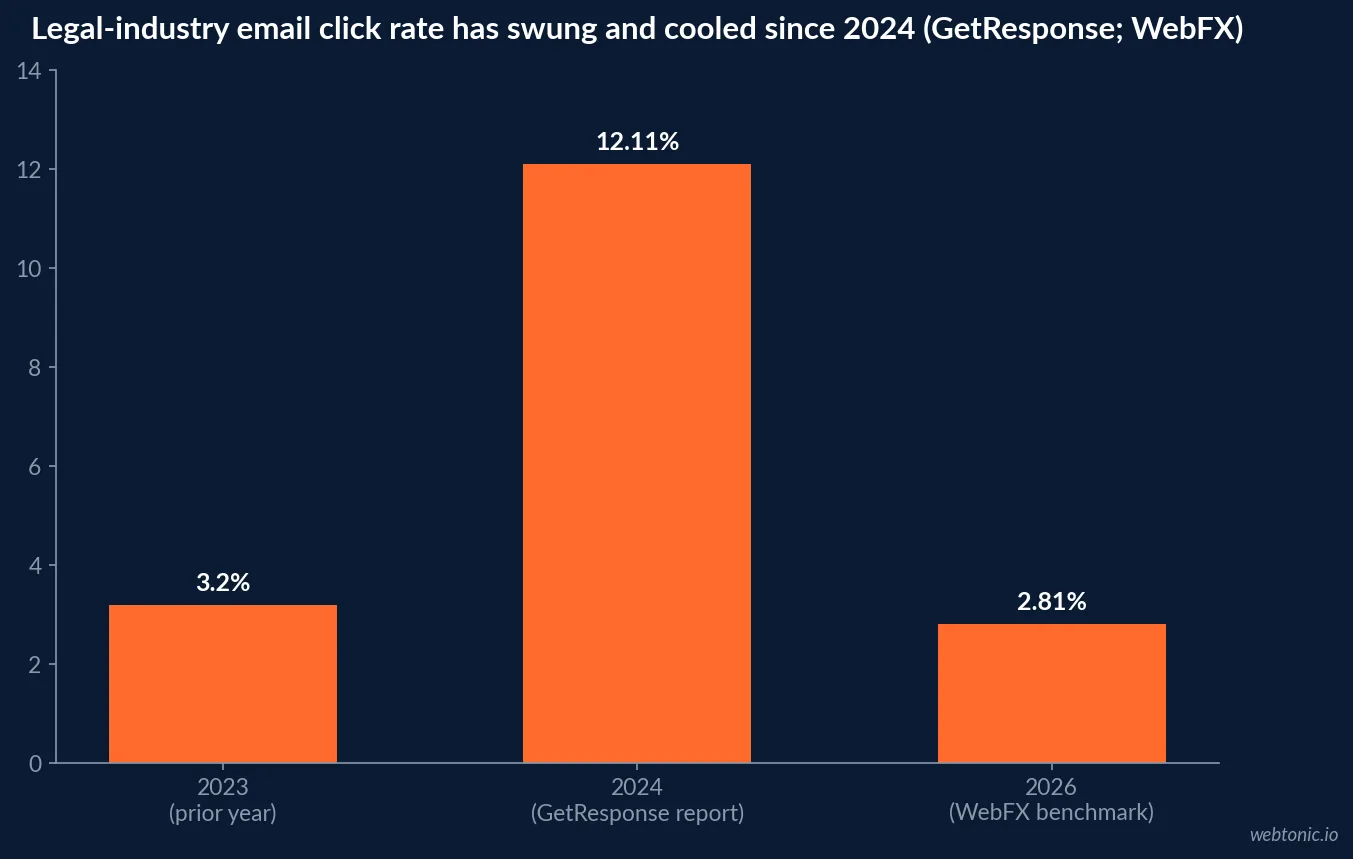
Legal-services email click-through rates nearly quadrupled in GetResponse's 2024 benchmark report, then cooled back toward pre-spike levels in the most recent 2026 industry data. No source breaks either number out by immigration practice area, so this page tracks the legal-category swing honestly and reads it against the immigration caseload that plausibly drove it.
Key Takeaways
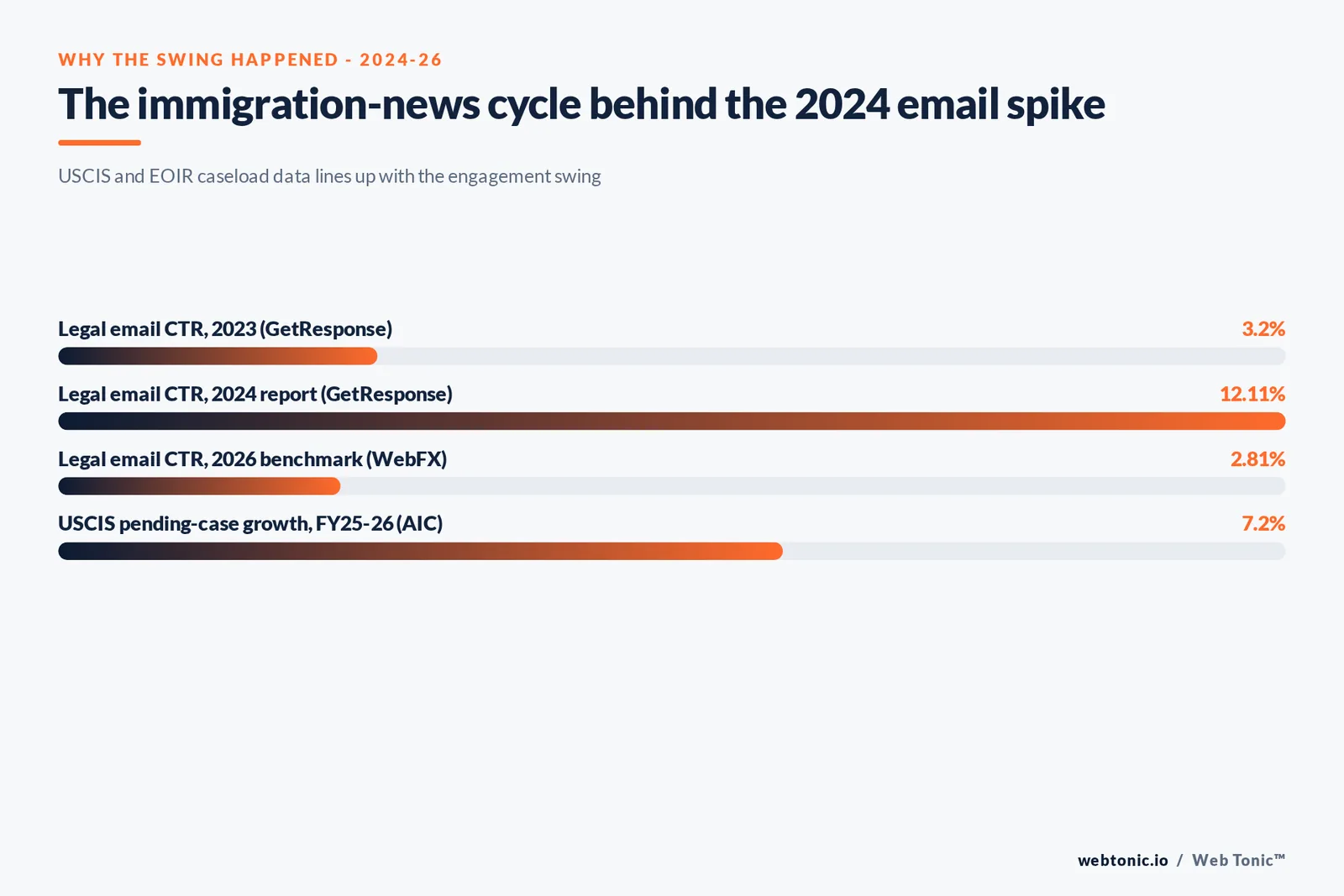
- 12.11% legal-services email click-through rate in GetResponse's 2024 report, up from 3.2% the prior year - almost a 4x jump.
- 47.26% legal-services open rate in that same 2024 report.
- 25.63% legal-services click-to-open rate in the 2024 report.
- 42.53% was the all-industry average open rate that same year, versus legal's 47.26%.
- 5.14% was the all-industry average click rate, versus legal's 12.11%.
- 11.31% legal-industry click-through rate in Constant Contact's own benchmark data - much closer to the 2024 spike than the pre-spike baseline.
- 20.29% legal-industry open rate in that same Constant Contact benchmark.
- GetResponse's report attributes the 2024 spike to "exceptional regulatory news density" that year.
- 12.1 million USCIS cases were pending in FY2026 Q2, up 7.2% year over year.
- 3,092,988 cases sit in the Immigration Court backlog as of August 2026.
- No published dataset isolates immigration law from the broader legal-services email category.
- Litera's Concep platform publishes the closest available legal-specific benchmark, built from actual law-firm sends, but still not broken out by practice area.
The spike the 2024 data actually shows
GetResponse's Email Marketing Benchmarks report, built from more than 4 billion emails its platform sent in 2023, recorded Legal Services at a 47.26% open rate, a 12.11% click-through rate and a 25.63% click-to-open rate - the standout figure being that CTR jumping from 3.2% the year before, a rise the report itself flags as unusual: "when it comes to clicks, Legal Services observed a notable jump from 3.2% to 12.1%. That's almost a 4x increase, a leap we've not observed before."
Legal beat the all-industry average of 42.53% open and 5.14% click in the same report by a wide margin, which makes the category worth watching closely rather than dismissing as noise.
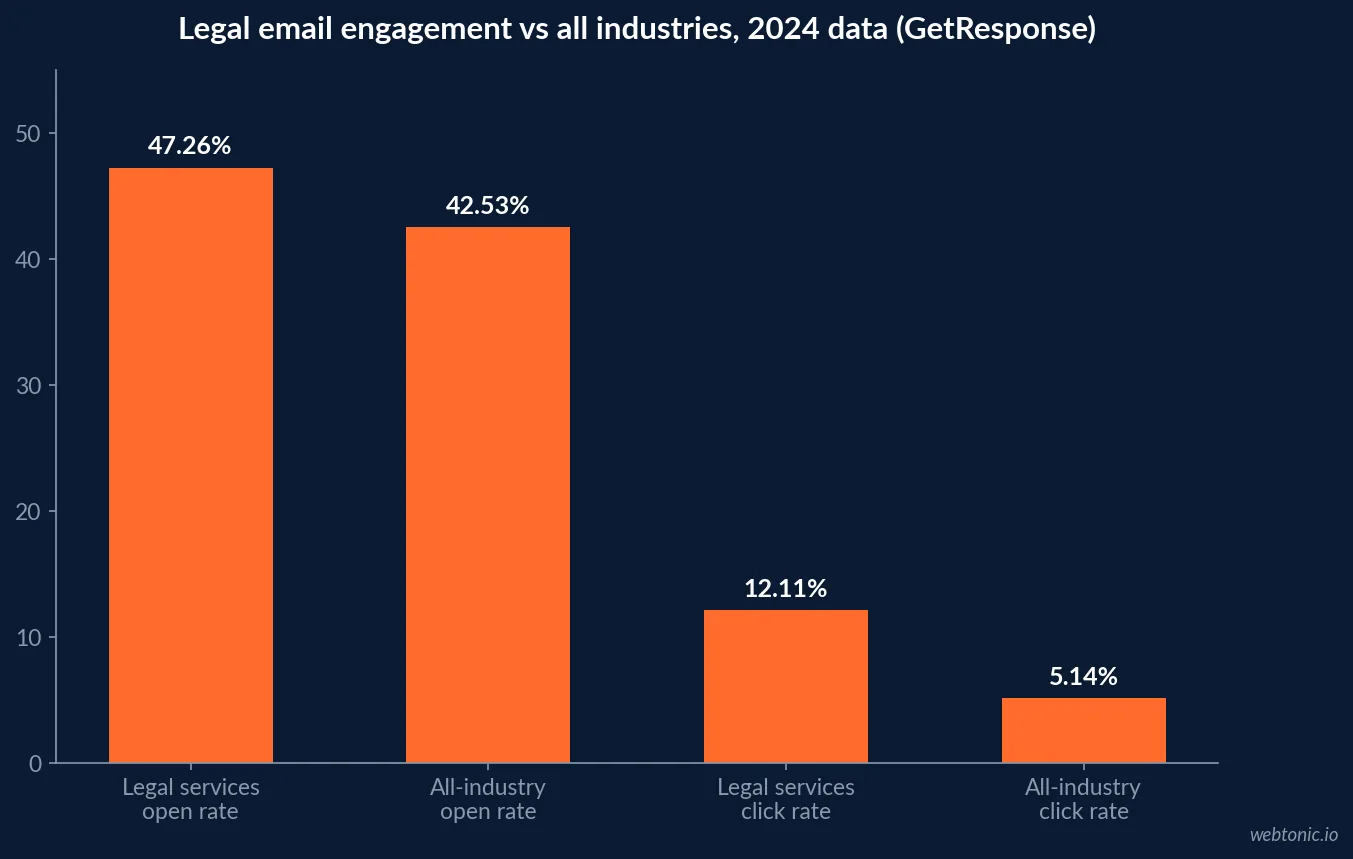
| Metric, legal services (2024 report, 2023 data) | Legal figure | All-industry average | Source |
|---|---|---|---|
| Open rate | 47.26% | 42.53% | GetResponse |
| Click-through rate | 12.11% | 5.14% | GetResponse |
| Click-to-open rate | 25.63% | 11.95% | GetResponse |
| Unsubscribe rate | 0.17% | 0.14% | GetResponse |
| Bounce rate | 2.39% | 2.79% | GetResponse |
What the more recent data shows
No newer legal-specific edition of the GetResponse report has been published since 2024, so the most recent broadly cited comparison point is Constant Contact's own Legal Services industry averages, which places the Legal industry at a 20.29% open rate and an 11.31% click-through rate. That click rate sits much closer to the 2024 spike of 12.11% than to the pre-2024 baseline of 3.2%, which reads as legal subscriber engagement holding near its elevated level rather than fully normalizing back down.
The two reports use different sample compositions and years, so the comparison is directional, not a controlled year-over-year study - but the direction itself, a sharp spike followed by a cool-down, is the useful signal for setting realistic targets.
Why immigration email likely rode this swing harder
GetResponse's own explanation for the 2024 spike is "exceptional regulatory news density" that year, and immigration law was squarely inside that density: 2023 and 2024 both carried major USCIS policy shifts and enforcement-priority changes that would plausibly push subscribers with an open case to click through to a case-specific update far more often than a routine newsletter would expect. Neither GetResponse nor Constant Contact isolates immigration inside their legal-industry figures, so this is a reasonable inference from the timing, not a sourced immigration-specific number.
The underlying caseload has not eased since. The American Immigration Council's analysis of USCIS data puts pending cases at 12.1 million for FY2026 Q2, up 7.2% year over year, and TRAC puts the Immigration Court backlog at 3,092,988 cases as of August 2026. A list built from people with an open matter in that backlog has structural reasons to keep clicking on status updates, policy explainers and deadline reminders, independent of any single news cycle.
The closer, still-imperfect legal-specific proxy
Litera's Concep Email Benchmark Report analyzes every campaign sent by hundreds of legal and professional services firms through its own platform each year, which is a tighter proxy than an all-industry vendor table because the sample is actually law firms rather than a mixed business population. Even Litera's report does not break results out by practice area, so an immigration firm reading it should still expect its own numbers to diverge, particularly around filing deadlines, policy announcements and court date reminders that a general professional-services list would not share.
| Data source | What it measures | Immigration-specific? | Best use |
|---|---|---|---|
| GetResponse 2024 report | 4B+ emails, Legal Services category, 2023 data | No | Historical spike reference |
| Constant Contact benchmark data | Cross-vendor legal industry average | No | Current planning cap |
| Litera Concep annual report | Hundreds of actual law firm sends | No, but closer proxy | Sanity-check firm's own rate |
| A firm's own send history | The firm's actual subscriber base | Yes, by definition | The real target once data exists |
What the click-to-open rate says that the click rate alone does not
Click-through rate mixes two things: how many people open the email and how many of those openers click. GetResponse's 2024 report separates that out with a click-to-open rate of 25.63% for legal services against an all-industry 11.95%, meaning that even after accounting for the unusually high open rate, legal openers clicked at more than double the typical rate. That distinction matters for an immigration firm deciding whether to invest in subject-line testing (which moves opens) or in-body content and calls to action (which moves clicks among people who already opened) - the 2024 data points squarely at the second lever being the one legal audiences respond to.
| Engagement layer | Legal figure (2024) | All-industry figure (2024) | What it isolates |
|---|---|---|---|
| Open rate | 47.26% | 42.53% | Subject line and sender reputation |
| Click-to-open rate | 25.63% | 11.95% | In-body content and calls to action |
| Unsubscribe rate | 0.17% | 0.14% | List fatigue or mismatched frequency |
What to set as an operating target now
Given the gap between the 2024 spike and the 2026 normalization, the more defensible planning assumption for an immigration firm's newsletter is closer to the 20.29% open / 11.31% click range from Constant Contact's data, with the explicit expectation that individual sends tied to a policy announcement, filing deadline or court date can spike well above that baseline the way the whole category did in 2023. Building the send calendar around the backlog and policy calendar, rather than a fixed cadence, is what the 2024 spike actually recommends.
Our data and analytics practice builds that kind of calendar-aware benchmarking; see our email marketing statistics hub for the cross-industry figures this page builds on, or the list of agencies we compare against for context on vendor choice.
Bounce and unsubscribe rates moved less than clicks did
Not every metric swung the way engagement did. GetResponse's 2024 report puts legal-services bounce rate at 2.39%, slightly below the all-industry 2.79%, and legal unsubscribe rate at 0.17% against an all-industry 0.14% - both close enough to the broader average that the click-rate spike looks like a genuine engagement shift rather than a byproduct of list churn or deliverability problems. That distinction matters because a firm seeing a click spike alongside a rising unsubscribe rate would be looking at fatigue, not enthusiasm; the 2024 data shows neither for the legal category as a whole.
The practical read: when an immigration firm's own send around a policy announcement produces a similar click spike without a matching jump in unsubscribes, that is the pattern the 2024 legal data says to expect, not an anomaly to second-guess.
| Health metric (2024 data) | Legal services | All-industry average | Read |
|---|---|---|---|
| Bounce rate | 2.39% | 2.79% | Legal lists were slightly cleaner than average |
| Unsubscribe rate | 0.17% | 0.14% | Marginally higher, not a fatigue signal on its own |
| Spam complaint rate | 0.01% | 0.01% | No difference from the broader average |
What a sensible send cadence looks like against this data
Given a click rate that can move nearly fourfold inside a single reporting year, a fixed weekly or monthly cadence is the wrong model for an immigration firm's newsletter. The 2024 spike happened because subscribers had a concrete reason to click - a policy change that could affect their own case - not because the sender increased frequency. A firm that instead tries to force engagement back up by mailing more often risks pushing the unsubscribe rate toward the higher end of what GetResponse's data considers normal for the category, without recovering the click-through rate that made 2024 unusual in the first place.
The more defensible cadence separates two lists with two different jobs: a lower-frequency general newsletter that holds to something close to the 2026 baseline, and a triggered, policy-news send that goes out only when USCIS, EOIR or a relevant court issues something that changes a subscriber's own case timeline. That structure is what the 2024-to-2026 swing actually recommends, even though no source states it as an explicit best practice.
What still needs an immigration-specific study
Three gaps remain open until a vendor or bar association publishes immigration-specific email data: whether the 2024 spike was driven more by asylum and removal-defense subscribers than by business immigration or family-based petitioners; whether multilingual sends outperform English-only sends for this audience, given the Migration Policy Institute's finding that a large share of immigrants report limited English proficiency; and whether the 25.63% click-to-open figure holds at the same level once isolated to immigration specifically rather than the broader legal category that also includes personal injury and corporate practices. Until then, the legal-category numbers on this page are the most defensible substitute available.
A firm with the send volume to test this internally does not need to wait for a vendor report: split a policy-update send into an English-only and a bilingual version for one quarter, hold everything else constant, and compare the click-to-open rate against the 25.63% legal-category figure above. That single test would close more of the immigration-specific gap than any published benchmark currently can.
Frequently Asked Questions
How did legal email engagement change between 2024 and 2026?
GetResponse's 2024 Email Marketing Benchmarks report, built from more than 4 billion emails sent through its platform in 2023, showed Legal Services jumping from a 3.2% to a 12.11% click-through rate year over year - almost a fourfold increase the report itself calls unusual. The most recent broadly cited figure, Constant Contact's own benchmark data puts Legal at 20.29% open rate and 11.31% click-through rate, which sits closer to the 2024 spike than to the pre-2024 baseline. No immigration-specific cut of either dataset exists, so this describes the legal category as a whole.
Why did legal email clicks spike so sharply in the 2024 data?
GetResponse's own report attributes the jump to what it calls 'exceptional regulatory news density' in 2023, the year its 2024 report measured. That period overlaps with a wave of USCIS policy changes and shifting immigration enforcement priorities, which plausibly pushed subscribers on immigration- and compliance-adjacent lists to click through to case-specific updates at unusually high rates. Neither GetResponse nor any other source isolates immigration firms specifically inside that number.
What should an immigration firm expect its newsletter open rate to be now?
Absent an immigration-specific study, the two most recent, differently-sourced legal benchmarks bracket a reasonable range: GetResponse's 2024 report (2023 data) showed a 47.26% open rate for legal services, while Constant Contact's benchmark shows 20.29%. The gap between those two numbers reflects different sample compositions and years as much as a real trend, so an operating target closer to the 2026 figure - with spikes expected around major policy announcements - is the more defensible planning assumption.
Does the current immigration backlog affect email strategy?
It supports frequency over silence. TRAC's Syracuse University data shows 3,092,988 cases in the Immigration Court backlog as of August 2026, and USCIS's own figures show 12.1 million pending cases in FY2026 Q2. A caseload that large means subscribers on an immigration firm's list are more likely to have an open matter waiting on a status change, which is the exact trigger the 2024 GetResponse spike suggests drives above-average engagement.
Is a general email vendor benchmark good enough, or does immigration need its own study?
A general benchmark is a reasonable starting cap, not a substitute for a firm's own data. Litera's Concep platform publishes a dedicated legal and professional services benchmark report each year built from actual law-firm sends, which is a closer proxy than an all-industry number, but even that report does not break results out by practice area. Until an immigration-specific study exists, benchmark against the legal category and track the firm's own year-over-year change against these vendor swings.
Sources
GetResponse, 2024 Email Marketing Benchmarks report
Constant Contact, Legal Services industry email averages
Litera Concep, legal and professional services email benchmark
American Immigration Council, USCIS backlog analysis
TRAC Immigration, Syracuse University