Table of contents

A product placement reliably moves brand recognition and purchase interest, but only when the show is genuinely engaging and the placement connects to the plot - and the global market buying that screen time crossed USD 29.6 billion in 2023, per PQ Media's tracking of the category.
Key Takeaways
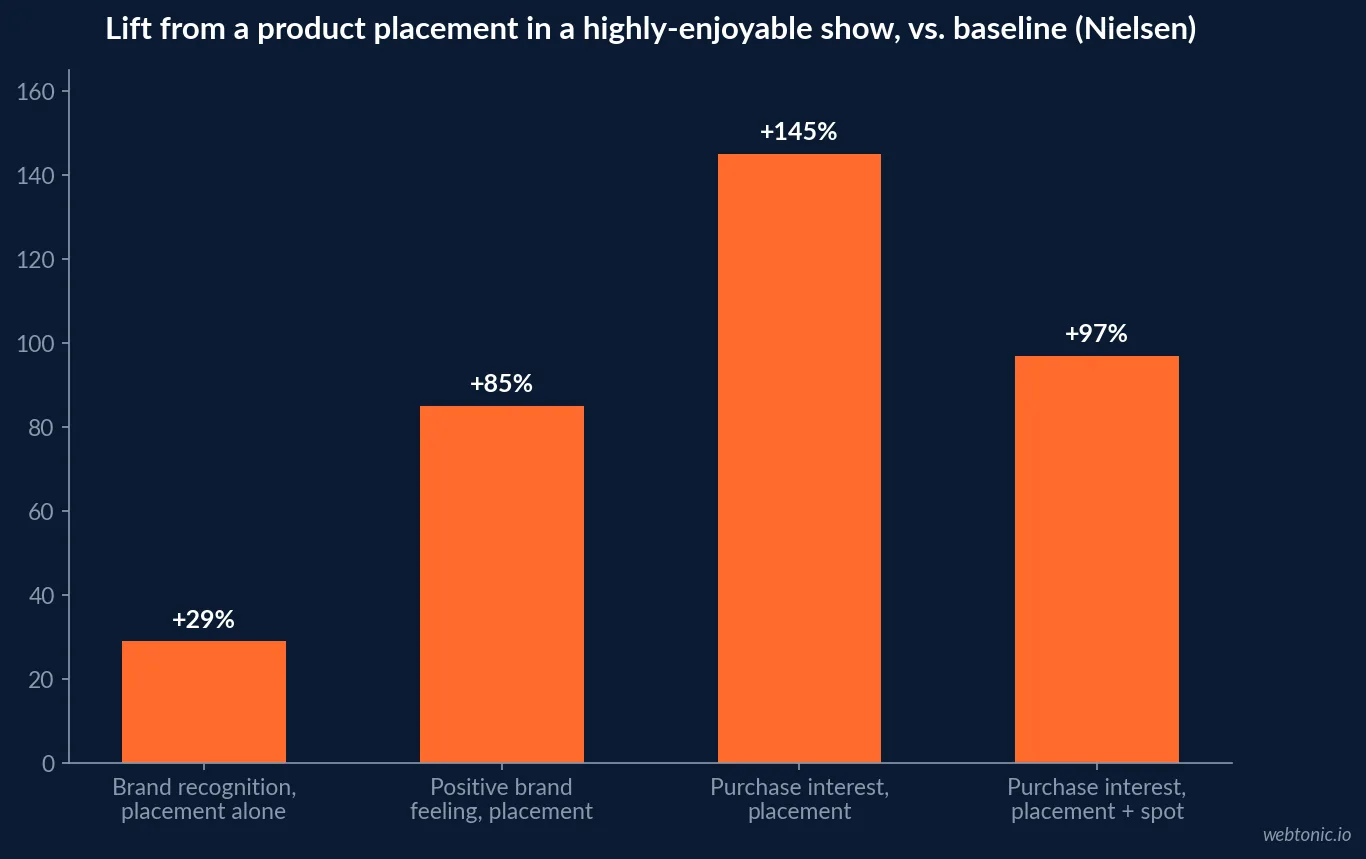
- Global product placement spending hit USD 29.6 billion in 2023, up 12.3% year over year, per PQ Media.
- Spending grew 14.3% in 2022 before decelerating on the 2023 US writer and actor strikes.
- The category declined only 0.7% in 2020, its lone pandemic-year dip in a decade of growth.
- Placements carry a strong, consistent effect on brand memory, per a peer-reviewed meta-analysis.
- Effects on attitude and purchase intention are small-to-modest by comparison.
- Plot-connected placements outperform unconnected ones on both cognitive and attitudinal measures.
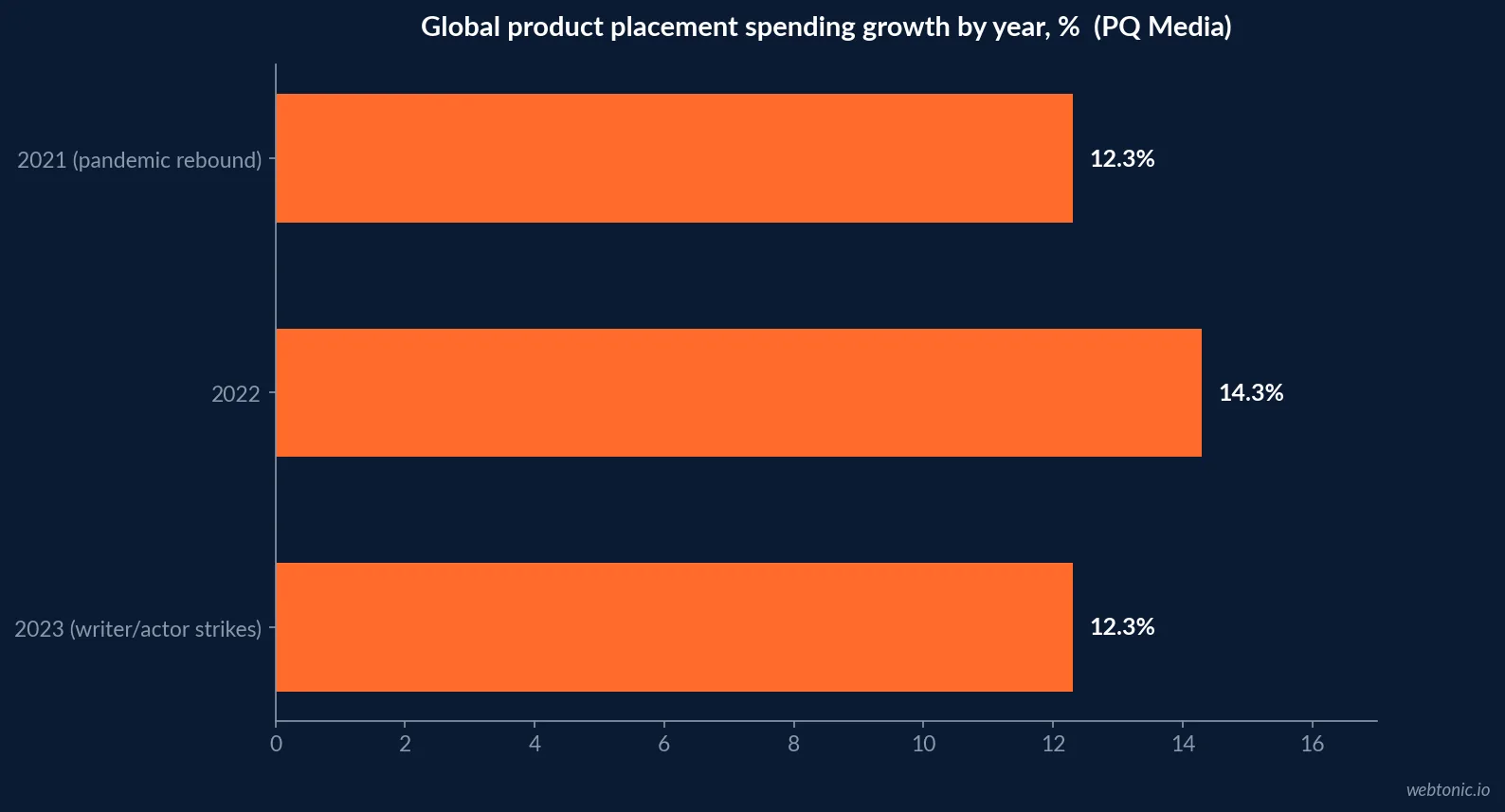
- Brand recognition rose 29% for placements shown during highly-enjoyable programs, per Nielsen.
- Positive brand feeling rose 85% under the same conditions.
- Purchase interest rose 145% for placement-only exposure in enjoyable programming.
- A placement plus a commercial spot rose 97% on purchase interest, the strongest combined effect Nielsen measured.
- Lifestyle programming delivers a 59% recognition boost when the show is highly enjoyable.
- 57.5% of viewers recognized a brand when exposed to both a placement and a commercial, versus 46.6% for the commercial alone.
- Disclosure boosts memory of the placement with no measured backlash on persuasion.
- Dramas that connect emotionally see recognition climb from 30% to 39%, near lifestyle-show levels.
What the market is actually buying
PQ Media, which has tracked branded entertainment spend since launching the original US Product Placement Forecast in 2005, reports global product placement spending growing 12.3% in 2023 to USD 29.63 billion, decelerating from a 14.3% gain in 2022 because of the US writer and actor strikes that shuttered production for months. The category posted ten straight years of double-digit growth from 2010-2019, broken only by a 0.7% decline in 2020 during the pandemic, before rebounding 12.3% in 2021. Nearly fifty years into tracking this below-the-line tactic, PQ Media has recorded only two minor spending declines - evidence that brands treat placement spend as durable media budget, not a discretionary extra.
| Year | Global spend growth | What drove it | Source |
|---|---|---|---|
| 2020 | -0.7% | Pandemic production shutdowns | PQ Media |
| 2021 | +12.3% | Post-pandemic production rebound | PQ Media |
| 2022 | +14.3% | Accelerating streaming and film slate | PQ Media |
| 2023 | +12.3% to USD 29.6B | Growth despite US writer/actor strikes | PQ Media |
What a placement reliably moves - and what it doesn't
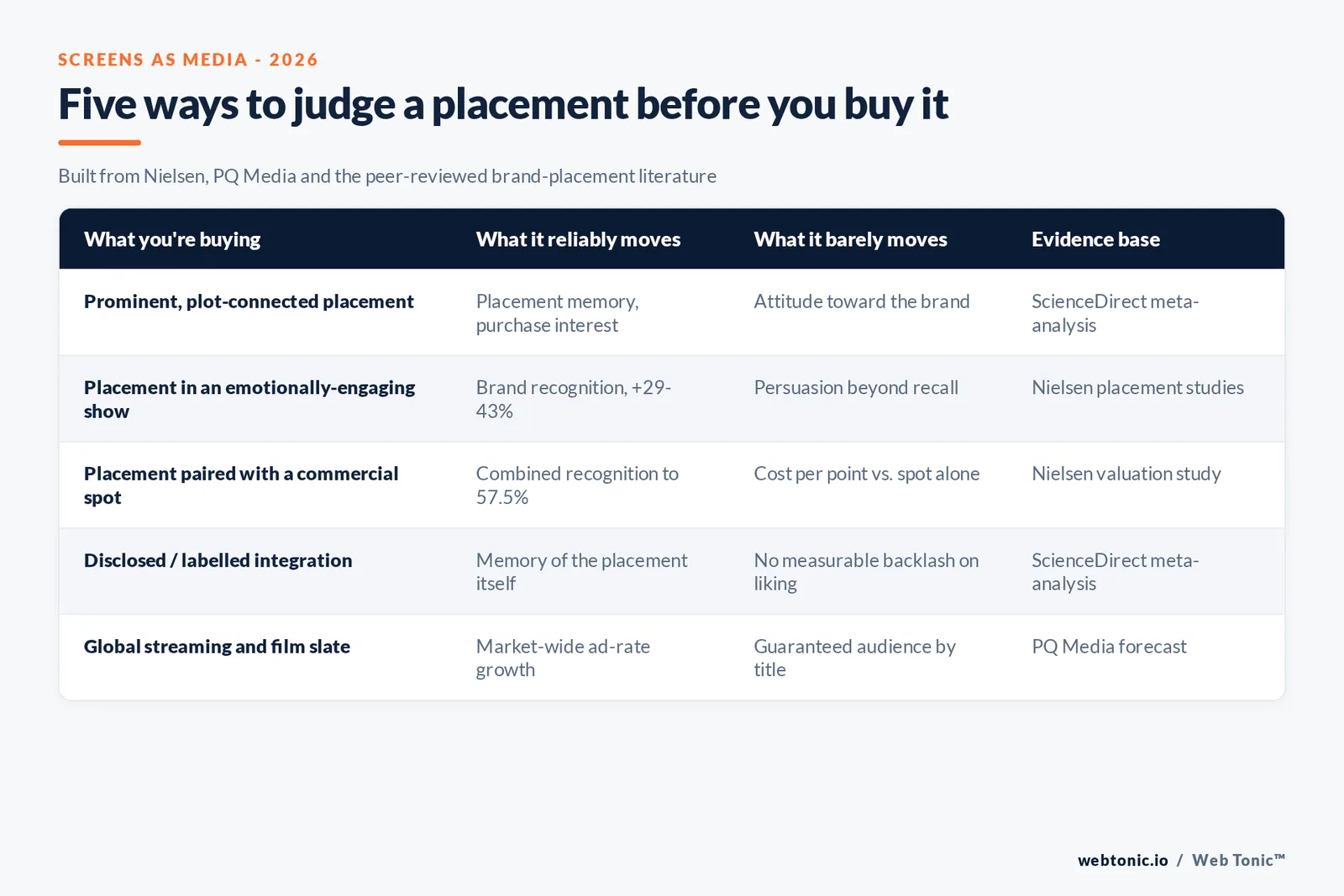
The most rigorous evidence on placement effectiveness comes from a meta-analytic synthesis covering the accumulated academic literature on brand placements. Its central finding is a split effect: placements carry a strong, consistent positive effect on brand placement memory, but only small-to-modest effects on brand salience, consumer attitude and conation (purchase intention or choice). The study identifies plot connection as the executional factor most associated with stronger cognitive and attitudinal effects, and finds that prominent placements boost memory without any measurable backlash on persuasion - meaning a placement does not have to be subtle to avoid annoying the audience.
One counter-intuitive finding: disclosing a placement (labeling it as sponsored or paid content) enhances memory of the placement itself, with no other measurable effect - good news for brands navigating disclosure requirements, since transparency does not appear to cost the brand any of the recall lift it paid for.
| Outcome measured | Effect size (meta-analysis) | Strongest driver | Source |
|---|---|---|---|
| Brand placement memory | Strong, consistent positive | Prominent, well-integrated placement | Journal of Business Research meta-analysis |
| Brand salience | Small-to-modest positive | Repetition across the storyline | Journal of Business Research meta-analysis |
| Attitude toward the brand | Small-to-modest positive | Plot connection | Journal of Business Research meta-analysis |
| Purchase intention / choice | Small-to-modest positive | Plot connection | Journal of Business Research meta-analysis |
| Memory of the placement, when disclosed | Enhanced, no other change | Clear disclosure labeling | Journal of Business Research meta-analysis |
How much program enjoyment amplifies the effect
Nielsen's product placement valuation research, based on a survey of roughly 10,000 individuals across 200 consumer brands and 50 TV programs, quantified exactly how much a placement's performance depends on the show around it. In highly-enjoyable programs, brand recognition rose 29% for placements versus 21% for a standalone commercial spot, positive brand feeling rose 85% for placements versus 75% for spots, and purchase interest rose 145% for placements versus 120% for spots - with the combined placement-plus-spot exposure reaching 97% on purchase interest, the strongest combined lift Nielsen measured. Lifestyle programming specifically delivered a 59% recognition boost when the show was highly enjoyable, and dramas that connected emotionally with viewers saw recognition climb from a baseline 30% to 39%, approaching lifestyle-show levels.
A separate Nielsen valuation study, run over nine months across the same 50 programs and 200 brands, found 57.5% of viewers recognized a brand when exposed to both a placement and a commercial for it, against 46.6% for the commercial alone - the clearest evidence that placement and traditional spot buying compound rather than cannibalize each other.
| Program type / condition | Recognition lift | Notes | Source |
|---|---|---|---|
| Placement, highly-enjoyable program | +29% | Vs. baseline exposure | Nielsen |
| Commercial spot, highly-enjoyable program | +21% | For comparison, same conditions | Nielsen |
| Placement + spot combined | +5% incremental | On top of either format alone | Nielsen |
| Lifestyle programming, highly enjoyable | +59% | Category-specific boost | Nielsen |
| Dramas, emotionally engaging | 30% to 39% | Approaches lifestyle-show levels | Nielsen |
Does placement work the same way across every media type?
The Nielsen and academic data cited throughout this page comes primarily from television, where the measurement infrastructure is oldest and deepest. PQ Media's forecast tracks the category more broadly across TV, film, videogames and music video, and highlights videogame and interactive placements as one of the fastest-expanding channels precisely because they let a brand exist inside a world a player actively controls, rather than a scene they only watch. The core mechanism the meta-analysis identifies - stronger effects when the placement connects to what is actually happening on screen - should generalize across formats, but the size of the effect in games, podcasts and short-form video is measured far less rigorously than the fifty-TV-program Nielsen dataset this page leans on, and buyers should treat placement rates in newer formats as directionally useful rather than precisely benchmarked yet.
What decides the ad rate for a placement
Unlike a spot buy priced on reach and frequency, a placement's rate is negotiated around the show, the scene and the brand's willingness to be woven into the story rather than interrupt it. PQ Media's forecast attributes the category's near-uninterrupted growth over almost fifty years of tracking to two forces working together: placements create emotional connections with harder-to-reach, more mobile and tech-savvy younger audiences, and they stimulate more online engagement with a brand than a spot typically does on its own. That combination is what lets branded entertainment command a premium even when overall ad budgets are under pressure - the rate reflects an audience relationship a commercial break cannot buy at any price.
Streaming has changed who sets that rate. As ad-supported tiers expand across the platforms that once ran commercial-free, placement has become one of the few ways those platforms can carry a brand message without breaking the binge-watching experience a subscriber is paying to avoid interrupting - which is part of why PQ Media's forecast has spending accelerating across the 2022-2026 window even as traditional linear ad budgets flatten.
| Buying factor | What it does to the rate | Why | Source |
|---|---|---|---|
| Plot connection vs. background prop | Raises the rate | Stronger memory and attitude effects | Meta-analysis |
| Highly-enjoyable program vs. average show | Raises the rate | Recognition and purchase-interest lifts scale with enjoyment | Nielsen |
| Paired with a commercial spot | Raises the combined rate | Highest measured combined recognition, 57.5% | Nielsen |
| Ad-supported streaming tier | Raises demand for the format | Preserves the ad-free feel of the platform | PQ Media |
| Production disruption (e.g. strikes) | Slows spend growth, not the rate itself | Fewer slots to buy into, not weaker demand | PQ Media |
Buying placement like measurable media
The throughline across the Nielsen data, PQ Media's spend tracking and the academic meta-analysis is that placement behaves like a measurable media channel with its own attribution profile: strong on recall, moderate on persuasion, and best bought alongside a traditional spot rather than instead of one. That argues for treating a placement buy the way you would treat any other paid channel - with a recall and intent measurement plan attached before the deal is signed, not after the episode airs.
Our performance creative team plans branded integration alongside paid media buys so the two measurement plans share the same intent and recall benchmarks from day one, and our data and analytics practice builds the pre/post recall study that turns a placement deal into a number a board can defend. Talk to us before your next placement deal locks in a spend commitment without a way to prove the lift.
Frequently Asked Questions
Does product placement actually work, or is it a vanity buy?
The peer-reviewed evidence says it works on specific outcomes, not on every outcome. A meta-analytic synthesis in the Journal of Business Research finds placements have a strong, consistent positive effect on brand placement memory, and only small-to-modest effects on brand attitude and purchase intention. Nielsen's own valuation studies found purchase interest lifts of up to 145% for a placement shown during a highly-enjoyable program, so the effect is real, but it concentrates in recall first and persuasion second.
What makes one placement work better than another?
Plot connection and program enjoyment. The same meta-analysis finds that placements connected to the storyline strengthen both cognitive and attitudinal effects compared to placements that just sit in the background, and Nielsen's studies show recognition lifts scale directly with how emotionally engaging the surrounding content is - a placement in a forgettable scene under-performs one in a scene the audience is actually invested in.
How big is the global product placement market in 2026?
PQ Media, the industry's longest-running tracker of branded entertainment spend, reported global product placement spending growing 12.3% in 2023 to USD 29.6 billion, after a 14.3% gain in 2022 and a brief 0.7% decline in 2020 during the pandemic. The category has grown in nine of the last ten years PQ Media has tracked it, interrupted mainly by the 2020 shutdown and the 2023 US writer and actor strikes.
Does disclosing a placement hurt its performance?
Not by the evidence available. The meta-analysis found that disclosure enhances memory of the placement itself with no significant backlash on attitude or purchase intention - viewers remember the brand more, not less favorably, once they know it was placed.
Is a placement a substitute for a traditional commercial, or a complement?
A complement, per Nielsen's valuation research. Viewers exposed to both a placement and a commercial for the same brand showed the highest combined recognition and purchase-interest lifts in Nielsen's testing, ahead of either format alone - which is also why brand integration is typically bought alongside a media plan rather than instead of one.
Sources
PQ Media - Global Product Placement Forecast 2022-2026
Journal of Business Research - The Effectiveness of Brand Placements: A Meta-Analytic Synthesis
Nielsen (via Multichannel News) - Product Placements Succeed in Emotionally Engaging Shows
Nielsen (via HispanicAd) - Nielsen Measures the Impact of Product Placement
YouGov / BENlabs - Product Placement Plotted 2024