Table of contents

Pre-orders convert on certainty, not price. Across more than 1 million transactions, 90.4% carried no discount, and the average cancellation rate sat at just 5.4% - the opposite of the assumption most launch plans start with.
Key Takeaways
- 90.4% of pre-orders are not discounted (PreProduct, 1M+ orders).
- Average cancellation rate is 5.4% across that same dataset.
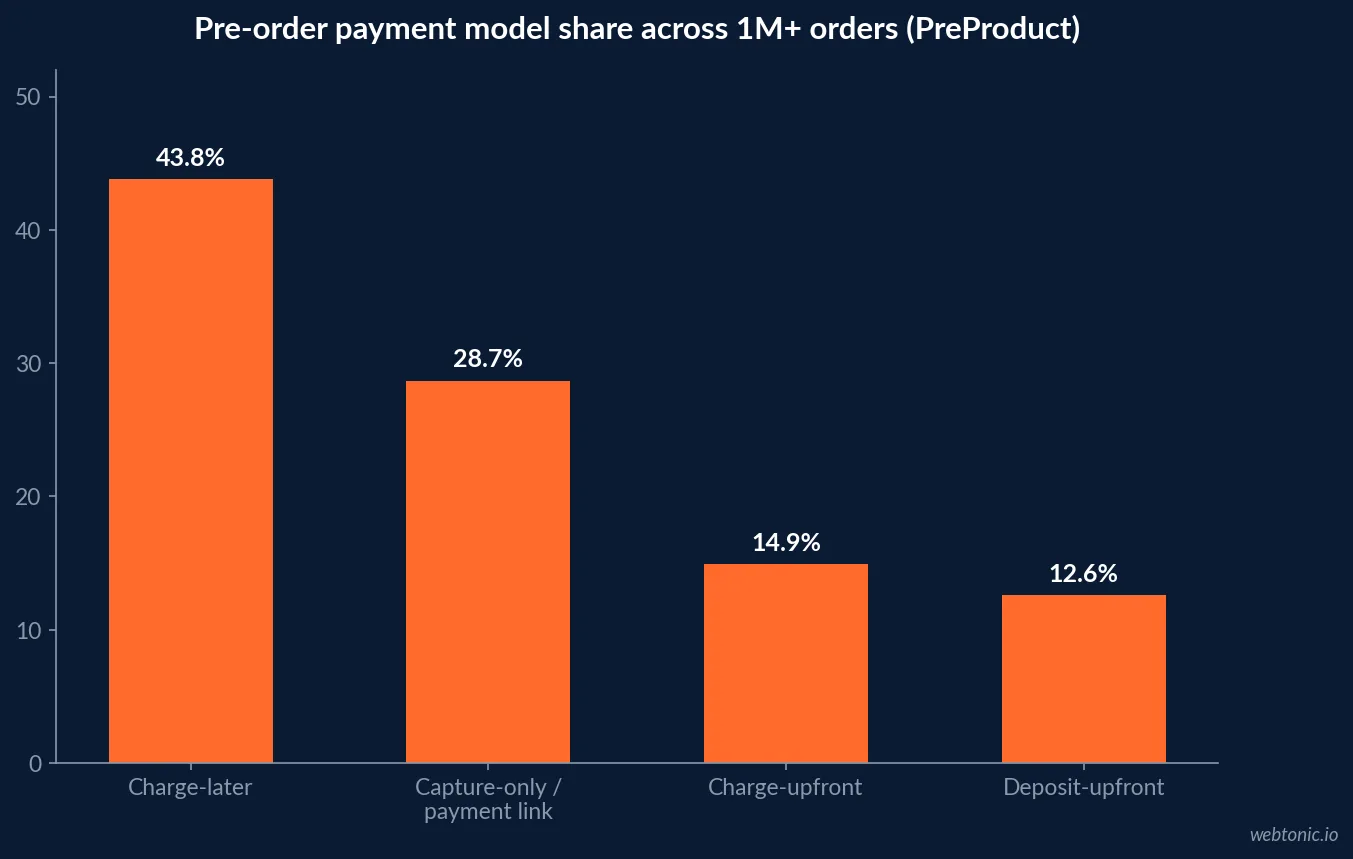
- Charge-later is the dominant payment model at 43.8% of listings.
- Capture-only/payment-link runs 28.7% of listings.
- Charge-upfront (14.9%) and deposit-upfront (12.6%) split the remainder.
- 20.6% of pre-orders ship within 30 days of the order being placed.
- 5,560 Shopify stores booked USD 63.6M in preorders in 12 months (Notify Me, 2026).
- 91% of those preorders were paid in full up front.
- Fewer than 1% of that same dataset cancelled.
- The top 25 Shopify pre-order apps hold 91,805 combined installs across 2.1M tracked stores.
- The single most-installed app holds a 24.6% share of that app category.
- US video game spending hit USD 60.7 billion in 2025, up 1.4% (ESA/Circana/Sensor Tower).
- Hardware spending rose 9% to USD 5.4 billion in that same year.
- 82% of players age 8+ use mobile as their gaming platform.
- Apple's iPhone 18 Pro drew over 7 million China preorders.
- Only 40.7% of active Indiegogo campaigns were confirmed funded in Q1 2026 (TCF Research).
The payment-model mix, and what each one is actually for
PreProduct's analysis of more than 1 million pre-orders totaling over USD 85 million shows the market has settled on charge-later as the default: 43.8% of listings wait to bill the customer until the product is ready to ship. Capture-only or payment-link models cover 28.7%, letting the merchant send a payment request only once fulfillment is imminent. The remaining share splits between charge-upfront (14.9%) and deposit-upfront (12.6%), both of which trade a little conversion friction for cash in hand before the item exists.
| Payment model | Share of listings | When the customer is charged | Best fit |
|---|---|---|---|
| Charge-later | 43.8% | When product is ready to ship | Standard restocks, seasonal drops |
| Capture-only / payment link | 28.7% | When merchant sends the link | Limited runs, made-to-order |
| Charge-upfront | 14.9% | Immediately at checkout | High-demand, low-cancellation-risk items |
| Deposit-upfront | 12.6% | Partial now, balance later | Capital-intensive or custom builds |
Why the discount instinct is usually wrong
The most counter-intuitive number in the PreProduct dataset is also the most useful one for planning: 90.4% of pre-orders carry no discount whatsoever. Customers who pre-order are buying certainty - being first in line, guaranteeing they get the item at all - not chasing a markdown. Layering in a discount on top of that motivation mostly compresses margin without changing the buyer's decision.
Cancellation risk backs up the same story. PreProduct's average cancellation rate is just 5.4% across the full dataset, and Notify Me's 2026 report on 569,000 preorders across 5,560 stores found fewer than 1% cancelled, with 91% paid in full upfront. A committed pre-order buyer rarely walks away; the operational risk sits almost entirely on the merchant's side of the ship-date promise, not the customer's side of the payment.
| Metric | PreProduct (1M+ orders) | Notify Me (569K preorders, 5,560 stores) |
|---|---|---|
| Cancellation rate | 5.4% | Under 1% |
| Share paid in full upfront | 14.9% charge-upfront | 91% |
| Share discounted | 9.6% | Not separately reported |
| Total volume analyzed | USD 85M+ | USD 63.6M over 12 months |
How long buyers will actually wait
The most common ship window in PreProduct's data runs to roughly four to five months out, but the distribution has real weight at the short end too: 20.6% of pre-orders ship within 30 days of the order. That spread matters for how a strategist sets the ship-date promise - committing to the far end of the range when the operational reality sits closer to 30 days needlessly suppresses conversion, while promising 30 days on a product that will actually take five months is the fastest way to inflate the cancellation rate above the 5.4% baseline.
Which apps merchants actually trust with this
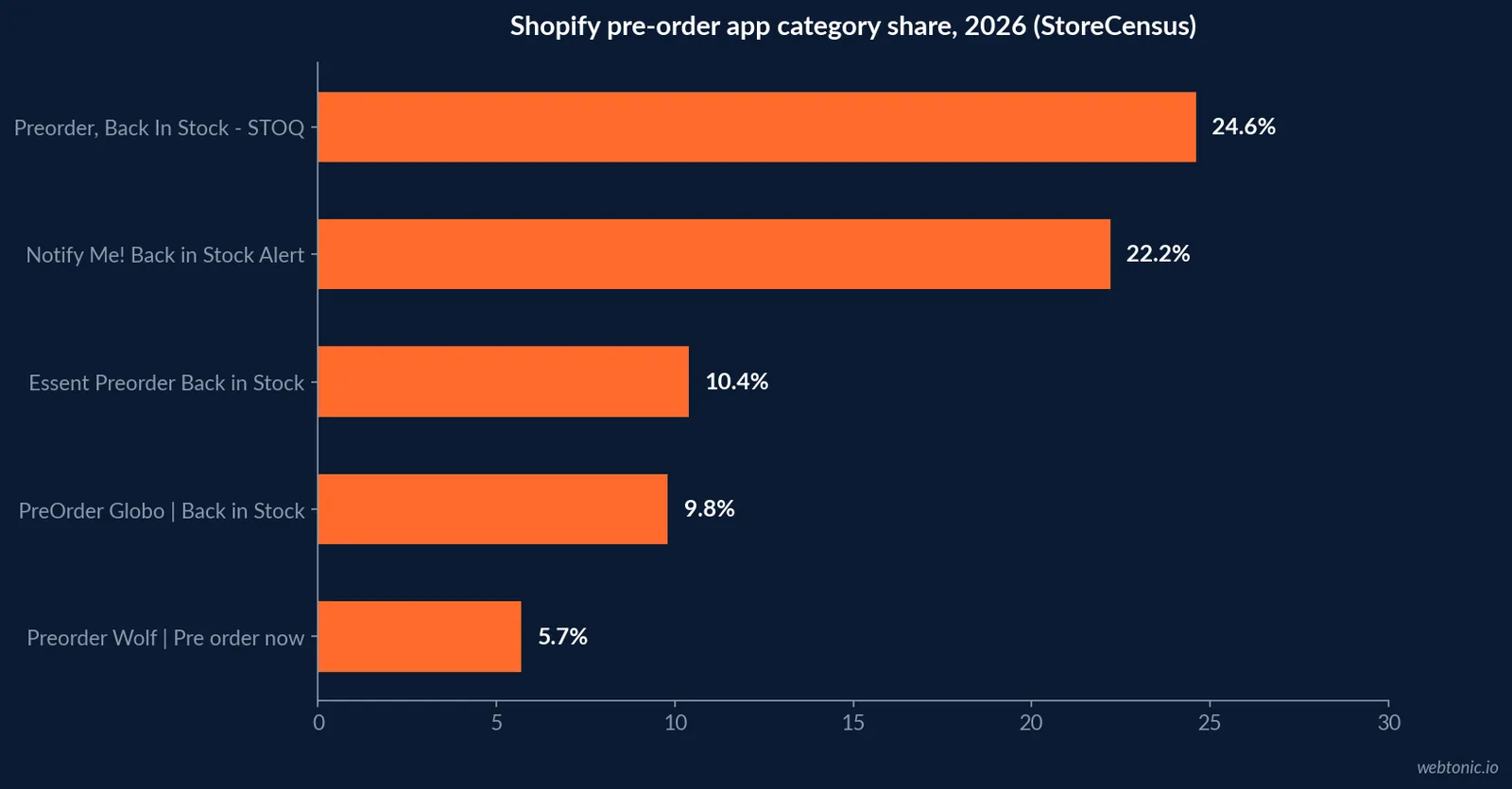
StoreCensus's 2026 tracking of Shopify's app ecosystem shows the top 25 pre-order apps hold a combined 91,805 active installs across 2,125,096 tracked stores. The category leader, Preorder/Back In Stock - STOQ, holds a 24.6% share, with Notify Me! Back in Stock Alert close behind at 22.2%. Together the top two apps already control nearly half the category, which tells strategists this is a mature, consolidated tooling space rather than an experimental one.
| Shopify pre-order app (2026 install data) | Active installs | Category share |
|---|---|---|
| Preorder, Back In Stock - STOQ | 22,595 | 24.6% |
| Notify Me! Back in Stock Alert | 20,386 | 22.2% |
| Essent Preorder Back in Stock | 9,593 | 10.4% |
| PreOrder Globo | Back in Stock | 8,964 | 9.8% |
| Preorder Wolf | Pre order now | 5,227 | 5.7% |
What happens when demand overwhelms the system
Two 2026 launches show what a strategist is actually planning for at the high-demand end of the curve. Nintendo's Switch 2 preorder window opened at midnight and quickly produced sellouts, error messages and even canceled confirmation emails at multiple major US retailers as checkout systems buckled under simultaneous demand. Apple's iPhone 18 Pro reportedly drew over 7 million preorders in China alone, with several retailers selling out in under a minute after preorders opened on September 12, and first three-day revenue reportedly double the prior year's iPhone 17 Pro launch over the same window.
Neither launch ran a discount to hit those numbers. Both ran on a fixed, well-publicized go-live moment and a product buyers already wanted before the page went live - confirming the same pattern PreProduct's aggregate data shows at much smaller scale: certainty and timing convert; price cuts are not the lever.
The category that pre-orders were built to serve first
Video game hardware and software remain the largest structural user of the pre-order model. The Entertainment Software Association, with Circana and Sensor Tower, reports US consumer spending on video games hit USD 60.7 billion in 2025, up 1.4%, with hardware sales rising 9% to USD 5.4 billion - the category most exposed to pre-order-driven launch spikes. Mobile now dominates the platform mix, with 82% of players age 8 and older playing on a mobile device, which is quietly changing where pre-order-style mechanics (early access, founder's packs) actually convert best.
| ESA/Circana/Sensor Tower 2025 US video game data | Figure | Change vs. 2024 |
|---|---|---|
| Total consumer spending | USD 60.7 billion | +1.4% |
| Hardware/console sales | USD 5.4 billion | +9% |
| Subscription service spending | Grew | +20% |
| Accessory sales | USD 2.95 billion | -7% |
| Players age 8+ using mobile | 82% | Dominant platform |
Where reward-based crowdfunding fits, and where it does not
Reward crowdfunding is pre-order economics wrapped in a fundraising product, and it converts on much thinner odds than a standard ecommerce pre-order. TCF Research's Q1 2026 analysis of 551 active Indiegogo campaigns found only 40.7% confirmed funded at the time of capture, with the category's totals heavily skewed by a small number of outlier campaigns. Kickstarter's own 2025 recap reports its curated Open Calls program, which pre-vets creators before launch, running closer to an 80% success rate - a useful reminder that curation and pre-vetting change the odds far more than the pre-order mechanic itself.
| Crowdfunding pre-order data point | Figure | Source |
|---|---|---|
| Indiegogo campaigns confirmed funded, Q1 2026 | 40.7% of 551 tracked | TCF Research |
| Indiegogo campaigns still active at capture | 59.3% | TCF Research |
| Kickstarter Open Calls success rate, 2025 | Close to 80% | Kickstarter |
| New creators supported via Open Calls, 2025 | ~700 first-time, 800 returning | Kickstarter |
What the ship-date promise actually costs when it slips
Every dataset in this piece treats the ship-date promise as the real product being sold, not the item itself. A pre-order buyer has already agreed to wait; what they have not agreed to is waiting past the date they were told. That distinction explains why PreProduct's 5.4% average cancellation rate sits where it does - low, but not zero - and why Notify Me's tighter, shorter-window preorders came in under 1%. The gap between those two numbers is largely a function of how long and how firm the promised window was, not the product category.
For a strategist, that means the ship-date estimate deserves the same rigor as the pricing decision, if not more. A conservative estimate that under-promises and consistently over-delivers will protect the cancellation rate far better than a discount ever will, since discounts do not appear to move the buyer's decision in the first place per the 90.4% no-discount figure above.
A planning checklist for the next pre-order launch
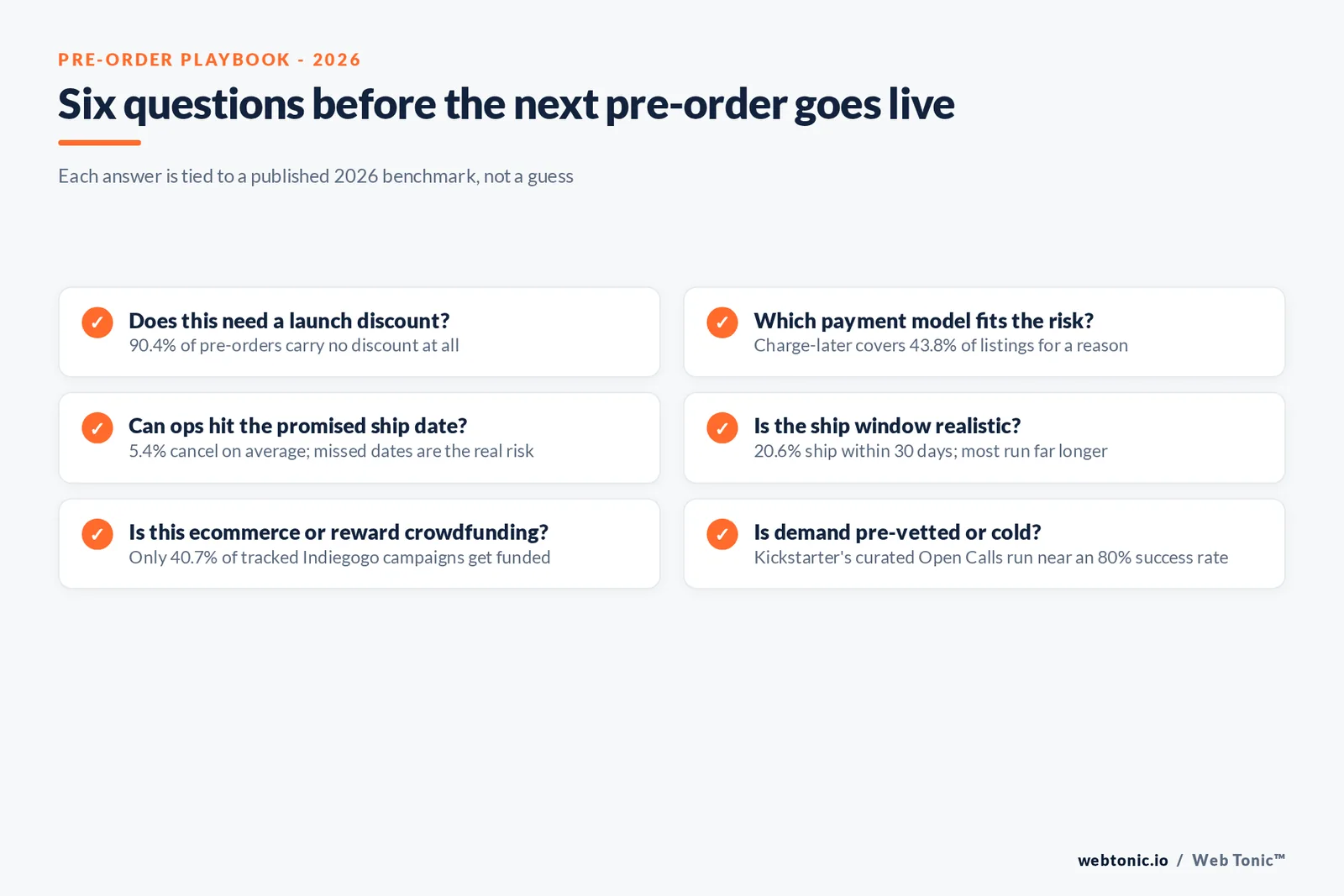
Default to no discount and let scarcity or a firm ship date do the conversion work. Match the payment model to production risk - charge-later for standard restocks, deposit-upfront for anything capital-intensive or custom. Promise a ship window your operations team can actually hit; the 5.4% average cancellation rate is a ceiling worth staying under, not a target. And if the product category leans toward reward crowdfunding instead of direct ecommerce, budget for a sub-45% base funding rate unless the campaign is pre-vetted the way Kickstarter's Open Calls are.
Our growth marketing team builds the launch sequencing around exactly this kind of data before a ship date ever goes public, and our performance creative practice pressure-tests the scarcity and certainty messaging that the highest-converting launches above actually ran on.
The takeaway for strategists building the next launch plan
Pre-order buyers are already convinced; the job of the launch plan is not to persuade them harder with a discount, it is to not break their trust with a missed ship date. Every dataset in this piece, from PreProduct's 1 million orders to Apple's China preorder numbers, points the same direction: certainty converts, price cuts do not move the needle, and the ship-date promise is the only variable worth obsessing over. Talk to us if you want that sequencing built for your next launch.
Frequently Asked Questions
Do pre-orders need a discount to work?
No, and the data says the opposite is closer to true. PreProduct's dataset of more than 1 million pre-orders found 90.4% carry no discount at all. Customers pre-order for access and certainty of getting the item, not to save money, which means a strategist who defaults to a launch discount is solving a problem most pre-order buyers do not actually have.
What is a normal cancellation rate for a pre-order program?
Low, if the product and timeline are credible. PreProduct's average across more than 1 million orders is 5.4%. Notify Me's 2026 report on 569,000 preorders across 5,560 stores found fewer than 1% cancelled. Anything meaningfully above that range signals a mismatch between the promised ship date and what the operation can actually deliver.
Which payment model should a merchant default to?
Charge-later is the market default, used on 43.8% of listings in PreProduct's dataset, followed by capture-only/payment-link at 28.7%. Charge-upfront (14.9%) and deposit-upfront (12.6%) trade some conversion friction for guaranteed cash flow before the item ships - useful for capital-intensive or custom-made goods, riskier for anything with a long or uncertain production timeline.
How much demand can a high-profile hardware pre-order actually generate?
Enough to break retailer checkout systems. Nintendo's Switch 2 launch saw preorders sell out within minutes at multiple major US retailers and crash order flows at more than one chain. Apple's iPhone 18 Pro reportedly drew over 7 million preorders in China alone, with some retailers selling out in under a minute of preorders opening. Neither event required a discount; both ran on scarcity and committed launch dates.
Is crowdfunding a form of pre-order, and does it convert differently?
Yes, and it runs on far thinner odds. TCF Research's Q1 2026 analysis of 551 active Indiegogo campaigns found only 40.7% confirmed funded at time of capture, with results heavily skewed by a handful of outlier campaigns. Reward-based crowdfunding pre-orders should be modeled as a fundraising product with pre-order economics layered on top, not treated like a standard ecommerce pre-order button.
Sources
PreProduct - How pre-orders work, data from 1M+ orders
Notify Me - The Preorder Advantage, 2026 report
StoreCensus - Most popular Shopify pre-order apps, 2026
Entertainment Software Association - 2025 US video game spending
Kickstarter - 2025 stats and Open Calls recap
TCF Research - Q1 2026 Kickstarter and Indiegogo report
AP News - Nintendo Switch 2 preorder demand
PhoneArena - iPhone 18 Pro China preorder reports