Table of contents
Somewhere around 4.5 million podcasts exist right now, according to Listen Notes' podcast database, and search engines can't listen to a single one of them. Google, Bing, and every AI tool built on top of them can only read text, which means a brilliant 45-minute conversation is invisible to search unless something turns it into words on a page.
Podcast SEO is that translation work: turning episodes into content search engines can actually crawl, rank, and recommend. This guide covers exactly how to make that happen, from keyword research to the platforms that matter most in 2026.
Key Takeaways
- Search engines can't process raw audio. Podcast SEO works by surrounding each episode with text, titles, descriptions, show notes, and transcripts, that search engines and podcast platforms can actually read.
- A single 30-minute episode transcribes into roughly 5,000 to 8,000 words, the equivalent of several blog posts worth of indexable content from one recording.
- YouTube now holds a 39 percent share of monthly US podcast consumers, the highest of any single platform, and 31 percent of listeners discover new podcasts there.
- Web browser podcast listening rose from 5.4 percent to 7.3 percent of total listens between June 2024 and January 2025, meaning more listeners are finding shows through direct search rather than dedicated apps.
- Transcripts are the single biggest SEO lever available, since they unlock long-tail keyword rankings a title and description alone never could.
- Podcast SEO happens on two fronts at once: inside podcast platforms like Apple Podcasts and Spotify, and on your own website, where the real search engine indexing takes place.
What Is Podcast SEO?
Podcast SEO is the practice of optimizing a podcast's titles, descriptions, show notes, and supporting website content so episodes become discoverable through search engines and podcast platforms alike. It borrows the same fundamentals as any search engine optimization work, relevant keywords, clear structure, internal links, but adapted to a format search engines can't natively read.
That adaptation matters because of a hard technical limit. Google's strength lies in deciphering written content, and while some direct audio indexing exists, it remains inconsistent and limited. Everything reliable about podcast search still comes down to the text surrounding the audio: episode titles, descriptions, and the show notes published alongside each release. Whatever the platform, the goal is the same. A podcast should be findable by people who don't already know it exists, not just by an audience that already follows the show.
YouTube Has Become a Major Podcast Platform
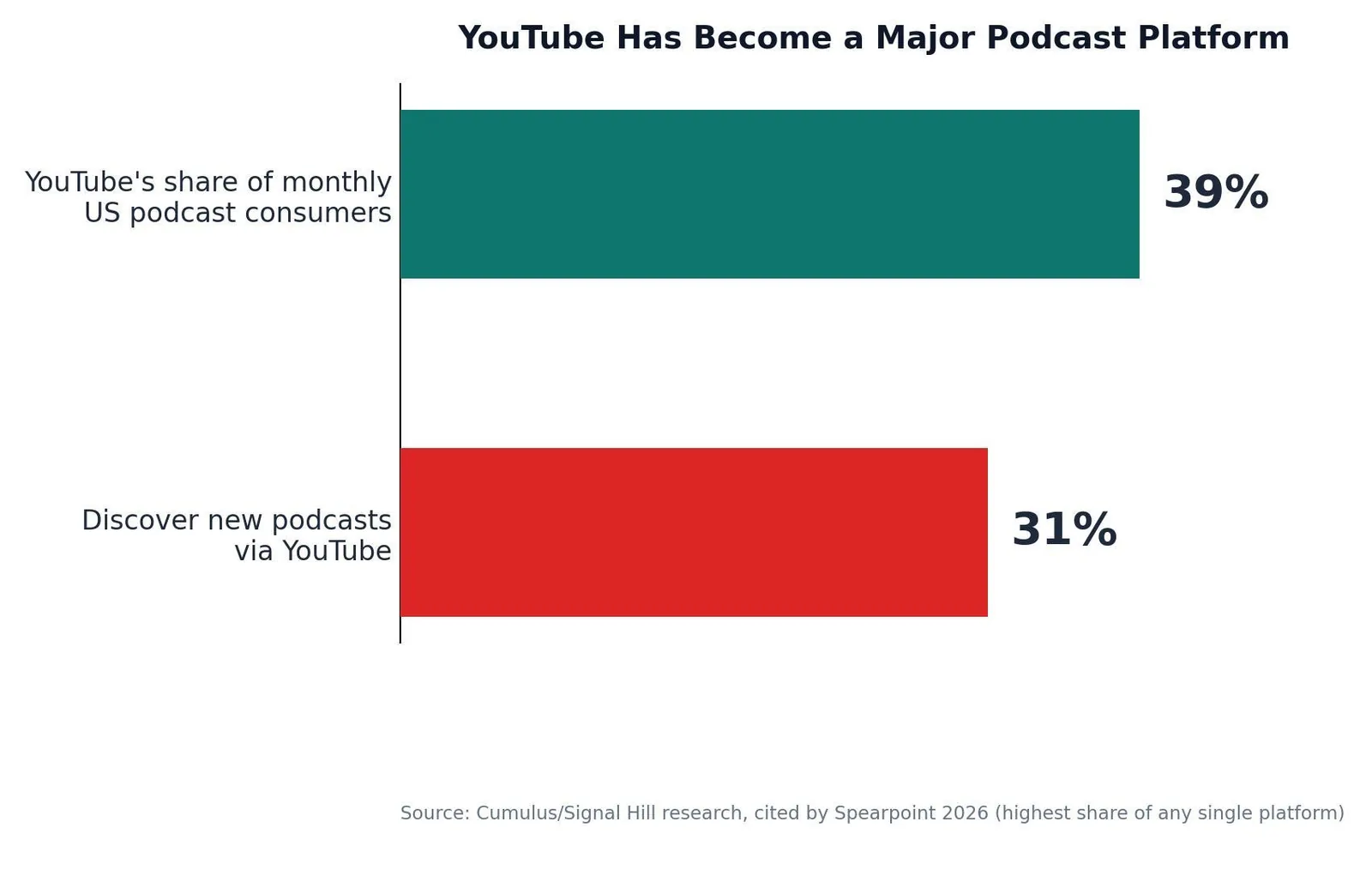
The platform landscape shifted meaningfully in the past two years. According to Cumulus/Signal Hill research, corroborated directly by Cumulus Media and Signal Hill Insights' own Spring 2025 Podcast Download report, YouTube has surpassed traditional podcast apps as the primary discovery channel in the US, holding a 39 percent share of monthly podcast consumers, ahead of Spotify and Apple Podcasts. Separately, 31 percent of listeners report discovering new podcasts specifically through YouTube, making it the second most common discovery method after podcast apps themselves.
That shift means optimizing only for Apple Podcasts and Spotify now leaves a meaningful discovery channel untouched. Video versions of episodes, even simple static-image uploads with captions, extend a show's reach into a platform many podcasters still treat as an afterthought.
One Episode, Multiplied Into Searchable Text
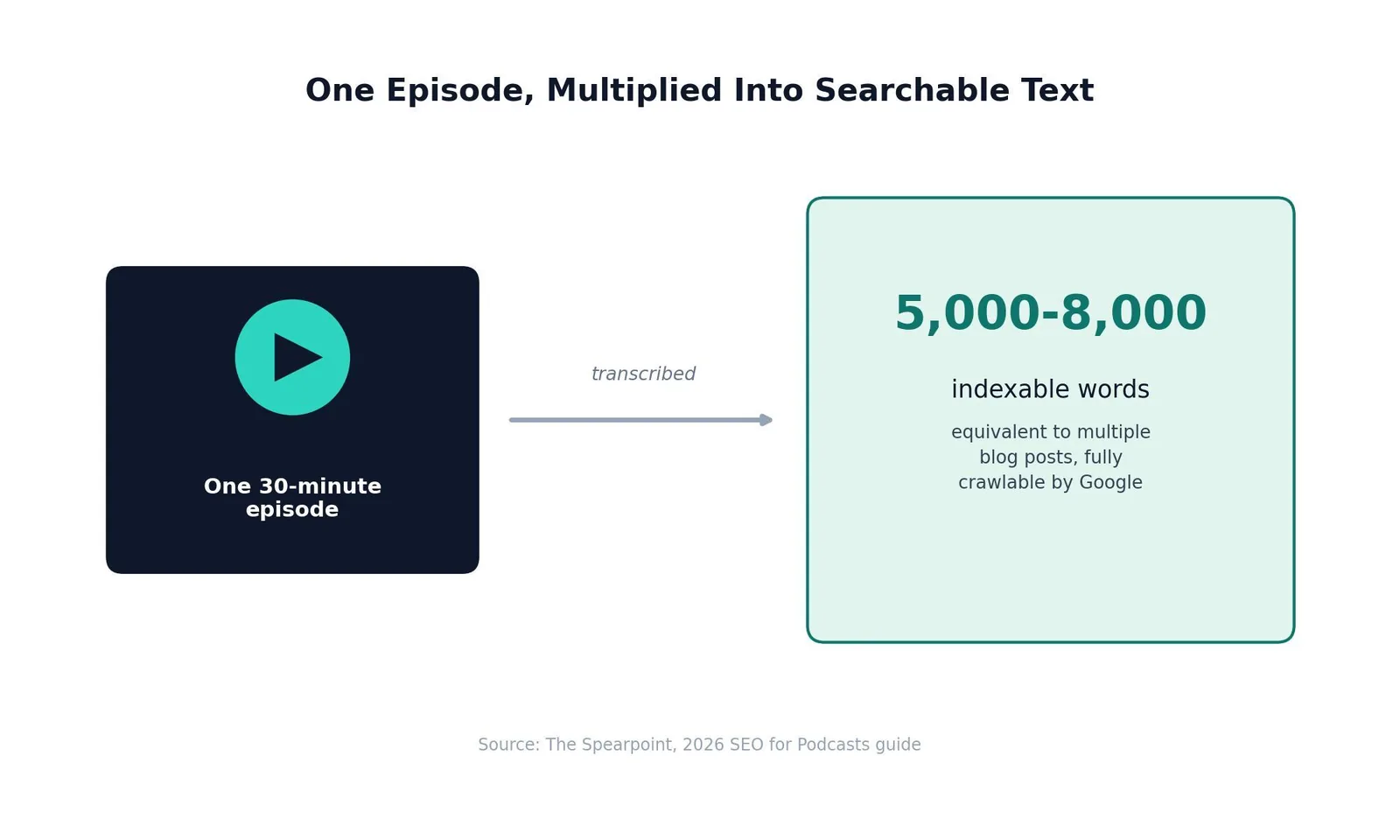
Transcripts are where the real SEO leverage lives. A single 30-minute episode typically produces 5,000 to 8,000 words once transcribed, according to The Spearpoint's 2026 guide to SEO for podcasts, roughly the equivalent of several full blog posts generated from a single recording session. That volume of text opens the door to ranking for long tail keywords and natural phrase variations that a short episode description could never capture on its own.
Podcast Discovery Platforms Compared
| Platform | How It Ranks Content | Optimization Focus | Reaches Google Search? |
|---|---|---|---|
| Apple Podcasts | Internal algorithm, category-based | Keyword-rich title, description, categories | No |
| Spotify | Internal algorithm, listener behavior | Description, categories, engagement signals | No |
| YouTube | Google-owned video algorithm | Title, description, captions, thumbnails | Yes, indirectly |
| Your own website | Standard Google indexing | Episode pages, transcripts, internal links | Yes, directly |
Only your own website gives you full control over what Google actually indexes. Apple Podcasts and Spotify operate closed ecosystems with their own internal search, useful for in-platform discovery, but invisible to general web search unless the same content also exists on a page search engines can crawl.
Browser-Based Podcast Listening Is Growing
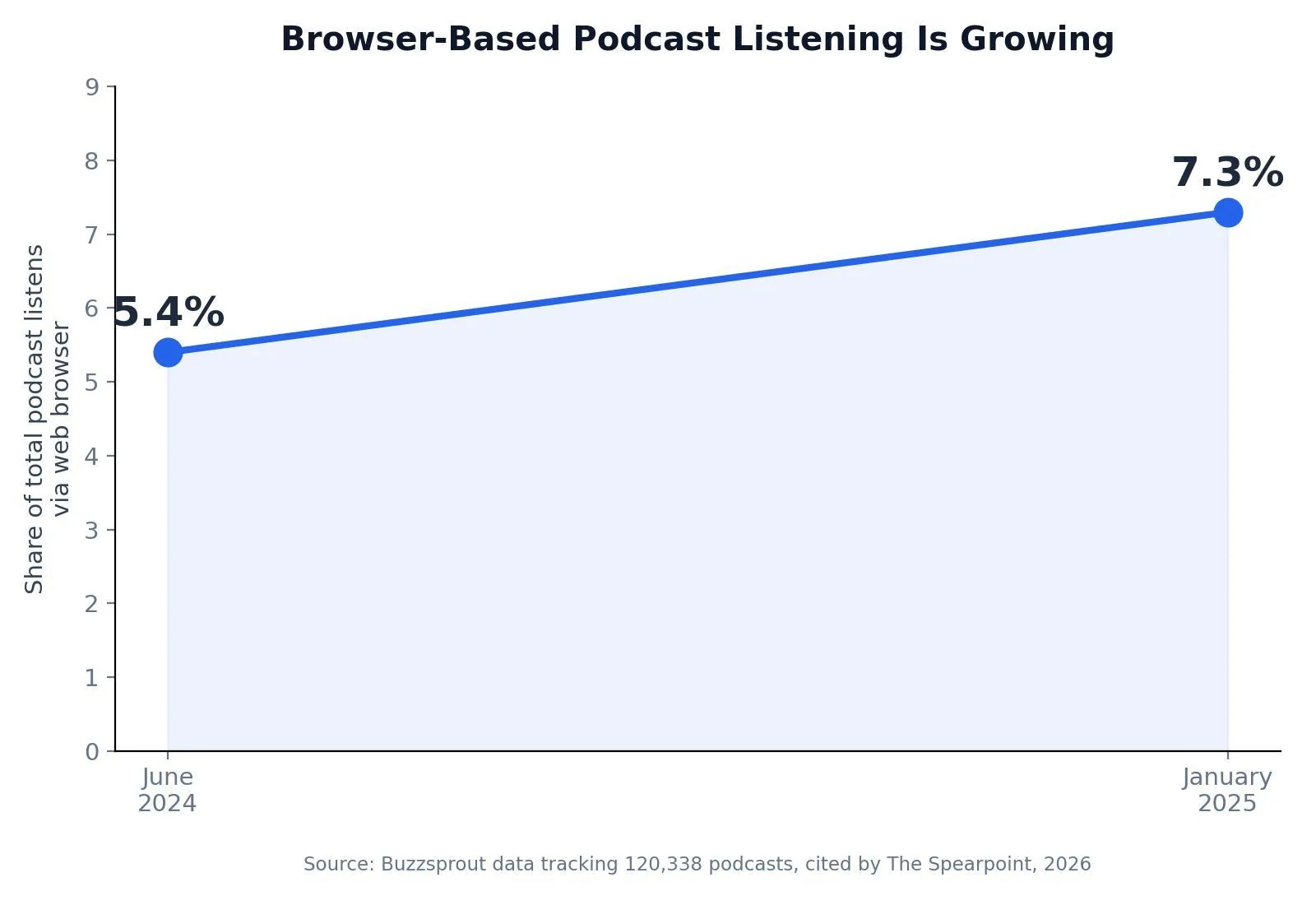
Direct search is becoming a bigger part of how people find shows. Buzzsprout data tracking 120,338 podcasts found that web browser listening rose from 5.4 percent of total listens in June 2024 to 7.3 percent by January 2025. That trend signals more listeners finding episodes through a direct Google search rather than opening a dedicated podcast app first, which makes a well-optimized episode page more valuable than it was even a year ago.
Podcast SEO tool
Is your latest episode SEO-ready?
Check off what this episode already has. Your score updates as you go.
0 of 5
Check off items above to see how discoverable this episode really is.
The Podcast SEO Roadmap
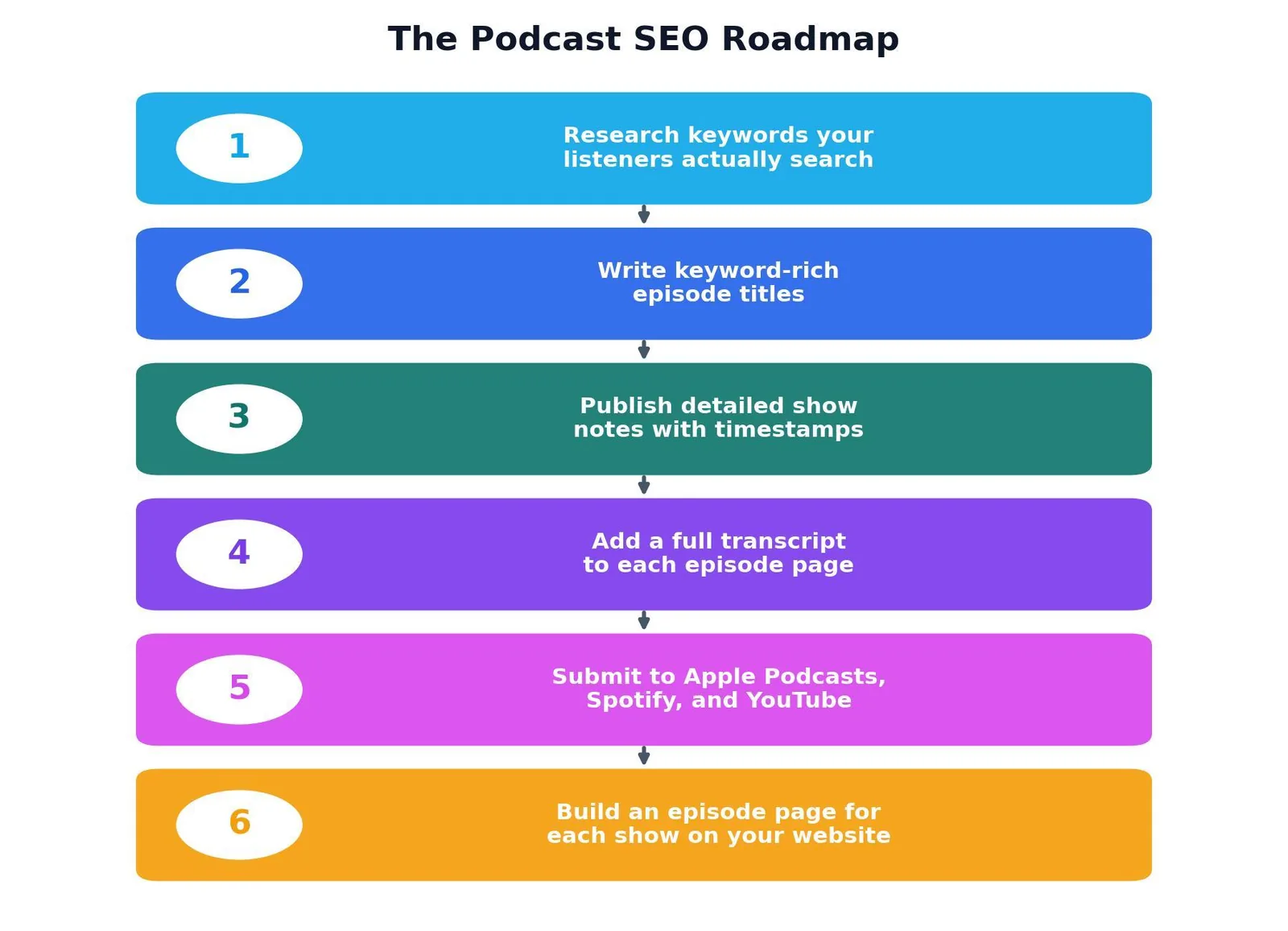
Step 1: Research keywords your listeners actually search
Identify relevant keywords tied to your niche before recording, not after. People searching for a topic use fairly predictable phrasing, and knowing it in advance shapes both the episode content and the title. This is also where a show defines who it's actually for. A clear, specific niche will consistently outperform a broad one when it comes to building a loyal, searchable audience.
Step 2: Write keyword-rich episode titles
Avoid vague names like "Episode 42." A descriptive, keyword-rich title tells both listeners and search engines exactly what the episode covers, and it's one of the most important ranking elements available for any single episode.
Step 3: Publish detailed show notes with timestamps
Show notes summarize the episode, reinforce important keywords, and, when paired with timestamps, help both podcast directories and impatient listeners find the exact moment they care about.
Step 4: Add a full transcript to each episode page
A transcript turns an audio file into a fully crawlable page. This single step helps search engines understand the entire content of an episode, not just the fragment captured in a short description.
Step 5: Submit to Apple Podcasts, Spotify, and YouTube
Distribution across Apple Podcasts, Spotify, and YouTube covers the platforms where people actually search for and discover new shows, each with its own internal algorithm worth optimizing for separately.
Step 6: Build an episode page for each show on your website
Every episode deserves its own page: title, embedded audio or video, show notes, transcript, and links to related episodes. This is what actually gets indexed by Google search, since the podcast platforms themselves largely don't.
Step 7: Repurpose clips for social media
Short video clips pulled from an episode and posted to social media extend a show's reach well beyond people already searching for it. It won't directly move a Google ranking, but it drives the same kind of discovery traffic YouTube does, and it gives people a reason to seek out the full episode afterward.
Common Podcast SEO Mistakes to Avoid
The most common one is publishing episodes without any transcript, which forfeits the single biggest source of indexable, keyword-rich content available from the recording itself.
Vague, non-descriptive episode titles are a close second. They waste one of the highest-leverage ranking signals a podcast has, since a title has to work for both human browsing and search engine matching.
YouTube gets treated as an afterthought more often than it should, given that the platform now holds a larger share of monthly podcast consumers than either dedicated app, and ignoring it means missing real discovery volume.
Skipping a dedicated website entirely rounds out the list, and it leaves a show with no page Google can actually index, no matter how good the audio content itself is.
Frequently Asked Questions
Can Google actually listen to and rank podcast audio directly?
Some direct audio indexing exists, and it's improving, but it remains inconsistent and limited. Google's own Search Central documentation confirms that structured data and on-page text are what its systems reliably read and use for rich results, which is why the reliable path to ranking is still the text around the episode: titles, descriptions, show notes, and full transcripts.
Do I need a transcript for every single episode?
It's the highest-leverage single step available, so yes, ideally. A transcribed episode can produce thousands of words of indexable content that a short description alone never will.
Is podcast SEO the same as optimizing for Apple Podcasts and Spotify?
Not entirely. Those platforms have their own internal search algorithms worth optimizing separately, but neither one feeds directly into Google search results. True podcast SEO also requires a website presence that search engines can actually crawl.
How long does it take to see results from podcast SEO?
Results vary by niche and competition, but consistent publishing with proper show notes and transcripts over several months typically produces noticeable improvements in visibility, similar to the timeline for standard content SEO.
The Bottom Line on Podcast SEO
A great episode that nobody can find performs the same as no episode at all, at least as far as search engines are concerned. Podcast SEO closes that gap by giving every recording a text footprint search engines can actually crawl: a strong title, detailed show notes, a full transcript, and a dedicated page on a website Google indexes directly.
Start with your most recent episode. Add a transcript, tighten the title, and build out the show notes. That one episode becomes the template for every one after it.
More from Web Tonic: growth marketing services, data & analytics.
Sources: listennotes.com · thespearpoint.com · westwoodone.com · developers.google.com