



Table of contents
WordPress powers 36% of contractor websites in the plumbing services trade and remains the dominant CMS for plumbing service firms, but a 47-site benchmarking study reveals that most WP-powered plumbing sites fail basic Core Web Vitals tests and load nearly 4× slower than optimized alternatives.
Key Takeaways
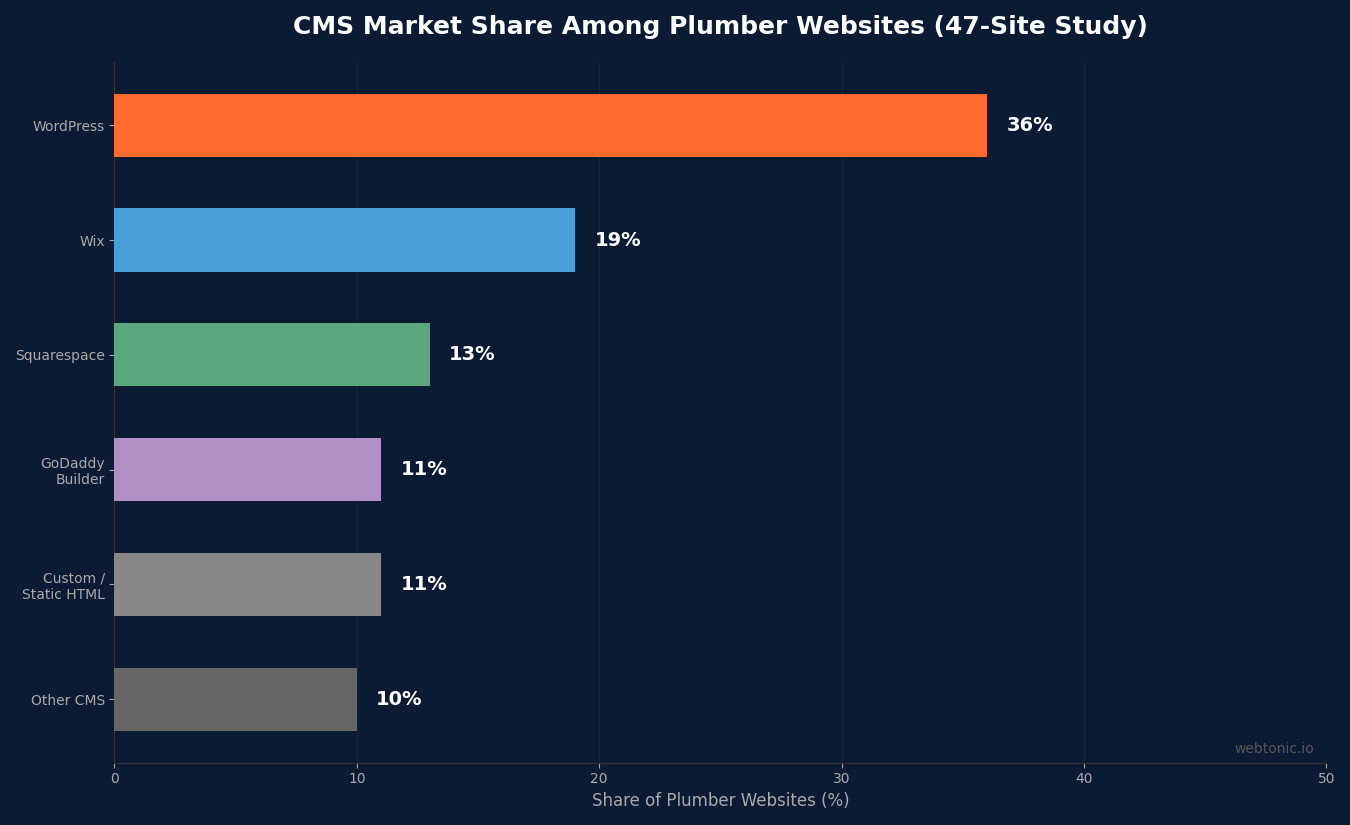
- WordPress holds 36% CMS share among plumber websites in a 47-site study across 15 U.S. cities, followed by Wix at 19% and Squarespace at 13% (Claremont Software, 2026).
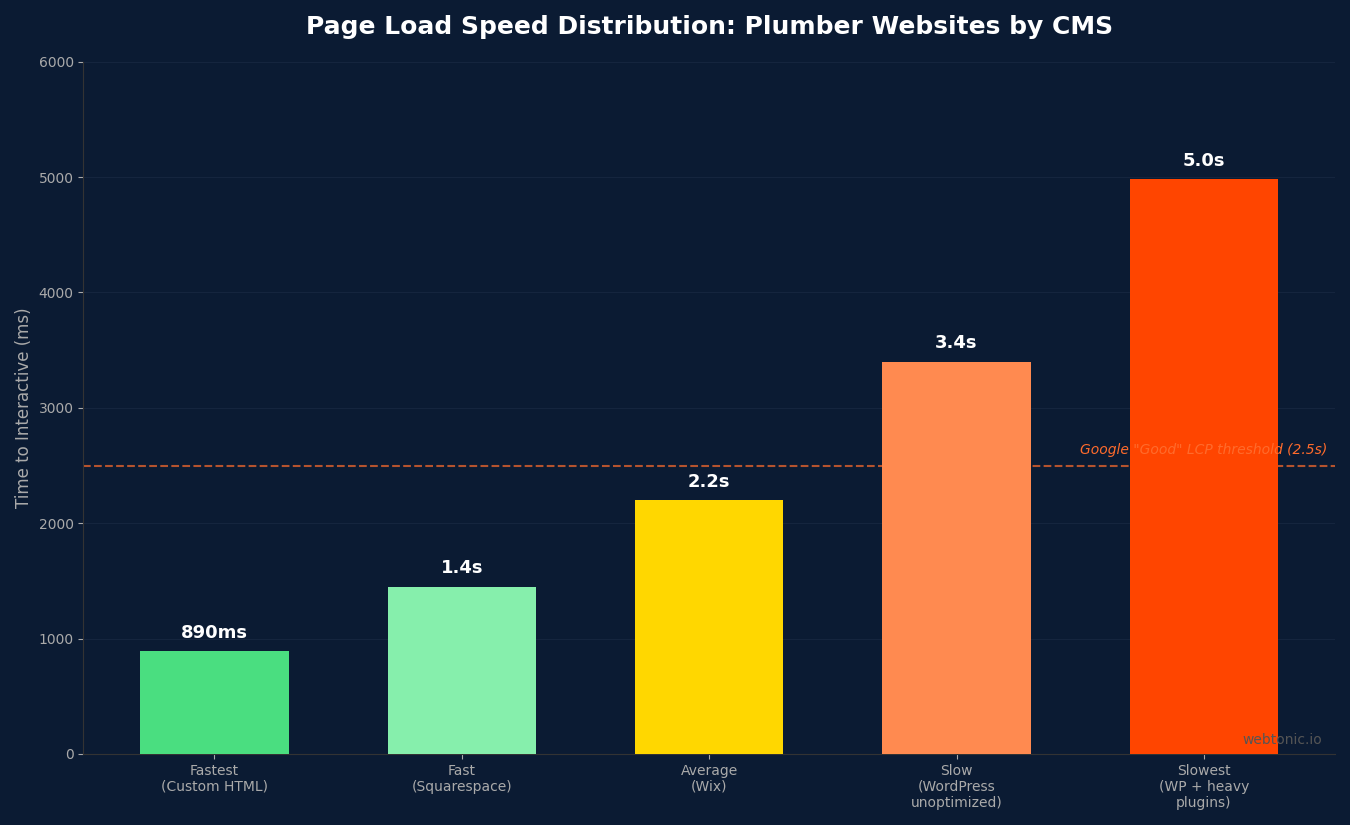
- The average WP plumber website loads in 3.4 seconds, nearly 4× slower than the fastest custom HTML sites at 890ms — and above the 2.5-second threshold that triggers measurable visitor abandonment (Claremont, 2026).
- WordPress commands 43.4% of all websites globally and 59.2% of the identifiable CMS market, making it the undisputed platform leader by any measurement methodology (W3Techs, July 2026).
- Industry-average contractor site conversion sits at 1.5–3%, while top-performing sites achieve 12–16% through five tactical fixes: speed optimization, trust signals, click-to-call placement, form simplification, and review integration (Astra Results, 2026).
- Phone calls convert to booked contractor jobs at 30–50%, compared to just 2–5% for contact forms and 5–15% for chat widgets — making click-to-call the single highest-ROI feature on any WP site (PipelineOn / Invoca, 2026).
- 40% of the 47 analyzed plumber sites had no analytics tracking installed, meaning nearly half the plumbing services trade operates blind with zero visibility into traffic sources or lead attribution (Claremont, 2026).
Plumber Website Performance Data at a Glance
| Metric | Value | Source |
|---|---|---|
| WordPress share of contractor sites | 36% | Claremont 2026 |
| WordPress global website share | 43.4% | W3Techs July 2026 |
| Wix share of contractor sites | 19% | Claremont 2026 |
| Avg. WP load time (unoptimized) | 3.4 seconds | Claremont 2026 |
| Fastest site load time (custom HTML) | 890ms | Claremont 2026 |
| Slowest site load time (WP) | 4,981ms | Claremont 2026 |
| Avg. conversion rate (industry) | 1.5–3% | Astra Results 2026 |
| Top-tier conversion rate | 12–16% | Astra Results 2026 |
| Phone call booking rate | 30–50% | PipelineOn / Invoca |
| Sites without analytics | 40% | Claremont 2026 |
CMS Distribution Among Plumbing Contractor Websites
The Claremont Software 2026 study analyzed 47 contractor websites across 15 U.S. cities, producing the most granular CMS benchmarking dataset available for the plumbing services trade. WordPress leads with 36% adoption, but the study reveals a nuanced picture: WP sites span the full performance spectrum, from highly optimized installations that rival custom builds to bloated sites with 40+ plugins that take nearly 5 seconds to render.
Wix sites accounted for 19% of the sample and produced the study's lowest conversion metrics — including an average conversion rate of just 0.1%. As the Claremont study notes, "Wix may look affordable upfront, but the hidden costs show up in search ranking performance and page speed." Custom and static HTML sites made up 11% of the total and produced the cleanest code by a significant margin.
Page Speed and Core Web Vitals Performance
Speed is where WP-powered plumbing sites face their biggest challenge. The average unoptimized WP site in the study loaded in 3,400ms — well above the 2,500ms LCP threshold that both visitors and crawlers treat as a quality signal. The slowest site clocked in at 4,981ms (nearly 5 full seconds), running an uncompressed WP installation with render-blocking scripts stacking on every page load.
The contrast with the fastest sites is dramatic. Custom HTML sites averaged 890ms — a 3.8× speed advantage that translates directly to lower bounce rates and higher lead capture. Borah Labs' contractor benchmarks confirm this pattern at scale, showing that the gap between "feels instant" and "feels broken" sits precisely at the 2.5-second threshold. For plumbing services firms running WP, the fix path is clear: managed hosting, image compression, plugin pruning (keep under 15 active), and server-side caching can bring load times below 1.5 seconds without rebuilding the site.
Conversion Rate Benchmarks for Contractor Websites
Astra Results' 2026 analysis breaks down the conversion rate landscape for plumbing contractor sites with precision. The industry average sits at 1.5–3%, while top-performing sites achieve 12–16% — an 8–10× gap closed with the same five tactical fixes implemented in the same order over 60–90 days.
| Conversion Fix | Avg. Lift | Implementation Time | WP Complexity |
|---|---|---|---|
| Speed optimization (sub-2s load) | +20–35% | 1–2 weeks | Moderate — hosting + caching plugins |
| Trust signals (reviews, badges, licenses) | +15–25% | 2–3 days | Easy — widget plugins or manual HTML |
| Click-to-call button (sticky mobile) | +40–60% | 1 day | Easy — most themes support natively |
| Form simplification (3 fields max) | +25–40% | 1–2 days | Easy — any form plugin |
| Review integration (inline, not sidebar) | +10–20% | 2–3 days | Moderate — API or embed widget |
Contact Methods: Phone vs. Form vs. Chat for Contractors
PipelineOn's 2026 analysis, drawing on Invoca's home repair conversion study, quantifies the booking rate gap between contact methods. The data is unambiguous:
| Contact Method | Booking Rate | WP Implementation | Best For |
|---|---|---|---|
| Phone (click-to-call) | 30–50% | Native tel: link or sticky CTA plugin | Emergency jobs, high-intent visitors |
| Chat widget | 5–15% | Tawk.to, LiveChat, or chatbot plugin | After-hours inquiries, scheduling |
| Contact form | 2–5% | WPForms, Gravity Forms, Contact Form 7 | Quote requests, non-urgent inquiries |
| Online booking | 8–20% | Radius Booking or BookingOr WP plugin | Scheduled maintenance, recurring visits |
The 6–25× booking rate advantage of phone calls over forms makes click-to-call the single highest-ROI feature on any plumbing service site — WP or otherwise. Yet the Claremont study found that many sites bury their phone numbers below the fold or hide them behind hamburger menus on mobile. A sticky mobile CTA bar with a prominent phone button typically produces the largest single conversion lift available on a WP installation, often delivering measurable growth within the first 48 hours of deployment.
Analytics and Tracking Gaps in the Trade
Perhaps the most striking finding from the Claremont study is that 40% of the 47 analyzed sites had no analytics tracking installed. These firms operate with zero visibility into which pages visitors see, which traffic sources produce leads, or which campaigns generate booked jobs. For WP installations, adding analytics requires a single plugin (Site Kit, MonsterInsights, or a manual header injection) and under 15 minutes of setup — making this gap a matter of awareness, not technical difficulty.
Firms that do track performance gain an immediate competitive advantage. Data intelligence tools connected to WP via API or tag management allow contractors to identify their highest-value pages, optimize underperforming landing experiences, and attribute booked jobs to specific ad campaigns. The firms in the Claremont study running both analytics and call tracking reported significantly higher quote conversion rates than those operating without measurement infrastructure.
Best Practices for Plumber Websites on WordPress
- Prioritize load speed above all other optimizations — moving from 3.4s to sub-1.5s requires managed hosting ($25–$50/month), a caching plugin (WP Rocket or LiteSpeed), image compression (ShortPixel or Imagify), and pruning plugins to under 15 active.
- Implement click-to-call as a sticky mobile CTA — the 30–50% phone booking rate versus 2–5% for forms means every visitor who can't find the phone number represents lost revenue. Place the phone button in the header and as a sticky footer bar.
- Install analytics on day one — 40% of contractor sites lack any tracking. GA4 via Site Kit takes 15 minutes and provides the baseline data needed for every future optimization decision.
- Simplify forms to 3 fields maximum — name, phone, and problem description. Every additional field reduces form completion by 5–10%. Contact form best practices consistently show that shorter forms produce more leads at no quality loss.
- Display reviews inline on relevant pages — embedding testimonials next to the corresponding task type (e.g., drain cleaning reviews on the drain cleaning page) produces 10–20% higher conversion than sidebar or footer placement.
- Run Core Web Vitals audits quarterly — WP themes and plugin updates frequently introduce render-blocking resources. A quarterly CWV check using PageSpeed Insights prevents gradual performance degradation that erodes ad campaign ROI.
WordPress Plugin Ecosystem for the Plumbing Trade
One of WP's strongest advantages for plumbing contractors is its plugin ecosystem. The WordPress.org repository includes specialized tools for the plumbing services trades, including Radius Booking (field scheduling with job type capture and geographic service area filtering) and BookingOr (appointment booking for plumbers, electricians, and HVAC technicians). These integrations give plumbing firms the same online booking and scheduling capability as enterprise platforms — at a fraction of the cost.
Beyond booking, plumbing companies running WP benefit from purpose-built integrations across several categories:
- Reputation management plugins — automated review request emails post-job, inline testimonial display, and aggregate star rating schema injection. These directly support the 10–20% conversion lift from review integration identified in the Astra Results study.
- Call tracking plugins — WP-compatible solutions from CallRail, Invoca, and CallTrackingMetrics insert dynamic number insertion (DNI) into WP themes, enabling attribution of the 30–50% of phone-booked jobs back to specific Google Ads campaigns or landing pages.
- Schema markup plugins — Rank Math and Yoast inject LocalBusiness, FAQPage, and HowTo structured data that help plumbing company pages appear in rich results. Given that 46% of all queries involve local search intent, proper schema dramatically improves Google local map pack visibility.
- Speed optimization plugins — WP Rocket, LiteSpeed Cache, and Autoptimize address the 3.4-second average load time problem. Combined with managed hosting from Cloudways or Kinsta, these tools routinely bring WP sites below the 2.5-second Core Web Vitals threshold.
WordPress vs. Alternative Platforms: Performance by Metric
| Platform | Market Share (Plumbing Sites) | Avg. Load Time | Avg. Conversion Rate | Setup Cost |
|---|---|---|---|---|
| WordPress (optimized) | 36% | 1.2–1.8s | 3–12% | $3,000–$8,000 |
| WordPress (unoptimized) | — | 3.4–5.0s | 0.5–2% | $500–$2,000 |
| Wix | 19% | 2.2s | 0.1% | $200–$800 |
| Squarespace | 13% | 1.4s | 1.5–3% | $500–$2,000 |
| Custom / Static HTML | 11% | 890ms | 2–5% | $5,000–$15,000 |
| GoDaddy Builder | 11% | 2.8s | 0.5–1.5% | $100–$400 |
The data makes a clear case: an optimized WP installation delivers the best balance of customization, conversion performance, and cost for plumbing businesses. The risk with WP lies in the unoptimized deployment — sites built on cheap shared hosting with 30+ plugins routinely perform worse than a simple Squarespace template. The platform is only as good as its configuration, which is why plumbing businesses serious about digital lead generation typically invest $3,000–$8,000 in a properly built WP site rather than a $500 drag-and-drop template.
Mobile Experience and Responsive Design for Plumbing Sites
Over 60% of plumbing-related web traffic now comes from mobile devices — a ratio driven by homeowners searching for emergency plumbing repair help on their phones. The Claremont study found that mobile responsiveness varied dramatically across the 47 plumbing sites analyzed, with several WP-powered sites still serving desktop-width layouts on mobile screens. This creates both a usability and a search ranking penalty, as Core Web Vitals metrics like Cumulative Layout Shift (CLS) are measured on the mobile version of each page.
For plumbing businesses on WP, the mobile experience determines whether a visitor becomes a lead or bounces to a competitor. Sticky click-to-call buttons on mobile produce 40–60% more phone inquiries than sites that require scrolling to find contact information. Combined with mobile-targeted ad campaigns, a well-optimized WP mobile experience creates a direct pipeline from ad click to booked job in under 30 seconds.
Related reading
- PI Law WordPress Stats & Data
- Pest Control WordPress Statistics
- Phone & Tech Retail WordPress Statistics (2026)
- Custom Web Development services at Web Tonic
Frequently Asked Questions
What percentage of contractor websites use WordPress?
WordPress powers approximately 36% of contractor websites according to a 47-site study across 15 U.S. cities. Globally, WP powers 43.4% of all websites and holds 59.2% of the identifiable CMS market.
How fast should a contractor website load?
Under 2.5 seconds — that's the Core Web Vitals LCP threshold. The average unoptimized WP plumber website loads in 3.4 seconds, while top performers hit 890ms. Sites exceeding 2.5 seconds see measurably higher bounce rates and lower lead capture.
What is a good conversion rate for a contractor website?
The industry average is 1.5–3%, but top-performing sites achieve 12–16%. The gap is closed through five tactical fixes: speed optimization, trust signals, click-to-call, form simplification, and review integration — implemented in that order over 60–90 days.
Is WordPress or Wix better for contractors?
WordPress outperforms Wix for contractors by a wide margin. Wix sites averaged just 0.1% conversion in the Claremont study, while WP sites ranged from 1.5% to 12%+ when properly optimized. WP offers superior plugin ecosystem, customization depth, and ownership of the codebase.
What is the most important feature on a contractor website?
Click-to-call functionality. Phone calls book at 30–50% versus 2–5% for forms and 5–15% for chat widgets. A prominent, sticky phone button — visible on every page, especially on mobile — produces the largest single conversion lift on any contractor website.
Sources
Claremont Software — We Analyzed 47 Plumber Websites (2026)
Astra Results — Plumbing Website Conversion: 5 Fixes to Hit 6%
PipelineOn — Chatbot, Form, or Phone: Best Contact Method
Borah Labs — Plumber Website Benchmarks
W3Techs — WordPress vs Wix Usage Statistics (July 2026)
WMTips — Top 25+ Website Builders by Market Share (2026)


