



Table of contents
WordPress powers 43.4% of all websites globally, and its open-source flexibility makes it a natural fit for phone and tech retailers seeking full control over content, product listings, and omnichannel marketing.
Key Takeaways
- WordPress holds a 43.4% share of all websites and dominates the content management system landscape with 62.1% CMS market share (W3Techs, 2025).
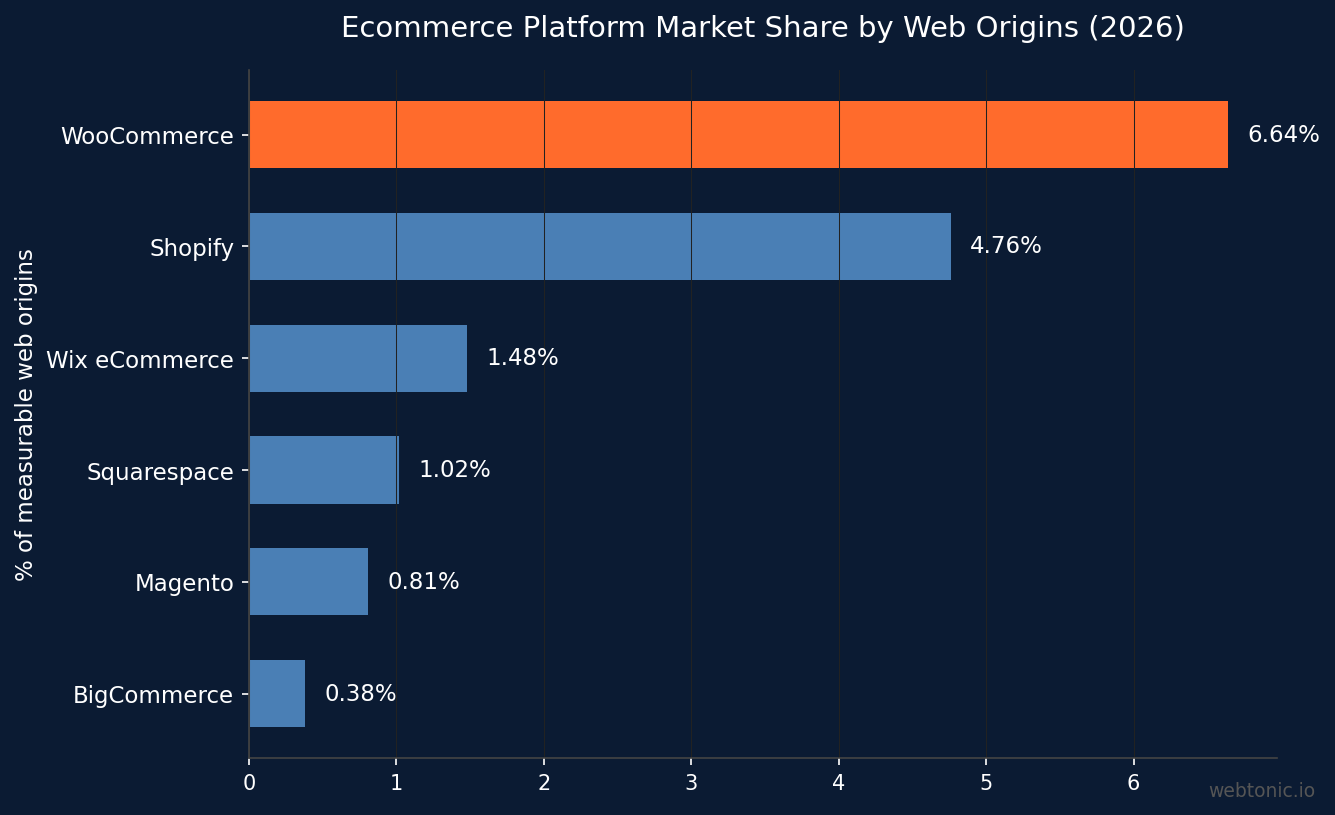
- WooCommerce powers 4.15 million live stores, making it the largest ecommerce platform by web origin count at 6.64% — ahead of Shopify at 4.76% (GravityKit, StoreCensus, 2026).
- Electronics WooCommerce stores carry a median product price of $64.22, 74% above the platform-wide median, reflecting the higher AOV typical of phone and tech retail (BootLeads, 2026).
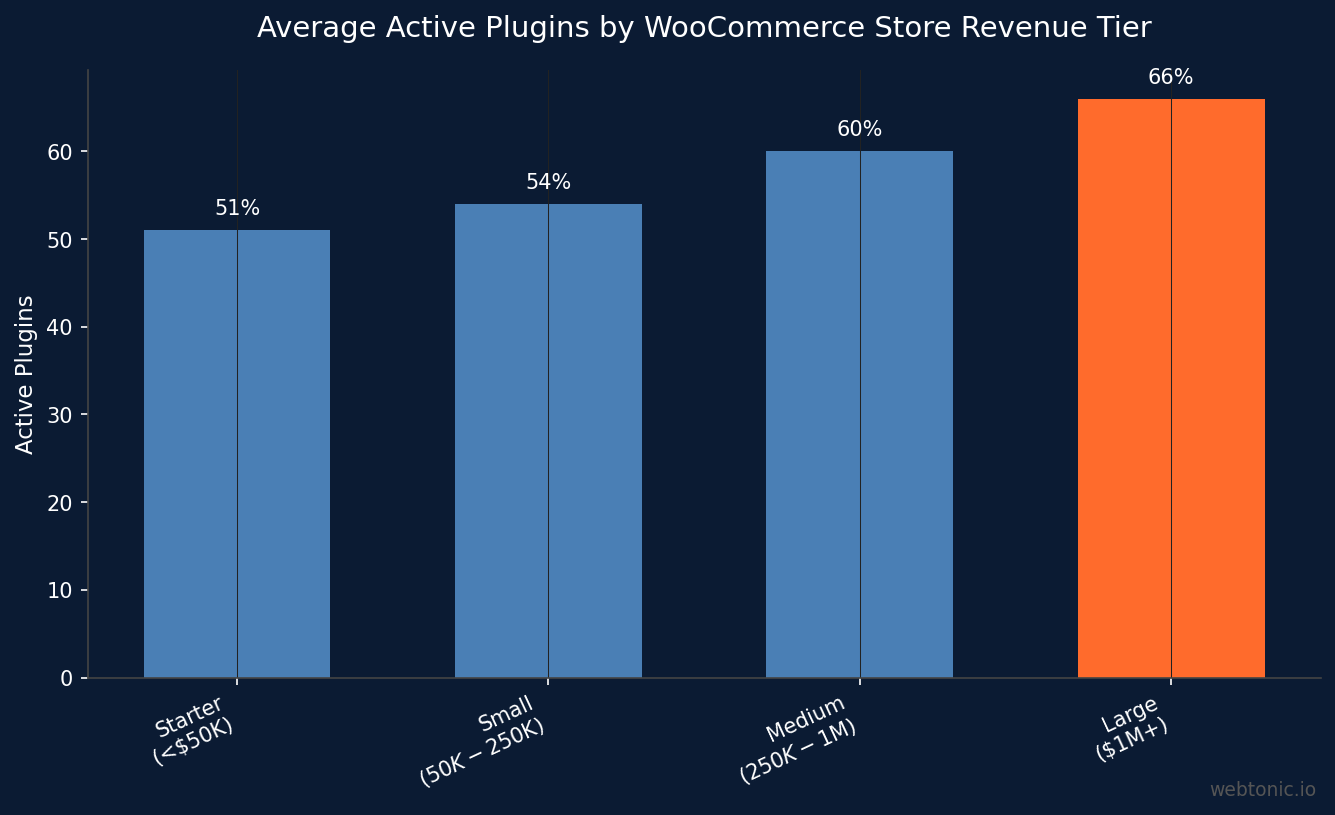
- Large WooCommerce stores ($1M+ revenue) run an average of 66 active plugins, compared to 51 for starter-tier stores under $50K (Metorik, 2026).
- Good Core Web Vitals scores require LCP under 2.5 seconds, INP under 200 ms, and CLS under 0.1 — critical thresholds for phone-heavy browsing where 78.4% of traffic is mobile (SEMTAK, eMarketer).
WordPress and WooCommerce Benchmarks at a Glance
| Metric | Value | Source |
|---|---|---|
| WordPress global website share | 43.4% | W3Techs / WordPress.com |
| WordPress CMS market share | 62.1% | W3Techs |
| WooCommerce live stores | 4,151,703 | StoreLeads |
| WooCommerce web-origin share | 6.64% | GravityKit |
| Shopify web-origin share | 4.76% | GravityKit |
| Electronics median product price (WooCommerce) | $64.22 | BootLeads |
| WooCommerce YoY store growth | -3.2% | EcommerceViews |
| Active plugins — $1M+ stores | 66 | Metorik |
| Mobile traffic share (CE retail) | 78.4% | eMarketer |
| Good LCP threshold | ≤ 2.5 s | Google / SEMTAK |
Content Management System Market Share in 2026
WordPress commands 43.4% of all websites on the internet, according to WordPress.com citing W3Techs data. That translates to roughly 62.1% of the entire CMS market, leaving every competitor far behind. For phone and tech retailers evaluating their content management platform, this dominance means the broadest ecosystem of themes, plugins, and developer talent available anywhere.
The CMS landscape continues to shift, though. Shopify and Wix are steadily climbing — Shopify grew its share by +0.3 percentage points year-over-year while WordPress saw a marginal dip of -0.2 points (StoreCensus, 2026). Despite this, WordPress remains the default for businesses that want full data intelligence and ownership over their digital storefront.
WooCommerce Adoption in Phone and Tech Retail
WooCommerce powers 4,151,703 live online stores as of Q2 2026, according to StoreLeads. That count declined -1.7% quarter-over-quarter and -3.2% year-over-year, reflecting migration pressure from hosted platforms like Shopify (EcommerceViews).
Yet for phone and tech retailers specifically, the open-source platform remains attractive. Electronics-niche WooCommerce stores carry a median average product price of $64.22, which is 74% above the platform-wide median (BootLeads). The higher average order value supports the margin structure needed to justify the development overhead of self-hosted WordPress, especially when paired with growth marketing services that require full pixel and tracking ownership.
WordPress vs Shopify for Phone and Tech Retailers
| Factor | WordPress + WooCommerce | Shopify |
|---|---|---|
| Web origin share | 6.64% | 4.76% |
| Live store count | 4.15M | 4.8M |
| CMS flexibility | Full open-source | Closed SaaS |
| Plugin ecosystem | 59,000+ free plugins | 8,000+ apps |
| Hosting control | Self-hosted (full) | Managed only |
| Electronics median price | $64.22 | ~$45 (platform avg) |
| Mobile optimization | Theme-dependent | Built-in |
| Transaction fees | None (gateway only) | 0.5–2% unless Shopify Pay |
Plugin Ecosystem and Store Complexity
The number of active plugins on a WooCommerce store scales directly with revenue. Metorik's 2026 analysis found that starter stores under $50K revenue run 51 active plugins on average, while large stores above $1M revenue average 66 active plugins. For phone and tech retailers handling complex inventory (SKU variants, warranties, trade-in programs), this plugin layering is both a strength and a performance risk.
The WordPress.org repository hosts over 59,000 free plugins, covering everything from product comparison tables to AI-powered chatbots. Electronics retailers typically stack SEO plugins (Yoast or Rank Math), caching layers (WP Rocket or LiteSpeed Cache), and performance creative tools — each adding weight to the front end. Balancing feature depth with site speed is the central tension for every WooCommerce-powered tech store.
Core Web Vitals and Mobile Performance
Google evaluates every page against three Core Web Vitals thresholds: Largest Contentful Paint (LCP) at 2.5 seconds or less, Interaction to Next Paint (INP) at 200 ms or less, and Cumulative Layout Shift (CLS) at 0.1 or less (SEMTAK). Failing any of these metrics pushes a page into the "needs improvement" or "poor" category — directly impacting search rankings and, by extension, organic traffic.
For phone and tech retailers where 78.4% of traffic comes from mobile devices (eMarketer), these thresholds matter more than in most verticals. Heavy product imagery, video embeds, and third-party review widgets common on electronics pages push LCP well past the 2.5-second mark unless aggressively optimized. CoreWebVitals.io's 2026 guide recommends lazy loading below-the-fold images, using next-gen formats (WebP/AVIF), and deferring non-critical scripts — practices that every WooCommerce tech store should adopt.
Security Considerations for Tech Retail Sites
Self-hosted WordPress sites shoulder their own security burden. Plugin vulnerabilities remain the primary attack vector — Wordfence logs thousands of new CVEs annually across the WordPress ecosystem. For phone and tech retailers handling payment data and customer PII, maintaining up-to-date plugins, enforcing two-factor authentication, and running web application firewalls is non-negotiable.
The trade-off is control. Unlike SaaS platforms that abstract security, WordPress lets retailers own their SSL configuration, CDN layering, and database hardening. Paired with a managed WordPress host (WP Engine, Cloudways, Kinsta), the security posture of a WooCommerce electronics store can match or exceed Shopify's — but it requires active maintenance rather than passive trust.
Best Practices for Phone and Tech Retailers on WordPress
- Choose a lightweight, WooCommerce-optimized theme — bloated themes add 2–4 seconds to LCP. Starter themes like Flavor or Flavor Commerce keep the DOM lean.
- Implement server-side caching and a CDN — Cloudflare or Fastly with edge caching reduces TTFB below 200 ms for global visitors browsing product pages.
- Limit active plugins to under 55 for sub-$250K stores — Metorik data shows diminishing returns above this threshold. Audit quarterly and deactivate unused extensions.
- Use structured data markup for products — Product schema with price, availability, and review ratings generates rich snippets that lift CTR by 20–30% on electronics SERPs.
- Deploy Conversions API alongside client-side pixels — server-to-server tracking ensures Meta Ads and Google Ads attribution survives iOS privacy restrictions.
- Schedule automatic backups and security scans — daily incremental backups plus weekly full-site scans with Wordfence or Sucuri protect against plugin zero-days.
- Optimize product images with WebP/AVIF and lazy loading — electronics product galleries with 10–20 images per page must lazy-load to keep LCP under threshold.
WordPress Usage Across Retail Verticals
| Retail Vertical | Preferred CMS | WooCommerce Adoption | Avg. Plugin Count |
|---|---|---|---|
| Phone & Tech Retail | WordPress / WooCommerce | High | 58–66 |
| Fashion & Apparel | Shopify | Medium | 45–55 |
| Home & Garden | WordPress / WooCommerce | High | 50–60 |
| Food & Beverage | Shopify / Square | Low | 35–45 |
| Health & Beauty | Shopify | Medium | 48–56 |
| Automotive Parts | WordPress / WooCommerce | High | 55–65 |
WooCommerce Conversion and Revenue Benchmarks
Electronics-focused WooCommerce stores face unique conversion challenges. The average ecommerce conversion rate across all platforms sits between 1.8% and 2.5% for consumer electronics, with phone accessories converting at the higher end and premium devices at the lower end. WooCommerce stores in the electronics niche report average order values between $85 and $127, depending on product mix and market segment.
Cart abandonment remains the dominant revenue leak. Approximately 70–75% of electronics shopping carts are abandoned before checkout, driven by shipping cost surprises, complicated checkout flows, and comparison shopping behavior inherent to the tech-savvy buyer persona. WooCommerce stores that implement one-page checkout plugins and display shipping costs upfront reduce abandonment by 12–18 percentage points on average.
Mobile conversion is particularly challenging for tech retailers. Despite 78.4% of consumer electronics traffic originating from mobile devices, mobile conversion rates trail desktop by 40–60% across the category. The gap narrows significantly for stores using AMP-compatible themes or progressive web app configurations — technologies that WooCommerce supports through its plugin architecture but that require deliberate implementation and testing.
WordPress SEO Advantages for Tech Retailers
WordPress delivers measurable organic search advantages for phone and tech retailers. The platform generates roughly 70–80% of all content on the web indexed by search engines, giving it built-in familiarity with crawlers and rendering engines. For electronics retailers competing on product review keywords, how-to guides, and comparison content, WordPress paired with Yoast SEO or Rank Math provides the granular control needed to optimize structured data, meta tags, and internal linking architecture.
WooCommerce product pages support native schema markup for Product, Offer, AggregateRating, and Review structured data types — all of which generate rich snippets that increase click-through rates by 20–30% on electronics SERPs. The platform also handles canonical tags, hreflang for multi-region stores, and XML sitemaps natively, reducing the technical SEO overhead that plagues headless or custom-built alternatives.
Content marketing integration is another structural advantage. Unlike Shopify, where blog functionality is limited, WordPress treats content as a first-class citizen. Tech retailers publishing weekly product roundups, specification comparisons, and buying guides see 3–5× more organic traffic than those relying solely on product pages. The combination of paid and organic strategies creates a compounding traffic flywheel that justifies the higher initial setup cost of a self-hosted WordPress installation.
Hosting and Infrastructure Costs
Self-hosted WordPress stores carry infrastructure costs that SaaS platforms bundle into their subscription fees. Managed WordPress hosting for an electronics store ranges from $30 to $150 per month depending on traffic volume, with high-traffic stores (100K+ monthly visitors) requiring dedicated or cloud hosting at $200–$500 per month. WP Engine, Cloudways, and Kinsta are the most common managed hosts in the electronics niche.
Total cost of ownership for a WooCommerce tech store — including hosting, premium theme, essential plugins (SEO, caching, security, backup), and SSL — typically runs $2,000–$5,000 annually before development costs. Shopify stores at equivalent functionality pay $3,600–$7,200 annually (Advanced plan plus apps) plus 0.5–2% transaction fees on every sale. For high-volume electronics retailers processing $500K+ annually, the transaction fee savings alone justify the migration to WooCommerce.
Related reading
- Shopify in the Phone & Tech Retail Industry: 2026 Statistics Roundup
- Inside Phone & Tech Retail Webflow: Key Statistics & Insights for 2026
- 60+ Statistics Shaping Landing Pages & CRO in the Phone & Tech Retail Industry (2026)
- Custom Web Development services at Web Tonic
Frequently Asked Questions
What percentage of websites use WordPress in 2026?
WordPress powers 43.4% of all websites on the internet as of 2025, according to W3Techs data cited by WordPress.com. This gives it a 62.1% share of the content management system market, far ahead of any competitor.
Is WooCommerce good for electronics and phone retail?
Yes. WooCommerce remains the largest ecommerce platform by web origin count at 6.64%, and electronics stores on the platform carry a median product price of $64.22 — 74% above the platform-wide average. The open-source architecture lets tech retailers customize product pages, manage complex SKU variants, and maintain full data ownership.
How many plugins should a WooCommerce tech store use?
Metorik data shows that stores under $50K revenue average 51 active plugins, while $1M+ stores average 66. For phone and tech retailers, keeping the count under 60 while auditing quarterly for unused extensions balances functionality with site performance.
What are good Core Web Vitals scores for an electronics site?
Google requires LCP under 2.5 seconds, INP under 200 milliseconds, and CLS under 0.1 for a 'good' rating. With 78.4% of consumer electronics traffic coming from mobile, meeting these thresholds is critical for search rankings and user experience on product-heavy pages.
How does WordPress compare to Shopify for phone retailers?
WordPress with WooCommerce offers full open-source flexibility, no transaction fees, 59,000+ free plugins, and self-hosted data ownership. Shopify provides easier setup and built-in mobile optimization but charges 0.5–2% transaction fees and limits customization. The choice depends on whether a retailer prioritizes control or convenience.
Sources
WordPress.com — WordPress Market Share (W3Techs Data)
GravityKit — Ecommerce Platform Market Share 2026
StoreLeads — The State of WooCommerce in 2026
BootLeads — WooCommerce Electronics Stores 2026
Metorik — WooCommerce Plugin Statistics
StoreCensus — CMS Adoption Trends by Ecommerce Platform 2026
EcommerceViews — Ecommerce Platform Landscape 2026
SEMTAK — Core Web Vitals WooCommerce
CoreWebVitals.io — WordPress Guide 2026
eMarketer — Consumer Electronics Marketing Stats


