



Table of contents

Key Takeaways
- 20,070 personal injury law firms (56.9%) run WordPress, making it the most common technology of any kind in the PI legal vertical.
- WordPress powers 41.9% of all websites globally and holds 59.4% of the CMS market share as of June 2026, nearly 12× its nearest competitor.
- WordPress-adopting PI firms score 40.3 SI on average, a 26.9-point lift over non-adopters, correlating with broader technology investment.
- 63% of law firm websites run WordPress across a 303-site study of 25 U.S. markets, with the remaining 37% mostly custom-built.
- 92.7% of WordPress law firm sites use a page builder, led by Elementor (27.2%) and Divi (26.7%).
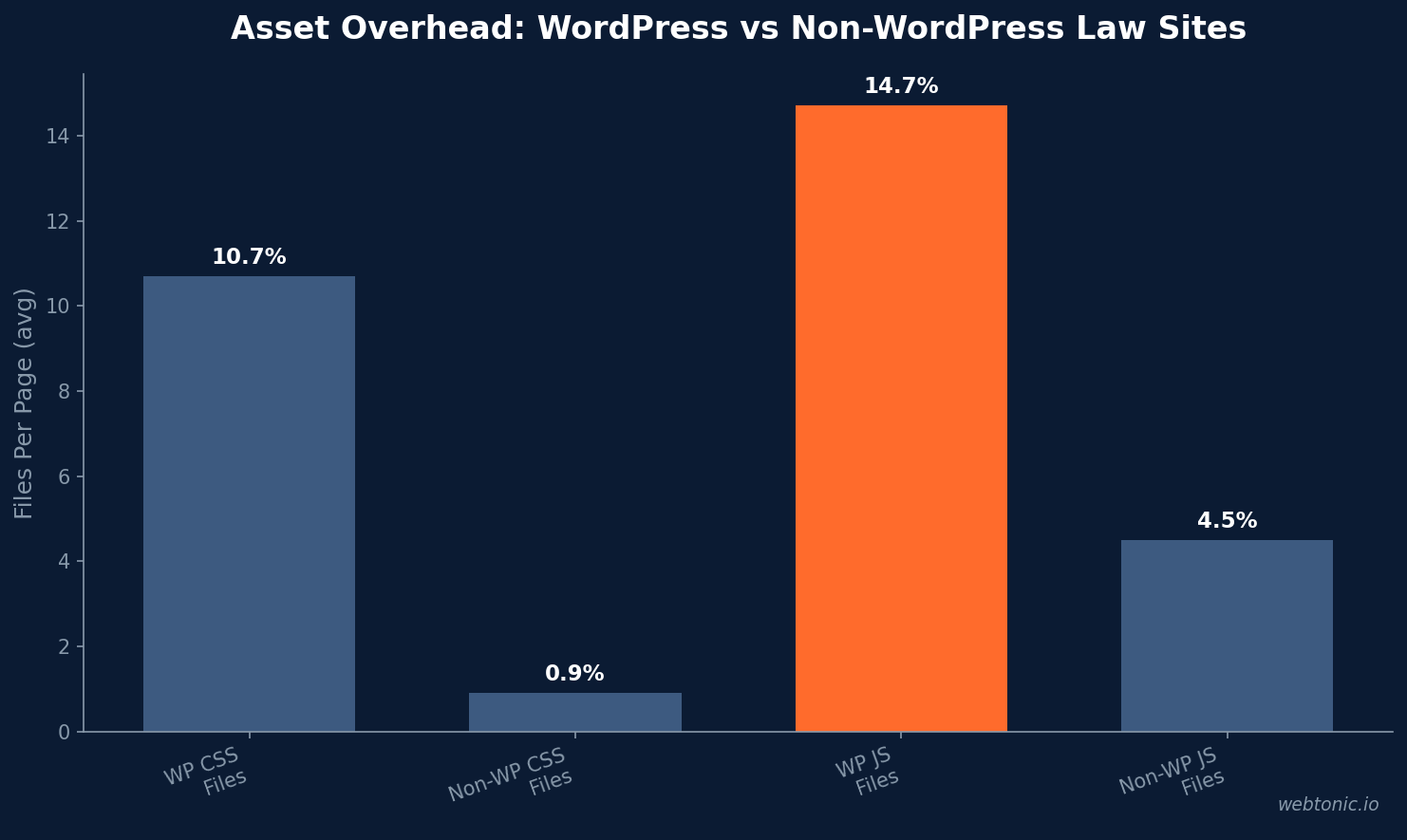
- WordPress sites load 12× more CSS files (10.7 vs 0.9) and 3.3× more JavaScript files (14.7 vs 4.5) than non-WordPress sites.
- The average PI website converts 2.8% of visitors into leads, but top performers using optimized WordPress configurations hit 18%.
Personal Injury Law × WordPress: Benchmarks at a Glance
| Metric | Value | Source |
|---|---|---|
| PI firms using WordPress | 20,070 (56.9%) | TopLawDog |
| WordPress global website share | 41.9% | W3Techs / Custom.legal |
| WordPress CMS market share | 59.4% | W3Techs / Custom.legal |
| Avg SI — WordPress adopters | 40.3 (+26.9 lift) | TopLawDog |
| Law firm sites on WordPress (study) | 63% | Constellate Research |
| WordPress sites with page builders | 92.7% | Constellate Research |
| Avg PI website conversion rate | 2.8% | LEXGRO |
| Top PI conversion rate | 18% | LEXGRO |
WordPress Adoption Among Personal Injury Law Firms
TopLawDog's technology tracking data provides the most comprehensive view of WordPress adoption in the PI space. 20,070 personal injury law firms use WordPress, representing a 56.9% adoption rate across all tracked PI firms. That makes WordPress the single most common technology in the entire personal injury legal vertical — more prevalent than Google Analytics, Microsoft 365, or any other platform.
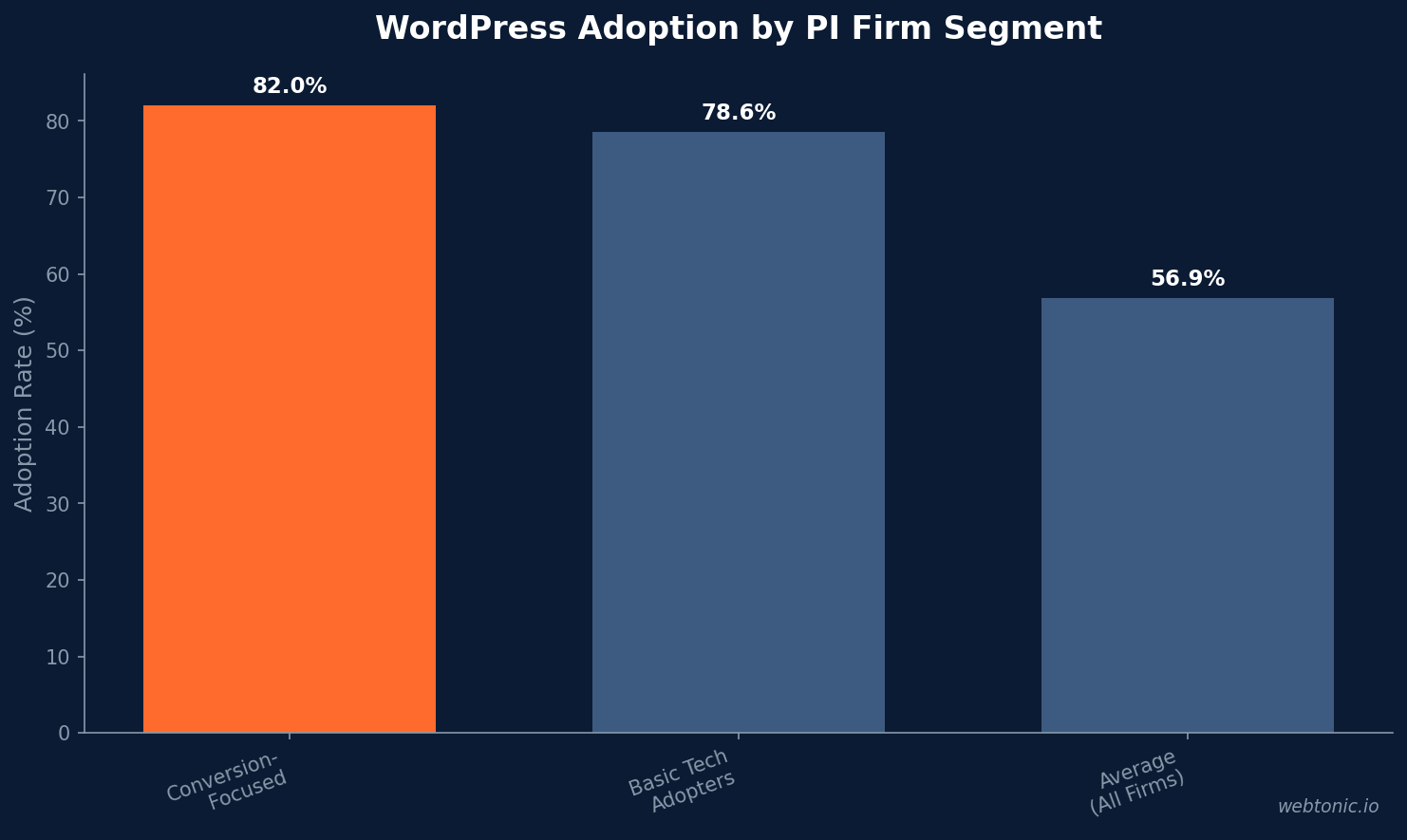
Adoption is especially strong among established, technology-forward firms. Conversion-Focused Firms lead at 82.0% adoption, followed by Basic Tech Adopters at 78.6%. The data shows a clear correlation: WordPress-adopting PI firms average a Sophistication Index of 40.3, a 26.9-point lift over firms without it. Firms investing in WordPress tend to invest in broader marketing technology stacks including analytics, tracking pixels, and CRM integrations.
WordPress Adoption by PI Firm Segment
| Firm Segment | WordPress Adoption | Firms Using |
|---|---|---|
| Conversion-Focused Firms | 82.0% | 4,783 |
| Basic Tech Adopters | 78.6% | 5,338 |
| Awareness-Only Firms | 56.9% (avg) | 3,082 |
| Minimalist Tech Users | Below avg | — |
| Retention Innovators | Varies | — |
CMS Market Share: WordPress Dominance in Legal
Custom Legal Marketing's W3Techs analysis puts WordPress's global position in full context. As of June 2026, WordPress powers 41.9% of all websites and holds 59.4% of the CMS market share — exceeding all other CMS platforms combined. Shopify, its nearest competitor, holds just 4.8%, making WordPress nearly 12× larger by market share.
For personal injury firms, that gap translates into practical advantages: a larger developer ecosystem, more SEO tooling options, better long-term platform support, and a deep bench of legal-specific integrations. WordPress's plugin library includes 59,000+ free plugins and 12,000+ themes, with specialized tools for practice management (Clio, MyCase), intake form builders (Gravity Forms, WPForms), and SEO plugins (Yoast, Rank Math).
The PI legal services market is worth $61.7 billion in the United States according to IBISWorld 2025 data. Firms competing for cases in this massive market overwhelmingly choose WordPress because it offers the flexibility to build practice area pages, case result archives, attorney bios, local city landing pages, and blog content within a single SEO-optimized CMS platform.
WordPress Performance: Asset Overhead and Page Speed
Constellate Research's 303-site study across 25 high-growth U.S. markets reveals the performance reality of WordPress installations in the legal industry. 63% of law firm websites run WordPress, but the platform comes with measurable asset overhead that impacts page load speed:
WordPress vs Non-WordPress: Asset Overhead (303-Site Study)
| Measure | WordPress Sites | Non-WordPress Sites |
|---|---|---|
| Average CSS files per page | 10.7 | 0.9 |
| Average JS files per page | 14.7 | 4.5 |
| Average detectable plugins | 4.2 | — |
| Sites using a page builder | 92.7% | — |
| Sites still loading jQuery | 67% | — |
WordPress sites load roughly 12× more CSS files and 3.3× more JavaScript files than non-WordPress alternatives. This overhead directly impacts page load times for prospective clients visiting the site, especially on mobile where 62.4% of law firm traffic now originates according to CuFinder's 2026 benchmarks.
67% of WordPress law firm sites still load jQuery, a legacy JavaScript library adding unnecessary weight to every page load. Combined with near-universal page builder usage (92.7%), WordPress PI sites often carry significant performance debt that undermines the return on marketing investment by increasing bounce rates on slower connections.
Theme and Plugin Ecosystem for PI Law Firms
Constellate's research exposes extreme theme fragmentation across the legal WordPress landscape: 130+ distinct themes across 191 WordPress law firm sites. The most popular theme, Hello Elementor, appears on only 9.4% of tracked sites. This fragmentation means no standard "law firm WordPress configuration" exists — every site is a custom combination of theme, page builder, and plugin stack.
Page builders dominate the development approach: Elementor leads at 27.2%, followed by Divi at 26.7%. The remaining 37% of non-WordPress law firm sites are mostly custom-built (101 of 112 sites), with Duda, Wix, Squarespace, and GoDaddy accounting for just 11 sites combined across all 25 markets studied.
The most common co-occurring technologies among WordPress-adopting PI firms, according to TopLawDog's co-occurrence data:
- Google Analytics at 61.9% of WordPress adopters — traffic and conversion measurement
- Microsoft 365 at 53.7% — productivity and case document management
- Facebook Pixel — conversion tracking for social ad campaigns
- Google Tag Manager — centralized tag deployment for marketing attribution
- Yoast SEO / Rank Math — on-page optimization and schema markup
PI Website Conversion Benchmarks on WordPress
LEXGRO's 2026 data reveals a massive conversion gap between average and top-performing PI websites. WordPress powers the majority of sites on both ends of this performance spectrum:
PI Firm Conversion by Traffic Source (2026)
| Traffic Source | Visitor-to-Lead Rate | Cost Per Lead |
|---|---|---|
| Google LSAs | 15%–18% | $378 |
| Organic search (SEO) | 5%–8% | $183 |
| Google Ads (search) | 3%–6% | $442 |
| Social retargeting | 2%–4% | $18–$78 |
| Social (cold) | 0.5%–1.5% | $50–$150 |
The average PI website converts 2.8% of visitors into leads. Top-performing WordPress sites hit 18%, primarily through Google Local Services Ads and optimized landing pages. The gap between 2.8% and 18% is enormous: a firm generating 3,000 monthly visitors converts 84 leads at 2.8% versus 540 leads at 18% — same traffic, same spend, 6.4× the pipeline.
Key conversion drivers on WordPress: landing page video lifts conversions by 86%, leads contacted within one minute convert 391% better than those contacted later, and mobile visitors convert at only 1.5%–2.5% (versus 2.8%–3.6% on desktop), making mobile optimization critical for performance-focused WordPress configurations.
WordPress Security and Maintenance for PI Firms
WordPress's open-source nature creates both flexibility and maintenance obligations. The November 2024 governance crisis between Matt Mullenweg and WP Engine — involving trademark disputes, plugin repository access revocation, and legal threats — sent shockwaves through the WordPress ecosystem. However, WordPress's installed base is so enormous that no realistic migration path exists for most firms.
For PI firms handling sensitive client information, WordPress security requires active management:
- Plugin auditing: The average WordPress law firm site runs 4.2 detectable plugins plus a page builder. Each plugin is a potential vulnerability vector that requires regular updates.
- SSL and hosting: 98.6% of legal Shopify stores use Cloudflare (forced by Shopify's infrastructure). WordPress firms must configure SSL, CDN, and hosting security independently.
- Backup and disaster recovery: With 20,070 PI firms on WordPress, the platform is a high-value target. Automated daily backups and staging environments are baseline requirements.
WordPress Best Practices for Personal Injury Firms
- Audit and reduce plugin bloat. The average WordPress law firm site runs 4.2 detectable plugins plus a page builder. Every unnecessary plugin adds CSS and JavaScript files that slow page load for mobile visitors, who make up 62.4% of all law firm website traffic in 2026.
- Choose your page builder deliberately. 92.7% of WordPress law firm sites use one, but Elementor (27.2%) and Divi (26.7%) have very different performance profiles. Benchmark your site's Core Web Vitals against competitors in your local market.
- Eliminate jQuery where possible. 67% of WordPress law firm sites still load jQuery. Modern WordPress themes and professional developers can remove this legacy dependency entirely to improve page speed.
- Build conversion-optimized landing pages. The 6.4× gap between average (2.8%) and top (18%) conversion rates means the landing page experience matters more than the traffic source. Add video for an 86% lift, clear CTAs, and fast-response intake forms.
- Install proper tracking from day one. Only 61.9% of WordPress-adopting PI firms use Google Analytics. The other 38.1% have no visibility into which pages, channels, or keywords drive signed cases and revenue.
WordPress vs Alternative Platforms for PI Firms
The CMS landscape beyond WordPress is thin for personal injury practices. Constellate's data shows that of the 37% of law firm websites not using WordPress, the vast majority (101 of 112 non-WordPress sites) are fully custom-built platforms. Only 11 sites combined use Duda, Wix, Squarespace, or GoDaddy across all 25 markets studied. This means the practical choice for most PI firms is between WordPress and a custom-built solution — not between WordPress and another off-the-shelf CMS.
Custom-built sites carry significantly lower asset overhead (0.9 CSS files and 4.5 JS files on average) but require substantially higher development budgets and ongoing maintenance costs. For solo practitioners and small PI firms, WordPress offers the best balance of SEO capability, developer availability, and total cost of ownership. For large, multi-location PI firms with dedicated development teams, custom platforms can deliver superior page speed performance that directly impacts mobile conversion rates and Google Ads quality scores.
Shopify, the nearest CMS competitor at 4.8% market share, is fundamentally mismatched for PI law. It serves just 22 PI firms (0.1%) and is designed for product commerce rather than the content-rich, SEO-optimized informational architecture that personal injury practices require for organic search visibility and paid landing page performance.
Related reading
- PI Law Shopify Stats & Data
- Personal Injury Law Landing Pages & CRO Trends: Data-Driven Insights for 2026
- Plumbing WordPress Statistics: CMS Share, Speed & Conversion Data (2026)
- Custom Web Development services at Web Tonic
FAQ
How many personal injury law firms use WordPress?
20,070 personal injury law firms (56.9%) use WordPress, according to TopLawDog's technology tracking data. This makes WordPress the single most adopted technology in the PI legal vertical, ahead of Google Analytics, Microsoft 365, and every other platform or tool.
What is the CMS market share of WordPress for law firms?
WordPress holds 59.4% of the global CMS market share and powers 41.9% of all websites as of June 2026 according to W3Techs. Among law firms specifically, Constellate Research found 63% run WordPress across a 303-site study of 25 high-growth U.S. markets.
Does WordPress slow down law firm websites?
WordPress sites load 10.7 CSS files and 14.7 JavaScript files on average — compared to 0.9 and 4.5 for non-WordPress sites. With 92.7% using page builders and 67% still loading jQuery, WordPress sites carry measurable performance overhead. Proper optimization through plugin auditing, CDN configuration, and careful theme selection can close this gap significantly.
What is the average conversion rate for a PI law firm website?
The average PI website converts 2.8% of visitors into leads. Top-performing sites reach 18% through Google LSAs and optimized landing pages. Adding video to landing pages produces an 86% conversion lift, and leads contacted within one minute convert 391% better than those contacted later.
What are the best WordPress plugins for personal injury firms?
The most impactful plugins for PI firms include Yoast SEO or Rank Math for on-page optimization, Gravity Forms or WPForms for intake forms, Clio or MyCase integrations for practice management, and Google Analytics / Tag Manager for conversion tracking. Currently only 61.9% of WordPress PI firms use Google Analytics.
Sources
TopLawDog — WordPress for Law Firms (20,070 PI Firms)
Custom Legal Marketing — WordPress for Personal Injury Firms
Constellate Research — WordPress Theme Impact on Law Firm Performance
LEXGRO — PI Website Conversion Benchmarks 2026
CuFinder — Law Firms Marketing Benchmarks 2026


