Table of contents
Snapchat sells an awareness impression for $5.84 and a conversion impression for $27.10 — nearly five times more for the same audience. Deciding which of those a phone or tech retailer should buy is the entire Snapchat question, and the answer starts with who is actually on the platform.
Key Takeaways
- Snapchat reported 483 million daily active users in Q1 2026, up 5%.
- Monthly active users reached 956 million.
- North America daily users fell 7% to 92 million.
- Rest of World daily users grew 12% to about 294 million.
- Quarterly revenue was $1.529 billion, up 12%.
- Advertising revenue was $1.243 billion, up 3%.
- North America ARPU is $9.23 against $1.20 Rest of World.
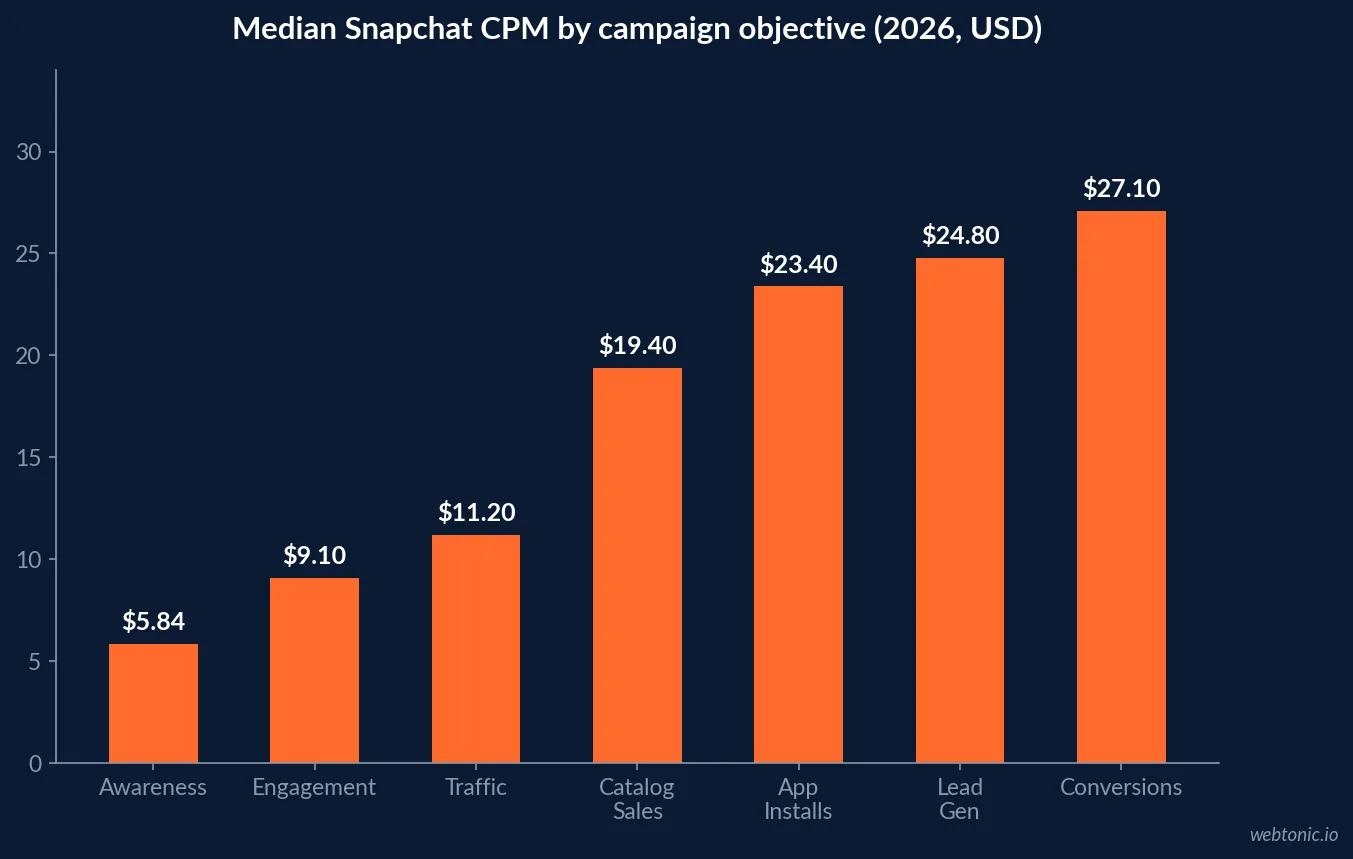
- Median CPM ranges from $5.84 (Awareness) to $27.10 (Conversions).
- Median CPC is $0.84, interquartile range $0.51–$1.34.
- Median CTR is 1.04%, rising to 1.36% on Spotlight.
- Catalog Sales CPMs are about 15% below equivalent Meta inventory.
- Awareness CPMs run 30–40% cheaper than Meta.
- Median DTC first-purchase CPA is $23.40; top quartile under $14.
- US local services CPA averages $42.80.
- Campaigns under $20/day exit learning within 14 days only 8% of the time.
- 37.1% of the ad audience is 18–24; about 75% is under 35.
- AR Lenses were played over 9 billion times a day in Q1 2026.
- 75% of daily users engage with AR every day.
- 250 million+ users have engaged with AR shopping lenses.
- 80% of shoppers feel more confident buying after using AR.
Snapchat cost benchmarks by objective
The most useful 2026 dataset covers 2,431 campaigns from 412 advertisers spending $11.4 million over four months, with 58% of spend in the US. Its central finding is the objective spread: the closer the objective sits to a sale, the closer Snapchat pricing gets to Meta.
| Objective | Median CPM | 25th–75th percentile | Read |
|---|---|---|---|
| Awareness | $5.84 | $3.20–$9.40 | Cheapest inventory, 30–40% under Meta |
| Engagement | $9.10 | $5.40–$13.60 | Awareness with a quality filter |
| Traffic | $11.20 | $6.80–$16.90 | Click-optimised auction |
| Catalog Sales | $19.40 | $11.20–$28.90 | About 15% below Meta dynamic product ads |
| App Installs | $23.40 | $14.90–$35.20 | Highly competitive, huge variance |
| Lead Generation | $24.80 | $15.10–$39.40 | Healthy CPM, variable lead quality |
| Conversions / Purchases | $27.10 | $17.40–$41.80 | Comparable to or above Meta |
Click and engagement metrics look better than the CPM table suggests. Median CPC across objectives is $0.84 ($0.71 on Traffic, $1.18 on Conversions), materially below the $1.10–$2.00 range typical of matched Meta audiences, and median CTR of 1.04% runs roughly 22% above Meta on equivalent placements. Spotlight is the most engaged inventory at 1.36%, Story Ads the largest bucket at 0.94%.
The audience question device retailers have to answer first
Snapchat's Q1 2026 filings show 483 million daily and 956 million monthly active users, but the commercially important line is regional: North America fell 7% to 92 million daily users while Rest of World grew 12% to about 294 million. Since North America generates 55.5% of revenue from 19% of users at a $9.23 ARPU against $1.20 elsewhere, a US or Canadian retailer is buying into a shrinking but high-value pool.
| Age band | Share of Snapchat ad audience | Device retail implication |
|---|---|---|
| 13–17 | About 15–18% | Influencer, not the payer |
| 18–24 | 37.1% (largest segment) | First own-name contract, mid-range devices |
| 25–34 | About 22% | Upgrade cycle and accessories |
| 35–44 | About 14% | Family plans and trade-ins |
| 45+ | About 8–10% | Thin: use other channels |
Purchase influence within that skew is genuinely high: 61% of Snapchat users aged 18–27 have bought something they saw on the platform, 64% of Gen Z students say a purchase was influenced by Snapchat, 63% of all users say the same, and 56% have shared an ad with someone. 92% of daily Snapchatters involve friends in their shopping process, and over half send product photos while shopping — which is closer to how a phone actually gets chosen than any funnel diagram.
CPA by vertical, and where Snapchat breaks
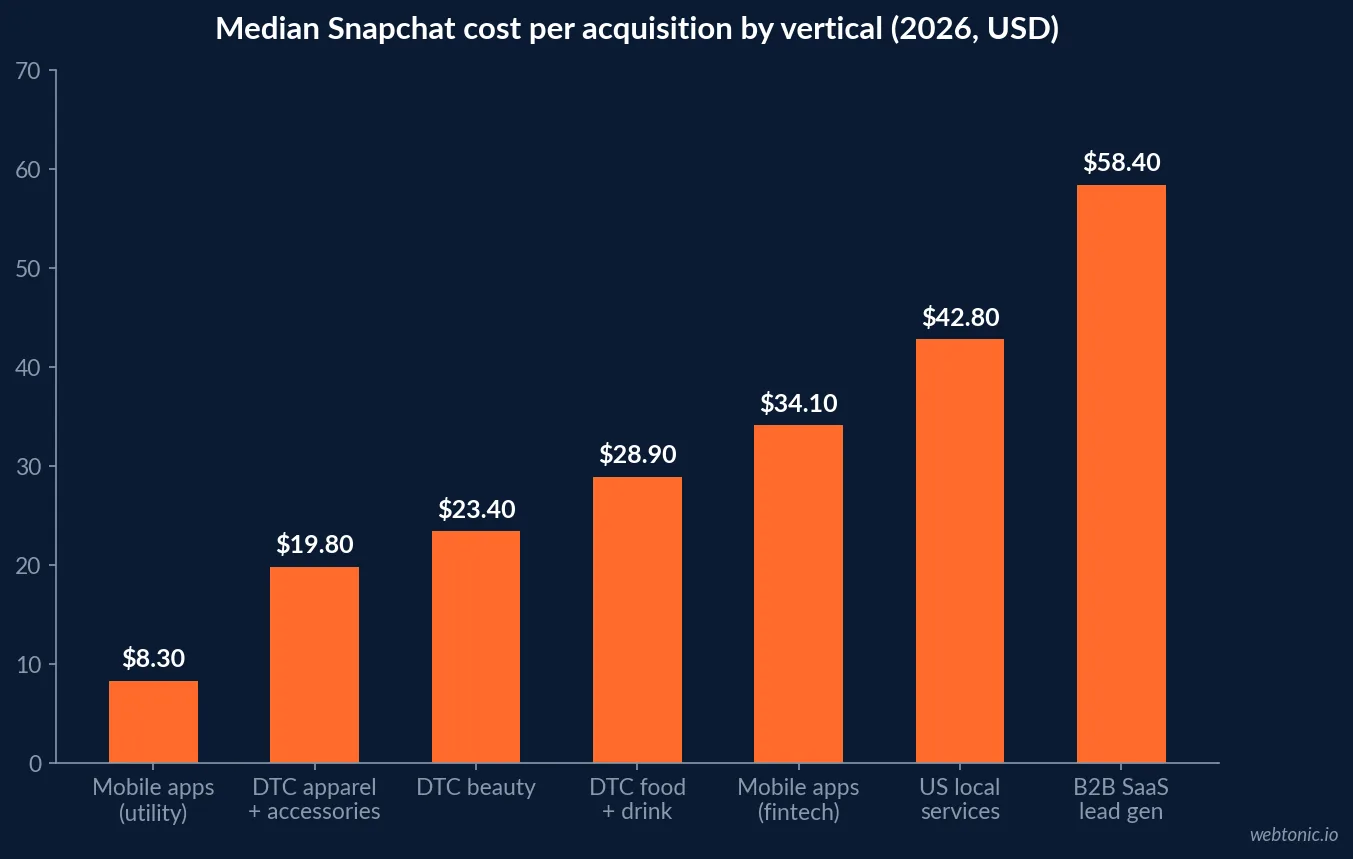
The same dataset's CPA table is the most honest argument for and against the channel. Consumer product categories with young buyers perform; anything requiring an older or professional audience does not.
| Vertical | Median CPA | 25th–75th percentile |
|---|---|---|
| DTC apparel and accessories | $19.80 | $12.40–$32.10 |
| DTC beauty and cosmetics | $23.40 | $14.20–$34.80 |
| DTC food and beverage | $28.90 | $17.60–$44.20 |
| Mobile apps (utility) | $8.30 | $3.80–$16.20 |
| Mobile apps (fintech) | $34.10 | $19.40–$58.70 |
| Local services (US) | $42.80 | $22.10–$71.30 |
| B2B SaaS lead generation | $58.40 | $31.20–$98.40 |
Read those against category economics. Consumer electronics ecommerce converts at 2.65% on a $185 average order with a 21.5% repeat rate, so a $20–$25 CPA works for accessory bundles and mid-range handsets and strains on single low-margin items. A physical store with a service radius sits closer to the $42.80 local services number, which is why footfall campaigns need an offer, not a brand message.
Creative rules the platform actually enforces
Snapchat is a full-screen, sound-on, vertical environment where the ad competes with a message from a friend. The measurable penalties for ignoring that are large: video longer than 30 seconds costs roughly 60% more per impression and converts about half as well as under-7-second video, and a landscape asset repurposed from another channel is the most common explanation for CTR below 0.5% against a 1.04% median. A well-scored native creative can cost 30–50% less than a mediocre one for the same placement.
Attention arrives fast and leaves faster. 55% of Gen Z viewers recall a Snapchat ad after only 0–2 seconds, which means the product, the price and the offer have to be legible in the first frame rather than after a build-up. For device retail the highest-yield formats are the ones that show stock and price immediately: single-product price cards, trade-in value comparisons, and accessory bundles shot in hand rather than on white.
| Creative decision | Measured effect | Practical rule |
|---|---|---|
| Video under 7 seconds | Baseline cost and conversion | Default length for prospecting |
| Video over 30 seconds | About 60% higher CPM, roughly half the conversion | Only for retargeting warm audiences |
| Native vertical vs repurposed landscape | Landscape linked to sub-0.5% CTR | Never reuse a feed asset unchanged |
| Strong creative quality score | 30–50% lower cost | Refresh before raising bids |
| Spotlight placement | 1.36% CTR vs 0.94% Story Ads | Test separately, not bundled |
| First-frame price or offer | Supports 0–2 second recall | Lead with the number |
Budget floors: the $5 a day trap
Snapchat's self-serve minimum is $5 a day, and it is the most misleading number in the platform's marketing. In practitioner data, campaigns under $20 a day cleared the learning phase within 14 days only 8% of the time. The likelihood of finding a stable CPA inside two weeks rises steeply with daily budget.
| Daily budget | Median days to exit learning | Chance of a stable CPA in 14 days |
|---|---|---|
| $5–$20 | No exit within 14 days | 8% |
| $20–$50 | 7.4 days | 24% |
| $50–$100 | 5.1 days | 41% |
| $100–$250 | 3.2 days | 67% |
| $250+ | 2.1 days | 84% |
Practical translation for a retailer: a channel test at $5–$20 a day (about $150 a month) buys a signal too weak to act on; $30–$50 a day clears learning for awareness and traffic; an ecommerce conversion programme needs $50–$100 a day, and scaling starts above $250. Creative quality is the other lever: a well-scored native ad can cost 30–50% less than a mediocre one, and video over 30 seconds costs roughly 60% more per impression than under-7-second video while converting about half as well.
AR is the format that only exists here
AR Lenses were played more than 9 billion times a day on average in Q1 2026, with 75% of daily Snapchatters engaging with AR daily and more than 400,000 Lenses submitted in the quarter, up 150% year over year. On the commerce side, Snap reports more than 250 million users engaging with AR shopping lenses over 5 billion times, and 80% of shoppers saying AR makes them more confident in a purchase.
For phone and tech retail the honest use cases are narrower than the headline numbers: case and colour visualisation, wearables and audio try-on, and catalogue-powered lenses over accessory ranges. A handset itself does not need virtual try-on — the attachment products do, and attachment is where the margin sits.
How Snapchat fits alongside the rest of the plan
Snapchat is rarely the channel that closes a device sale on its own, and the numbers say it does not need to be. Awareness inventory at $5.84 CPM is 30–40% cheaper than Meta for the same audience, and average CPM across objectives lands near $8 against roughly $10 for TikTok and $14.19 for Meta. That makes it a reach and consideration buy that feeds branded search and store visits, measured on assisted revenue rather than platform-reported purchases.
The caveat is measurement. Because electronics already loses roughly 39% of paid conversions to under-reporting, a channel bought for assist value will look worse than it is in a last-click dashboard. Any Snapchat test needs the same server-side event tracking and a holdout or geo comparison, or the read will be a verdict on your tracking rather than on the channel.
| Platform | Typical CPM | Typical CPC | Role for device retail |
|---|---|---|---|
| Snapchat (average) | About $8 | $0.84 | Cheap reach with a young skew |
| Snapchat (awareness) | $5.84 | $0.71 on Traffic | Top-of-funnel arbitrage |
| TikTok | About $10 | $0.62 | Reach plus creator-led proof |
| Meta | $14.19 ($14.50 electronics) | $1.10–$2.00 | Conversion workhorse |
| Google Search | — | $1.15 (Shopping $0.88) | Captures the demand others create |
How to run Snapchat without wasting the test
- Buy the cheap end first. Awareness at $5.84 CPM is the platform's real arbitrage; conversions at $27.10 price like Meta.
- Fund the learning phase. Below $20/day you have an 8% chance of stable data.
- Segment out under-18s from any credit or contract offer — up to 18% of the audience cannot transact.
- Keep video under 7 seconds and vertical: over 30 seconds costs about 60% more per impression.
- Use Catalog Sales for accessories at $19.40 CPM, roughly 15% under Meta dynamic product ads.
- Benchmark CPA against $19.80–$23.40, not against your search CPA of $48.50.
- Test Spotlight placement for its 1.36% CTR before widening placements.
Channel selection for device retail is arithmetic on audience age, basket size and margin. That is how our growth marketing team sizes it, with creative built for the placement by performance creative — if you want a straight answer on whether Snapchat can pay back on your basket, ask us. Learn more about how we work.
Frequently Asked Questions
What do Snapchat ads cost in 2026?
Cost depends almost entirely on objective. Median CPM is $5.84 for Awareness, $9.10 for Engagement, $11.20 for Traffic, $19.40 for Catalog Sales, $23.40 for App Installs, $24.80 for Lead Generation and $27.10 for Conversions. Median CPC across objectives is $0.84 and median CTR is 1.04%, from a dataset of 2,431 campaigns and $11.4 million in spend.
Is Snapchat's audience old enough to buy a flagship phone?
Partly. About 15–18% of the ad audience is 13–17 and cannot transact on credit, while 37.1% is 18–24 and 22% is 25–34. Roughly 75% of users are under 35. That makes Snapchat strong for accessories, mid-range handsets, trade-in offers and repair services, and weak for premium enterprise-grade hardware.
What is a realistic Snapchat CPA for retail?
In a 2026 practitioner dataset, median CPA was $19.80 for DTC apparel and accessories, $23.40 for beauty, $28.90 for food and drink, $42.80 for US local services and $58.40 for B2B lead generation. Median DTC first-purchase CPA was $23.40, with the top quartile below $14 and the bottom quartile above $48 — a spread explained by creative quality, not by the platform.
How much budget does a Snapchat test actually need?
The stated minimum is $5 a day, but campaigns under $20 a day exit the learning phase within two weeks only 8% of the time. Median time to exit is 7.4 days at $20–$50 a day, 5.1 days at $50–$100, 3.2 days at $100–$250 and 2.1 days above $250. Treat $50–$100 a day as the practical floor for a conversion campaign.
Does AR try-on do anything measurable for device retail?
It is the platform's most distinctive asset. Snapchatters played AR Lenses more than 9 billion times a day on average in Q1 2026 and 75% of daily users engage with AR daily. More than 250 million users have engaged with AR shopping lenses over 5 billion times, and 80% of shoppers say AR makes them more confident in a purchase. For phone retail that maps to case and wearable try-on and in-store size or fit questions.
Sources
Snapchat Ads cost benchmarks 2026, 2,431 campaigns
Snapchat Ads pricing and budget floors 2026
Snap Inc. Q1 2026 financial results
Snapchat statistics 2026: users, revenue, AR
100 Snapchat usage statistics 2026
Sprout Social Snapchat statistics 2026
SocialPilot Snapchat statistics 2026
Snap on catalog-powered AR shopping lenses
Snapchat Ads for ecommerce: what works
Consumer electronics marketing benchmarks 2026