



Table of contents
Organic search remains the dominant traffic channel for consumer electronics and phone retail websites, driving 29–50% of all sessions depending on brand maturity. These 2026 SEO statistics reveal where the biggest opportunities — and performance gaps — sit for phone and tech retailers competing for search visibility.
Key Takeaways
- Consumer electronics sites get 29–50% of traffic from organic search, making SEO the largest or second-largest channel by session volume (CuFinder / Eightx, 2026).
- Organic conversion rates range from 1.8% to 4.2% for online electronics stores, with schema-rich, mobile-fast sites clustering at the upper end (Authority Specialist, 2026).
- Only 51.3% of mobile sites pass all three Core Web Vitals (LCP, INP, CLS) — a critical gap for phone-accessory stores where 78.4% of traffic is mobile (JustAnalytics / CuFinder, 2026).
- Mobile pages load 87% slower than desktop — median LCP of 3.8s vs. 2.1s (HTTP Archive / Searchlab, 2026).
- Category pages generate 60–70% of organic sessions for e-commerce stores despite receiving far less optimisation attention than product pages (Authority Specialist, 2026).
- Organic search accounts for 35–55% of revenue-generating sessions for established online retailers, outperforming paid channels on cost-per-acquisition after month 9 (Authority Specialist, 2026).
- Product schema with required 2026 fields increases rich-result eligibility — Google pushed three previously optional fields into "effectively required" status for retail queries (Gatilab, 2026).
Phone & Tech Retail SEO Benchmarks at a Glance
| Metric | Consumer Electronics | E-commerce Avg. | All Industries |
|---|---|---|---|
| Organic Traffic Share | 29–50% | 35–45% | 53% |
| Organic CVR | 1.8–4.2% | 2.0–4.0% | 2.35% |
| Mobile Traffic Share | 78.4% | 72% | 60% |
| CWV Pass Rate (Mobile) | ~51% | 48% | 51.3% |
| Median Mobile LCP | 3.8s | 3.5s | 3.8s |
| Category Page Organic Share | 60–70% | 55–65% | N/A |
Sources: CuFinder Consumer Electronics Benchmarks 2026, Eightx Organic Traffic Share 2026, Authority Specialist Ecommerce SEO Benchmarks 2026, JustAnalytics CWV Statistics June 2026, HTTP Archive / Searchlab Technical SEO 2026.
Organic Traffic Share in Consumer Electronics
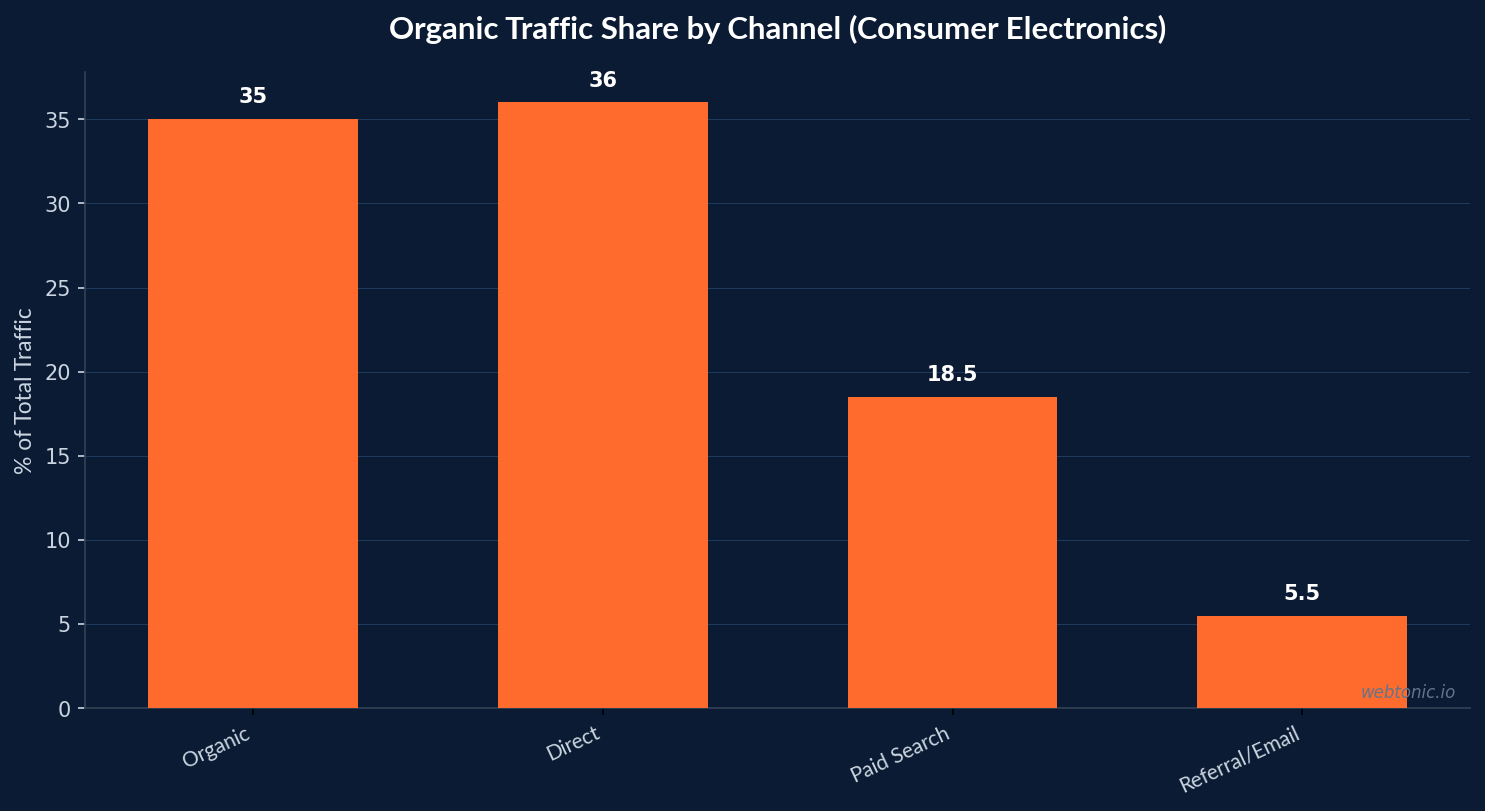
CuFinder's 2026 Consumer Electronics Benchmarks report that organic search delivers 29% of global traffic for major consumer electronics sites, trailing only direct traffic (41.5%). In the U.S., organic's share is slightly lower at ~25% due to heavier paid-search investment (18.5% paid vs. 14.5% globally).
For DTC-focused phone and tech retailers, the picture shifts dramatically. Eightx's 2026 vertical analysis shows that consumer electronics DTC brands get 35–50% of traffic from organic search, making it the single largest acquisition channel — ahead of direct (20–30%) and paid (20–30%).
- Established retailers (12+ months of SEO investment) report organic search driving 35–55% of revenue-generating sessions, outperforming paid channels on cost-per-acquisition after month 9 (Authority Specialist, 2026).
- Referral and email combined account for just 5–10% of consumer electronics traffic, reinforcing organic and paid as the two pillars (CuFinder, 2026).
This data makes a compelling case for growth marketing services strategies that prioritise organic visibility alongside paid acquisition.
SEO Conversion Rate Benchmarks for Tech Retail
Authority Specialist's 2026 study of 41 online stores found that organic conversion rates range from 1.8% to 4.2% for e-commerce, with stores featuring rich product schema and fast mobile load times clustering at the upper end. The widest performance gap was not in keyword targeting but in crawl efficiency and technical health.
| Traffic Source | Typical CVR Range | Notes |
|---|---|---|
| Organic Search | 2–4% | Higher-intent queries convert best |
| Direct / Branded Search | 3–5% | Strong brand recognition lifts CVR |
| Email & SMS | 3–6%+ | Warm audiences, highest CVR channel |
| Paid Search | 1.5–3% | Depends on keyword match quality |
| Paid Social | 0.8–2% | Top-funnel; lower immediate intent |
Source: Karbon Analytics — Shopify Conversion Rate Benchmarks 2026.
For phone accessory stores specifically, organic search CVR averages 2.1% on mobile and 3.9% on desktop (CuFinder, 2026) — a gap that underscores the importance of mobile UX optimisation. Retailers closing this gap through progressive web apps, simplified checkout flows, and accelerated mobile pages can unlock 30–50% revenue uplifts from their existing organic traffic.
Core Web Vitals & Mobile Performance
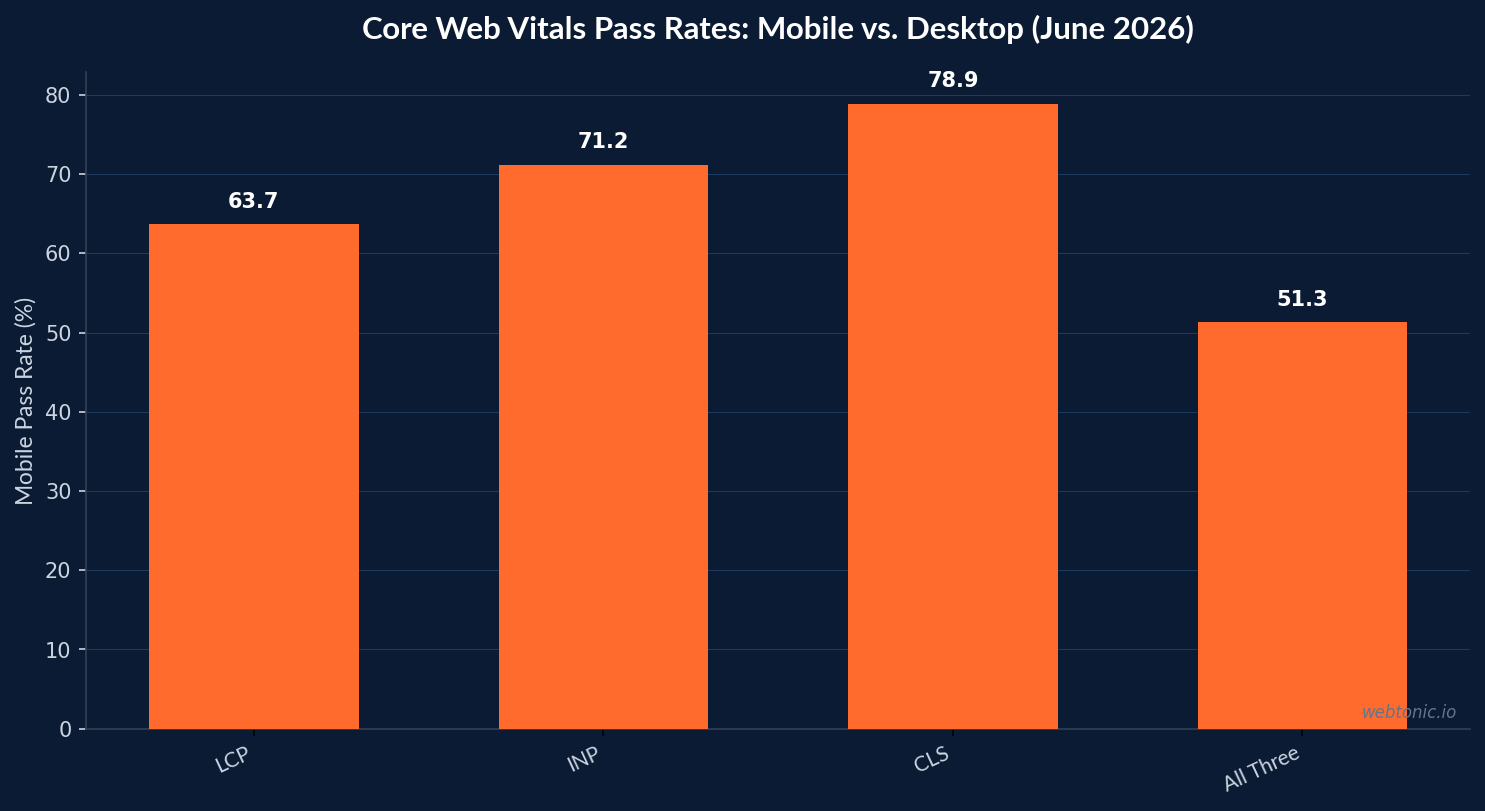
With 78.4% of consumer electronics traffic coming from mobile devices (CuFinder, 2026), Core Web Vitals performance directly affects both rankings and revenue. JustAnalytics' June 2026 CWV report reveals significant pass-rate gaps:
| Core Web Vital | Mobile Pass Rate | Desktop Pass Rate | Gap |
|---|---|---|---|
| LCP (Loading) | 63.7% | 78.4% | −14.7pp |
| INP (Interactivity) | 71.2% | 89.1% | −17.9pp |
| CLS (Visual Stability) | 78.9% | 82.3% | −3.4pp |
| All Three | 51.3% | 67.8% | −16.5pp |
Source: JustAnalytics — Core Web Vitals Statistics June 2026.
- Mobile pages load 87% slower than desktop: median LCP is 3.8 seconds on mobile vs. 2.1 seconds on desktop (Searchlab / HTTP Archive, 2026).
- Google's Core Web Vitals impact 70% of search queries as a ranking signal (Zipdo, 2026).
- Every 0.1-second improvement in load time lifts conversion rates by up to 8% (Think with Google) — a substantial revenue impact for high-traffic electronics stores.
- 48% of mobile origins pass all three CWV metrics for e-commerce specifically, placing the sector slightly below the cross-industry average (CO Consulting, 2026).
Phone retailers investing in Meta Ads management should prioritise LCP and INP improvements, which offer the largest mobile pass-rate gains and the most direct conversion impact.
Category Pages: The Overlooked SEO Lever
One of the most striking findings from Authority Specialist's 2026 e-commerce study is that category pages generate 60–70% of organic sessions despite receiving far less optimisation attention than product pages. For phone and tech retailers, this means "phone cases," "wireless earbuds," and "USB-C chargers" category pages are doing more SEO heavy lifting than individual product listings.
- Category pages with 300+ words of unique content outperform thin categories by ~40% in organic sessions.
- Internal linking from category pages to top-selling products distributes authority more effectively than flat site architectures.
- Faceted navigation — filtering by brand, price, or feature — must be properly canonicalised to avoid duplicate-content issues that dilute ranking signals.
- Breadcrumb and BreadcrumbList schema on category pages improve both click-through rates and crawl efficiency, particularly for large electronics catalogues.
Tech retailers should treat category pages as content assets, not just product grids, and allocate Google Ads strategy tips resources to optimising them alongside product pages.
Product Schema & Structured Data in 2026
Google's 2026 updates pushed three previously optional Product schema fields into "effectively required" status for retail queries (Gatilab, 2026). For phone and tech retailers, implementing comprehensive structured data is now table stakes for rich-result eligibility.
- Product schema compliance increases rich-result eligibility for price, availability, and review snippets — the primary CTR boosters in electronics SERPs.
- "additionalProperty" arrays for tech specs (RAM, storage, screen size) give Google granular product understanding and improve matching for comparison queries (Lumio, 2026).
- Schema-compliant product pages are the foundation of AI citation — as AI search grows, structured data determines which products get referenced in generative results (GeoLikeAPro, 2026).
- Shipping and return schema (shippingDetails, hasMerchantReturnPolicy) now influence both rich results and Google Shopping eligibility for electronics products.
Retailers who combine schema with Google Ads pricing guide gain both rich-result visibility and AI-search citation simultaneously.
SERP Visibility & Competitive Landscape
GrowByData's 2025 Electronics Search Benchmark Report highlights dramatic SERP share-of-voice (SOV) shifts in the electronics vertical:
- Amazon's organic SOV contracted by 12.1% in electronics SERPs, creating opportunities for DTC brands and niche retailers.
- YouTube's SOV grew by 7.4%, reflecting the increasing role of video content in product-discovery queries.
- Reddit and Quora are rising discovery platforms — their UGC content now appears in a growing share of electronics search results, providing new syndication opportunities for retailers.
- HP surged 332% in holistic SERP SOV by blending shopping and organic search strategies, demonstrating the power of integrated approaches.
For phone and tech retailers, the takeaway is clear: a diversified SEO strategy that includes traditional organic, video content, and community presence delivers the broadest SERP coverage. Combined with Facebook Ads ROI analysis, this approach protects against platform-specific SOV volatility.
SEO Best Practices for Phone & Tech Retailers
- Prioritise category page optimisation. These pages drive 60–70% of organic sessions — add unique content, optimise titles, and build internal links from them to top products.
- Fix mobile Core Web Vitals. Only 51.3% of mobile sites pass all three CWV metrics. Focus on LCP (image optimisation, server response) and INP (JavaScript efficiency) for the greatest ranking and conversion impact.
- Implement comprehensive Product schema. Include the three newly required fields and use "additionalProperty" arrays for tech specs to improve rich-result eligibility.
- Close the mobile conversion gap. With 78.4% mobile traffic but 2.1% mobile CVR vs. 3.9% desktop, mobile UX improvements yield disproportionate revenue gains.
- Build topical authority through content. Spec-comparison pages, buying guides, and repair tutorials earn organic backlinks and establish E-E-A-T signals that strengthen the entire domain.
- Monitor SERP SOV shifts. Amazon's declining SOV creates opportunities — target queries where marketplace dominance is weakening and DTC brands can capture share.
- Optimise for AI search. Schema-compliant pages with structured data are the foundation of AI citation. Ensure product data is machine-readable for generative search engines.
Content Strategy for Electronics SEO
The most successful phone and tech retailers treat content as a strategic SEO asset, not an afterthought. Data from multiple sources points to specific content types that drive disproportionate organic performance:
- Buying guides ("Best Wireless Earbuds Under $100") rank for high-volume informational queries and feed internal links to product and category pages. These pages typically earn 3–5× more organic backlinks than product pages alone.
- Spec-comparison tables serve dual purposes: they rank for "[product A] vs [product B]" queries while providing structured data that AI search engines can parse and cite directly.
- Repair and troubleshooting content captures a massive long-tail audience. "How to fix [phone model] [issue]" queries generate consistent traffic year-round and build topical authority in the electronics space.
- Industry statistics and trend pages attract media citations and backlinks. A well-researched "State of Phone Repair Pricing 2026" report can earn 50–100 referring domains within 12 months of publication.
Retailers that publish at least 2–4 in-depth content pieces per month alongside product launches see compounding organic traffic gains, with months 6–12 typically delivering the steepest growth curve as topical authority accumulates across the domain.
Technical SEO Priorities for Electronics Sites
Beyond Core Web Vitals, several technical SEO factors disproportionately affect phone and tech retail sites due to their typically large catalogues, frequent inventory changes, and complex filtering systems:
- Crawl budget management is critical for stores with thousands of SKUs. Products that go out of stock should return proper 404 or 301 responses rather than soft-404 pages that waste crawl budget and dilute site authority.
- Canonical tags on filtered URLs prevent duplicate-content issues from colour, storage, and carrier variants of the same product. Without proper canonicalisation, a single phone model can generate 10–50 near-duplicate URLs.
- XML sitemaps segmented by product category improve crawl efficiency for large catalogues. Separating "phones," "accessories," and "repair parts" into distinct sitemaps allows Google to prioritise high-value pages.
- Hreflang implementation for multi-market retailers prevents keyword cannibalisation between regional storefronts — a common issue for electronics brands operating in the US, UK, Canada, and Australia simultaneously.
Related reading
- Phone & Tech Retail Technical SEO Statistics: Speed, Crawl and Schema Data for 2026
- Phone & Tech Retail Local SEO Statistics: 2026 Search, Reviews & GBP Data
- Phone & Tech Retail Link Building Statistics: 2026 Costs, ROI & Benchmarks
- GEO & AEO services at Web Tonic
Frequently Asked Questions
What percentage of traffic comes from organic search for electronics sites?
Consumer electronics sites receive 29–50% of traffic from organic search depending on brand maturity and market. DTC-focused retailers typically see the higher end (35–50%), while major brands with strong direct traffic see 29% organic (CuFinder / Eightx, 2026).
What is a good organic conversion rate for a tech retail website?
Organic conversion rates for e-commerce electronics range from 1.8% to 4.2%, with schema-rich, mobile-optimised sites at the upper end. The mobile-specific average is 2.1% vs. 3.9% on desktop (Authority Specialist / CuFinder, 2026).
How do Core Web Vitals affect phone retailer rankings?
Core Web Vitals impact 70% of search queries as a ranking factor (Zipdo, 2026). Only 51.3% of mobile sites pass all three metrics, so retailers that achieve full compliance gain a significant competitive advantage, especially given 78.4% mobile traffic share in consumer electronics.
Why are category pages so important for tech retail SEO?
Category pages generate 60–70% of organic sessions for e-commerce stores (Authority Specialist, 2026). They rank for broad, high-volume terms ("wireless earbuds," "phone cases") that individual product pages cannot target effectively.
Is structured data necessary for electronics product pages?
Yes. Google's 2026 updates made three Product schema fields effectively required for retail queries (Gatilab, 2026). Structured data drives rich results (price, availability, reviews) and is the foundation for AI-search citation across generative engines.
Sources
CuFinder — Consumer Electronics Marketing Benchmarks 2026
Eightx — Organic Traffic Share by Vertical 2026
Authority Specialist — Ecommerce SEO Benchmarks 2026
Authority Specialist — Online Retailer SEO Statistics 2026
JustAnalytics — Core Web Vitals Statistics June 2026
Searchlab — Technical SEO Statistics 2026
Karbon Analytics — Shopify Conversion Rate Benchmarks 2026
Gatilab — Product Schema Markup 2026
GrowByData — Electronics Search Benchmark Report
Zipdo — Mobile SEO Statistics 2026
CO Consulting — Page Speed Statistics 2026


