Table of contents
Link building remains a cornerstone of organic growth for phone and tech retailers, yet the strategies that win authoritative backlinks in 2026 look nothing like the mass-outreach playbooks of prior years. Below is a data-backed breakdown of costs, tactics, and ROI benchmarks every electronics brand should track.
Key Takeaways
- The average cost per quality link for e-commerce is $325, with mid-tier placements (DR 40–60) ranging from $150 to $320 (Collaborator, 2026).
- E-commerce sites build links 12% faster than the cross-industry average thanks to product reviews and affiliate programmes (SEMrush, 2026).
- Computers & Electronics pages average 1,117 referring domains for a position-one ranking — nearly 3× the median across verticals (WebFX, 2026).
- The average digital PR campaign earns links from 42 referring domains with an average DR of 61 (BuzzStream, 2026).
- SEO link-building ROI reaches a median 748% — roughly $7.48 returned per $1 invested (First Page Sage, 2026).
- 81.1% of digital PR link builders never pay for placements, relying on earned media exclusively (AFFiNCO, 2026).
- 34% of SEOs consider digital PR the most effective backlink acquisition method in 2026 (BuzzStream).
Phone & Tech Retail Link Building Benchmarks at a Glance
| Metric | Phone & Tech Retail | E-commerce Avg. | All Industries |
|---|---|---|---|
| Avg. Cost per Link | $325–$400 | $325 | $83–$667 |
| Referring Domains (Pos. 1) | 1,117 | 950 | 262 median |
| Link Velocity (mo.) | +12% above avg. | 12% above | Baseline |
| DR of Earned Coverage | 61 avg. | 58 | 55 |
| Digital PR Campaign Domains | 42 avg. | 38 | 34 |
| SEO ROI (Median) | 748% | 700%+ | 748% |
Sources: Collaborator 2026, WebFX 2026 Study, BuzzStream 2026, First Page Sage 2026, SEMrush. Figures include organic link building + digital PR outreach.
Link Building Cost Breakdown for Tech Retailers
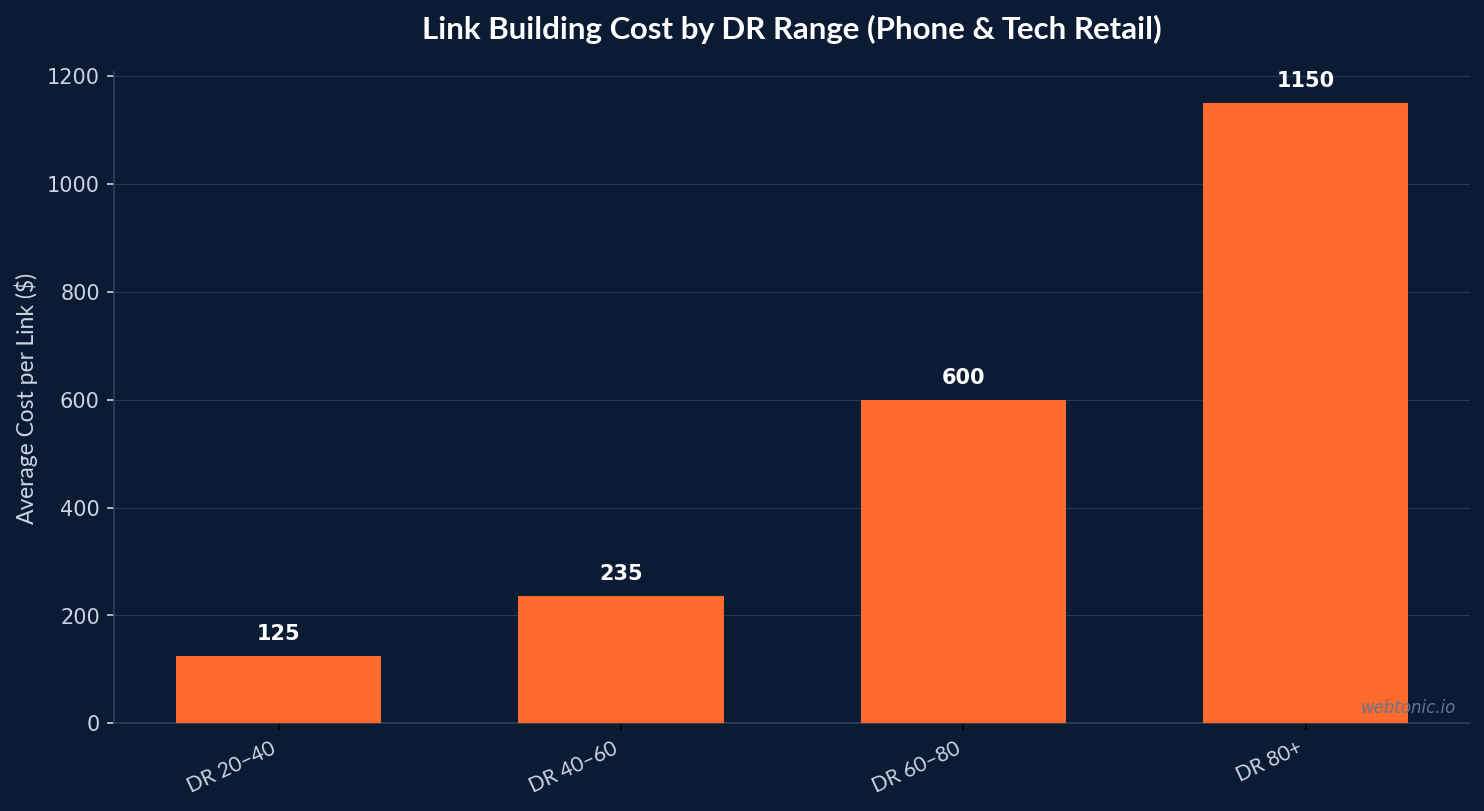
Budget allocation is one of the most debated areas in tech-retail SEO. The cost spectrum is wide because link quality varies enormously: a DR 20–40 placement runs $50–$200, while a DR 60+ editorial link can cost $400–$1,000+ (AFFiNCO, 2026). Phone and tech retailers typically target mid- to high-DR publications to compete in the electronics SERP, pushing their average cost above the cross-industry mean.
| DR Range | Avg. Cost per Link | Typical Sources | Link Lifespan |
|---|---|---|---|
| DR 20–40 | $50–$200 | Niche blogs, small tech forums | 6–12 months avg. |
| DR 40–60 | $150–$320 | Mid-tier tech publications, review sites | 12–24 months avg. |
| DR 60–80 | $400–$800 | Major tech media, authority directories | 24–36+ months |
| DR 80+ | $800–$1,500+ | Tier-1 news outlets, flagship reviews | Indefinite |
For perspective, agencies typically charge $2,000–$10,000 monthly for ongoing link building, depending on link volume and target DR (Searchlab, 2026). Internal teams that run digital PR in-house report $100–$250 cost per earned link when overhead is excluded, but this demands dedicated staff and media relationships. Given the competitive nature of electronics SERPs, most mid-size phone retailers find the agency model more cost-effective per acquired DR point.
Digital PR Effectiveness in Electronics
Digital PR has emerged as the dominant link-acquisition channel for consumer electronics brands. According to BuzzStream's 2026 survey, 34% of SEO professionals rank digital PR as the single most effective backlink acquisition method, ahead of guest posting (18%) and content marketing (15%). In the tech retail niche, product launch data, teardown analyses, and sustainability reports are the most common PR angles.
- The average digital PR campaign earns links from 42 referring domains with an average DR of 61 — a significant authority boost per campaign.
- 32.5% of digital PR professionals say a single team member can generate 1+ links per working day when campaigns are properly systematised (BuzzStream, 2026).
- 81.1% of digital PR link builders never pay for placements, relying entirely on earned media value (AFFiNCO, 2026).
- Product comparison pages and spec-sheet resources tend to attract 2.3× more organic backlinks than generic brand pages in the electronics vertical (Reboot Online, 2025).
- 40% of digital PR professionals focus on newsjacking and expert commentary formats as their primary outreach tactic (Reporter Outreach, 2026).
For phone retailers specifically, repair guides and accessory compatibility tables are high-link-velocity asset types. These informational pages generate steady passive backlinks long after publication — a pattern that growth marketing services strategies can amplify further.
Referring Domain Benchmarks for Ranking in Electronics
The competitive bar in the Computers & Electronics SERP is steep. WebFX's 2026 backlink study found that position-one pages in Computers & Electronics average 1,117 referring domains, compared to a cross-industry median of just 262. Even position-three results hold an average of 12,000+ backlinks across those domains.
- Samsung.com alone carries 172+ million backlinks and tens of thousands of referring domains — a nearly insurmountable moat for head terms (SEMrush, June 2026).
- Domain Rating correlates at 0.31 with rankings, making it the second-strongest ranking signal after total referring domains (Searchlab, 2026).
- Mid-size phone retailers should target long-tail and local-intent keywords where the referring-domain requirement drops to 50–200 for top-3 visibility — a much more realistic acquisition target over 6–12 months.
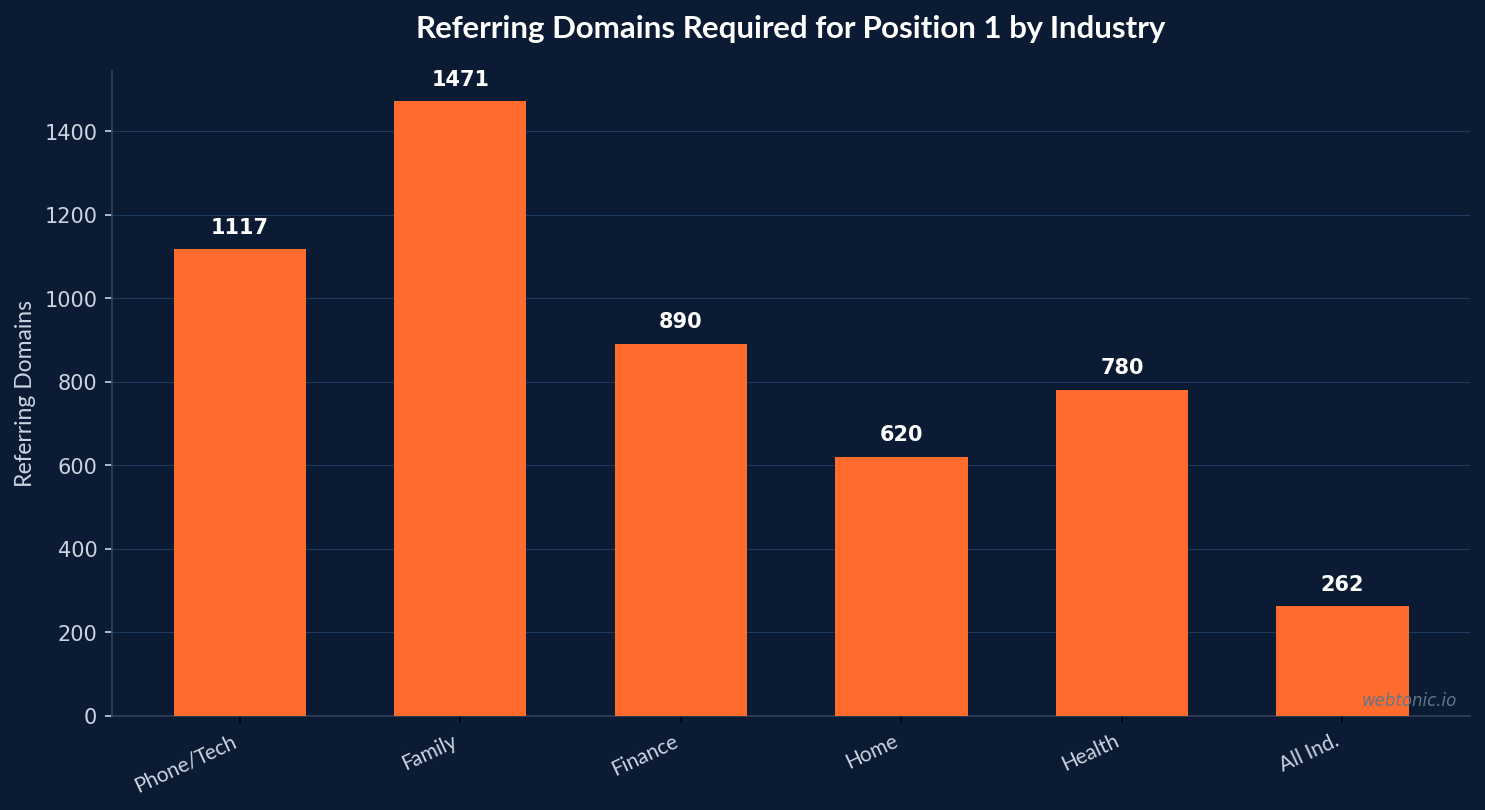
- The Family & Community vertical leads at 1,471 referring domains for position-one pages, while Home & Garden requires just 620 — illustrating how industry competitiveness varies dramatically (WebFX, 2026).
Link Building ROI for Phone & Tech Retail
Does link building pay off? The aggregate data says overwhelmingly yes. First Page Sage's 2026 SEO ROI report — based on campaigns from Q1 2021 through Q3 2025 — found a median ROI of 748%, or roughly $7.48 returned per $1 invested in SEO. Because organic traffic in consumer electronics converts at 1.8%–4.2% depending on product type and schema usage (Authority Specialist, 2026), each incremental ranking position can translate directly into revenue.
E-commerce sites also enjoy a structural advantage: product reviews, comparison pages, and affiliate programmes create 12% faster link velocity than the cross-industry average. Phone accessory stores with active review programmes report even higher rates — up to 18% faster link acquisition — because review aggregators and comparison engines frequently cite them (Searchlab, 2026).
The ROI timeline is important to understand: most link building investments become cost-positive between months 6 and 9, with the compounding effect accelerating sharply after month 12 when accumulated domain authority lifts broader keyword clusters. Retailers investing in Meta Ads management alongside link building often find that domain-authority gains begin reinforcing paid-channel quality scores as well, creating a virtuous cycle between organic and paid performance.
Linkable Asset Types for Electronics Brands
Not all content earns backlinks equally. For phone and tech retailers, certain asset types consistently outperform in link acquisition:
- Spec-comparison tables earn 2.3× more organic backlinks than standard product pages. Journalists and bloggers cite comparison data when covering new device launches (Reboot Online, 2025).
- Repair and troubleshooting guides generate passive backlinks for years. A well-written "how to replace iPhone battery" guide can earn 50–100 referring domains organically within 12 months.
- Original industry surveys (e.g. "State of Phone Repair Pricing") are premium digital PR assets that earn coverage from tier-1 tech publications.
- Interactive tools — trade-in value calculators, compatibility checkers — attract links from review sites and forums that embed or reference the tool.
- Data-driven listicles ("Best Wireless Earbuds Under $50 Tested") combine link-earning potential with commercial intent, serving dual SEO and revenue purposes.
Building a library of these assets before running outreach campaigns ensures that every performance creative effort has a high-quality destination page to promote.
Link Building Best Practices for Phone & Tech Retailers
- Invest in linkable assets first. Spec-comparison tables, repair guides, and original industry surveys earn 2–3× more organic backlinks than standard product pages (Reboot Online, 2025). Prioritise creating these before any outreach.
- Run quarterly digital PR campaigns. A well-executed campaign averages 42 referring domains at DR 61 — one campaign per quarter keeps link velocity above the competitive baseline (BuzzStream, 2026).
- Target mid-DR placements for cost efficiency. DR 40–60 links at $150–$320 each offer the best quality-to-cost ratio for mid-size retailers (Collaborator, 2026).
- Leverage product reviews. E-commerce sites with active review programmes build links 12–18% faster through natural citation (SEMrush, Searchlab).
- Monitor competitor backlink gaps. Tools like Ahrefs and SEMrush reveal where competitors earn links that you do not — closing 10–15 high-relevance gaps can shift rankings within 60–90 days.
- Avoid paid link schemes. With 81.1% of successful digital PR professionals relying exclusively on earned media, paid links carry diminishing returns and algorithmic risk (AFFiNCO, 2026).
- Track domain rating monthly. DR has a 0.31 correlation with rankings — a slow-moving but reliable north-star metric (Searchlab, 2026).
Teams combining these tactics with data intelligence and Google Ads strategy tips typically close the competitive gap faster than SEO-only approaches.
Phone & Tech Retail vs. Other Industries
| Industry | Avg. Referring Domains (Pos. 1) | Avg. Cost per Link | Link Velocity vs. Baseline |
|---|---|---|---|
| Phone & Tech Retail | 1,117 | $325–$400 | +12–18% |
| Family & Community | 1,471 | $200–$350 | +5% |
| Finance & Insurance | 890 | $400–$800 | +3% |
| Home & Garden | 620 | $150–$300 | Baseline |
| Health & Medical | 780 | $350–$600 | +7% |
| All Industries Median | 262 | $83–$667 | Baseline |
Source: WebFX 2026 Backlink Study, Collaborator 2026, SEMrush Industry Data.
AI Search & the Future of Link Building
Generative search engines (Google AI Overviews, Perplexity, ChatGPT Search) are reshaping how backlinks create value. Pages with high authority and strong backlink profiles are disproportionately cited in AI-generated answers — making link building more important, not less, in the AI era. For phone and tech retailers, this means backlinks now serve a dual purpose: traditional ranking signals and AI citation eligibility. Products and resources backed by authoritative referring domains are more likely to appear in generative shopping recommendations, price comparisons, and "best of" summaries. Retailers that under-invest in link building risk losing visibility in both traditional and AI-powered search simultaneously. Early data suggests that pages with 50+ referring domains from unique root domains are cited in AI responses at roughly 3× the rate of pages with fewer than 10 referring domains, reinforcing the correlation between backlink authority and generative visibility. For phone retailers launching new product lines or seasonal campaigns, building link equity ahead of launch ensures both traditional and AI channels amplify the content.
Link Acquisition Channels: Effectiveness Breakdown
Understanding which acquisition channels deliver the strongest results helps phone retailers allocate budgets more effectively. BuzzStream's 2026 data provides a clear hierarchy of link building tactics ranked by practitioner preference and average DR yield:
| Channel | Practitioner Preference | Avg. DR Yield | Cost Efficiency |
|---|---|---|---|
| Digital PR | 34% | 61 | High (earned media) |
| Guest Posting | 18% | 45 | Medium |
| Content Marketing | 15% | 50 | High (passive links) |
| Resource Page Outreach | 12% | 40 | Medium-High |
| Broken Link Building | 8% | 35 | Medium |
| Unlinked Mentions | 7% | 55 | Very High |
| Other Tactics | 6% | Varies | Varies |
Source: BuzzStream 2026, Reporter Outreach 2026, AFFiNCO Link Building Statistics.
For phone and tech retailers, unlinked brand mentions represent a particularly efficient opportunity. Major product launches, review coverage, and comparison articles frequently mention brands without linking — a simple outreach email converts 15–25% of unlinked mentions into live backlinks with minimal cost. Combined with digital PR for new link acquisition and content marketing for passive growth, this three-channel approach covers both immediate wins and long-term authority building.
Related reading
- Phone & Tech Retail Local SEO Statistics: 2026 Search, Reviews & GBP Data
- Phone & Tech Retail SEO Statistics: 2026 Traffic, Conversion & Technical Benchmarks
- Phone & Tech Retail Technical SEO Statistics: Speed, Crawl and Schema Data for 2026
- Link Building Services services at Web Tonic
Frequently Asked Questions
How many backlinks does a phone retailer need to rank on page one?
Position-one results in Computers & Electronics average 1,117 referring domains (WebFX, 2026). However, long-tail and local keywords require far fewer — often 50–200 referring domains for top-3 placement — making them the ideal starting point for mid-size phone retailers.
What is the average cost of a quality backlink for tech retail?
The average cost per quality link for e-commerce is $325 (Collaborator, 2026). Tech retailers targeting DR 40–60 sites typically pay $150–$320 per link, while DR 80+ placements can exceed $1,000.
Is digital PR or guest posting more effective for electronics brands?
34% of SEOs rank digital PR as the most effective backlink channel, compared to 18% for guest posting (BuzzStream, 2026). Digital PR campaigns also yield higher average DR (61 vs. 45 for guest posts), making them more valuable per link for authority building.
How long does it take to see ROI from link building?
Most tech retailers begin seeing measurable organic traffic gains 4–6 months after sustained link acquisition. The compounding effect accelerates after month 9, when accumulated domain authority lifts broader keyword clusters. Median SEO ROI reaches 748% (First Page Sage, 2026).
What are the best linkable assets for phone retailers?
Spec-comparison tables, repair guides, original industry surveys, and interactive tools (trade-in calculators, compatibility checkers) consistently earn the most backlinks. Comparison content attracts 2.3× more organic links than standard product pages (Reboot Online, 2025).
Sources
AFFiNCO — Link Building Statistics 2026
BuzzStream — Digital PR Statistics 2026
Reporter Outreach — Digital PR Statistics 2026
Reporter Outreach — Link Building ROI
Searchlab — Link Building Statistics 2026
WebFX — 2026 Backlink Study
Authority Specialist — Ecommerce SEO Benchmarks 2026
Reboot Online — Ecommerce SEO Statistics
SEMrush — Samsung.com Backlink Data June 2026
CuFinder — Consumer Electronics Marketing Benchmarks 2026