



Table of contents
Hyperlocal backlinks remain the fastest authority signal for pest control companies competing in local search — operators who invest in targeted link acquisition increase domain authority by 8–15 points in six months, while those hit with link penalties lose 30–60 % of organic traffic and leads. Here are the link building benchmarks, authority data, and citation statistics that shape pest control SEO performance in 2026.
Key Takeaways
- 8–15 point domain authority increase achievable in six months through hyperlocal link building and citation consistency (RankPill).
- 30–60 % traffic and lead reduction after ranking penalties triggered by bad backlinks or anchor overuse (Southern Digital Consulting).
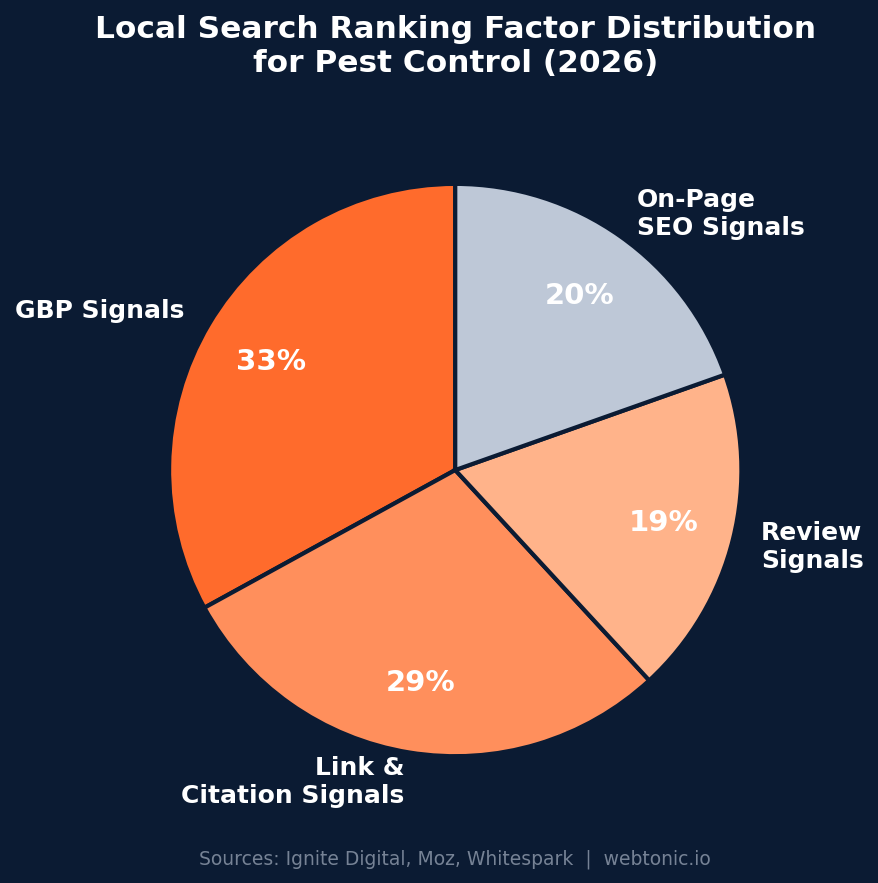
- GBP signals account for ~32 % of local ranking influence, reviews 16–20 %, on-page SEO 15–19 %, and link signals ~28 % (Ignite Digital / Moz).
- 784 % organic traffic increase documented in a pest control case study using silo content strategy and targeted backlinks (Loopex Digital).
- 89.7 % of pest control sites are losing organic traffic, with a median 57 % decline from previous peaks (Cube Creative 300-site audit).
- 10–15 high-authority directories recommended for consistent local citation building (Authority Specialist).
- "Pest control" generates 550,000 global monthly searches with a keyword difficulty of 60/100 and average CPC of $16.82 (RankPill).
- 5 quality backlinks outperform 10,000 spam links — relevance and authority outweigh raw link volume in every ranking model (Pest Control Millionaires).
Pest Control Link Building Benchmarks at a Glance
The table below consolidates link building and authority metrics from multiple industry sources to give pest control operators a clear performance baseline.
| Metric | Benchmark | Source |
|---|---|---|
| DA Increase (6-Month Program) | 8–15 points | RankPill |
| Traffic Loss From Link Penalty | 30–60 % | Southern Digital Consulting |
| Link Signals Share of Local Ranking | ~28 % | Moz / Whitespark |
| GBP Signals Share of Local Ranking | ~32 % | Ignite Digital |
| Review Signals Share | 16–20 % | Ignite Digital |
| On-Page SEO Signals Share | 15–19 % | Ignite Digital |
| Citation Directories Needed | 10–15 high-authority | Authority Specialist |
| Pest Control Keyword Difficulty | 60/100 (Hard) | RankPill |
Local Ranking Factors and Link Signals
Link building for pest control operates within a specific local ranking framework. According to Ignite Digital's 2026 State of Search report, the local ranking signal distribution for pest control breaks down as follows: Google Business Profile signals account for roughly 32 % of local ranking influence, reviews represent approximately 16–20 %, and on-page signals represent approximately 15–19 %. Link and citation signals fill the remaining share at roughly 28 % — making backlinks the second-largest controllable ranking factor behind GBP optimization.
This distribution means pest control operators cannot rely on link building alone, but also cannot ignore it. A company with strong GBP signals but weak backlinks will consistently lose map pack positions to competitors who have both. The AFFiNCO local SEO research confirms that on-page signals (NAP data, local content, service pages, authority) contribute roughly 19 % to local pack rankings — and authority is built through links.
Link Building Case Studies in Pest Control
Real-world case studies provide the strongest evidence for link building ROI in the pest control vertical:
| Company / Study | Strategy | Result | Source |
|---|---|---|---|
| OvoControl (Pigeon Control) | Silo content + authority backlinks | 784 % organic traffic increase, 552 % keywords in top 10, 54 % DR increase | Loopex Digital |
| Pestline (General Pest) | Targeted backlinks to build DA | Improved rankings and qualified traffic through high-quality referring domains | Top Rankings |
| Copes Pest & Termite | Quality over quantity link acquisition | Domain authority growth from very few initial backlinks | Skylark SEO |
| Squarespace Pest Control Site | Technical SEO + link equity distribution | Domain rating increased to 46 through quality link focus | Loopex Digital |
| Envirobug (General Pest) | Technical audit + spam cleanup + monthly link building | Improved rankings after disavowing toxic backlinks | Rankberry |
The OvoControl case is particularly instructive: Loopex Digital achieved a 784 % organic traffic increase by combining silo content architecture with niche-relevant backlinks from authority pest control and environmental management sites. The strategy focused on two content pillars — "how to get rid of pigeons" and "industrial bird control" — with each silo reinforced by targeted outreach to niche-specific writers and publications.
Critical Link Building Mistakes in Pest Control
Southern Digital Consulting's analysis identifies the most damaging patterns that trigger ranking penalties:
- Backlink profile neglect — trusting agencies without reviewing source quality leads to link graphs filled with low-authority blogs, foreign directories, and non-industry sources. Sites drop out of the map pack after acquiring links from generic web directories and private networks.
- Anchor text manipulation — overusing exact-match service keywords as anchor text triggers SpamBrain penalties. Operators report traffic and lead reductions of 30–60 % after ranking drops from bad backlinks or anchor overuse.
- Ignoring link velocity — sudden spikes in backlink acquisition from unrelated domains are a manual review trigger. Sustainable link building follows a steady, organic growth curve.
- Neglecting disavow maintenance — quarterly audits using Ahrefs, SEMrush, or Majestic should scan for new irrelevant domains, content mismatches, or suspicious link spikes.
- Buying generic links — industry operators confirm that 5 quality backlinks from local news outlets, industry associations (NPMA), and local government sites outperform 10,000 spam links from expired domains and coupon platforms.
Local Citation Building for Pest Control
Citations — online mentions of a business's Name, Address, and Phone number (NAP) — function as both link building and local trust signals. SiteRank's 2026 guide identifies three citation tiers:
- General directories: Yelp, Angi, BBB, and local Chambers of Commerce provide high-DA backlinks and NAP consistency signals.
- Industry-specific platforms: PestWeb, NPMA directories, and pest control review aggregators provide niche relevance that general directories lack.
- Local community listings: City government directories, neighborhood associations, and local business roundups carry strong geographic relevance for map pack rankings.
Authority Specialist recommends building consistent citations across 10–15 high-authority directories specific to the operator's service area. Domains with established local citations and review volume rank faster than newer domains entering competitive markets, regardless of overall domain authority.
Search Volume and Competition Context
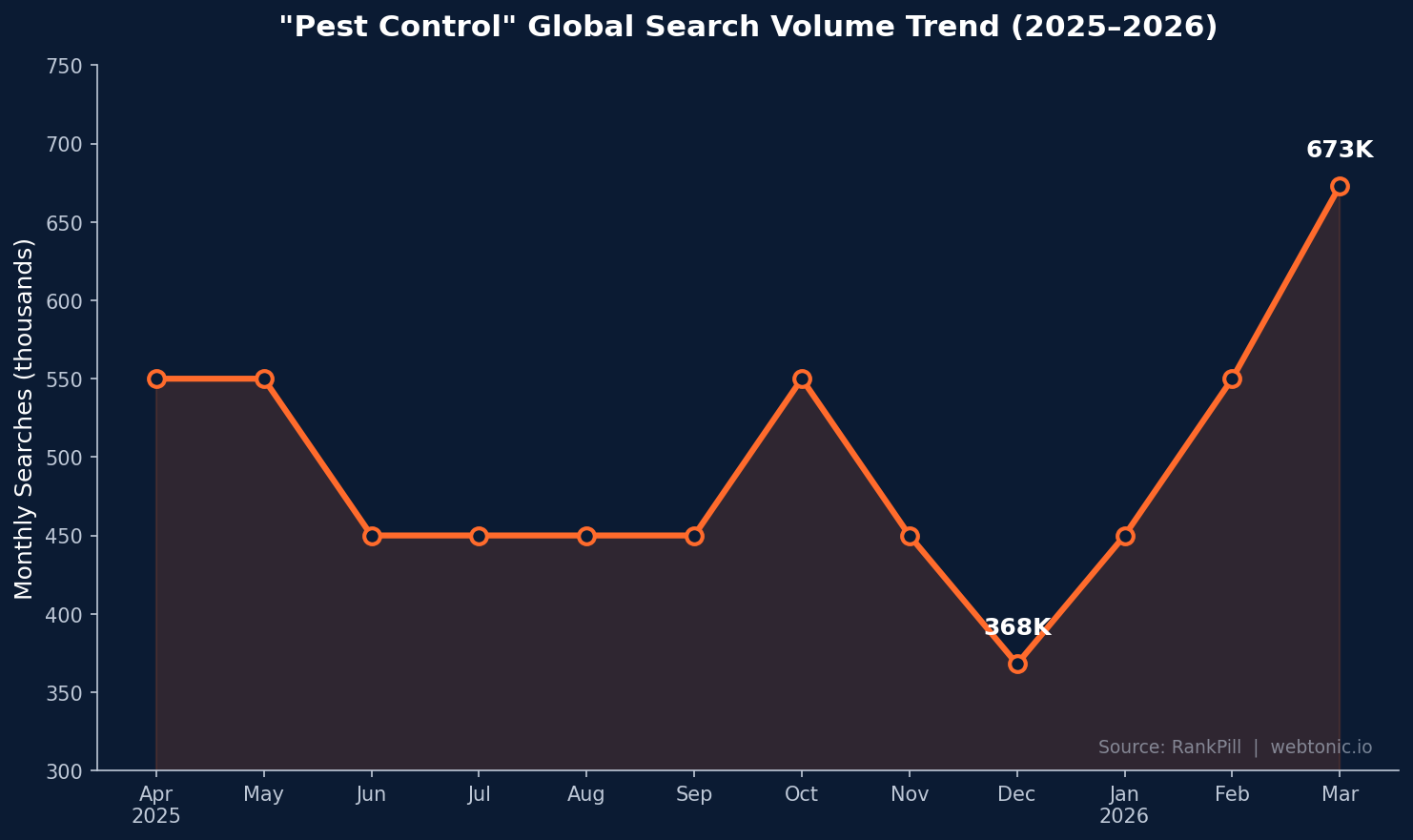
Link building investment should be calibrated to the competitive landscape. RankPill's 2026 data shows that "pest control" generates 550,000 global monthly searches with a keyword difficulty score of 60/100 (Hard) and an average CPC of $16.82. Monthly search volume follows a pronounced seasonal curve — peaking at 673,000 in March and dropping to 368,000 in December.
National brands like Orkin and Terminix dominate head terms, but local operators can capture hyperlocal queries (e.g., "[pest type] removal [neighborhood]") through targeted backlink and content strategies. The path to visibility runs through hyperlocal authority building — earning links from local press, sponsorships, and service-area-specific content rather than competing for generic national terms.
Link Building Best Practices for Pest Control
- Audit before you build — export all backlinks from Google Search Console and Ahrefs quarterly. Identify and disavow toxic links from gambling sites, foreign directories, and expired domains. Benchmark your link profile against the top 3 local competitors.
- Prioritize local relevance — links from local news outlets, property management companies, real estate blogs, and municipal websites carry more ranking weight for pest control than generic high-DA directories.
- Diversify anchor text — avoid exact-match keyword anchors. Mix branded anchors (company name), URL anchors, and natural phrase anchors. An anchor profile dominated by a single service keyword is a penalty trigger.
- Leverage industry associations — NPMA membership, state pest control association directories, and manufacturer certification pages provide high-authority, niche-relevant backlinks that most competitors overlook.
- Create link-worthy assets — pest identification guides, seasonal prevention checklists, and regional pest maps earn organic backlinks from local media and homeowner resources without outreach.
- Build citations consistently — 10–15 directories with perfect NAP consistency, updated quarterly. Inconsistent citations actively suppress local rankings.
- Monitor link velocity — steady, organic growth (2–5 quality links per month) outperforms monthly spikes. Google's SpamBrain algorithm specifically flags unnatural acquisition patterns.
The Pest Control Organic Traffic Crisis
Link building takes on added urgency in light of the industry-wide organic traffic decline documented by Cube Creative's 300-site audit: 89.7 % of pest control sites are losing organic traffic, with a median decline of 57 % from their previous peak. Three forces accelerated this collapse in 2024: Google AI Overviews answering questions directly on the results page, the shutdown of free Google Business Profile websites, and a site diversity update limiting domain representation per query.
Of 300 audited companies, only 14 (10 % of those that attempted it) built geographic landing pages correctly. Companies without working geo-pages were 4× more likely to have a serious issue elsewhere on their site. In this environment, strong backlinks and citation signals are among the few controllable factors that can offset algorithmic headwinds and maintain map pack visibility.
Related reading
- The State of Pest Control Review Management in 2026
- What App Marketers Should Budget for Pest Control ASO
- Pest Control Generative Engine Optimization Data and Statistics
- Link Building Services services at Web Tonic
FAQ
How many backlinks does a pest control company need to rank?
Quality matters more than quantity. 5–10 high-quality, niche-relevant backlinks from local news outlets, industry associations, and property-related websites outperform thousands of low-quality directory links. Focus on earning links from sites that are topically and geographically relevant to your service area.
How long does it take for link building to improve pest control rankings?
A consistent program typically shows measurable results in 3–6 months. Operators investing in hyperlocal link building and citation consistency can expect 8–15 points of domain authority growth within that window (RankPill). Competitive markets may require longer timelines, and national franchise brands have inherent DA advantages that compress ranking timelines in their favor.
What types of backlinks are most valuable for pest control?
The highest-value links come from local press coverage (newspaper features, TV station websites), industry associations (NPMA, state pest control associations), local government directories, and property management and real estate sites. These combine high domain authority with local and topical relevance — the two factors that carry the most weight in local search rankings.
Can bad backlinks hurt a pest control website?
Yes — significantly. Sites penalized for manipulative link patterns experience 30–60 % traffic and lead reductions. Common triggers include link graphs dominated by irrelevant or repurposed expired domains, anchor diversity ignored in favor of a single service keyword, and sudden influxes of links from sites with no real audience. Quarterly audits and proactive disavow maintenance are essential.
What is the difference between citations and backlinks for pest control?
Citations are online mentions of your Name, Address, and Phone number (NAP) on directories like Yelp, Angi, and the BBB — they may or may not include a clickable link. Backlinks are hyperlinks from external websites pointing to your domain. Both contribute to local rankings, but citations primarily signal business legitimacy and geographic relevance, while backlinks build domain authority. A comprehensive local SEO strategy needs both: 10–15 consistent citations plus ongoing quality backlink acquisition.
Sources
Ignite Digital — The State of Search for Pest Control Companies in 2026
RankPill — SEO for Pest Control: The Complete 2026 Guide
Southern Digital Consulting — Critical Backlink Mistakes in Pest Control
Loopex Digital — Pest Control Squarespace SEO Case Study
Authority Specialist — Pest Control SEO Statistics 2026
SiteRank — Local SEO for Pest Control: 2026 Ultimate Guide
AFFiNCO — Local SEO Statistics 2026
Cube Creative — What 300 Pest Control Audits Revealed About Website Traffic
Pest Control Millionaires — Pest Control Backlinks


