Table of contents
The U.S. pest control industry generated USD 13.416 billion in service revenue in 2025, spread across 16,565 firms, 81.4% of which run only one or two locations. That fragmentation, combined with a review-fraud problem both Yelp and Trustpilot report catching at scale, is what defines reputation management in this category in 2026 - not a single national benchmark, but a fight for the same review real estate between independents and franchise brands.
Key Takeaways
- U.S. pest control revenue reached USD 13.416 billion in 2025.
- That is a 6% increase from USD 12.654 billion in 2024.
- Growth ran 2.7 times the U.S. real GDP growth rate that year.
- There were 16,565 pest control firms operating in the U.S. in 2025.
- 81.4% of those firms run just one or two locations.
- Yelp removed over 193,700 community-reported reviews in 2024.
- Yelp filtered nearly 500,000 AI-generated reviews from being published.
- Yelp more than doubled account closures year over year for emerging threats.
- Trustpilot caught 90% of detected fake reviews automatically in 2024.
- Trustpilot's fake-review rate has held near 6% of total reviews for several years running.
- Google disclosed removing 95 million policy-violating reviews in 2021.
- The FTC's fake-review rule, 16 CFR Part 465, took final effect in August 2024.
- Cross-industry, 74% of consumers only weigh reviews from the last three months.
- "Consistent sentiment across reviews" is the single strongest review-trust factor at 56%.
- 89% of consumers expect a reply to any review they post.
An industry growing fast and staying fragmented
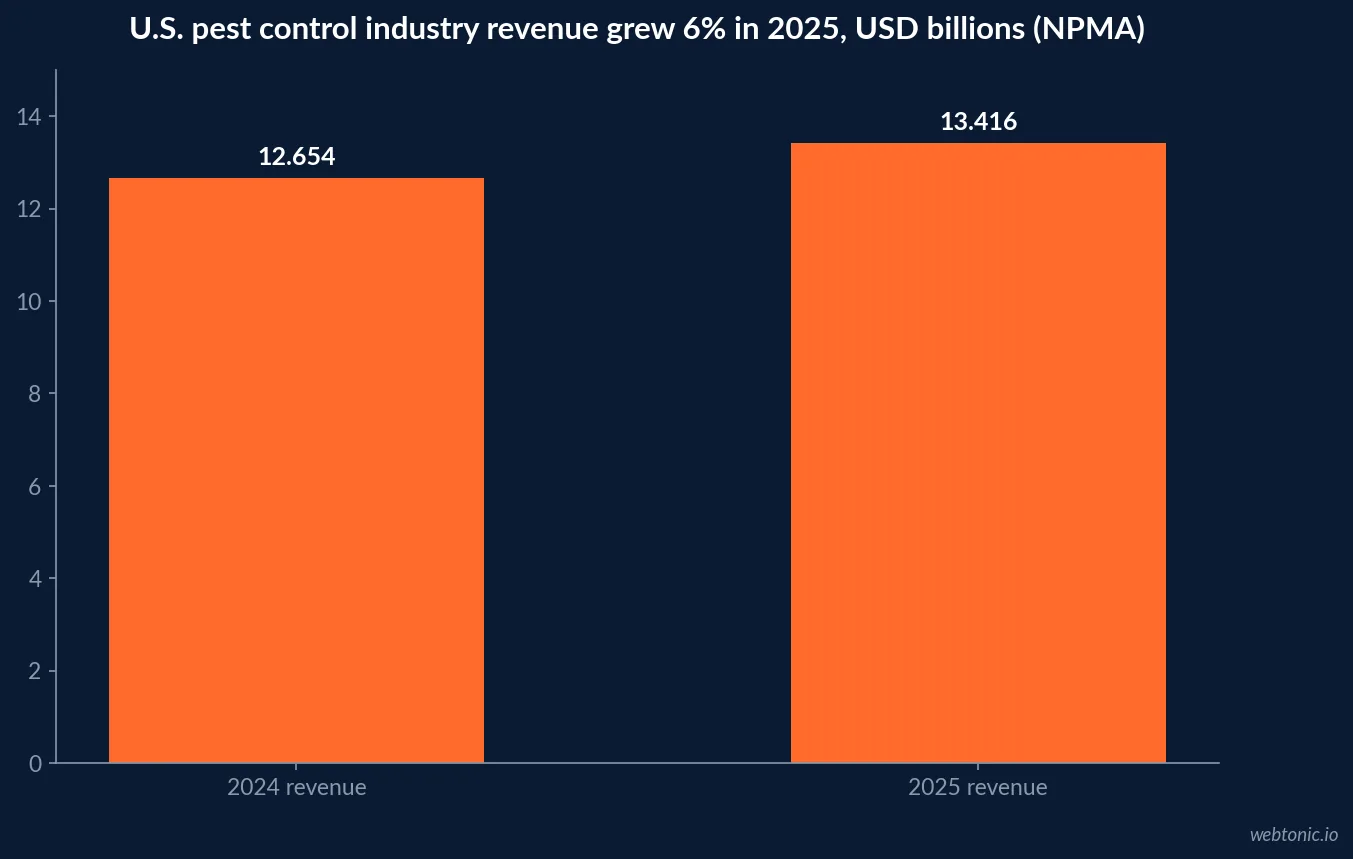
The National Pest Management Association, citing the 26th edition of Specialty Consultants LLC's annual industry analysis (an 800-owner/manager survey, more than half NPMA members), reports total U.S. structural pest control service revenue of USD 13.416 billion in 2025, up 6% from USD 12.654 billion in 2024 - more than 2.7 times the year's real GDP growth rate. The same report counts 16,565 pest control firms operating nationally, with 81.4% running just one or two locations.
That is the defining structural fact for reputation management in this category: a market growing faster than the broader economy, made up overwhelmingly of small operators competing for the same local-pack visibility as national franchise names like Orkin and Terminix.
| Metric | 2025 figure | Change | Source |
|---|---|---|---|
| Total U.S. pest control revenue | USD 13.416 billion | +6% vs. 2024 | NPMA / Specialty Consultants LLC |
| 2024 revenue | USD 12.654 billion | baseline | NPMA / Specialty Consultants LLC |
| Growth vs. U.S. real GDP growth | 2.7x | n/a | NPMA / Specialty Consultants LLC |
| Total pest control firms operating in the U.S. | 16,565 | n/a | NPMA / Specialty Consultants LLC |
| Firms running 1-2 locations | 81.4% | n/a | NPMA / Specialty Consultants LLC |
What the review platforms themselves report policing
Neither Yelp nor Trustpilot breaks its fraud-detection numbers out by category, so the figures below are the cross-industry rate at which fake and manipulated reviews are being caught on the platforms a pest control company's profile lives on - useful context, not a pest-control-specific finding, and labeled as such.
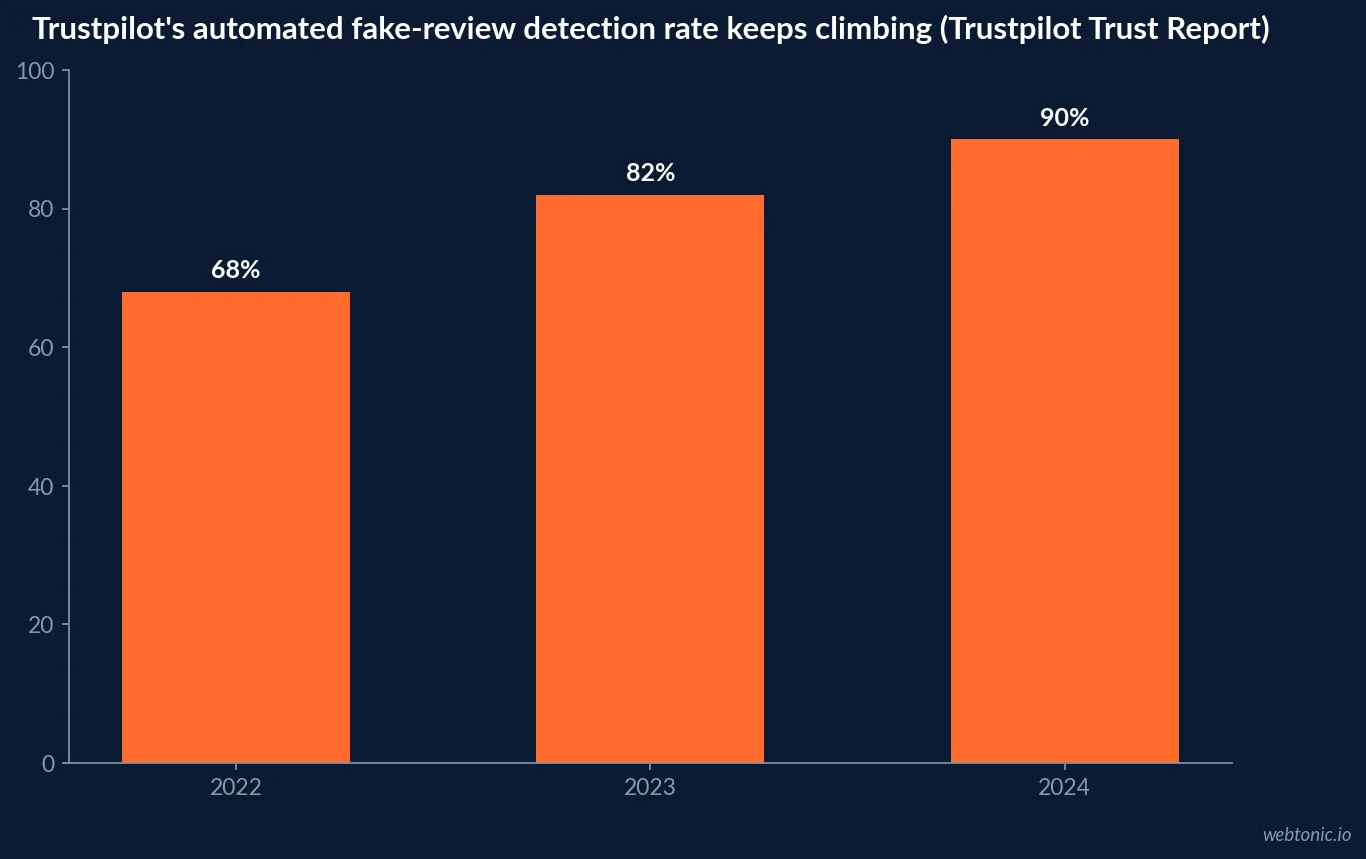
Yelp's 2025 Trust & Safety Report says it removed over 193,700 community-reported reviews, of which 25% did not reflect a firsthand consumer experience and 11% contained threats, lewdness, or hate speech; it also filtered nearly 500,000 AI-generated reviews before they ever published, and more than doubled account closures year over year to combat what it calls emerging threats, including review-extortion scams that had targeted businesses on Google. Trustpilot's own Trust Report shows its automated detection rate climbing every year: 68% of detected fake reviews were caught automatically in 2022, rising to 82% in 2023 and 90% in 2024, on a fake-review rate that has held near a steady 6% of total review volume across those same years.
| Platform | What was reported | Figure | Year |
|---|---|---|---|
| Yelp | Reviews removed after community reports | 193,700+ | 2024 (2025 report) |
| Yelp | AI-generated reviews filtered pre-publication | ~500,000 | 2024 (2025 report) |
| Yelp | Account closures for emerging threats | More than 2x prior year | 2024 (2025 report) |
| Trustpilot | Fake reviews caught automatically | 90% of detected | 2024 (2025 report) |
| Trustpilot | Fake-review share of total volume | ~6% | Multi-year, steady |
| Policy-violating reviews removed | 95 million | 2021 (last disclosed figure) |
Google's own enforcement ladder for fake engagement
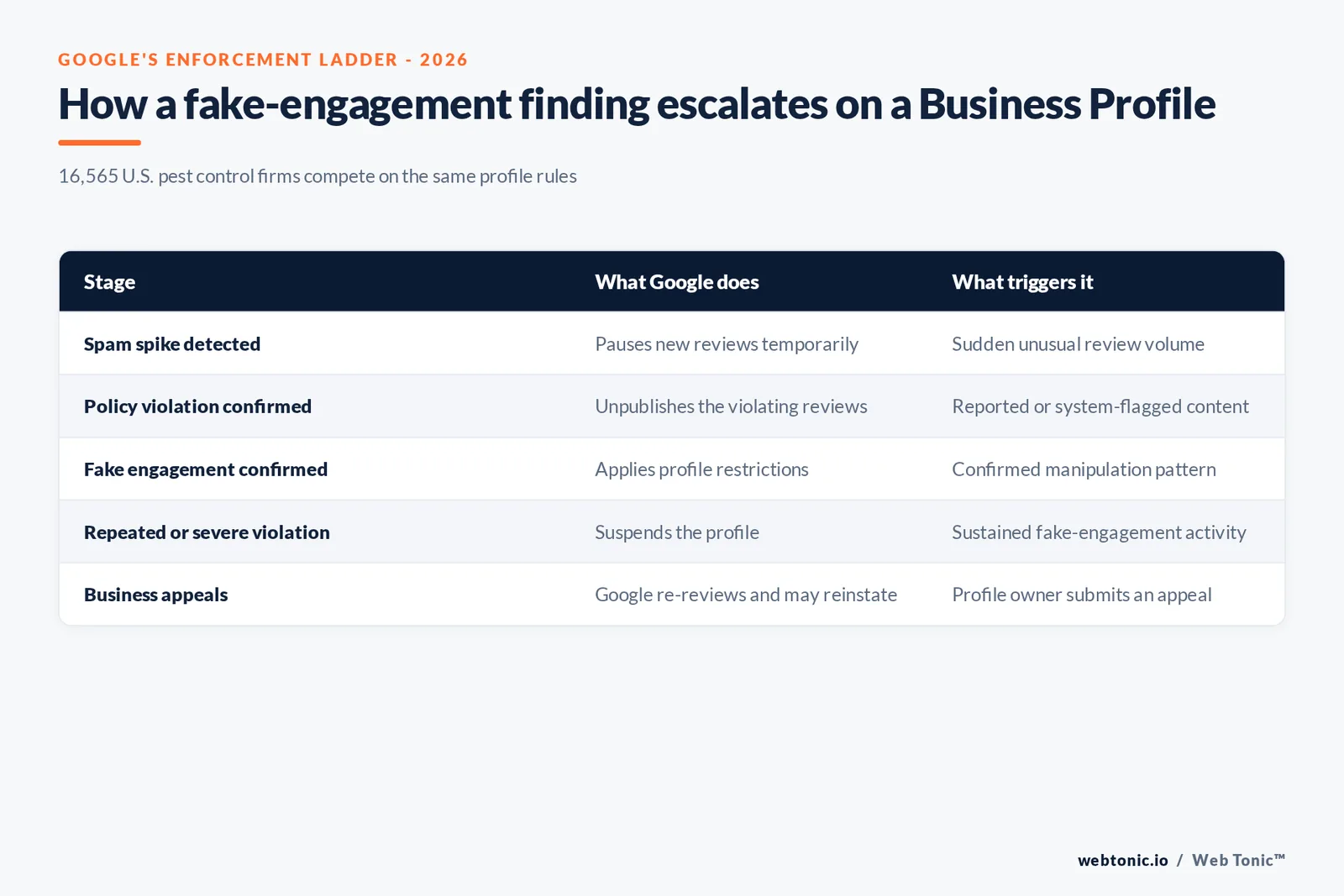
Google's Overview of Business Profile policies makes clear that reviews are covered by the same Prohibited and Restricted Content rules as every other profile format, and its reporting tool only removes reviews that are actually found to violate policy - disputing a real customer's negative experience is not grounds for removal. Google's April 2026 Maps protections post describes systems that now detect specific fake-review scam patterns and stop suspicious posts before they go live, and that pause new reviews on a profile when a sudden spike in spam is detected. Confirmed fake-engagement violations can lead to profile restrictions up to suspension, which must be appealed and reinstated before the profile can accept new content again.
The FTC rule reaches every location in a franchise system
The FTC's 16 CFR Part 465 rule, finalized in August 2024, prohibits creating, buying, or knowingly disseminating reviews that misrepresent a real customer's experience, and prohibits conditioning compensation on a review being positive - obligations that apply to each individually owned pest control franchise location, not only to the parent brand's corporate marketing. In a category where 81.4% of firms are small, owner-operated businesses, that responsibility sits squarely with the local operator running the review-request program day to day.
How a small independent competes against a national brand's review volume
BrightLocal's 2026 Local Consumer Review Survey - a cross-industry study, not a pest-control-specific one - rates "consistent sentiment across multiple reviews" as the single strongest review-trust factor at 56%, ahead of "positive experience language" at 46% and "posted within the last month" at 44%. That ordering favors the smaller operator: a franchise location sitting on a thousand lifetime reviews with inconsistent recent sentiment reads worse to this metric than an independent with forty consistent, recent, replied-to reviews. Combined with the finding that 74% of consumers only weigh reviews from the last three months, review velocity - not lifetime volume - is the lever a smaller pest control company actually controls.
| Review-trust factor (cross-industry) | Share of consumers who weigh it | Source |
|---|---|---|
| Consistent sentiment across multiple reviews | 56% | BrightLocal LCRS 2026 |
| Review describes a positive experience | 46% | BrightLocal LCRS 2026 |
| Review posted within the last month | 44% | BrightLocal LCRS 2026 |
| Only weighs reviews from the last 3 months | 74% | BrightLocal LCRS 2026 |
| Expects a reply to any review posted | 89% | BrightLocal LCRS 2026 |
A working review-integrity checklist for a pest control operator
- Request reviews from every completed service, disclosed and unconditioned, never gated to route only satisfied customers to the public link (an FTC 16 CFR 465 violation pattern).
- Track recency, not just lifetime count - 74% of consumers only weigh the last three months.
- Reply to every review inside a week; 89% of consumers expect some response.
- Monitor for a sudden spike in reviews from a single period, which is the same pattern Google's own spam systems flag before a profile gets paused.
- Keep franchise-location review programs compliant independently - the FTC rule reaches each location, not only corporate marketing.
What review-gating looks like in this category, and why it fails both rules
A common pattern in home-services categories is a triage flow that asks customers privately "how did we do?" first, then only routes the ones who answer positively to the public review link - quietly filtering out the negative feedback before it ever reaches Google or Yelp. That practice sits on the wrong side of both frameworks discussed above: the FTC's 16 CFR Part 465 rule reaches review solicitation practices that suppress negative experiences from public view, and Google's own fake engagement policy treats systematic, one-sided review generation as a signal worth restricting a profile over. The compliant version of the same workflow asks every completed-service customer for a review through the same public link, and handles service recovery for unhappy customers through a separate support channel rather than by hiding their feedback.
| Review-request pattern | FTC 16 CFR 465 risk | Google policy risk |
|---|---|---|
| Ask every customer, same public link | Compliant | Compliant |
| Triage privately, only route happy customers publicly | Non-compliant (selective solicitation) | Flagged as fake engagement pattern |
| Incentivize a review without disclosure | Non-compliant | Violates review policy |
| Incentivize equally regardless of sentiment, disclosed | Compliant | Compliant if disclosed |
Frequently Asked Questions
How big and how fragmented is the U.S. pest control industry?
The National Pest Management Association (NPMA), citing the 26th edition of Specialty Consultants LLC's annual industry analysis, reports total U.S. structural pest control service revenue of USD 13.416 billion in 2025, up 6% from USD 12.654 billion in 2024 - more than 2.7 times the U.S. real GDP growth rate that year. The industry counted 16,565 pest control firms in 2025, and 81.4% of them operate one or two locations. That fragmentation is exactly why review profiles matter more here than in a consolidated category: a small independent competes on the same Google Maps pack as a national franchise, and a review profile is one of the few signals that travels with the smaller brand.
Are fake reviews a bigger problem in home services than elsewhere?
The platforms' own trust reports don't break the figure out by category, but they show fraud at scale across every local-service segment pest control competes in. Yelp's 2025 Trust & Safety Report says it removed over 193,700 community-reported reviews, filtered nearly half a million AI-generated reviews, and more than doubled account closures to fight emerging threats. Trustpilot's Trust Report 2025 found 90% of the fake reviews it detected in 2024 were caught by automated models, against a steady roughly 6% fake-review rate across its total review volume in recent years. Pest control, as a category prone to review-gating and incentivized reviews, sits squarely inside what both platforms are policing.
What does Google actually do about fake reviews on a pest control profile?
Google's own Business Profile help documentation describes an escalating response: it may temporarily disable new reviews and ratings on a profile, unpublish existing reviews found to violate policy, and in cases of confirmed fake engagement, show searchers a warning that fake reviews were removed. Google's own blog post on Maps protections describes systems that now detect specific fake-review scam patterns and stop them before they go live, and separately disclosed removing 95 million policy-violating reviews in a single year (2021) - the most recent year Google has published that specific figure.
Does the FTC's fake-review rule change anything for pest control franchises?
Yes, directly. The FTC's 16 CFR Part 465 rule, finalized in August 2024, bars any business - franchisor or franchisee - from creating, buying, or knowingly disseminating reviews that misrepresent a real customer's experience, and bars conditioning compensation on a review being positive. For a franchise system with dozens of independently owned locations, that puts compliance responsibility on each location's own review-solicitation practice, not only on corporate marketing - a fact pattern the rule was written to reach.
How does an independent pest control company compete with a national brand's review count?
Not on volume alone. BrightLocal's 2026 Local Consumer Review Survey - cross-industry, not pest-control-specific - finds 74% of consumers only weigh reviews from the last three months and rate 'consistent sentiment across multiple reviews' as the single most important review factor. A smaller independent with 40 recent, consistent, replied-to reviews is competing on recency and reply behavior even against a franchise location sitting on ten times the lifetime review count.
Internal resources worth reading alongside this one
For the local-search visibility side of this category, see Web Tonic's pest control local SEO statistics page. Independent operators evaluating a broader growth-marketing partner can review our growth marketing services, check our agency background, or get in touch to scope a review-management program.
Sources
NPMA - U.S. Pest Control Industry Sustains Steady Growth, 2026
Yelp - Trust & Safety Report 2025
Trustpilot - Trust Report 2025
Federal Trade Commission - Fake Reviews Final Rule, 2024
Google Business Profile Help - Prohibited and Restricted Content Policies
Google - New Ways We're Protecting Businesses on Maps, 2026
BrightLocal - Local Consumer Review Survey 2026