



Table of contents
Key Takeaways
- Email marketing delivers $36–$42 ROI for every $1 spent in the pest control sector, making it one of the highest-return channels available (Cube Creative).
- Pest control companies should target 18–20% open rates and 2–3% click-through rates; top performers reach 25–30% open rates (Cube Creative).
- Segmented campaigns increase revenue by up to 760% compared to generic batch-and-blast sends (Cube Creative).
- 91% of pest control customer cancellations are preventable, with 62% of churned customers citing "feeling uncared for" — automated email nurture directly combats this (Cube Creative).
- Commercial pest control emails average a 23.6% open rate, outperforming many B2B services benchmarks (Benchmarketing).
- Welcome sequences sent immediately after signup see meaningfully higher open rates than a company's average campaign blasts (US Tech Automations).
- Automated reminders and follow-ups cut down missed appointments and contribute to a reported 28% average increase in customer revenue (Briostack).
Pest Control Email Marketing Benchmarks at a Glance
| Metric | Benchmark | Top Performers |
|---|---|---|
| Open Rate | 18–20% | 25–30% |
| Click-Through Rate | 2–3% | 4–5% |
| Click-to-Open Rate | 8–9% | 12–15% |
| Unsubscribe Rate | Below 1% | Below 0.5% |
| Bounce Rate | Below 2% | Below 1% |
| Commercial Open Rate | 23.6% | 28%+ |
| ROI per $1 Spent | $36–$42 | $50+ |
| SMS Emergency Response | 45% response rate | 60%+ |
Email Channel ROI Compared to Other Pest Control Marketing Channels
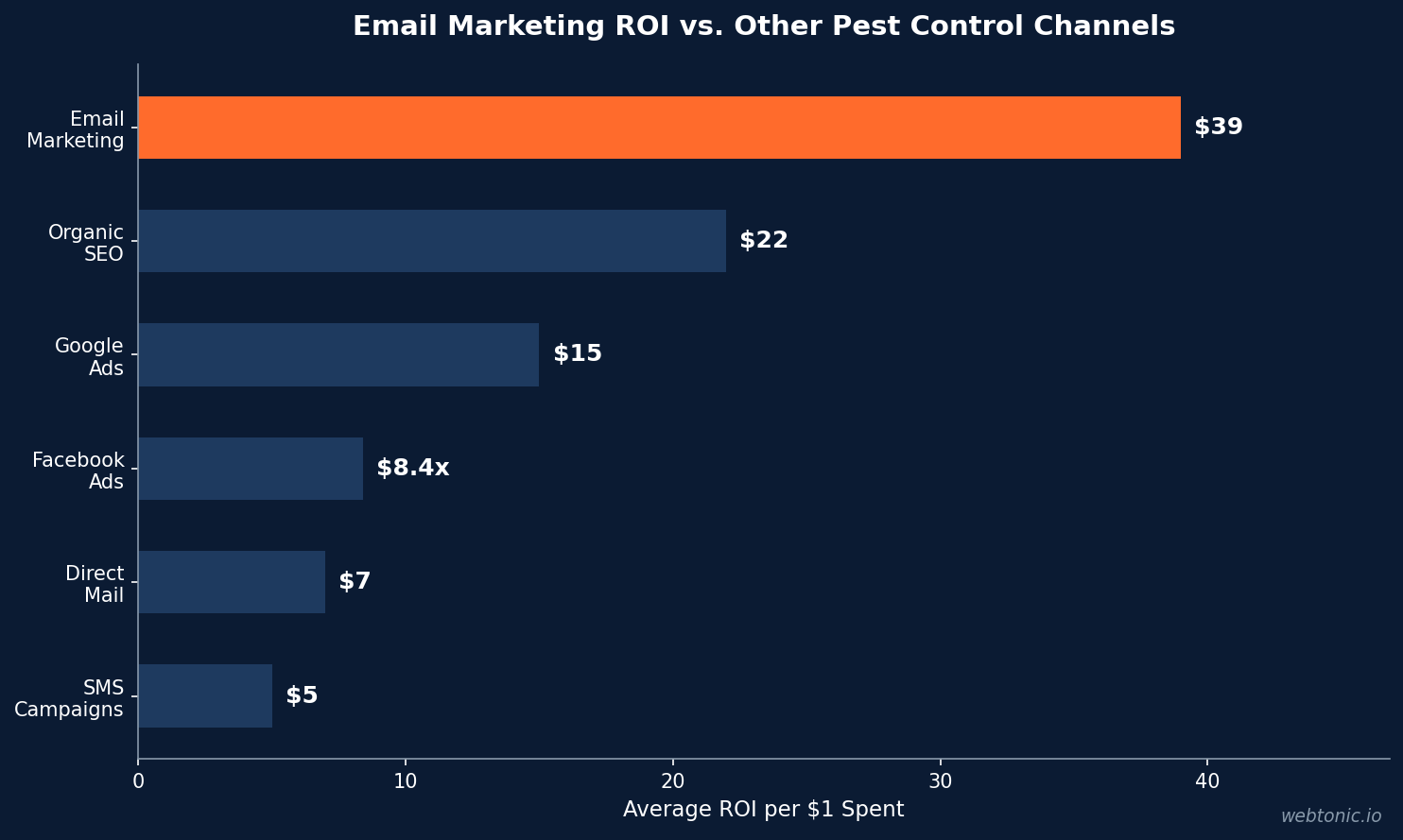
Email consistently outperforms other digital channels on a dollar-for-dollar return basis. The chart below compares average ROI across the primary channels pest control operators rely on, based on aggregated industry data from Cube Creative and MarketingLTB.
The Power of Email Segmentation for Pest Control
Segmented email campaigns can increase revenue by up to 760% compared to unsegmented sends, according to Cube Creative's pest control marketing benchmarks. Generic "batch and blast" emails treat a brand-new lead the same as a five-year recurring customer, diluting relevance and suppressing engagement.
Pest control operators should build at least seven core segments from existing CRM data: service history, customer type (residential versus commercial), geographic zone, customer status (active, new, inactive, lead), seasonal service interest, property type, and engagement level. Starting with service history and geographic segmentation is the lowest-friction entry point, delivering 15–25% higher open rates and 30–50% higher click rates immediately (Cube Creative).
Automation Workflows That Drive Recurring Revenue
The pest control industry's recurring revenue model makes it uniquely suited for email automation. Recurring accounts represent the majority of a pest control company's revenue base, according to the NPMA 2025 Industry Cost Study cited by US Tech Automations — every lapsed recurring account that goes unaddressed is a multi-year subscription ending with nobody trying to save it.
Five automation workflows deliver the highest impact on autopilot (Cube Creative):
- New customer onboarding — 4 emails over 14 days introducing services, setting expectations, and offering a referral incentive.
- Service reminders — 3 emails at 7 days, 2 days, and morning-of to reduce no-shows and improve route density.
- Post-service follow-up — satisfaction survey plus cross-sell of related services within 48 hours.
- Lapsed customer re-engagement — triggered after 90–180 days of inactivity with a time-sensitive reactivation offer.
- Seasonal pest alerts — region-specific warnings tied to peak activity months (termite swarms in spring, mosquito surges in summer).
Retention and Churn Prevention Through Email
91% of pest control customer cancellations are preventable, with the leading cancellation driver being customers who feel "uncared for" (62% of churned accounts). Strategic email marketing directly combats this by maintaining consistent touchpoints between service visits (Cube Creative).
Companies using automated email nurture sequences see measurable improvements in retention. Briostack reports that its clients achieve a 28% average increase in customer revenue after implementing lifecycle email automations, driven primarily by reduced churn and increased upsell conversions on quarterly and annual plans.
Open Rate Performance by Email Type
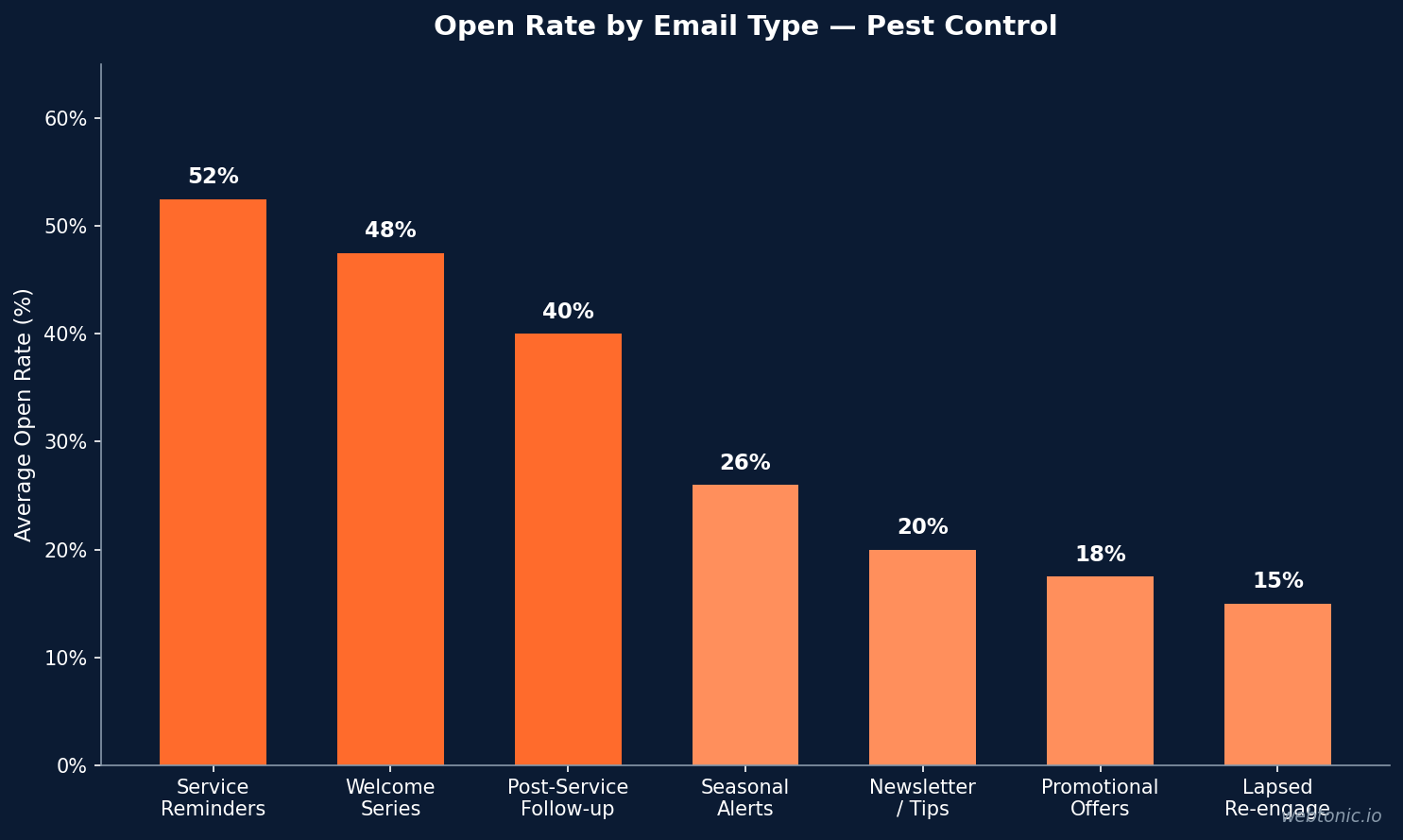
Not all pest control emails perform equally. Transactional and trigger-based messages consistently outperform promotional blasts. The chart below breaks down typical open rate ranges by email category for pest control operators.
Email Campaign Types and Performance Benchmarks
| Campaign Type | Avg Open Rate | Avg CTR | Primary Goal |
|---|---|---|---|
| Welcome Series | 40–55% | 5–8% | Onboard new customers |
| Service Reminders | 45–60% | 10–15% | Reduce no-shows |
| Seasonal Alerts | 22–30% | 3–5% | Generate service requests |
| Promotional Offers | 15–20% | 2–3% | Drive bookings |
| Post-Service Follow-up | 35–45% | 4–6% | Collect reviews, upsell |
| Lapsed Re-engagement | 12–18% | 1.5–3% | Reactivate dormant accounts |
| Newsletter / Tips | 18–22% | 2–3% | Brand awareness, trust |
SMS and Email: The Multi-Channel Advantage
Email alone leaves revenue on the table in pest control. SMS campaigns show a 45% response rate for emergency pest requests, compared to email's 22% average open rate for the same scenario (MarketingLTB). The most effective operators combine both channels: email for educational nurture and retention, SMS for time-sensitive alerts and appointment confirmations.
57% of pest control calls happen after business hours (MarketingLTB), making automated SMS acknowledgments critical for capturing emergency leads that arrive outside of staffed hours. Companies that respond within 5 minutes increase conversion rates by 2.5× compared to those with slower follow-up.
Best Practices for Pest Control Email Marketing
- Start with service history and geographic segmentation — these two data points are already in most CRM systems and deliver the fastest uplift.
- Keep subject lines under 50 characters and test urgency-based versus benefit-based hooks monthly.
- Send service reminders at three intervals (7 days, 2 days, morning-of) to minimize no-shows and cancellations.
- Use mobile-optimized templates — 81% of pest control customers search on mobile devices, and many read emails on the same device (MarketingLTB).
- Track revenue per email, not just open rate — high opens with low clicks reveal content problems, not subject line success.
- Automate lapsed account outreach at 90, 120, and 180 days with escalating offers to recapture recurring contract revenue.
- Include a clear single CTA per email — "Schedule Your Spring Treatment" outperforms multi-link newsletters for conversion.
- Comply with CAN-SPAM and TCPA by including physical address, unsubscribe link, and obtaining explicit SMS opt-in.
Pest Control vs. Other Home Services: Email Performance
| Industry | Avg Open Rate | Avg CTR | Email ROI per $1 |
|---|---|---|---|
| Pest Control | 18–23.6% | 2–3% | $36–$42 |
| HVAC | 20–24% | 2.5–3.5% | $38–$44 |
| Plumbing | 17–21% | 1.8–2.5% | $32–$38 |
| Landscaping | 21–26% | 2.5–4% | $34–$40 |
| Roofing | 15–19% | 1.5–2.2% | $28–$35 |
| Electrical | 19–23% | 2–3% | $33–$39 |
Email Metrics That Actually Matter for Pest Control Operators
Many pest control companies track vanity metrics that provide limited actionable insight. The metrics that drive real business decisions differ from standard email marketing dashboards. Here is a prioritized framework based on what top operators monitor (Cube Creative):
- Revenue per email sent — the single most important metric. A list generating $0.15–$0.40 per email sent is performing well for pest control; below $0.08 signals a segmentation or offer problem.
- Customer retention rate by email cohort — are emailed customers renewing at higher rates than non-emailed ones? Industry-leading operators see a 12–18 percentage point retention advantage for customers receiving regular service emails.
- List growth rate — new subscribers minus unsubscribes and bounces. Healthy pest control lists grow at 3–5% per month during peak season and 1–2% in off-season months.
- Lapsed account reactivation rate — what percentage of dormant accounts return after an email re-engagement sequence? Well-crafted sequences recover 8–15% of lapsed customers within 90 days.
- Click-to-open rate (CTOR) — a 8–9% CTOR is baseline; below this indicates content relevance issues regardless of how many emails get opened.
Common Email Marketing Mistakes in the Pest Control Industry
Even companies with active email programs leave revenue on the table through avoidable errors. The following mistakes are the most frequent and most costly for pest control operators:
- Sending to the entire list at once — unsegmented batch sends underperform segmented campaigns by as much as 760% on revenue impact. Even a basic two-segment split (active versus lapsed customers) creates meaningful uplift.
- Ignoring mobile rendering — with 81% of pest control customers searching on mobile devices (MarketingLTB), emails that break on smaller screens suppress click-through rates by 30–50%.
- No automation beyond newsletters — companies that rely exclusively on monthly newsletters miss the highest-ROI touchpoints: service reminders, post-treatment follow-ups, and lapsed account outreach.
- Weak or missing calls to action — pest control emails should drive a single, specific action ("Book Your Spring Inspection" or "Renew Your Quarterly Plan") rather than listing multiple links. Single-CTA emails generate 3–5× higher click rates than multi-CTA designs.
- Not tracking email-to-revenue attribution — without connecting email clicks to booked jobs and revenue, operators cannot evaluate true ROI or allocate budget effectively.
- Neglecting list hygiene — inactive subscribers and hard bounces drag down sender reputation. Clean your list quarterly by removing addresses with zero opens over 6 months and re-confirming opt-in for borderline contacts.
Pest Control Email Marketing Technology Stack
The right technology stack turns email marketing from a manual chore into an automated revenue driver. Most pest control companies operate on one of three tiers (US Tech Automations):
| Tier | Tools | Typical Monthly Cost | Capabilities |
|---|---|---|---|
| Basic | Mailchimp, Constant Contact | $30–$80/mo | Newsletter sends, basic templates, manual segmentation |
| Intermediate | ActiveCampaign, Drip + CRM integration | $80–$200/mo | Behavior triggers, CRM sync, multi-step automations |
| Advanced | HubSpot, Briostack, PestRoutes + marketing automation | $200–$500/mo | Full lifecycle automation, revenue attribution, predictive churn scoring |
Companies using industry-specific platforms like Briostack or PestRoutes benefit from pre-built pest control workflows and direct integration with scheduling and routing systems, reducing setup time from months to days. The key differentiator is trigger-based automation on customer events (service completed, renewal due, payment received) rather than calendar-based sends.
Seasonal Email Calendar for Pest Control Companies
Timing email campaigns to local pest pressure cycles dramatically improves engagement and booking rates. The following calendar framework aligns email themes with the most common pest activity patterns across the United States:
- January–February — Indoor rodent prevention tips, annual plan renewal reminders, early bird discounts for spring treatments. Lower email volume (2 per month) to avoid fatigue during the slow season.
- March–April — Termite swarm awareness campaigns, spring inspection offers, seasonal pest prevention checklists. Increase send frequency to 3–4 per month as homeowner attention peaks.
- May–June — Mosquito and tick prevention, outdoor entertaining pest-proofing guides, quarterly plan upsell sequences. Peak engagement period — this is the window for highest-impact promotional sends.
- July–August — Fire ant and wasp alerts, summer treatment reminders, referral incentive campaigns. Continue strong frequency with emphasis on urgency-driven subject lines.
- September–October — Fall rodent exclusion campaigns, wildlife prevention, end-of-season service wrap-ups. Begin transitioning messaging toward annual plan renewals.
- November–December — Holiday pest prevention (pantry pests, holiday decoration storage tips), annual plan renewal sequences, year-in-review customer appreciation emails.
Operators who align their email calendar with seasonal pest cycles see 25% higher engagement rates on seasonal content compared to generic promotional sends (MarketingLTB).
Related reading
- Where Pest Control Cold Email Outbound Budgets Are Headed
- What Pest Control Marketers Should Budget for Retention in 2026
- Pest Control Marketing Automation Data and Lead Management Benchmarks
- Email Marketing services at Web Tonic
Frequently Asked Questions
What is the average open rate for pest control marketing emails?
The average open rate sits between 18% and 20% for residential pest control campaigns, while commercial pest control emails average 23.6% according to Benchmarketing's 2026 cohort data. Top-performing operators achieve 25–30% by using behavioral segmentation and personalized subject lines.
How much ROI can pest control companies expect from email marketing?
Pest control email marketing returns an average of $36 to $42 for every $1 spent, with companies running full lifecycle automation sequences (welcome, reminder, lapsed re-engagement) reporting even higher returns. This ranks email among the highest-ROI channels available for home services.
What types of emails should pest control businesses send?
The highest-performing mix includes service reminders (highest open rates at 45–60%), welcome sequences (40–55%), post-service follow-ups (35–45%), seasonal pest alerts (22–30%), and lapsed customer re-engagement campaigns (12–18%). Promotional offers and newsletters complement these but should not be the only email type.
How often should a pest control company send marketing emails?
Most successful pest control operators send 2–4 emails per month per segment, with additional trigger-based messages (service reminders, post-treatment follow-ups) sent automatically based on customer events. Over-mailing drives unsubscribes above the 1% benchmark, while under-mailing lets competitors fill the trust gap.
Is SMS more effective than email for pest control marketing?
SMS outperforms email for time-sensitive communications — emergency pest requests see a 45% SMS response rate versus ~22% email open rate. However, email is superior for educational nurture, cross-selling, and long-form content. The highest-performing operators use both channels together: email for lifecycle nurture, SMS for appointment confirmations and emergency acknowledgments.
Sources
Cube Creative — Exterminator Email Benchmarks and Templates
Benchmarketing — Commercial Pest Control Marketing Benchmarks 2026
US Tech Automations — Scale Pest Control Email Sequences in 2026
Briostack — Pest Control Email Marketing 101
MarketingLTB — Pest Control Marketing Statistics 2026
Web Tonic — Growth Marketing Services
Web Tonic — Data Intelligence Services
Web Tonic — Best Email Marketing Agencies
Web Tonic — About Us
Web Tonic — Contact


