Table of contents

52% of U.S. homeowners used a licensed pest control professional in the past year, and the field-service platforms competing for that recurring business now sell marketing automation as a line item, not a project. This page prices that line item from the vendors' own pages, checks the lead response and email data behind the workflows, and never touches a Web Tonic rate.
Key Takeaways
- 52% of U.S. homeowners hired a pest professional in the past year (Harris Poll for NPMA, 2026).
- GorillaDesk Basic starts at USD 49 a month with automated email and text built in.
- GorillaDesk Pro is USD 99 a month and Growth is USD 149 for the first schedule.
- SMS is a USD 5-a-month add-on on top of any GorillaDesk plan, plus a message pack.
- FieldRoutes publishes no flat rate card - pricing scales with active customer count.
- Third-party listings put FieldRoutes entry pricing near USD 350 a month.
- HubSpot Marketing Hub Professional lists at USD 900 a month for three seats.
- HubSpot charges a one-time USD 3,000 onboarding fee on the Professional tier.
- Extra HubSpot seats run USD 45 a month on Professional, USD 75 on Enterprise.
- A lead contacted within an hour converts about 7x more often than a same-day-later lead (HBR, 2011).
- 54% of marketers are increasing automation budget for the year ahead (Ascend2, 2024).
- 28% rate their own automation strategy best-in-class, up from 25% a year earlier.
- 69% see at least some success from the automation already in place.
- Only 3% call their automation unsuccessful.
- Business and Finance email opens average 31.35% against a 35.63% all-industry average (Mailchimp).
- Business and Finance email clicks average 2.78% against a 2.62% all-industry average.
- All-industry email click-through sits at 1.36% as of December 2024 (Constant Contact).
- Email returns roughly USD 36 for every USD 1 spent across brands surveyed (Litmus).
- A Professional plan crossing 2,000 contacts adds roughly USD 250 a month on HubSpot's own tier math.
Who is actually buying this, and why the number matters
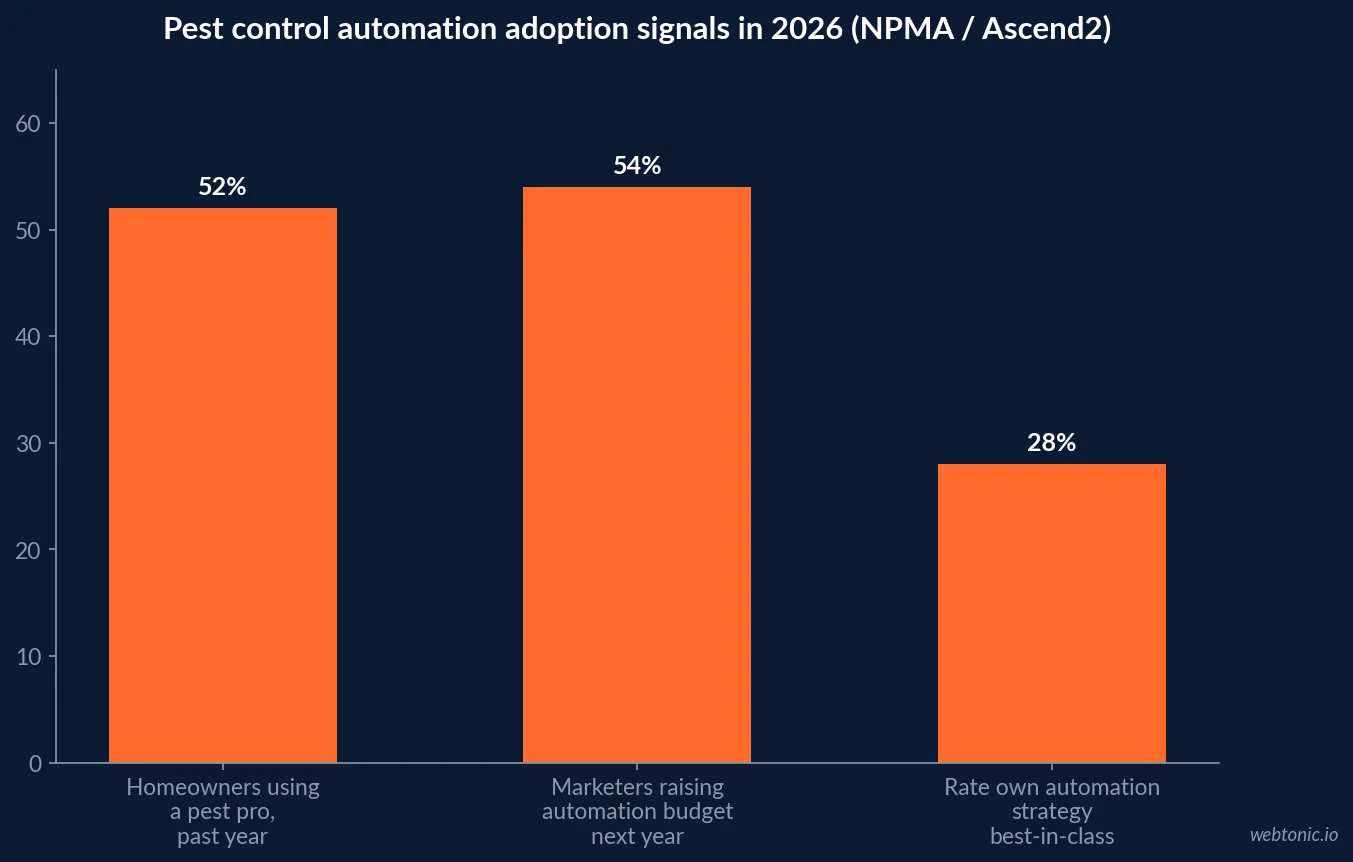
The demand side is not abstract. In a survey fielded online by The Harris Poll on behalf of the National Pest Management Association between January 29 and February 2, 2026, among 1,389 U.S. homeowners, 52% reported using a licensed pest control professional in the past year. NPMA's own read is that millions of homeowners still are not using a professional at all - which is exactly the population marketing automation workflows are built to capture and re-engage.
That is the case for the workflow. It is not, on its own, a case for any specific tool's price - which is where the vendors' own pricing pages take over.
| Signal (2026 unless noted) | Figure | Source | What it tells a pest control operator |
|---|---|---|---|
| Homeowners using a pest pro, past year | 52% | Harris Poll / NPMA | Just over half the addressable market already converts |
| Automation budgets rising next year | 54% | Ascend2 2024 (n=387) | Budget direction is up, cross-industry |
| Automation budgets falling | 11% | Ascend2 2024 | A minority are cutting spend |
| Rate own strategy best-in-class | 28% | Ascend2 2024 | Most teams see partial, not full, success |
| Lead-to-qualify odds, contacted within 1 hour | ~7x | HBR, 2011 | Speed is the lever automation is built to pull |
What field-service platforms charge for automation, in their own words
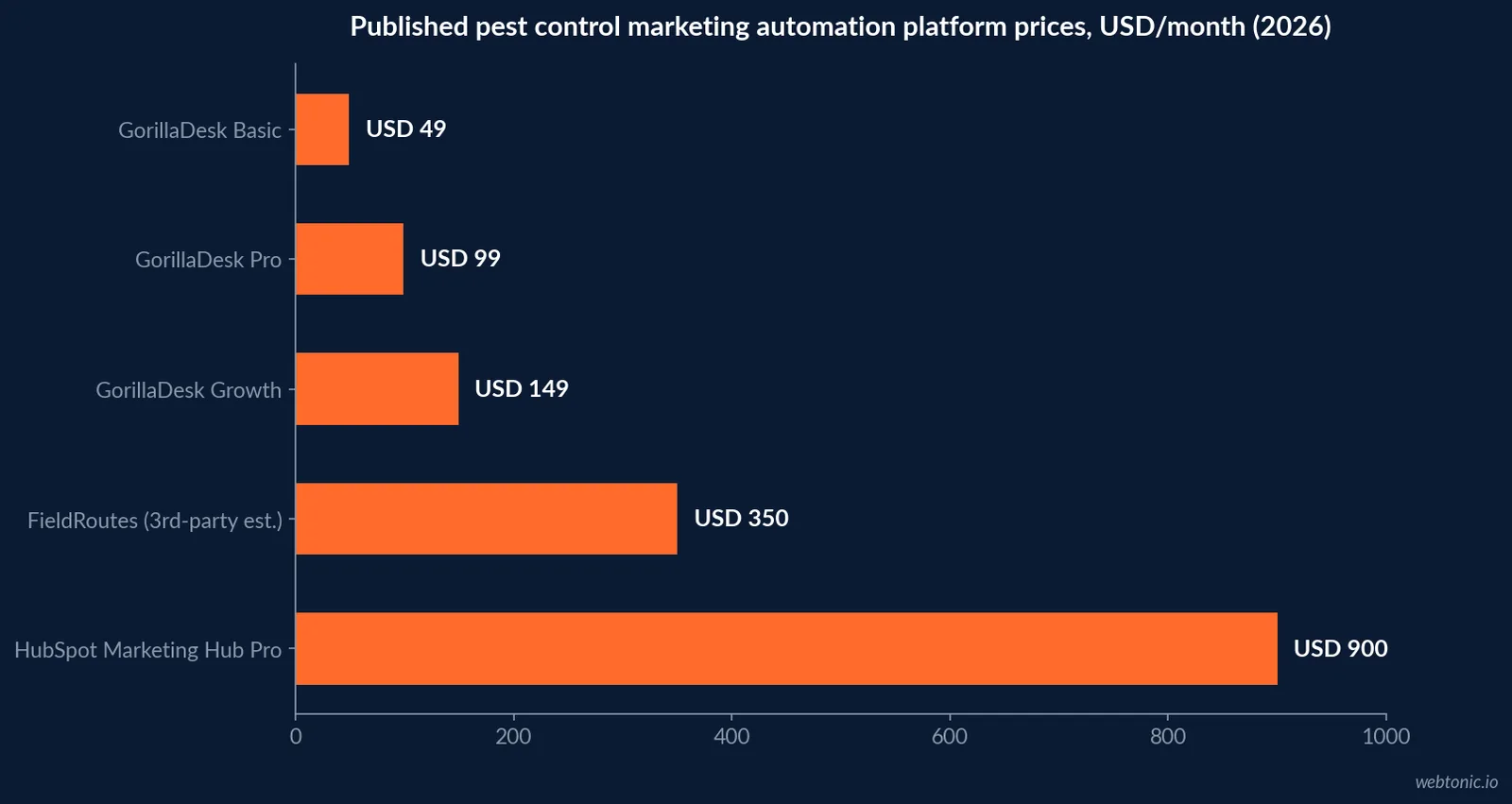
GorillaDesk's own pricing page lists three tiers for the first schedule: Basic at USD 49 a month, Pro at USD 99 and Growth at USD 149, each adding USD 50 per extra schedule. Automated emails and text reminders for invoices, estimates and work orders are included on every tier - only SMS text messaging costs extra, at a flat USD 5 a month for a local number plus a bulk message pack billed at one credit per 160 characters.
FieldRoutes' own pricing page takes the opposite approach: it publishes no flat rate, stating instead that "the monthly subscription is based on the number of active customers." Third-party software marketplace listings put entry pricing near USD 350 a month, which is directional, not a quote from FieldRoutes itself. Its own blog on Marketing Pro describes the workflow it is selling: automated follow-up on unsold estimates, expiring-subscription nudges and segment-based campaigns by service type or zip code - lead routing built around the route itself, not a generic contact list.
| Field-service platform | Published rate (own page) | What automation is included | SMS cost |
|---|---|---|---|
| GorillaDesk Basic | USD 49/mo, first schedule | Automated email + text reminders, invoicing | USD 5/mo number + credits |
| GorillaDesk Pro | USD 99/mo, first schedule | All Basic features, larger attachments | USD 5/mo number + credits |
| GorillaDesk Growth | USD 149/mo, first schedule | All Pro features, largest attachments | USD 5/mo number + credits |
| FieldRoutes | Scales with active customers, no rate card | Automated communication, lead management, follow-up campaigns | Included in platform |
| PestPac Sales Center | Quote-based (own page, no published rate) | Lead assignment, opportunity tracking, follow-up tasks | n/a |
What a general marketing platform costs instead
Operators who route pest control leads through a general marketing platform rather than their field-service suite are pricing a different product. HubSpot's own Marketing Hub pricing guide puts Professional at USD 900 a month for three core seats and 2,000 marketing contacts, with additional seats at USD 45 a month and a one-time USD 3,000 onboarding fee; Enterprise adds seats at USD 75 a month with a USD 7,000 onboarding fee. Crossing the 2,000-contact line on Professional adds roughly USD 250 a month automatically. Mailchimp's own pricing page starts its Standard plan at USD 20 a month for 0-500 contacts and 6,000 sends, rising with list size, and advertises "up to 27x ROI" on that plan - a vendor claim, not an audited figure.
Neither platform ships a service calendar or a dispatch queue. That is the trade-off: broader marketing tooling against purpose-built field-service automation.
Lead routing and response speed: the one number every workflow is chasing
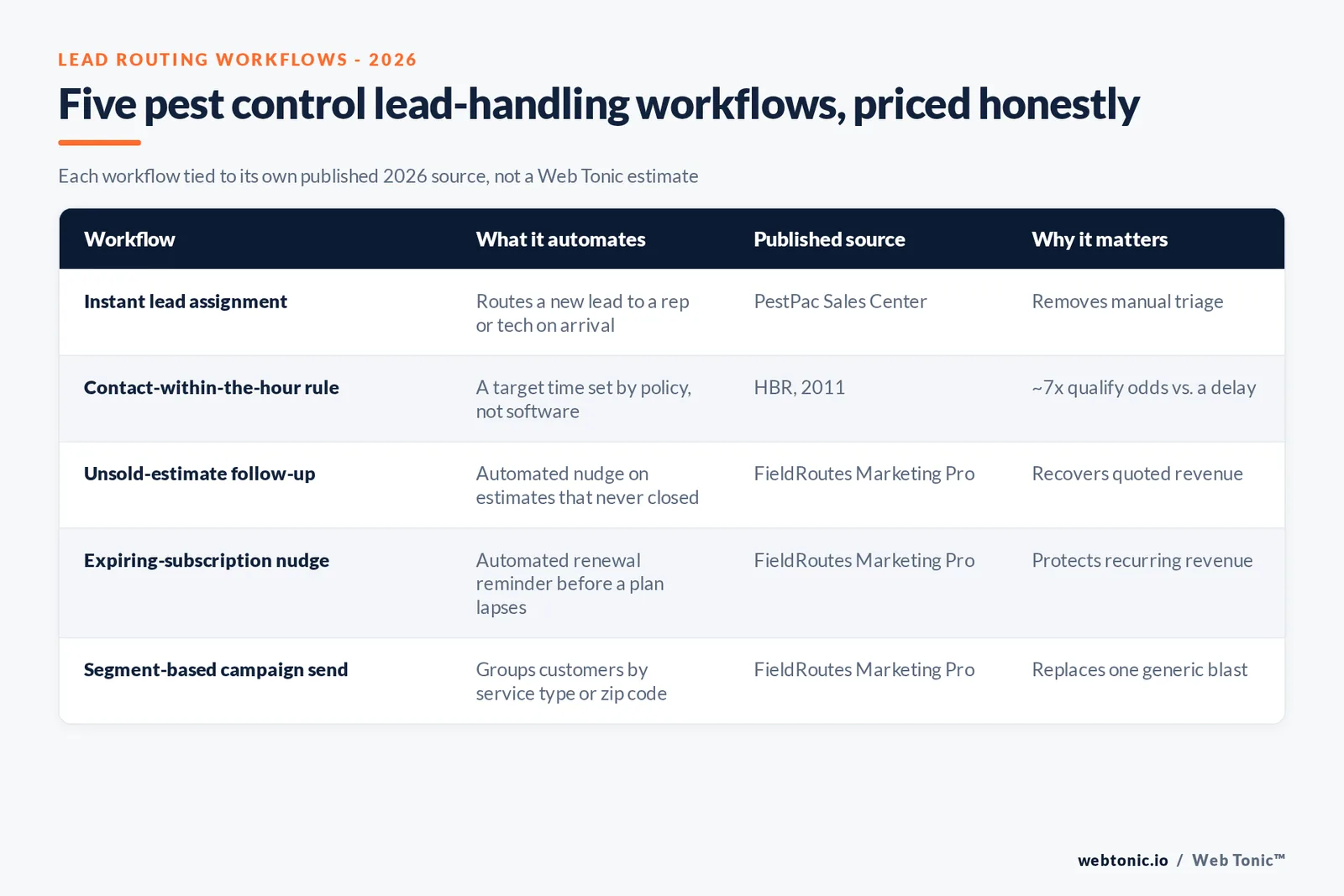
The most-cited benchmark behind "automate your lead follow-up" is still the 2011 Harvard Business Review study by Oldroyd, McElheran and Elkington: companies that contacted a web lead within an hour of submission were roughly seven times more likely to qualify it than those that waited even one hour longer, and odds kept falling the longer contact was delayed. It is a 2011 dataset - there is no more recent, equally cited replacement - so cite the year every time the figure is used.
PestPac's own CRM page describes the workflow this study justifies: automatic lead assignment, duplicate-match detection and follow-up task creation tied to the sales funnel, so a lead is not waiting on a human to notice it arrived.
| Lead-handling workflow | What it automates | Published source | Why it matters |
|---|---|---|---|
| Instant lead assignment | Routes a new lead to a rep or tech the moment it arrives | PestPac Sales Center (own page) | Removes the manual triage step |
| Contact-within-the-hour rule | Nothing automated - a target time set by policy | HBR, 2011 | ~7x qualify odds versus a delayed contact |
| Unsold-estimate follow-up | Automated nudge on estimates that never closed | FieldRoutes Marketing Pro (own blog) | Recovers revenue already quoted |
| Expiring-subscription nudge | Automated renewal reminder before a plan lapses | FieldRoutes Marketing Pro (own blog) | Protects recurring revenue |
| Segment-based campaign send | Groups customers by service type or zip code | FieldRoutes Marketing Pro (own blog) | Replaces one generic blast with several relevant ones |
Email click-through: what to compare a pest control send against
No platform publishes a pest-control-specific open or click rate, so the closest labeled proxy from Mailchimp's own benchmark page, last updated December 2023, is its Business and Finance category: a 31.35% open rate and a 2.78% click rate, against an all-industry average of 35.63% open and 2.62% click. Constant Contact's own December 2024 snapshot puts the all-industry click-through rate at 1.36%, a meaningfully lower baseline from a different measurement methodology - the gap between the two vendors' numbers is the platform difference, not a change in real behavior, and both should be named side by side rather than picked selectively.
On return, Litmus's own analysis puts email ROI at roughly USD 36 for every USD 1 spent across the brands it surveyed - the figure most often used to justify keeping email inside an automation workflow even when click rates look thin.
| Email benchmark (labeled) | Open rate | Click rate | Source |
|---|---|---|---|
| Business + Finance category | 31.35% | 2.78% | Mailchimp, Dec 2023 |
| All-industry average | 35.63% | 2.62% | Mailchimp, Dec 2023 |
| All-industry click-through | n/a | 1.36% | Constant Contact, Dec 2024 |
| Segmented vs. unsegmented (HubSpot) | n/a | +30% opens / +50% clicks reported | HubSpot State of Marketing, 2023 |
Where the automation budget is actually moving
Ascend2's State of Marketing Automation 2024 survey of 387 marketing decision-makers, fielded in February 2024, found 54% increasing their automation budget for the year ahead against 11% decreasing it and 30% holding flat. Only 28% called their current strategy best-in-class - up three points from the prior year - while 69% reported at least some success and just 3% called their automation unsuccessful. That is a cross-industry marketing-technology signal, not a pest control census, but it is the most current named survey on budget direction publicly available.
Read against the field-service rate card above, the practical implication is that most operators are not choosing whether to automate - they are choosing which line item on an existing platform to turn on next.
How to price the decision without guessing
Start from the workflow, not the software category. If the job is dispatch reminders, estimate follow-up and subscription renewal nudges tied to a service calendar, price GorillaDesk or FieldRoutes against their own published tiers first. If the job is broader nurture, segmentation and content automation with no route logic, HubSpot or a comparable general platform is the right comparison - and its onboarding fee belongs in the first-year number, not just the monthly rate. Either way, benchmark the resulting email performance against the Business and Finance category above rather than an all-industry average built on different traffic. Our growth marketing practice helps operators map that workflow before a platform is chosen; our data and analytics practice can benchmark the resulting pipeline once it is live. See also our breakdown of what paid search costs for the channel most automation workflows are built to support.
Frequently Asked Questions
What does pest control marketing automation software cost?
It is a line item inside the field-service platform, not a separate purchase for most operators. GorillaDesk's own pricing page lists Basic at USD 49 a month, Pro at USD 99 and Growth at USD 149 for the first schedule, with automated email and text reminders included on every tier; SMS is a USD 5-a-month add-on plus a bulk message pack. FieldRoutes does not publish a rate card - its own pricing page says the subscription scales with active customer count, though third-party marketplace listings put entry pricing near USD 350 a month. A general-purpose platform like HubSpot Marketing Hub Professional lists at USD 900 a month for three seats and 2,000 contacts on HubSpot's own pricing guide, plus a one-time USD 3,000 onboarding fee - a different category of spend than a field-service add-on.
Does automation actually change lead handling, or just email cadence?
The published evidence is about speed, not volume. The original Harvard Business Review study on B2B and B2C leads, published in 2011, found that contacting a web lead within an hour made a company roughly seven times more likely to qualify it than waiting until the second hour, and that the odds fell sharply after that. Field-service platforms build routing and reminder workflows explicitly to close that response-time gap without adding staff, which is a workflow claim, not an independent lead-cost benchmark.
What email click-through rate should a pest control campaign expect?
No platform publishes a pest-control-specific number, so the honest benchmark is the closest labeled industry category. Mailchimp's own aggregate benchmark page, last updated December 2023, puts the Business and Finance category at a 31.35% open rate and a 2.78% click rate against an all-industry average of 35.63% open and 2.62% click; Constant Contact's own December 2024 snapshot puts the all-industry click rate at 1.36%. Pest control sits inside neither category cleanly, so treat both as a bracket, not a target.
Is marketing automation adoption actually growing among small home-service teams, or is this an enterprise story?
Ascend2's State of Marketing Automation 2024 survey of 387 marketing decision-makers found 54% increasing their automation budget for the year ahead against 11% decreasing it, and 28% rating their own strategy best-in-class - up from 25% the year before. That is a cross-industry marketing-technology signal, not a pest control census, but it is the most recent named survey on budget direction available.
Should a pest control operator buy a field-service platform's automation or a general marketing platform?
The published feature lists answer this more clearly than any price comparison. GorillaDesk and FieldRoutes build routing, dispatch reminders and follow-up sequences around the service calendar itself - PestPac's own product page describes automatic lead assignment and follow-up task creation inside its Sales Center CRM. HubSpot, ActiveCampaign and Brevo build general email and workflow automation with no scheduling layer. A route-driven business is paying for two different jobs, and only one of the two ships appointment logic out of the box.
Sources
National Pest Management Association / Harris Poll - 2026 homeowner survey
GorillaDesk - Plans and pricing
GorillaDesk - SMS text messaging add-on
FieldRoutes - Pricing and plans
FieldRoutes - Marketing Pro workflow overview
PestPac - Pest control CRM software features
HubSpot - Marketing Hub pricing guide
Mailchimp - Marketing pricing
Mailchimp - Email marketing benchmarks by industry
Constant Contact - Email click-through rate benchmarks
Litmus - Email marketing ROI
Harvard Business Review - The Short Life of Online Sales Leads, 2011
Ascend2 - The State of Marketing Automation 2024